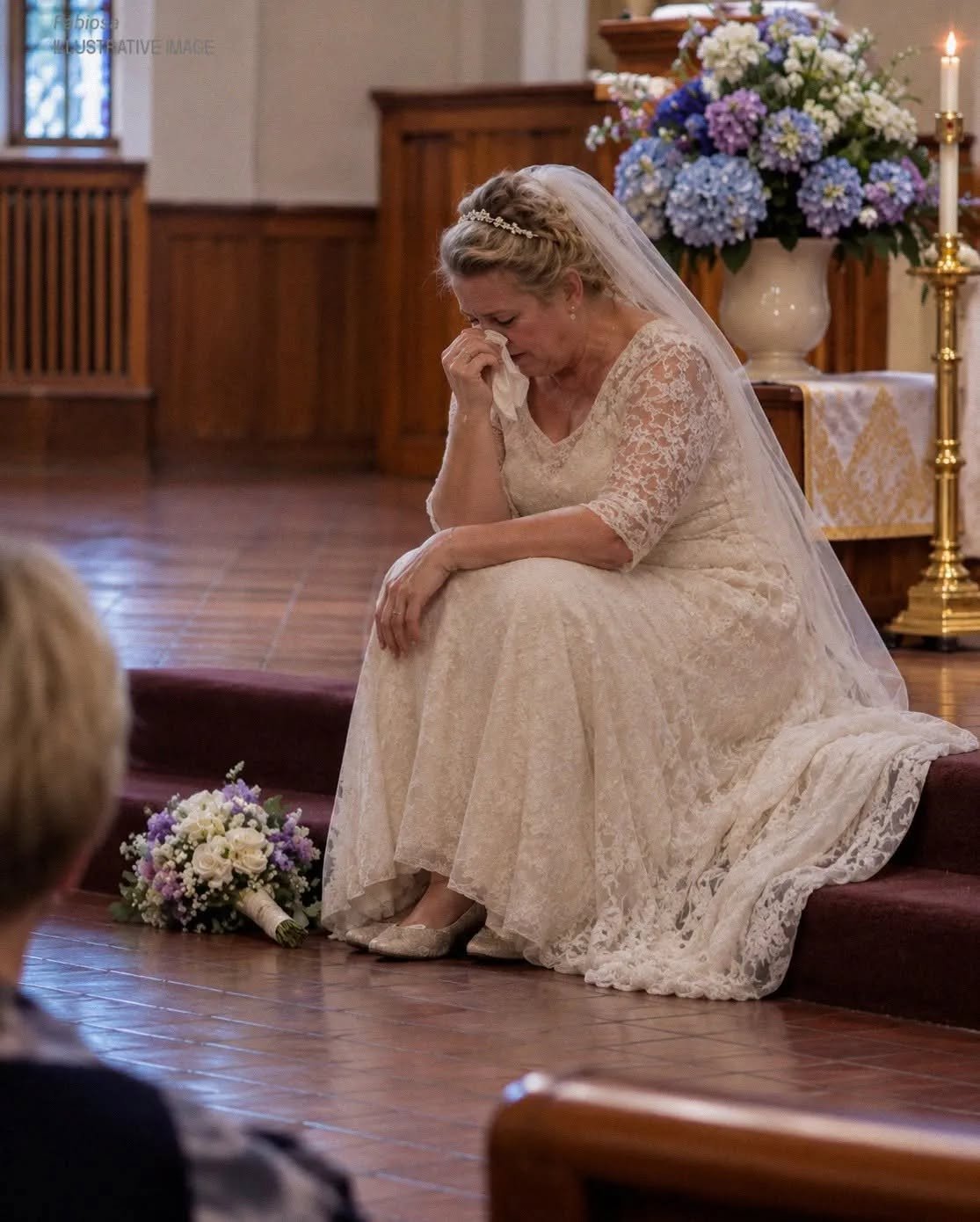
Every man I ever loved died before we could make it to the altar. By the time I turned forty, I had already said goodbye to three fiancés—three different futures, three sudden tragedies, and three wedding dresses that never saw an aisle.
For decades, I carried a quiet, suffocating dread that I was somehow jinxed. I stopped dating altogether because I couldn’t bear the thought of planning another wedding only to attend another funeral. Then, at fifty-eight, I met Thomas. On my sixtieth birthday, I finally put on a wedding dress again, daring to believe that happiness was within my reach. Yet just minutes before the ceremony, a few unexpected words from my groom—and a chilling phone call from my past—threatened to shatter everything all over again.
Listening for Sirens on My Wedding Day
On the morning of my sixtieth birthday, I stood alone in a quiet church bathroom wearing an ivory lace wedding dress, holding my breath and listening for sirens.
There weren’t any. Outside the heavy wooden door, a church bell chimed softly in the distance. Someone laughed in the hallway, and the organist practiced the same three gentle notes over and over again. Everything sounded ordinary, even peaceful. Still, I glanced down at my phone for the seventh time in ten minutes.
Thomas had sent a text twenty minutes earlier: “On my way. Love you.”
I stared at those four words, desperately wanting to believe he would actually walk through the doors. Every hour he survived that morning felt like a minor miracle.
Standing in my wedding dress at sixty, I couldn’t stop checking my phone and waiting for disaster to strike.
Three Fiancés, Three Tragic Goodbyes
People who haven’t lived through repeated loss often tell you that lightning doesn’t strike the same place twice. They don’t know what to say when it strikes three times.
Daniel was my first love. I was twenty-four, and we were just eleven days away from our wedding when a truck veered into his lane on his drive home from work. In a single second, our entire future vanished.
Michael came into my life years later, when I was thirty-one. He was a strong swimmer who loved the water, which made what happened on his fishing trip impossible to comprehend. His empty boat was found drifting aimlessly for hours before anyone realized he was missing. Searchers found his body three days later.
Robert was thirty-nine, and with him, I truly believed the storm had passed. The night before he died, we shared a warm dinner at home, laughing and playfully arguing over whether to serve pie or cake at our reception. He went to sleep beside me and suffered a sudden heart attack. By morning, he was gone.
Three good men. Three devastating endings. Always right before the vows.
After Robert’s funeral, I packed away my wedding plans and closed the door on romance. Friends gently assured me that I would find someone else someday, that time would heal the ache. They didn’t understand that I wasn’t afraid of being alone—I was terrified of loving someone else only to lose them. In the quiet hours of the night, a terrible question haunted me: Was it just cruel fate, or was there something wrong with me?
A Second Chance in the Pasta Aisle
I spent nearly two decades protecting my heart until, at fifty-eight, I met Thomas in the middle of a neighborhood grocery store.
He was standing in front of the shelves, squinting intently at the label on a jar of pasta sauce because he had forgotten his reading glasses at home. Without thinking, I slipped mine off and offered them to him. He put them on, let out a warm laugh, and asked if I came with the jar.
Thomas was a widower with two grown children, a crooked, disarming smile, and a sweet habit of leaving little handwritten notes on my kitchen counter. He was gentle, witty, and steady. When he eventually asked me to marry him, I said yes before my fear had a chance to talk me out of it. We chose my sixtieth birthday for the wedding because he wanted us to celebrate two new beginnings at once.
Best of all, Thomas never once mocked my anxiety. When we booked the church, I insisted on paying the deposit myself, quietly hoping that taking control might somehow ward off bad luck. Another evening, when he was just ten minutes late for dinner, I called him four times in a panic. He walked through the door carrying fresh flowers, apologizing for a flat tire, and sat patiently while I tried to explain why even a tiny delay felt like the start of a catastrophe.
“I can’t guarantee nothing will ever happen to me,” Thomas told me that night, holding my hand. “But I can promise I won’t make you face ordinary fears alone.”
He never promised me immortality. He simply promised to show up. And that was why I was standing in this church.
The Words That Stopped Everything
A soft knock broke through my thoughts. “Peggy?”
My dear friend Nora poked her head through the door, beaming. “He’s here. Both feet firmly on the ground, and very handsome, too.”
Relief washed over me so fast that I laughed until tears pricked my eyes. When I stepped out into the hallway, there was Thomas, standing tall in a tailored navy suit. I walked straight into his arms, careful not to crush the white flower pinned to his lapel.
“You made it,” I whispered against his shoulder.
“Of course I did,” he said softly. “I promised.”
Then, his warm smile slowly faded. “Peggy, there’s something I have to tell you before we say our vows.”
My stomach tightened instantly. He gently guided me into a small, quiet room beside the sanctuary and closed the door. He clasped my hands in his, looking deeply uncomfortable.
“Last night, I got a phone call,” he began. “It was a woman. She wouldn’t give her name, but she asked if today was our wedding. She knew about Daniel, Michael, and Robert.”
My hands turned to ice. “Who was she?”
“I don’t know,” Thomas said quietly. “She told me the other three men weren’t supposed to die.” He hesitated, his eyes full of worry. “She said you were.”
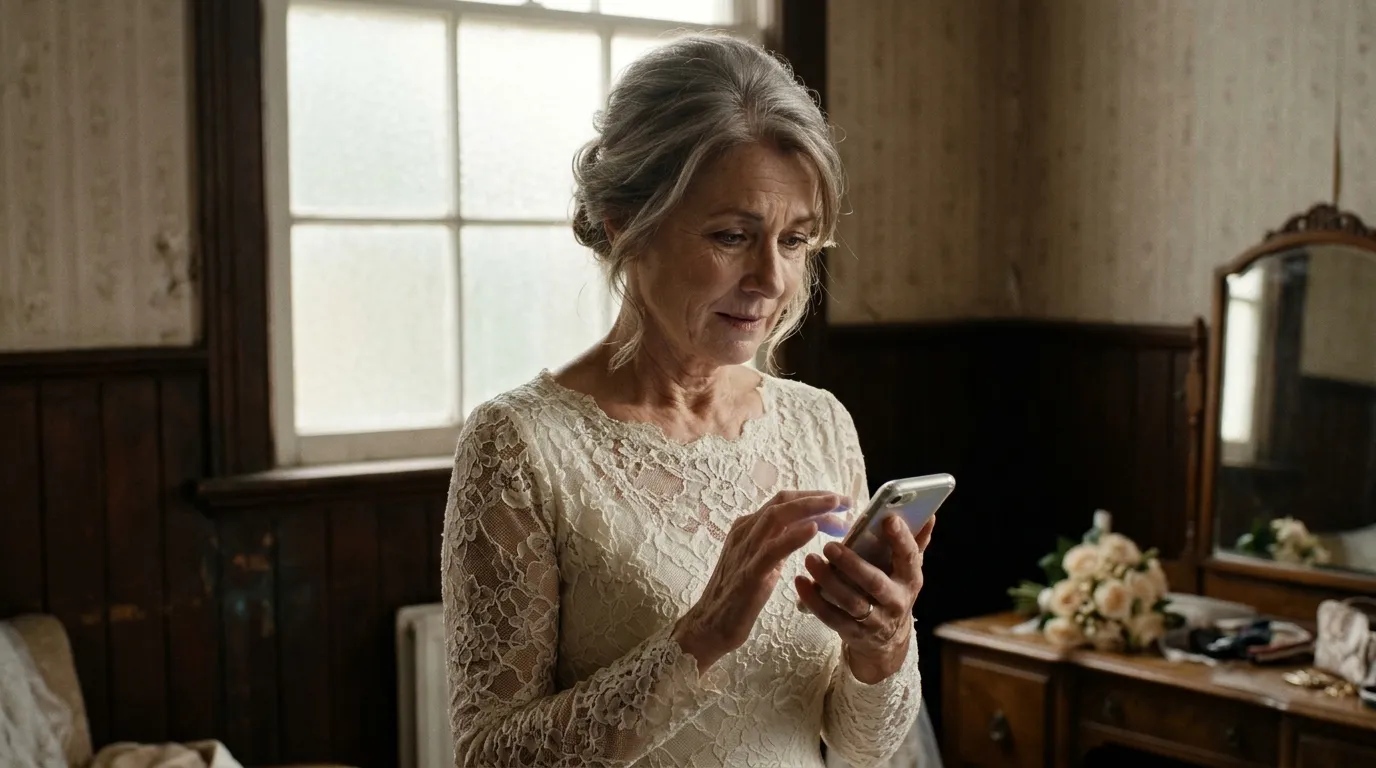
Minutes before the ceremony, Thomas shared the chilling phone call that brought my darkest fears rushing back.
I gripped the back of a wooden chair to steady myself. “Why didn’t you tell me last night?”
“I thought it was just a cruel prank,” he answered. “I didn’t want to ruin your sleep. But she called again this morning—and she knew which church we chose.”
Before I could even process his words, the phone in his jacket pocket began to ring. Thomas pulled it out, glanced at the screen, and looked up at me. “It’s her.”
He hit answer and put the call on speaker. “Who are you? What do you want?”
“You should have listened,” a cold, sharp voice came through the line. “Four men would still be alive today if Peggy had died instead of Ben.”
The air left my lungs. I hadn’t heard that voice in six years, yet I had known it almost my entire life.
“Margaret?” I breathed.
On the other end of the line, my older sister inhaled sharply. “So he doesn’t even know about Ben,” she said bitterly. “You always leave that part out.”
The Secret I Carried for Fifty Years
The walls of the small room seemed to tilt. Thomas called my name, but my feet were already moving. I hurried past the floral arrangements, past the murmur of waiting guests, and pushed open the side door into the church garden. I sank onto a weathered stone bench, gasping for fresh air.
Ben.
For nearly fifty years, I had tried so hard to remember him as a bright, funny little boy rather than a tragedy. At nine years old, Ben believed he could fix anything in the world with a piece of string. Once, he repaired my favorite doll with so much tape that she could no longer bend her arms. He was my little brother, and he had died trying to save me.
The garden gate creaked open. “Peggy?” Thomas walked over slowly and waited until I reached for his hand. “Who is Ben?”
“My little brother,” I whispered. “He drowned when I was eleven. Margaret was sixteen.”
I had told Thomas that I lost a brother when I was young, but I had never been able to speak the details out loud. Sitting in the sunlight, I finally let the memory spill out.
“We were staying at our grandparents’ house,” I told him. “There was a creek behind their property, and it had been raining hard for days. Ben and I went outside to get some paper boats we’d left under the porch. We walked down along the creek, and my foot slipped on the muddy bank.”
Even after half a century, I could still feel the shock of the freezing water and hear Ben shouting my name. He had dropped onto his stomach and reached his small arm out toward me. I caught his hand. For one brief, hopeful second, I thought he was going to pull me to safety. Then, the rain-soaked mud beneath him gave way.
Our grandfather heard our screams and ran down the hill. He managed to grab my dress as the current pushed me against a fallen branch near the shore. But Ben had already been swept into the deeper water. Grandpa couldn’t reach him, and by the time rescue teams arrived, my brother had disappeared downstream. They searched until dark while I sat wrapped in a blanket on the porch, convinced Ben would walk back up the path soaking wet and mad at me. He never came home.
“Margaret was inside the house,” I continued, wiping my cheek. “She had planned to come with us, but she stayed behind to finish a book. It wasn’t her fault. None of us knew the bank was going to collapse.”
“You were children, Peggy,” Thomas said gently.
“I know. Or at least, I thought I did.”
At Ben’s funeral, Margaret had cornered me by the coat closet, her face red and blotchy from crying. “He’d still be alive if you hadn’t gone near that creek,” she had hissed. Our mother overheard and pulled us apart, and our father sat on my bed that night promising me it was a terrible accident. But Margaret was my big sister—the person I looked up to, the one who used to tell me which thunderstorms were safe to sleep through.
From that day on, a wall rose between us. She stopped coming into my room. She refused to look at the paper birds Ben had taped to our window. And as we grew older, every tragedy in my life seemed to confirm her darkest belief. When Daniel died, she remarked that some people carried bad luck into every room. When Michael drowned, she sent a short note: “Maybe you should stop making promises you can’t keep.” After Robert’s funeral, she mailed me a photo of Ben beside a birthday cake with three words scrawled on the back: “Remember what happened.”
I had kept the photo, but I had hidden the words. And eventually, I stopped speaking to her altogether.
“Why didn’t you tell me about this?” Thomas asked softly.
“Because I knew you’d say it was nonsense, and I’d agree with you,” I admitted. “And then I’d lie awake at three in the morning wondering if she was right.”
Thomas sat closer, wrapping an arm around my shoulders. “I would never have dismissed how much it hurt you.”
Facing the Voice on the Other End
Inside the church, our loved ones were waiting. Thomas’s daughter, Anna, had spent hours arranging the flowers. Nora had brought packets of tissues for everyone. Yet sitting on that stone bench, I felt eleven years old all over again.
“Maybe we should just go home,” I whispered. “Every time I think I can have this, something happens.”
“Something did happen,” Thomas replied firmly. “Your sister said something cruel. That isn’t fate, Peggy. That’s just Margaret.”
Suddenly, a thought struck me. Our cousin Helen still kept in touch with Margaret—that must have been how she saw the wedding announcement and called the church to check if the groom had arrived. For fifty years, I had hidden from my sister’s blame. Looking at Thomas’s phone resting between us, I realized I couldn’t hide anymore.
“I want to call her back,” I said.
Thomas handed me the phone. “You don’t have to do this.”
“I think I do.”
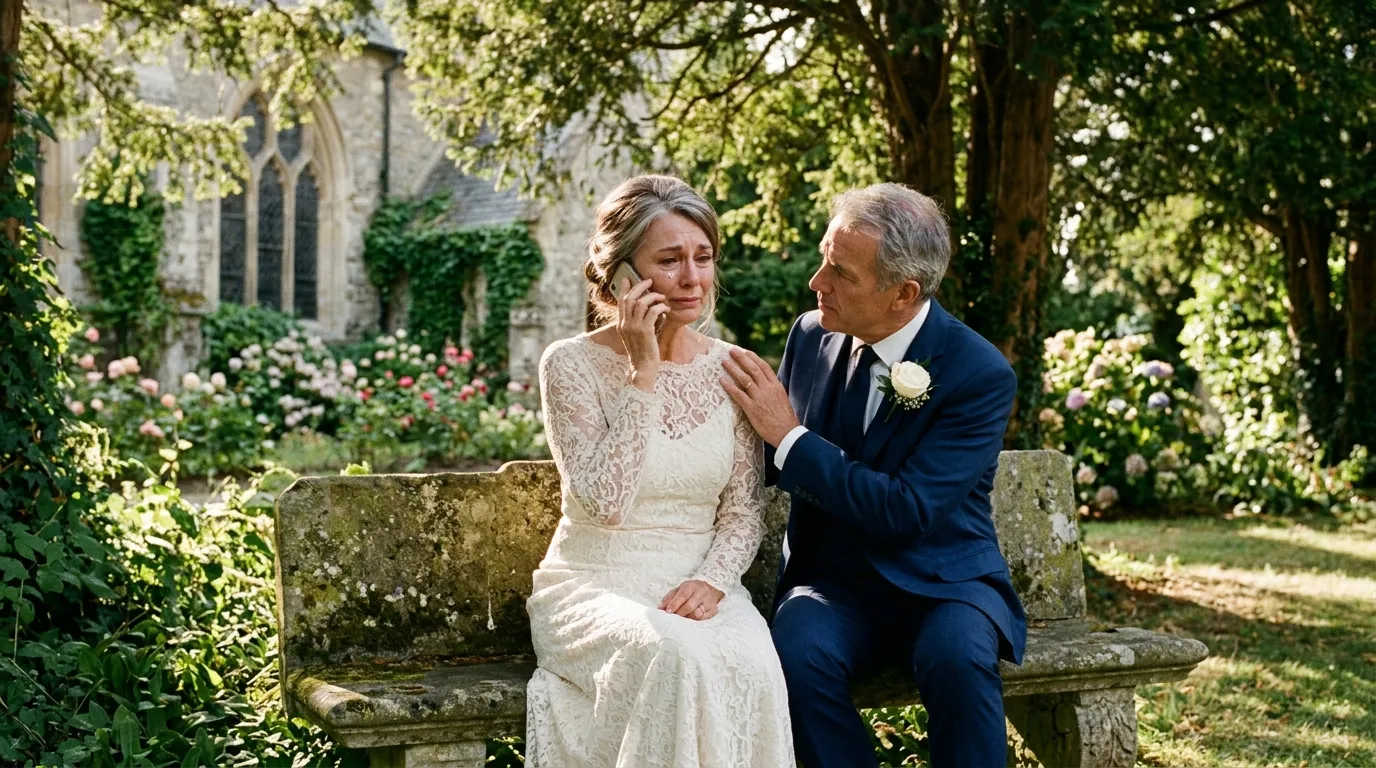
In the quiet of the church garden, I finally found the courage to confront the sister whose blame I had carried for fifty years.
I pressed dial. Margaret answered on the first ring. “Peggy.”
“Why did you call Thomas?” I asked, my voice steadier than I expected.
“Someone had to warn him,” she snapped. “Three men, Peggy. Three. And Ben before them.”
“What did you expect to happen today, Margaret?” Silence stretched across the line. “Answer me.”
“I thought he’d come to his senses,” she said tightly. “Or that something would happen before you reached the altar. It always does.”
“You expected him to die,” I said, the realization finally clicking into place. “And when you called the church and found out he arrived safely, you couldn’t stand it. You didn’t call to warn him—you needed him to believe you.”
Something shifted deep inside my chest. For decades, I had been terrified that Margaret possessed some awful truth I was too weak to face. Listening to her now, I heard something entirely different: a woman who had built her entire grief around blaming me, and who didn’t know how to exist if she was wrong.
“Thomas is alive,” I told her. “We’re outside the church, and we’re getting married in minutes. Daniel, Michael, and Robert are gone, and I will miss them for the rest of my life. But their deaths don’t prove anything about me.”
Thomas leaned in toward the phone. “Margaret, I knew Peggy had lost people she loved, and it didn’t scare me away. A drunk driver, a boating accident, a heart attack—none of those happened because Peggy loved them. I lost my first wife to an illness neither of us could stop. Would you blame me for loving her?”
“That’s different,” Margaret muttered.
“Only because you want it to be,” Thomas answered calmly.
I gently touched his sleeve. His defense meant the world to me, but this last part was mine to say.
“Do you remember what you said to me at Ben’s funeral?” I asked her. “You were sixteen and heartbroken. I was eleven. I waited all night for someone to bring my little brother home. For weeks, I checked his bedroom every morning because I couldn’t believe he was gone. You made me feel like loving him was something I had to apologize for. Every time I needed my big sister, you reminded me that I was still breathing and they weren’t.”
“He went into that water because of you,” she whispered.
“He reached for me because he loved me,” I said, tears streaming freely down my face. “Neither of us knew the bank would collapse. Mom, Dad, and Grandpa all told us it was an accident.” I took a deep breath and asked the question I had been too afraid to voice since childhood. “Margaret… were you angry all these years because you weren’t there?”
“Don’t,” she choked out.
“You were supposed to come outside with us, and you stayed in to read your book,” I said softly. “I never once blamed you for that. Ben didn’t die because you stayed inside, any more than he died because I slipped.”
Across the line, I heard a quiet, broken sob. “I should have gone with you,” Margaret whispered.
My heart ached for her. Beneath fifty years of sharp words and cold distance was a sixteen-year-old girl drowning in guilt she had never dared to speak aloud.
“I wish a hundred things were different, Margaret,” I said gently. “But wishing doesn’t make us responsible.”
“If it wasn’t your fault,” she wept, “then why did he have to die?”
“I don’t know,” I answered honestly. “I never knew. And that’s what makes it so awful.”
She was quiet for a long time. Finally, her voice tightened again. “I still can’t believe all four of them are gone.”
“Neither can I,” I said. Part of me still longed for my sister, for the comfort we had lost half a century ago. Yet wanting her back didn’t erase the pain she had caused, nor did it mean I had to surrender my life to her grief. “I didn’t kill Ben, Margaret. I didn’t kill Daniel, Michael, or Robert. And I am not going to spend the rest of my life apologizing for surviving.”
“Peggy, wait—”
“I am getting married today,” I told her firmly. “You won’t be there, and I need you to respect that.”
With shaking hands, I ended the call.
Walking Toward the Bells
Thomas set the phone down on the stone bench and wrapped his arms around me while I cried. These weren’t the panicked, breathless tears I had braced myself for that morning. They felt like the deep exhaustion of finally setting down a heavy suitcase I had been dragging for fifty years.
“I’m sorry,” I murmured against his lapel. “I’m ruining your suit.”
“It’s survived worse,” he smiled gently. “Luke spilled coffee on it at breakfast. Look, Peggy, we can postpone if you want. Nobody inside would blame you.”
I looked down at my ivory lace dress. Before this one, I had bought three others. My mother had quietly donated the first. I had returned the second to the shop. The third had sat sealed in a cardboard box in my closet for years because I couldn’t bear to look at it.
I thought of Daniel’s terrible, corny jokes. I thought of Michael singing happily off-key on long road trips, and Robert insisting that pie belonged at every celebration. I thought of little Ben drawing crooked, ridiculous birds at our kitchen table. Missing them would always be a part of who I was—but it didn’t have to be the only part.
“No,” I told Thomas, looking up into his kind eyes. “I want to marry you today.”
“Are you sure?”
“I’m still scared,” I admitted. “I can’t promise I’ll never be afraid again.”
“I wouldn’t believe you if you did,” he chuckled softly.
“But I’m here. You’re here. And for today, that is more than enough.”
He kissed my forehead and offered me his arm. Inside, Nora greeted us with wide, relieved eyes. I took a quiet minute to blot my eyes and fix my lipstick, then told her to cue the organist.
Minutes later, the sanctuary doors swung open. Thomas stood waiting at the altar. Anna smiled warmly through her tears, and Thomas’s son, Luke, gave me an encouraging nod. Taking a steady breath, I walked down the aisle toward the man I loved, one confident step at a time.
When it was time for our vows, I held Thomas’s hands and looked straight into his eyes. “I can’t promise we’ll have forever,” I said clearly. “But I promise I won’t waste the time we do have being afraid to love you.”
His eyes shone with emotion. “Then we’ll make the most of every ordinary day.”
We exchanged rings. We kissed. The church erupted into cheers and applause. Margaret wasn’t in the pews, and I didn’t know if she would ever apologize or if we would ever find our way back to each other. I hoped that someday she could remember Ben without needing someone to blame—but I finally understood that was healing only she could do for herself.
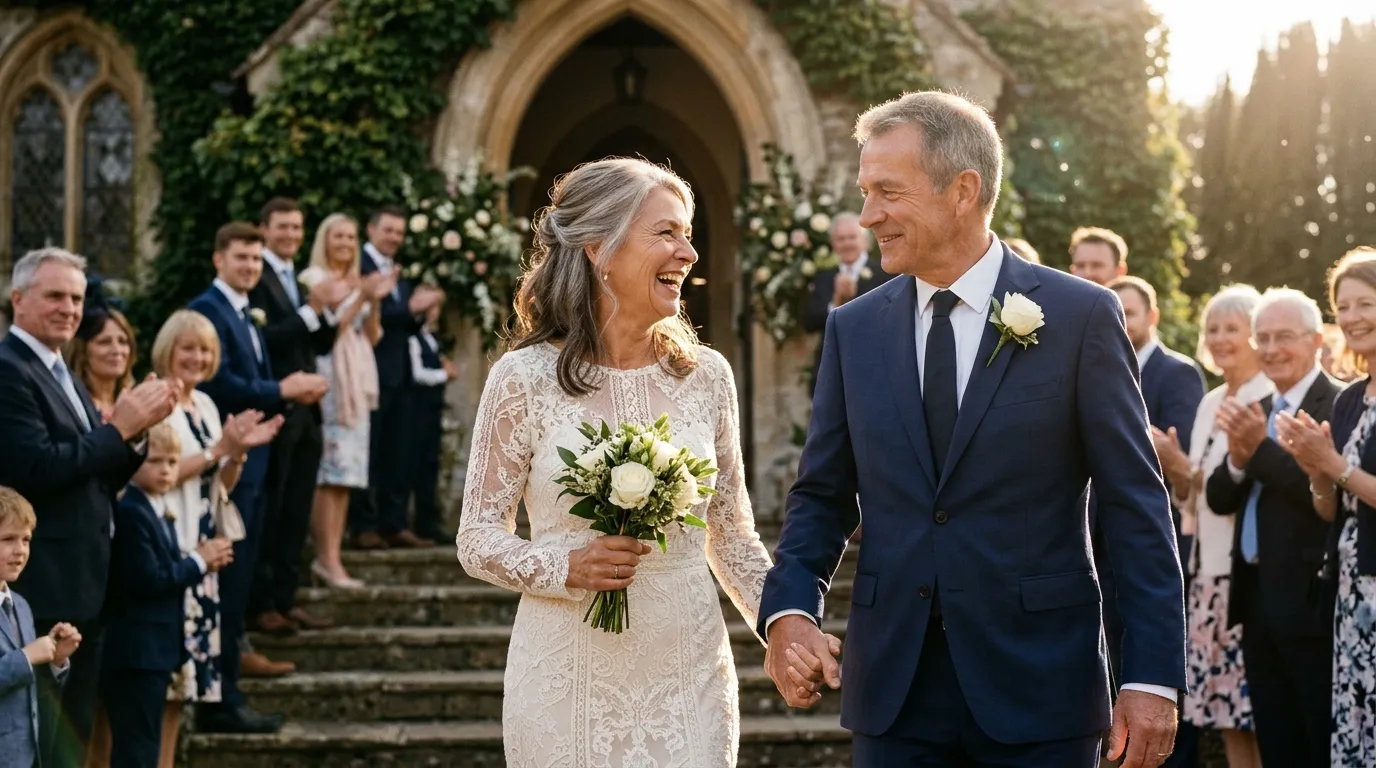
For the first time in decades, I didn’t listen for sirens—I listened to the wedding bells and walked beside my husband.
Outside, the church bells began to ring in the bright afternoon air. Thomas laced his fingers through mine as we stepped out into the sunshine. For the first time in decades, I wasn’t listening for sirens. I was listening to the bells, walking forward beside my husband.