At 62 years old, you think you know your own body. After all, I had lived in mine for more than six decades. I was the proud mother of two grown children and the doting grandmother of four energetic grandchildren. My periods had stopped when I was just 43—nearly nineteen years earlier. Menopause was a chapter I had closed and locked away a long time ago.
So when my belly began to swell for no apparent reason, pregnancy was the very last thing on earth I would have ever imagined. Yet, what started as a simple, puzzling change in my morning routine quickly spiraled into the most terrifying medical mystery of my life.
The
Morning Coffee I Couldn’t Drink
“Margaret, why aren’t you drinking your coffee?”
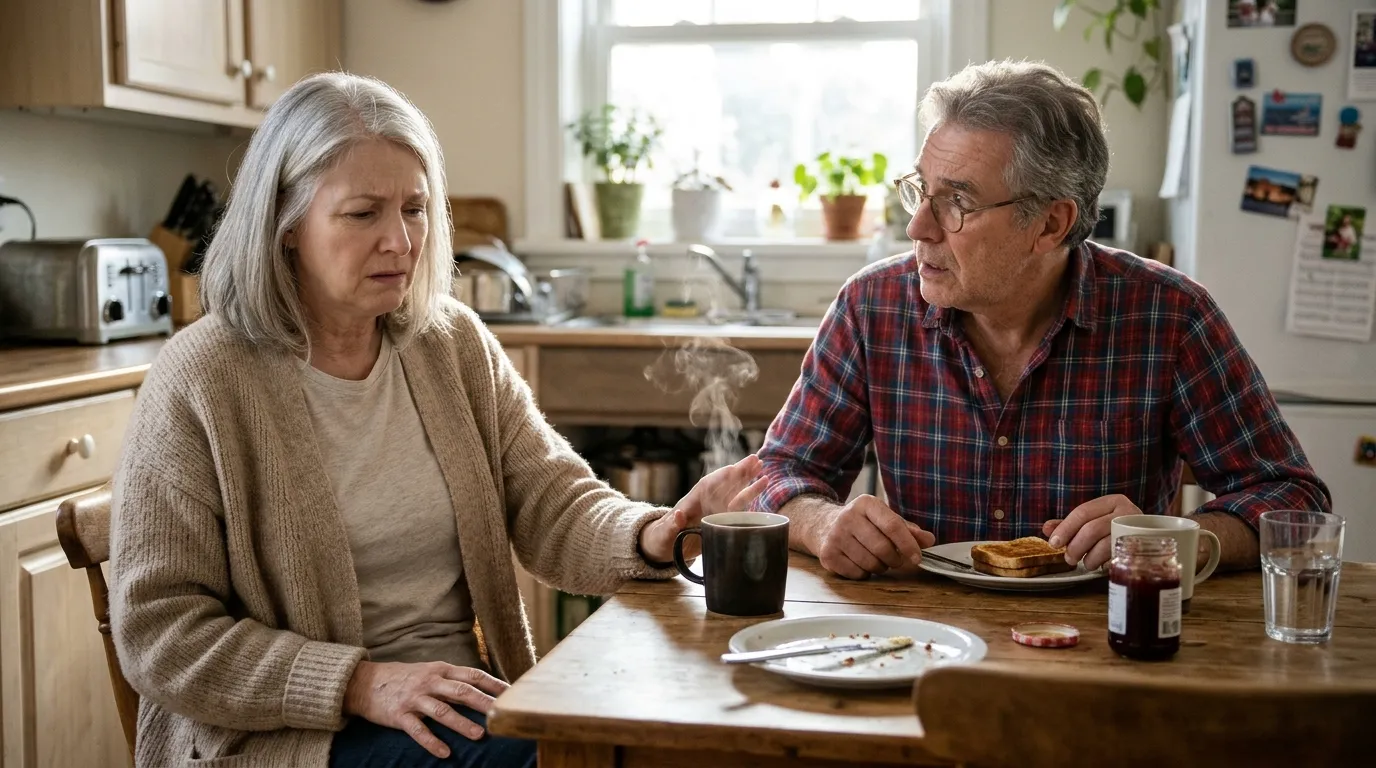
My husband, Robert, looked across the breakfast table at me in genuine surprise. Throughout our thirty-nine years of marriage, I had hardly ever started a single morning without a hot cup of coffee in my hands. It was my daily ritual, my comfort.
But that morning, the rich aroma drifting from the mug didn’t comfort me at all. Instead, it made my stomach twist violently.
“Maybe I ate something that didn’t agree with me yesterday,” I replied, gently pushing the cup away and resting my hand over my stomach.
For the first time in 39 years of marriage, even the smell of morning coffee made me nauseous.
I expected it to pass by the afternoon. It didn’t. The exact same wave of nausea hit me the following morning. By the third day, I couldn’t even look at breakfast without feeling sick.
A few weeks later, another strange change crept up on me. One morning, while getting dressed, I realized I could no longer button my favorite pair of pants. I had never been a naturally slim woman, so I shrugged it off. At my age, metabolism slows down, and putting on a few extra pounds is easy. Determined to fix it, I cut back on my portions and started taking brisk evening walks around the neighborhood.
Yet, the exact opposite happened. No matter how little I ate or how far I walked, my belly continued to grow—firm, round, and stubborn.
Two months later, Robert made a joke about it for the very first time. “Darling,” he teased, chuckling softly as I adjusted my sweater, “at this rate, we’ll soon have to prepare a nursery.”
We both laughed. The very idea of a 62-year-old grandmother being pregnant seemed completely ridiculous.
When the Joke Stopped Being Funny
Before long, however, the laughter faded. My body began behaving in ways I couldn’t explain. I started waking up frequently in the middle of the night, drenched in discomfort. A heavy, bone-deep exhaustion followed me everywhere I went, and my breasts became unusually tender and sensitive.
Then came the evening that made my blood run cold.
I was sitting quietly on the couch watching television when I suddenly felt a strange, unmistakable fluttering movement on the right side of my abdomen. I froze and immediately pressed my palm over the spot. A few seconds later, it happened again.
My heart began hammering against my ribs. I had been pregnant twice when I was younger, and a mother never forgets what those first tiny kicks feel like. This sensation felt frighteningly, impossibly similar.
“Robert, come here. Put your hand right here,” I called out, my voice trembling slightly.
My husband hurried over and placed his warm hand over my belly, waiting. Seconds ticked by, but the movement had already stopped. He gave me a reassuring pat and smiled. “You’re worrying too much, Margaret. It’s probably just digestion.”
I wanted to believe him. Another two months slipped by, and my waistline expanded so much that I was forced to buy clothes several sizes larger. Whenever I stepped outside to get the mail or run errands, I caught my neighbors giving me puzzled, lingering stares. Once or twice, I even noticed them whispering to one another behind their hands.
A Seven-Year-Old’s Innocent Question
That summer, my daughter, Emily, invited us over to her house for a sunny family gathering. Everything felt normal until I changed into my swimsuit and stepped toward the edge of the swimming pool. Suddenly, Emily stopped mid-sentence. She couldn’t take her eyes off my stomach.
“Mom,” she asked quietly, her brow furrowing, “when was the last time you saw a doctor?”
“Why are you asking me that?” I replied, suddenly feeling self-conscious.
“Have you really looked at yourself in the mirror lately? Mom, you look like you’re eight months pregnant.”
“Emily, don’t be ridiculous,” I said, trying to brush it off.
Just then, my seven-year-old granddaughter trotted over, placed her tiny, warm hand gently on my round belly, and looked up at me with wide, innocent eyes.
“Grandma,” she asked brightly, “is your baby a boy or a girl?”
Silence fell over the patio. Nobody laughed.
Emily didn’t waste another second. She immediately asked me to step away from the pool and guided me inside to a quiet, private room. Once the door was shut, she sat me down and began asking detailed questions about how I had been feeling. As I reluctantly confessed to the morning nausea, the constant exhaustion, and the strange movements inside my belly, the color drained from her face.
Without saying another word, she grabbed her keys and walked out of the house.
Two Pink Lines
Twenty minutes later, Emily returned carrying a small white pharmacy bag. She pulled out a box and handed it to me. “Mom, please take this.”
When I saw it was a pregnancy test, I was almost offended. “Have you completely lost your mind? I’m sixty-two years old!”
“Then prove to me that we have nothing to worry about,” she insisted, her eyes pleading. “Please, just do it for me.”
I agreed only to calm her down and put an end to the nonsense. A few minutes later, I stood alone in the quiet bathroom, staring down at the small plastic stick in my hand. My breath caught in my throat. I couldn’t believe my eyes.
Two distinct lines.
My hands began to shake uncontrollably. “Emily…” I whispered, barely able to find my voice.
My daughter rushed into the bathroom. The moment her eyes landed on the test, she clapped her hand over her mouth. “Oh, my God…”
Two tests, both positive—and neither of us could understand how it was possible.
Hoping it was a faulty kit, we tore open the second test. Minutes later, the result stared back at us, undeniable and terrifying: positive again.
For the very first time, true fear gripped my chest.
That evening, when Robert and I returned home, the silence in the house felt suffocating. I couldn’t find the words to explain what had happened. Finally, I walked over to the table and placed both pregnancy tests directly in front of him.
Robert stared at them without blinking for several long seconds. “What kind of joke is this?”
“It’s not a joke, Robert.”
His eyes darted from the tests to my swollen belly, and then back to the tests. “Margaret… are you sure?”
I broke down and burst into tears. “I’m not sure of anything anymore.”
Neither of us slept a wink that night. Robert sat up in bed searching the internet for medical stories about women who had conceived at an advanced age. What made the whole situation even more disturbing and bewildering was a private truth between us: Robert and I hadn’t been intimate in a long time. How on earth could I possibly be pregnant? Every article he found involved specialized fertility treatments—something I had never even considered, let alone undergone.
“Call a Surgeon Immediately”
Early the next morning, Emily called. “Mom, I’ve already scheduled an urgent doctor’s appointment for you. I’m coming with you.”
On the drive to the hospital, my abdomen felt unusually tight and heavy. Catching my breath had become noticeably harder, and no matter how I shifted in the passenger seat, I couldn’t find a comfortable position.
When I explained everything to the doctor, he paused and looked at my chart, convinced he had misheard me. “Sixty-two?” he asked carefully.
“Yes,” I replied.
“And you went through menopause nineteen years ago?”
I nodded silently and showed him the photos of the positive pregnancy tests on my phone. After asking a series of careful questions, he immediately ordered blood work and an ultrasound examination.
When the blood test results came back, my heart sank even further. They confirmed the presence of the exact hormone normally detected during pregnancy. Hearing that, Emily burst into tears right there in the waiting area.
“Mom, giving birth at your age could be extremely dangerous,” she sobbed, gripping my arm. “What if something happens to you?”
I tried to be strong for her, patting her hand and offering soft words of comfort, but deep down, I was petrified. My mind raced with impossible questions. If I really am carrying a baby, will it be healthy? How could I possibly raise a newborn at 62? What will happen to our family?
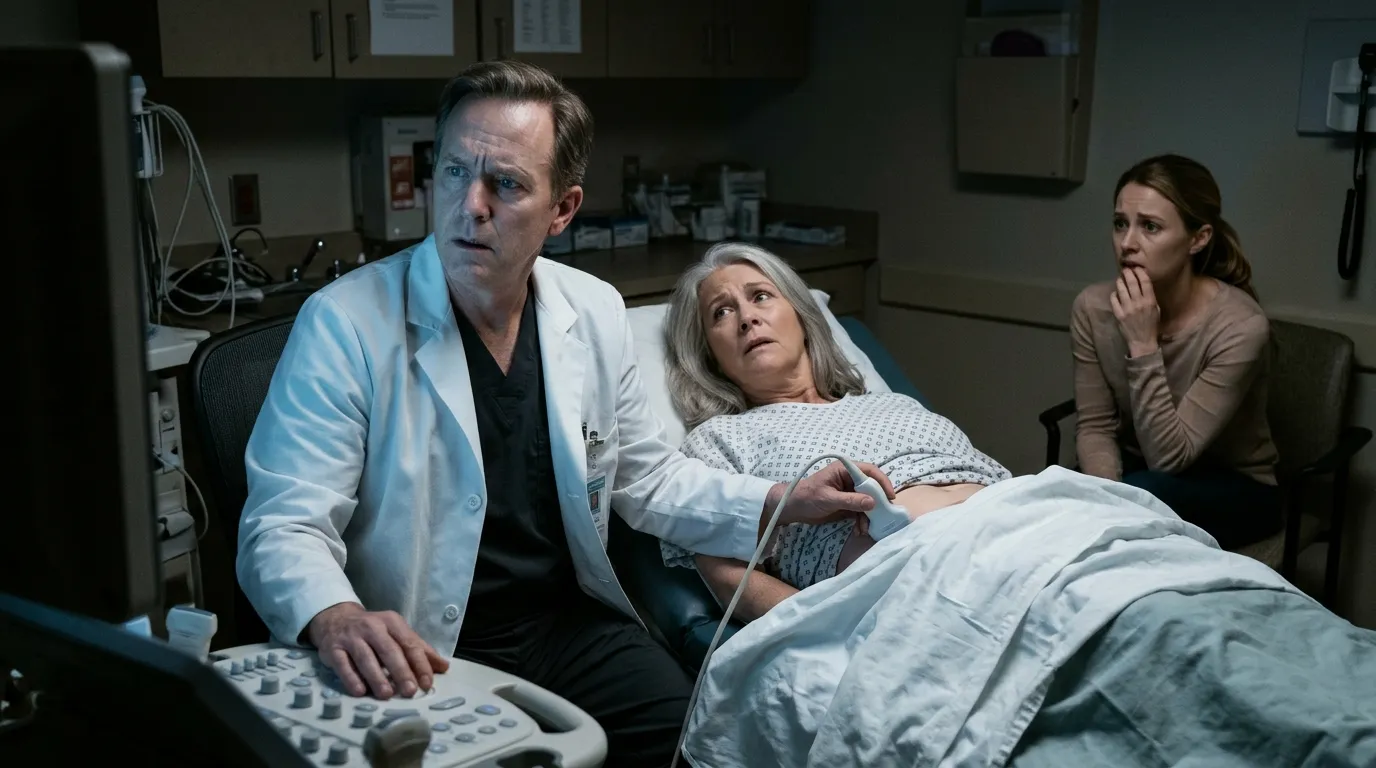
Inside the dimly lit ultrasound room, the doctor asked me to lie back on the examination table. He spread cool gel across my tight abdomen and began gliding the probe over my skin. At first, his expression remained calm and professional. But within seconds, a deep frown creased his forehead.
He shifted the probe to another side of my belly, squinted closely at the glowing monitor, and clicked several buttons to take measurements. Suddenly, he stopped moving altogether.
“Does it hurt here?” he asked, pressing gently.
“A little,” I admitted.
He turned his eyes back to the screen. As I watched him, I saw all the color drain from his face. He turned completely pale.
“Doctor,” I whispered, panic rising in my throat, “is something wrong with my baby?”
He didn’t answer me. Instead, he spun sharply toward the nurse standing nearby.
“Call a surgeon immediately,” he ordered, his voice tight with urgency. “And tell them to prepare the operating room.”
The Truth Behind the “Pregnancy”
Emily jumped out of her chair. “What’s happening? Is my mother in danger?”
The doctor gently urged her to stay calm. Within minutes, two senior specialists hurried into the room. They took turns studying the ultrasound monitor, speaking in hushed, serious tones, and asking me rapid-fire questions about my symptoms. Watching their grave expressions was pure torture.
Finally, I couldn’t bear the suspense for another second. “Please, just tell me the truth,” I pleaded, tears spilling down my cheeks. “Is my baby alive?”
A heavy silence filled the room. The senior doctor stepped away from the monitor, pulled up a stool, and sat right beside my bed.
“Mrs. Margaret,” he said softly, looking directly into my eyes, “there is no baby inside your abdomen.”
I stared at him in complete bewilderment. “I don’t understand. The pregnancy tests… the blood work… I even felt something moving inside me.”
The doctor took a deep, steady breath. “We’ve discovered a very large mass on one of your ovaries. We suspect it is a rare type of growth that produces the exact same hormone detected by pregnancy tests. That is why your tests came back positive.”
I felt as though the floor had vanished beneath me. “So… I’m not pregnant?”
“No,” he replied gently. “However, this mass has grown so large that it is already pressing heavily against your surrounding organs. We need to find out exactly what it is and remove it as soon as possible.”
Emily grabbed my hand and wept openly. Over the next several hours, additional scans confirmed the shocking reality: my rapidly growing belly wasn’t a miracle baby—it was an enormous ovarian tumor. Even the fluttering “kicks” I had felt on the couch were actually caused by intestinal activity and the immense pressure the tumor was placing on my internal organs.
All those months, I hadn’t been expecting a child. I had been quietly battling a dangerous illness I didn’t even know existed.
A Second Chance by the Pool
I was admitted to the hospital that very day. When Robert rushed into my room, he didn’t say a word at first—he simply wrapped his arms around me and held me tightly against his chest.
“All that matters is that you get better,” he whispered. “Nothing else is important.”
A few days later, I was wheeled into surgery. Thankfully, the operation was a complete success. The pathology results later confirmed that the mass was indeed a rare, hormone-producing ovarian tumor. Following the surgery, I received the necessary follow-up treatment and committed to regular medical checkups.
Six months later, I found myself standing beside my daughter’s swimming pool once again. The summer sun felt warmer, the air smelled sweeter, and for the first time in nearly a year, my body felt like my own. My belly no longer restricted my movements, I could take deep, effortless breaths, and I felt infinitely better.

Six months later, standing by the same pool—healthy, grateful, and surrounded by the family I love.
My seven-year-old granddaughter ran over and wrapped her little arms tightly around my waist. “Grandma, are you all better now?”
“Yes, sweetheart,” I smiled, kissing the top of her head. “I’m all better now.”
Across the patio, Emily smiled warmly, and Robert stepped up to take my hand in his.
Those terrifying months taught me a lesson I will carry for the rest of my life. As we grow older, it is far too easy to brush off sudden changes in our bodies—blaming them on aging, stubborn weight gain, or simple exhaustion—without realizing they might be urgent warning signs.
If my daughter hadn’t noticed my belly and insisted I take that pregnancy test, I might have kept putting off a doctor’s visit until it was far too late. As strange as it sounds, the pregnancy that never existed is the very thing that saved my life.