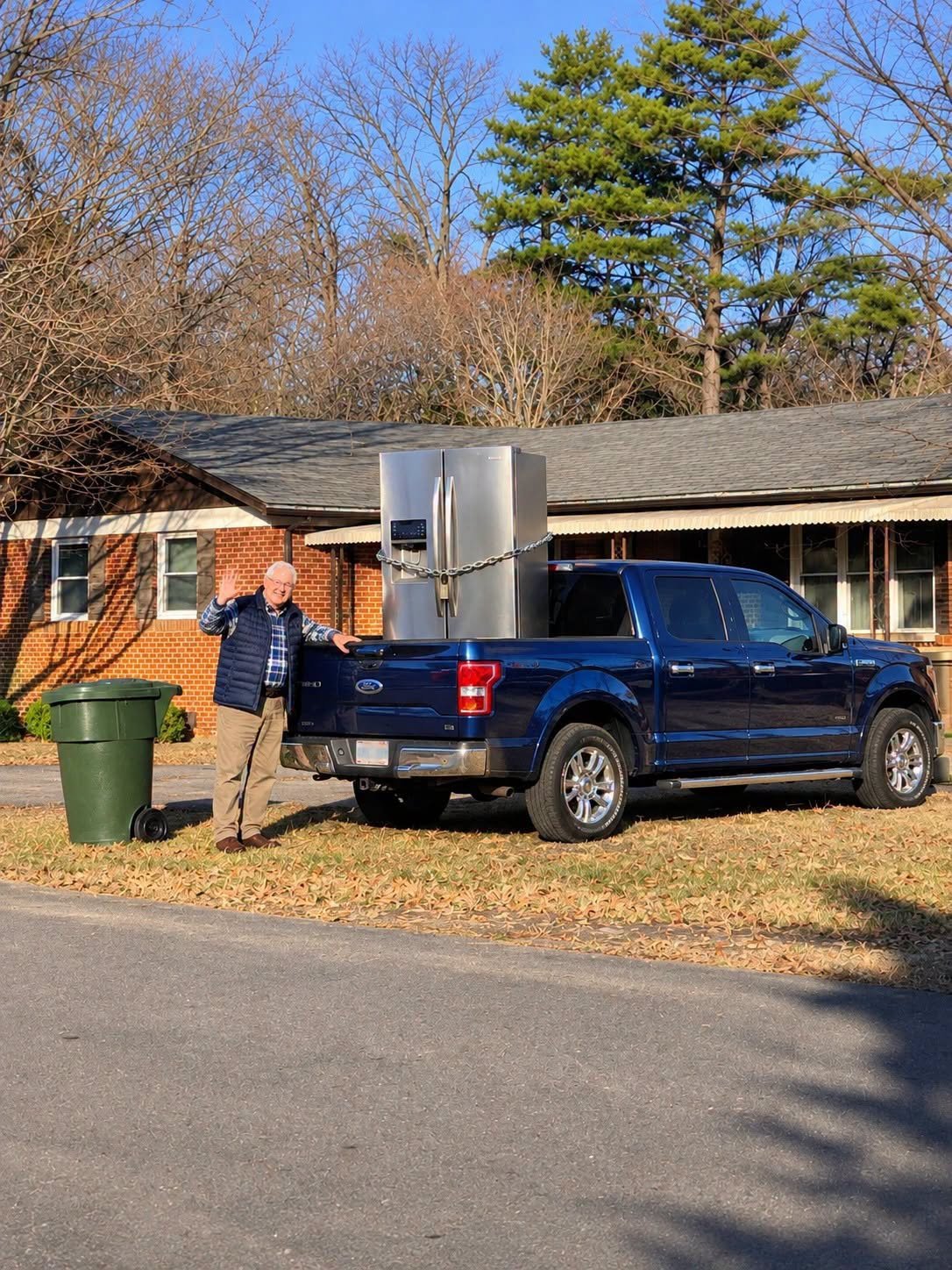
A white refrigerator stood in the bed of Mr. Harris’s pickup, taller than the cab, with a padlock on its door. At eight that morning, I was pulling my trash can up the driveway when he began backing across the street.
He stopped with the truck halfway in, pulled forward, and tried again. A low branch hung beside the drive, close to his passenger mirror.
I left the can by my mailbox and went into the street. Mr. Harris rolled down his window.
“Am I going to catch that branch, Natalie?”
“Not if you keep coming straight. I’ll watch it.”
He eased back a few feet, then stopped and pulled forward to correct his angle a second time. I moved where he could see me and held up one hand.
“You can come a little farther, Mr. Harris. Your mirror clears it.”
He backed in another foot. The mirror passed under the branch with room to spare, and he set the brake.
“Did I get it?” he called.
“You did. That branch didn’t touch you.”
He climbed out and looked at the pickup bed. Two wide straps held the refrigerator upright, one above the other. I walked around to the tailgate and saw that the padlock passed through a hasp fixed to the door.
“Is it going to the dump?” I asked.
“That’s where it’s headed.”
“The fee is twelve dollars now. I found that out when I took my old lawn chair.”
“For a chair?”
“Two chairs, if you count the one that folded itself while I was sitting in it.”
He smiled and checked his shirt pocket. “I’ve got a strawberry candy for Hope, next time she’s over.”
“She’ll hold you to that.” I pointed toward the refrigerator. “Where did you get it?”
He put his hand on the tailgate. “I picked it up this morning.”
The door was shut tight, and the straps crossed the front of it. I pressed my thumb against the side of my index finger.
“Do you need somebody to help you unload it? I could ask around.”
“Thank you, Natalie. It can wait.”
“I could find two people before lunch. Then you’d have your truck back.”
“I’ve got what I need.” He glanced toward his garage. “Would you bring that casserole dish over later?”
“The one I borrowed? It’s clean.”
“No hurry. I’ve got an errand first.”
I had crossed the street for him before, once with a stepladder and once with a jar he couldn’t open. He had asked for both. I started toward my porch, thinking I could offer again when I returned the dish.
Before I reached the steps, his pickup was moving. The white refrigerator went down the street above the cab.
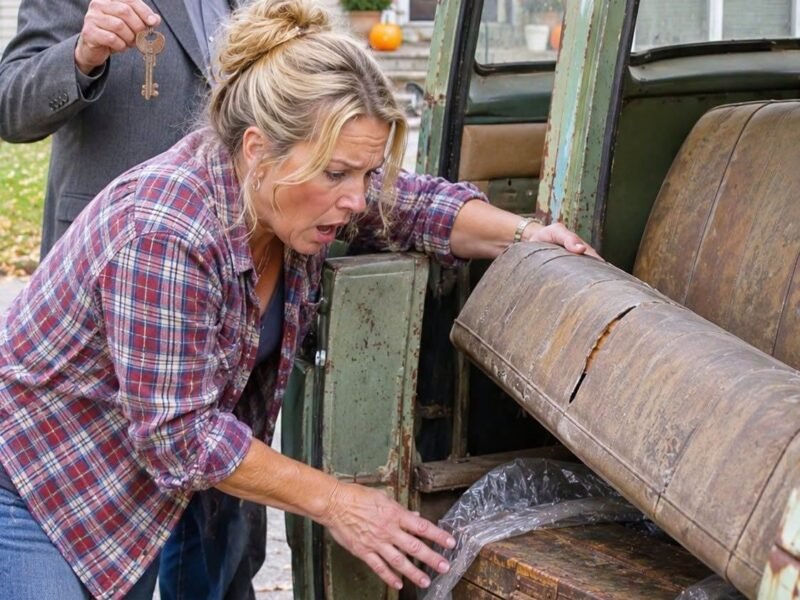
At eleven, I brought his casserole dish back and found him at the kitchen counter with two bags of groceries. One bag had split at the bottom, and he was holding it together with his elbow.
“Set it down before you lose the eggs,” I said.
“I’ve got the eggs.” He lifted out a carton and put it safely on the counter. A sleeve of crackers followed, with a yellow sticker that said 79 cents.
I took the dish from under my arm. “I washed this twice. The cheese was determined to stay.”
“That was the best part.” He turned the dish over to check the bottom. “You didn’t have to scrub my name off it.”
“I didn’t. Your tape finally gave up.”
He smiled and made room for it beside the sink. Then he opened the second grocery bag, and I saw the refrigerator behind him.
It was cream, with a dent near the handle. I had seen that dent plenty of times, but that morning I looked at it long enough for him to notice.
“Helen made that dent with a skillet,” he said, “and I never had the nerve to fix it.”
“How did she manage that?”
“She was putting the skillet away and I was standing where she wanted to be.” He lifted the milk from the bag. “I moved. The door didn’t.”
He opened the refrigerator and set the milk on the top shelf. The light came on, and he shut the door again.
“Did you replace this one?” I asked.
“No, that’s the same refrigerator.” He folded the empty bag and tucked it inside the other one. “Still keeps the milk cold.”
The one in his truck was white. I pressed my thumb against the side of my index finger and looked at the dent again.
“Then where did the other one come from?”
He reached for a grocery flyer lying beneath the crackers. “Did you see the price on these? I bought two sleeves.”
“That’s a good price,” I said. “But whose refrigerator is it?”
He smoothed the flyer on the counter. “I thought Hope might like the crackers when she comes over.”
“She will. She usually eats them before we get home.” I waited for him to look up.
Instead, he circled the price with a pen and pushed the flyer toward me. “The sale runs through Saturday. You can take this copy.”
I had thought the refrigerator in his truck might be his old one, waiting for a trip to the dump. I picked up the flyer, but I left the question where it was.
At the sink, he handed the casserole dish back to me. “This one’s yours, Natalie. Mine has the blue lid.”
I took the empty dish past the pickup. Its padlock was still in place.
At four, Hope called from Mr. Harris’s garage and asked if she could stay another ten minutes. I set the dish on my counter and crossed back over.
She was sitting on a low stool at his workbench, with a shallow pan of screws in front of her. Mr. Harris stood beside her, holding an empty glass jar.
“Does this one go with those?” he asked, pointing at a little silver screw.
Hope picked it up and turned it between her fingers. “No. The head’s different.”
“Good eye. Where should we put it?”
“The ones that don’t match anything get their own jar.” She reached for the jar, then stopped. “Do you have tape?”
Mr. Harris opened a drawer and gave her a roll of masking tape. Hope tore off a strip and pressed it against the glass, smoothing each end with her thumbnail.
“What are you calling it?” I asked.
“You’ll see. Can I use the black marker?”
He handed it to her without asking what she planned to write. She bent over the jar, her tongue caught between her teeth, and began forming a large W.
“I always have to think about the next part,” I said. “Do you want me to spell it?”
“No, Grandma. I know it.”
She printed E, then I, and checked the space left on the tape. Mr. Harris pulled another stool over for me while she finished the word and started the next one.
When she turned the jar toward us, the label read WEIRD ONES. The letters were a little crowded at the end, but every one was clear.
“You got it,” I said.
Hope put her hand over the mouth of the jar before I could see what she had set beside it. “This is for the special ones.”
Mr. Harris checked his shirt pocket and brought out a strawberry candy. He offered it to her, and she unwrapped it carefully over the pan.
“Not with the screws,” he said.
“I wasn’t going to drop it.”
“I wasn’t going to eat one, either, but there we are.” He moved the pan a few inches away, and Hope grinned at him.
He seemed perfectly happy to let her decide where his hardware belonged. I looked past the workbench to the open floor near the wall.
“Hope, do you think that space would be big enough for the refrigerator?”
She turned on her stool. “Maybe, if it stood up.”
“We could find somebody to help unload it,” I said. “Would it fit there, Mr. Harris?”
Hope set down the candy wrapper. Mr. Harris looked at the bare floor, then at a stack of boxes by the workbench. I pressed my thumb against the side of my index finger.
“I don’t know what’s in those,” he said, lifting the top box. “I’d better get them out of your way, Hope.”
She gathered her jar and marker against her chest. He carried the box across the garage and set it squarely in the space I’d pointed out.
Hope looked up at him. “Can I leave the jar here?”
“You can put it on the shelf,” he said. “That way we won’t lose your good lettering.”
She set it beside a row of cans and came back for her marker. I held the door while she went out to the driveway.
“Are you coming back tomorrow?” she asked him.
“If your grandma doesn’t have other plans for you,” he said.
I said she could come. Hope gave him a wave, and I took her home.
At six, I crossed the street again with two names on a sheet of paper. I had called both neighbors, and both had said they could come Saturday. Hope had gone back over to Mr. Harris’s, so I would ask her to walk home with me.
The garage door was open. Before I reached it, I heard Hope say, “Grandma can’t see her surprise till it’s ready.”
I stopped beside the pickup. Mr. Harris said something too low for me to hear.
Hope liked making cards, and Mr. Harris kept a drawer full of paper and odds and ends. I decided not to spoil whatever she was making. Then I called out, “Is this a good time?”
Hope sat on a stool with string looped around her fingers. Mr. Harris stood beside the workbench, checking his shirt pocket. He turned when he saw me.
“Come on in,” he said. “Hope was just showing me how to make a knot I can’t make myself.”
“It’s a bow,” she said. “You already knew how.”
“Not one that stays tied.”
She pulled the ends apart and started again. I held out the paper to him.
“I asked two neighbors about Saturday,” I said. “They can help unload the refrigerator. Would morning suit you?”
He looked at the names but didn’t take the sheet.
“That’s kind of you, honey, but I don’t need them. The refrigerator is headed for the dump.”
“Then how will you get it out of the truck?” I asked.
“I have a plan for it. You can tell them I appreciate the offer.”
Hope kept winding the string around her fingers. One end slipped loose, and she caught it against her knee.
“I’ve already bothered two people,” I said, “so you might as well let them help.”
Mr. Harris smiled, then shook his head. “I can manage it, Natalie. You don’t have to arrange anything.”
I pressed my thumb against the side of my index finger. On the paper, I had written both phone numbers too, in case he wanted to call and settle on a time.
Hope held up her finished bow. “This one stayed.”
“It did,” I said. “Are you ready to come home? Laura’s stopping by later.”
Hope slipped the bow off her fingers and laid it on the bench. Mr. Harris thanked me once more, and I folded the paper into a small square.
“I’ll take Hope home,” I said. “You let me know if Saturday gets too crowded.”
Mr. Harris nodded, and Hope picked up her string. She asked if she could come back to the garage on Friday, and he told her she could.
At seven, Laura lifted the lid from the shallow box on my kitchen table. I had kept it under a chair since I moved, with the photographs still jumbled together.
“Are these all from the old house?” she asked.
“Most of them. Could you look for the Christmas pictures at Mr. Harris’s? I want to check something in the background.”
Laura drew out a stack and squared the corners against the table. “What am I looking for?”
“His refrigerator. I want to see whether that dent was there years ago.”
She turned over a photograph of a ham, then one of Helen holding a pie. “Was the dent from a pie?”
“A skillet. Helen managed to hit the refrigerator with it, though she never would tell me exactly how.”
Laura found a picture with Mr. Harris standing by the kitchen counter. She held it under the light, but his shoulder covered most of the refrigerator.
“There’s another one here,” she said. “Wait until you see your hair.”
She slid it across. I had a red bow stuck above one ear, and Helen was laughing beside me. Behind us, the cream refrigerator stood with the skillet dent plainly visible near its handle.
“The dent was there,” Laura said. “That’s the same refrigerator he has now.”
“And the one in his truck is white.”
Laura set the photograph apart from the others. “Did he say whose it was?”
“No. He said he was taking it to the dump.” I pressed my thumb against my index finger. “I offered him help again, and he wouldn’t take it.”
Laura reached into the box and pulled out a paperback with a bent cover. Its pages had gone soft at the corners, and a grocery receipt marked a place near the middle.
“You used this to measure me,” she said. “I thought you’d thrown it out.”
“Was that the book that made you insist you’d grown an inch in a week?”
“An inch and a half. You said the cover was crooked.”
Under the book was a photograph of Laura standing beside the old hallway trim. Pencil lines and dates climbed the narrow edge, though the smallest writing had blurred.
“Can you read the first date?” I asked.
“First?” She tipped it toward the light. “No, but that’s my name above it.”
I held out my hand, then stopped. “I thought I was just missing paint until I tried to remember the dates.”
Laura looked at me. “Do you want this back in the box?”
I shook my head. “I don’t even know whether the new owners kept the trim when they started their work.”
Laura placed the photograph beside the bent paperback.
Laura touched the edge of the picture. “You wrote those dates in pencil, didn’t you?”
“I did. I kept meaning to go over them with a pen.”
She squared the corners with the paperback. “I’m glad you didn’t. I liked your pencil.”
On Friday at five, Mr. Harris opened his garage door and waved Hope inside. “My best sorter is back. Natalie, would you like a cup of coffee?”
“If there’s enough for you, too.”
“There will be in a minute.” He plugged in the little coffee pot by his workbench, then pulled a stool out for Hope. “I saved you the hard ones.”
Hope climbed onto the stool and peered into a shallow tin. The jar she had labeled WEIRD ONES stood beside it, still empty.
“Do they all have to be different?” she asked.
“They do for that jar. Otherwise they go with their friends.” He set two matching screws beside a third that was shorter and had a wide, flat head.
Hope dropped the short screw into the jar. “He doesn’t have any friends.”
“Not yet,” Mr. Harris said. “We’ll keep looking.”
He brought me coffee in a mug with a faded blue rim. The spoon was still in it, and I took it out before sitting down. Hope held up another screw.
“This one has green paint on it.”
“Does it match any in the tin?”
Hope searched through them, then shook her head. “The odd screws go in the WEIRD ONES jar,” she said, and dropped it in.
By the time I finished my coffee, the jar held a dozen screws of different lengths and colors. Hope screwed on the lid and read her label aloud, pleased with every letter.
I set my mug on the bench. I had made such a fuss about finding room in this garage. Mr. Harris had welcomed us back just the same.
He checked his shirt pocket and brought out a strawberry candy. Hope took it and slipped it into her shorts pocket.
“You’re saving that?” I asked.
“I might want it later.” She hopped down from the stool. “Does midnight count as morning, or do you have to wait for breakfast?”
Mr. Harris looked at her. “That depends on what you’re waiting for.”
Hope put her finger against her lips, then picked up the tin of matching screws. I thought of the card I had heard her mention and kept my question to myself.
At the doorway, Mr. Harris stopped beside the pickup. A metal latch on the bed hung loose, with its catch turned outward.
“I ought to fix that,” he said. “I’ll take care of it later.”
He pushed the latch against the truck bed but left it unfastened.
Hope called from the garage that she had found one more screw, and Mr. Harris went back inside to see it. I waited by the driveway until she came out with him, swinging her empty hands.
“Did the last one make it into the jar?” I asked.
“It didn’t match a single one,” she said. “Mr. Harris said that was a very good reason to keep it.”
He checked his shirt pocket, then smiled at Hope. “You’ve already got your candy, honey.”
She pressed her lips together and climbed into the car. I waved to him, and he raised a hand before turning toward the garage.
A metallic clang woke me at two o’clock Saturday morning. I sat up and listened, with the sheet twisted around my ankle. The garage light across the street was on.
I went to the bedroom window and lifted the shade. Mr. Harris was beside the pickup in his slippers, with one hand against the refrigerator door. It stood open.
I raised the window. “Mr. Harris? Are you all right?”
He looked over. “I’m all right, Natalie. Did I wake you?”
“Something did. Do you need a hand?”
“No, honey. Go on back to bed.” He glanced at the truck, then moved a little closer to the open door.
I could see a pale edge inside the refrigerator, too narrow to be a shelf. He reached in and shifted something, blocking my view with his shoulder.
“Are you taking it to the dump now?” I asked.
“Before breakfast, I hope.” He looked down at his slippers. “I suppose I ought to put on shoes first.”
His pocket hung open, and he patted it as if checking for a candy. I nearly told him Hope was asleep and wouldn’t be wanting one at this hour.
Then he stepped aside. The garage light reached past him and fell on a length of yellow wood painted with black sunflowers.
I put my thumb against the side of my index finger. One flower had a petal that bent around a knot, wider on one side than the other. I had painted it that way because I couldn’t make the brush go straight over the bump.
“Where did you get that?” I called.
He rested his hand on the refrigerator door but didn’t close it. From my window I could see only the painted face. The narrow edge was turned away.
I had written Laura’s name and dates on that edge. Was any of it still there? I leaned farther out, trying to see past him.
“Mr. Harris, is that my hallway?”
He looked up at me, the refrigerator door open beside him.
“Yes, honey,” he said. “Come on over.”
I found my slippers beside the bed and went down the stairs. By the time I crossed the street, he had one hand on the refrigerator door.
“Where did you get it?” I asked. “The trim, I mean.”
“Let me shut this before the wind catches it.” He pushed the door closed, and the yellow paint disappeared. I put my hand out, but he was already turning toward the back of the truck.
A metal latch hung loose from the pickup bed. He lifted it and showed me where it should have been fastened.
“That was your noise,” he said. “I meant to fix it yesterday.”
I pressed my thumb against my index finger. “Is the wood secure in there?”
He opened the refrigerator again and leaned in. Two blocks padded with folded cloth held the trim in place. He pressed each one, then checked the end nearest the door.
“It hasn’t moved,” he said. “I put those blocks in tight.”
One end of the board was tucked under a piece of cloth. I could see the sunflower I had painted, but not much beyond it.
“Did the new owners give it to you?” I asked.
“They did. They were remodeling.” He laid his hand on the cloth. “Their refrigerator gave out while the crew was there.”
I looked from the white door to his kitchen window. “And yours is still the cream one with the dent.”
“It is. Helen would have wanted me to tell you the skillet came off worse.”
I laughed, then looked back at the covered end. “How did this refrigerator get into your truck?”
“Their crew helped me load it. I meant to haul their refrigerator away, and then I needed a safe place for the wood.”
“So you put the trim inside?”
“After I padded it. I didn’t want it sliding around in the bed.” He glanced at the straps. “I was taking the refrigerator to the dump before breakfast.”
I had watched him drive around with it all summer. I had even brought him names of people who could help. Now I wanted him to move the cloth.
“Did it come off the doorway in one piece?” I asked.
“There are places you’ll want to see in good light. I can show you in the garage.”
He reached into his shirt pocket and touched the strawberry candies there. “Hope and I were going to bring it over this morning. We’d planned on surprising you.”
I had thought she meant a card. He did not know I had heard her, and I kept my mouth closed.
“I can bring the trim inside for you now,” he said.
He reached for the first padded block. I stepped closer to the truck.
“Please let me help with the next part.”
“Take the other end, then,” he said. “Keep it level with mine.”
I slid my hands beneath the board. We lifted it clear and carried it into the garage, where he had made room on the long workbench.
“Set it down easy,” he said. “There was a split near your end.”
I lowered it onto the bench and looked along the yellow paint. The crooked sunflower petal was still there, but a fine line ran through the stem of another flower.
“Did it break when they took it off?”
“In two places. A friend helped me glue the splits back together.” He pointed to the thin seams. “We clamped it right here on this bench.”
I put a fingertip beside one seam. The edges met closely, though a little ridge showed where the paint had lifted. “Will it hold?”
“It should. We gave the glue plenty of time.” He tapped the bench. “I’ve been working around that board for weeks.”
I looked at the boxes stacked against the wall. “Is that why you wouldn’t make room for the refrigerator in here?”
He checked his shirt pocket and smiled. “I needed the bench more, honey.”
I ran my hand above the painted face without touching it. Near the bottom, a small patch of yellow looked fresher than the rest.
“Did you paint that part?” I asked.
“Just touched it up where it needed it. I tried not to cover anything you put there.”
I pressed my thumb against the side of my index finger. “What about the narrow edge? Can I see it?”
He put his hands at either end, ready to turn the board. I remembered Laura standing beside that doorway while I made each pencil line, and I put my hand on the bench.
“Wait. Let’s carry it over together, and let Laura see it with us.”
He left the board where it was. “Tonight?”
“Is there a blanket we can wrap around it? I don’t want those ends catching on the door.”
“I’ve got one on the shelf.” He glanced toward the house. “You want to call her now?”
“I do. Will you wait here while I get my phone?”
He nodded and reached past a row of paint cans. The blanket was folded behind them, with a corner caught under a cardboard box.
I went across to my kitchen and picked up my phone from the counter. Laura would have to get out of bed, and Hope would hear about the board before Saturday morning could go the way she and Mr. Harris had planned.
When I returned to the garage, he spread the blanket across the bench. “This one was Helen’s picnic blanket,” he said. “It still has room for a little sawdust.”
I found Laura’s number and pressed call. Mr. Harris folded the blanket around one repaired end as the phone began to ring.
Laura answered on the fourth ring. “Mom? Is something wrong?”
“Can you come over? Mr. Harris has my old hallway trim, and I want you to see it.”
“Trim?” She was quiet for a second. “I’ll be there. Hope’s asleep, so I’ll leave her with her dad.”
Mr. Harris held out the unwrapped end of the board. “You take this one, honey. It’s lighter.”
I slid my hands under the wood. “What about the glued end?”
“I’ve got it. Just don’t let yours catch on the door.”
We carried it across the street, and I backed through my front door while he watched the blanket. We leaned the board against the hall wall, painted side out.
“The sunflower with the crooked petal is still there,” I said.
“So it is.” He checked his shirt pocket, then laid his hand against the board to keep it from slipping. “Let’s wait for Laura before we turn it.”
She arrived in a cardigan, with one button fastened wrong. I reached to fix it, but she had already spotted the yellow paint.
“Mom, is that really ours?”
“That’s what we’re going to see. Can you hold the hall light switch? It slips off if you don’t push it all the way.”
Laura held the switch up while Mr. Harris and I turned the trim. The blanket stayed folded around the lower end. Higher up, pencil lines crossed the narrow edge.
“There’s my name,” Laura said. She leaned closer. “And the dates. You wrote those?”
“Every birthday you would stand still for.” I pressed my thumb against my index finger. “Who thought to save it, Mr. Harris?”
He straightened the edge of the blanket. “Helen asked the new owners to call us if they ever took that doorway apart.”
Laura took her hand off the switch and the light went out. She pushed it back up, keeping her finger there.
“When did she ask them?” I said.
“After you moved. She told me she’d spoken to them, and after she passed away, I asked them again to let me know.” He looked at the repaired seam. “They remembered.”
I’d been picturing those marks under a coat of fresh paint, with nobody having said a word. I touched the edge of one pencil line, careful not to rub it.
“Will you help me hang it later today?” I asked. “We’ll have to get it at the proper height.”
“We will,” he said. “That old paperback ought to help us measure.”
“I’ll bring Hope over,” Laura said. She bent toward the board and rested one finger beside the first date I wrote.
“Will she mind being woken this early?” I asked.
“She’ll mind if I leave her home,” Laura said. She pulled her cardigan close and looked at the covered end of the board. “Should we wait to move the blanket?”
I pressed my thumb against my index finger. “Let’s leave it for her.”
At nine, Hope came through the front door ahead of Laura. She had a roll of tape in one hand and stopped when she saw the trim leaning against the wall.
“Did Mr. Harris bring it already?” she asked.
“He brought it over during the night. I saw it in his truck, and I asked him about it.” I stepped aside so she could get closer. “I’m sorry you didn’t get to show me the way you planned.”
Hope looked at the blanket. “Did you see the bottom?”
“Not yet. Is there something under there?”
She set the tape on the hall table and crouched beside the board. “You’re supposed to see the whole side at once.”
“I heard you telling Mr. Harris about a surprise once,” I said. “I thought you were making me a card.”
Hope turned around. “You heard me? I told him to wait until you went home.”
“You did. I was already near the garage.” I pointed to the blanket. “May I see it now?”
She pulled the fabric down from the end. Below Laura’s old marks was a short pencil line, with Hope’s name and a recent date written beside it in careful letters.
“I wanted my name to be there with Mom’s,” she said.
Laura crouched beside her. “Your letters are straighter than mine were.”
“I practiced on paper first.” Hope put her finger beside the line. “Mr. Harris held the board while I stood in my socks. He said not to wiggle.”
“How did you reach the pencil?” I asked.
“He handed it to me after he made the line. I wrote my name myself.” She looked at me. “Is it too low?”
“We’ll measure before he fastens it,” I said. “We’ll put it at the right height.”
She picked up the roll of tape again. “We finished yesterday. Mr. Harris kept the board in the refrigerator so it wouldn’t get bumped, and he was going to take the refrigerator to the dump before breakfast.”
“Was that why you saved your candy?” I asked. “You usually ate it before we got home.”
“I put it in my pocket because I was trying not to tell you.” She rubbed the edge of the tape. “I ate it later, when I couldn’t tell you anymore.”
I wished Helen could have seen Hope’s name beside Laura’s. I touched the repaired edge, then looked at the doorways. “Where do you think we should put it?”
Hope moved from the hall opening to the kitchen entrance, looking up at each side. Laura fetched the tape measure, and Hope carried it toward the kitchen doorway.
“Here,” Hope said, putting the end of the tape against the wall. “This is the one we use for lunch.”
Laura held the other end while Hope pulled out more tape than she needed. It curled onto the floor, and Laura caught it before it snapped back.
“Will the door still open?” Hope asked.
“We’d better check,” I said.
I swung the kitchen door toward the wall. There was room beside it for the trim, though Mr. Harris said we would have to be careful with the screws.
“Could we put it up today?” Hope asked.
“If Mr. Harris can spare the time.”
He checked his shirt pocket and smiled at Hope. “I can spare it. I’ll fetch my drill after lunch.”
By one o’clock, he was back with the drill and a handful of screws. Laura held the trim against the wall while he put a small level alongside it.
The yellow paint looked brighter in my kitchen than it had in the hall that morning. One black sunflower sat just above Laura’s oldest mark.
“How high should I hold it?” Laura asked.
I took the bent paperback from the counter. “Let’s put Hope beside it before we make any holes.”
Hope slipped off her shoes and stood against the wall. Mr. Harris held the trim while Laura stepped back to make room for me.
“Do I look straight?” Hope asked.
“Your shoulders do,” I said. “Your feet have other ideas.”
She lowered her heels, and I placed the book on her head. Mr. Harris moved the board up a little, then down until Hope’s line was even with the edge.
“Right there,” I said.
Laura steadied the trim again. Mr. Harris made a small pencil mark on the wall near the top, then another near the bottom.
I pressed my thumb against my index finger while he chose a screw. The drill would leave holes in the old wood, but it would hold the trim where Hope had chosen to put it.
“Go ahead,” I said.
He drove the first screw in, checked the level again, and fastened the bottom. Laura took her hands away slowly, keeping them close until the board stayed put.
Hope put her shoes side by side under the kitchen table. “Can I see if it still fits?”
I picked up the paperback again, and she backed against the wall. Mr. Harris moved his drill out of her way while Laura watched from the doorway.
Hope rocked forward as I lowered the book. “Feet flat, Hope,” I said.
Her heels settled on the floor. I rested the paperback on her head, beside the sunflower trim.
The edge of the book met her line.