At 2:07 in the morning, a trauma nurse broke down over a $4 coffee at my drive-thru window—and the man idling in the rain behind her changed both of our lives in ways neither of us could have predicted.
“Ma’am, it declined.”
I kept my voice low the first time I said it, almost gentle, as if maybe the card reader was just being stubborn and the problem had nothing to do with her.
She stared at me through the glass, blinking hard, like the words had floated right past her without landing.
“Can you run it again?” she asked.
She was wearing wrinkled blue scrubs under a heavy winter coat that hung open, unzipped. Her chestnut hair had been twisted up into a clip hours ago and was now falling loose around her face. Near the cuff of her sleeve, there was a dark dried smudge that looked like either coffee or blood, and I immediately hated myself for noticing.
I swiped the card a second time. The screen blinked red.
Declined.
That was the exact second her face shifted. Not into anger. Not even into embarrassment. Just into something hollowed out and completely finished.
She let her forehead drop against the top of the steering wheel and made a sound I still hear in my sleep sometimes. It wasn’t loud, and it wasn’t theatrical. It was just one thin, broken breath from a person who had been holding up far too much weight for far too long.
Behind me, my shift manager cleared her throat.
She didn’t need to say a word. I already had the rules memorized. No free drinks. No free food. No “being nice” unless corporate approved a promotion. If the register came up short, questions followed. Too many questions meant your hours got slashed. I was twenty-three years old, already behind on rent, and one past-due utility bill away from coming home to a dark apartment.
Inside the sedan, the woman began digging frantically through her center console with shaking hands.
“I’m sorry,” she whispered. “I know this is stupid. I’m really sorry.”
“It’s okay,” I told her, even though both of us knew it wasn’t okay at all.
Her fingers pulled up two dimes, a loose coat button, three crumpled gas receipts, and a tube of lip balm missing its cap. She stared at the pile in her palm and let out a single short laugh that sounded worse than crying.
“I just finished a fourteen-hour shift,” she said quietly, looking straight ahead at the wet glass. “We lost a man right near the end. I sat with his daughter because she couldn’t bear the thought of him dying alone. Then I walked out to my car, my gas light came on, and I thought… I just thought I could get one cup of coffee to make it home.”
She pressed her hand over her mouth, startled by how much had spilled out.
“My son is asleep at my neighbor’s house,” she added softly. “I have to pick him up before school. I just needed to stay awake long enough to drive.”
My manager stepped closer to my shoulder.
“If she can’t pay, move the line,” she murmured under her breath.
The nurse heard her. Of course she heard her.
She sat up straight in a rush, scrubbing the back of her hand across her cheeks like she was ashamed of having tears at all.
“It’s fine,” she said quickly. “Really. Just forget it.”
The Knock in the Rain
In a normal night, that would have been the end of the story. That is how overnight drive-thru shifts always work. People roll up exhausted, angry, lonely, half-hungry, or quietly falling apart. You hand them what they can pay for, or you send them back out into the dark. Then the next pair of headlights pulls forward.
Before I could even pass her card back, a firm knock rattled the metal wall right beside my window.
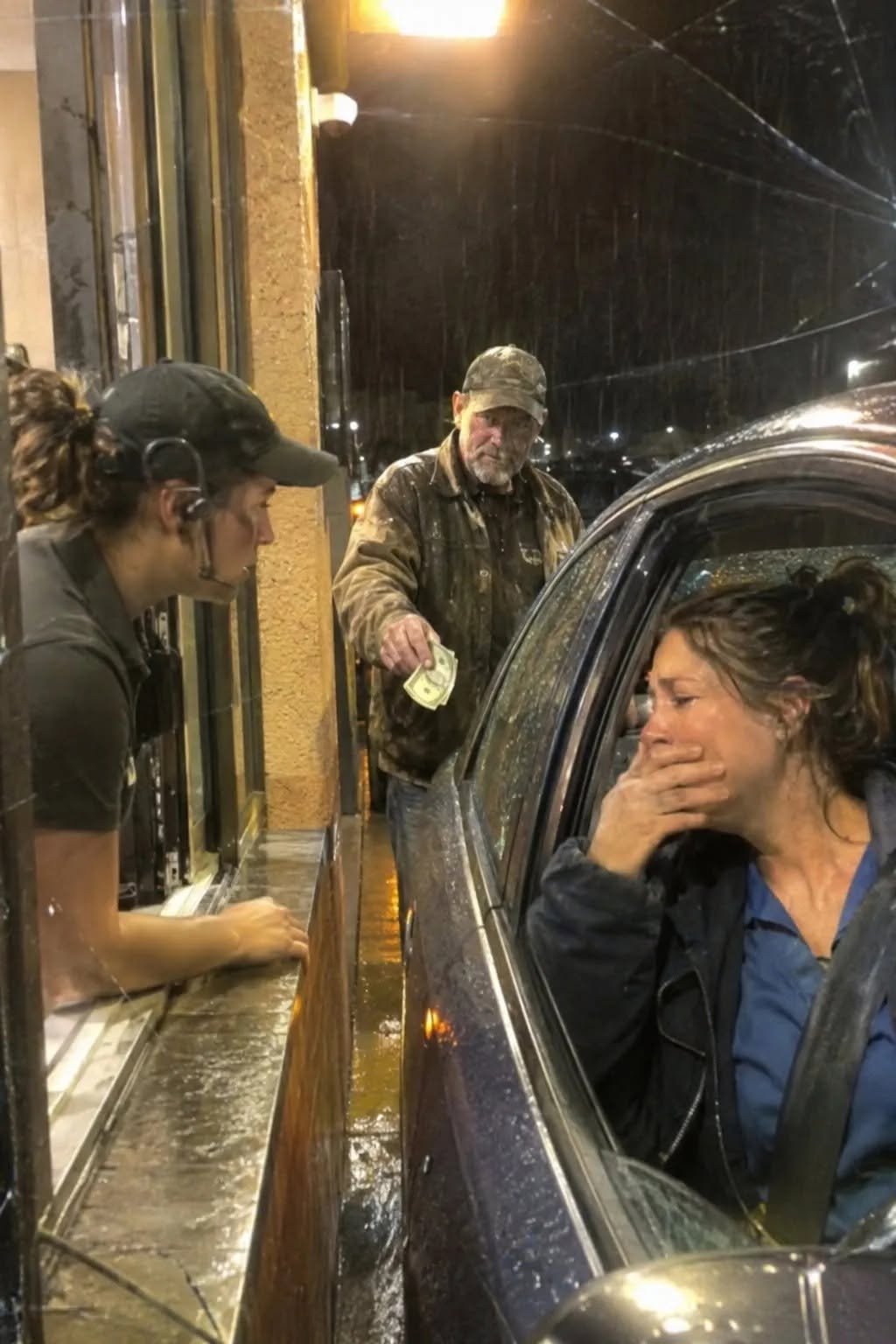
A man from the pickup truck behind her had stepped out into the pouring rain. He was broad-shouldered, somewhere in his late fifties, wearing a weathered brown canvas work jacket and a faded ball cap. His hands looked like they had spent decades lifting things heavier than they should have been. Rainwater dripped off his sleeves and pooled on the concrete ledge.
He reached past the glass and held out a crisp twenty-dollar bill.
“Her coffee,” he said plainly. “And whatever hot food you’ve got back there that’ll travel.”
At 2:07 a.m. in the pouring rain, a stranger stepped out of his pickup truck and refused to let an exhausted nurse drive away empty-handed.
The nurse whipped her head around so fast I thought her bumper might scrape the curb.
“No,” she said immediately. “Please, you don’t have to do that.”
He looked straight at her—not smiling, not trying to turn the moment into something out of a movie.
“My wife spent twelve days in intensive care last winter,” he said steadily. “I don’t remember every doctor who walked through that room. I don’t remember the names printed on the machines. But I remember the nurse who stayed beside her bed when I had to go home and shower. I remember the nurse who held her hand when she was terrified.”
The whole parking lot went quiet except for the steady drumming of rain against the metal awning.
“She told me once,” he went on, “that everybody remembers to thank the surgeons, and nobody sees the ones who walk in at three in the morning and keep watch while the rest of us fall apart.”
The woman in blue scrubs started crying again, only this time she didn’t try to hide her face.
“I’m so tired,” she whispered.
“I know,” he answered gently. “That’s why I’m paying.”
Behind me, my manager opened her mouth—almost certainly to recite the rule about not accepting outside cash at the window like that.
Before she could speak, the man laid a second twenty-dollar bill flat on the wet ledge.
“This one’s for the next person who pulls up looking like life just knocked them flat,” he said. “Don’t tell me no. I’ve been waiting a whole year to thank somebody.”
For once, my manager didn’t say a word.
I took the money. I poured the largest cup of coffee we carried, stirring in cream and sugar because the nurse looked too drained to make one more decision. I packed hot eggs, biscuits, hash browns, and two extra breakfast sandwiches she hadn’t even asked for. Then I reached into the cooler and dropped a small apple juice from the kids’ menu into the bag.
“For your son,” I told her.
She looked down at the heavy brown bag, then back up at my face.
“You’re going to get in trouble.”
“Probably,” I said.
From the rain, the big man let out one short, warm laugh.
“Then put the apple juice on mine, too.”
When I passed the bag through the window, her fingers were still trembling.
“Thank you,” she told him, her voice cracking.
He tipped his cap once.
“No,” he said. “Thank you for going back in every day.”
She pulled away slowly, both hands steady on the wheel, hot coffee in the cup holder and warm food riding on the passenger seat like proof that the world hadn’t gone completely cold. The man walked back to his pickup truck and never even ordered anything for himself. He just raised one hand in a quiet wave and merged out onto the dark highway.
I stood behind the glass holding that damp twenty-dollar bill like it weighed far more than paper should. I had started my shift in a cheap uniform feeling completely invisible. Yet for five minutes in the middle of the night, three worn-out strangers had reminded one another that being needed and being seen are not the same thing—and that sometimes a person survives one more dark drive home simply because someone noticed they were human.
When Kindness Meets a Spreadsheet
By noon the next day, that cup of coffee had turned into a formal write-up.
The extra sandwiches were labeled “unauthorized product loss.” And the little kids’ apple juice was apparently serious enough to earn its own separate line on a printed disciplinary sheet with my name typed at the top.
I stood in the cramped back office, still smelling faintly of fryer oil and burnt espresso, as my manager slid the paper across the desk. She didn’t look cruel or smug. Somehow, that made it hurt worse.
“You know why we’re back here,” she said.
I stared down at the sheet. Three breakfast sandwiches. Two hash browns. One kids’ juice. Every single item circled neatly in red ink. The rain from the night before had dried across my sneakers in dull gray streaks, and I kept my eyes glued to them because looking up felt too heavy.
“The man gave me a twenty,” I said.
“For the coffee,” she replied.
“He said hot food, too.”
“He didn’t specify six extra items.”
“It wasn’t six.”
She let out a slow, weary breath. “This isn’t helping.”
Her name was Denise. She was in her forties, always sharp at the corners, her hair pulled back so tightly it looked painful. People called her cold because they had no idea how expensive softness could get when you were barely holding onto your own rung of the ladder. Most nights, I convinced myself she cared more about rules than people. Standing across from her in that fluorescent box, I saw something different: a woman who had already endured one phone call about labor percentages, one about inventory variance, one about drive-thru speed timers, and one about why human decency didn’t fit neatly inside a corporate spreadsheet.
She tapped the page with her pen. “The drawer balanced. That part saved you.”
Saved. Not fixed. Not forgiven. Saved.
“The security cameras still show you bagging food that wasn’t rung in,” she continued. “The district supervisor reviewed the footage because that post from last night started going viral, and somebody at another store recognized our window.”
My head snapped up. “What post?”
She blinked. “You haven’t seen it?”
When I shook my head, she turned her phone around on the desk. Up on a local community page sat a long post written by a woman named Tessa Warren. I knew it was her before I even finished the opening line.
“Last night, at 2:07 a.m., I sat at a drive-thru window after a fourteen-hour shift and my card declined on a four-dollar coffee. I was already running on grief, no sleep, and the kind of exhaustion that makes you feel less like a person and more like whatever’s left after the day gets done with you. A young woman at the window looked at me like I was still human. The man behind me got out into the rain and paid for my food. The worker gave my son an apple juice he didn’t ask for. If either of you ever sees this, thank you. I made it home. My boy made it to school. And because of you, the world felt less cruel than it had fifteen seconds earlier.”
It had already been shared thousands of times. Under it sat endless rows of hearts and praying hands. People were tagging their friends, saying they were tearing up before work, saying night-shift nurses deserved free coffee for life, saying service workers carried the whole country on their backs.
And right underneath the warmth—because there is always an underneath—strangers were already tearing into each other.
If you can’t afford coffee, make it at home.
The employee should be fired. You don’t just hand out store inventory.
No, fire the manager for telling her to move the line.
Funny how everyone loves compassion until it touches profit.
Watch the company turn this into a commercial by Friday.
Was she even a real nurse?
How do we know the guy in the truck wasn’t just showing off?
A chill went straight through me. Not because of Tessa’s post, but because strangers online had done what they always do: they had found the softest, most fragile part of a real night and hammered it into a weapon.
Denise locked her screen and set the phone face-down.
“District is calling it a policy breach with public attention,” she said.
A dry laugh slipped out of me before I could stop it. “A policy breach. Over coffee and breakfast.”
“Over making a judgment call that wasn’t yours to make.”
A dozen sharp replies crowded my throat. I wanted to tell her it was absolutely my call because I was the one standing there when a woman looked ready to shatter against her steering wheel. I wanted to say nobody at district had to hear that quiet, broken sound. I wanted to remind her that the people who write policy manuals never clock in at 2:07 in the morning.
Instead, I just asked, “So what happens now?”
Denise folded her hands on the desk. Officially, I was receiving a final written warning. Unofficially, my hours were being cut for the next two weeks “until attention cooled down.”
That phrase stung worse than the paper. Attention cooled down. Like human beings were grease in a skillet. Like exhaustion had a safe serving temperature.
“I’m already barely making rent,” I said.
For half a second, something flickered across Denise’s face—a tiny crack in the armor—before it snapped shut again.
“I know,” she said quietly. “But I’m trying not to lose my own job over one night.”
The silence between us stretched long and heavy. It wasn’t a threat, and it wasn’t an apology. It was just the bare truth. And the hardest part was that I believed her.
By three o’clock that afternoon, my schedule had dropped from five shifts to two. By four, my landlord texted a polite reminder about late fees. By five-thirty, the electric company emailed one of those falsely cheerful notices using the words final courtesy right before they cut your power. Meanwhile, the comment section kept swelling. People demanded names, store numbers, photos, heroes, and villains. Nobody wanted to sit with the simple version: three tired people met at a window, and something kind happened.
The Apple Juice Lady
I worked the next overnight anyway, because rent doesn’t pause while you sort through an ethical crisis.
At 1:48 a.m., a familiar pair of headlights curved into the lane and my stomach dropped. Same older sedan. Same coat draped over the passenger seat. Same thin crack across the corner of the windshield. Only this time, a little boy was curled in the backseat against a dinosaur pillow, mouth open in deep sleep, one sneaker half kicked off.
Tessa pulled up to the glass and offered a small, tired smile.
“I was hoping it was you,” she said.
In the steadier light, she looked younger than I had first guessed—just worn thin in that way that makes age hard to read. Clean scrubs, dark shadows beneath her eyes, hospital badge clipped to her shoulder. Instinctively, I glanced back over my shoulder. Denise was standing at the prep counter. She saw the car, saw me looking, and deliberately turned her eyes away.
Tessa caught it immediately. “Am I getting you in trouble just by pulling up?”
“You already did that yesterday,” I said. It came out colder than I meant, and watching her face fall made my chest twist. “I’m sorry. That wasn’t fair.”
“No,” she murmured. “Maybe it was.”
She reached out with a folded card. “I came to thank you properly.”
“I can’t take cash.”
“It isn’t cash.”
I cracked it open. Inside wasn’t a bill—just a plain card from a discount pack with tiny yellow flowers printed on the front. In neat, steady handwriting, she had written:
You saw me at the exact moment I was trying hardest not to be seen. That mattered more than the coffee. My son drank that apple juice in the backseat and told me it tasted “sunny.” I haven’t had the heart to correct him. Thank you for getting us home.
I had to blink hard and look away before my eyes spilled over. Tessa tilted her head toward the backseat.
“That’s Noah,” she said softly. “He insisted on coming because I told him somebody at the coffee window helped us.”
“He should be asleep in his own bed,” I said.
“He should,” she agreed. “My neighbor had to leave early for a cleaning shift, and I’m pulling another overnight. So here we are.”
An entire country lived inside that one sentence—too many families passing sleeping children back and forth, too many kids resting in the wrong places because the right places cost too much, too many lives held together with favors and quiet apologies.
She apologized for the post, reminding me she hadn’t named anyone. Then she hesitated. “Did they cut your hours?”
I should have lied. Instead, something in the way she asked—quiet, unshocked, like someone who already knew what big systems do to ordinary people—pulled the truth out of me.
“A little,” I admitted.
“How much is a little?”
“Enough.”
Before either of us could say more, Noah bolted upright in the backseat, hair smashed flat on one side, squinting at me with total sleepy confusion.
“Is this the apple juice lady?” he asked.
Tessa burst out laughing so suddenly she had to cover her mouth, and a real laugh tore out of me too—the first honest one I’d had all day.
“Yes,” Tessa told him. “This is the apple juice lady.”
He studied my face with serious little-kid directness. “You got in trouble?”
I leaned my elbows on the window ledge. “Maybe a little.”
He thought about that for a beat, then reached into his pocket and held up two tightly crumpled dollar bills. “I brought my own this time.”
Something inside my chest nearly gave way. “You are absolutely not paying me with your emergency dinosaur money,” I told him.
He looked mildly offended. “It’s truck money. In case our car breaks.”
Tessa gave a small, helpless shrug. “He likes being prepared.”
That hit harder than the night before. It showed me exactly what kind of boy he was learning to be—the kind who carries adult worry folded inside his pocket, growing up far too useful far too soon.
I rang up one small hot chocolate and one plain bagel, and this time Tessa’s card went straight through. Before driving off, she tapped the glass. “I’m off Sunday morning. There’s a little spot down by the river that opens early and serves coffee that doesn’t taste like wet cardboard. Let me repay you in a way that won’t get you fired.”
Noah pressed his tiny palm against the window. I pressed mine against the other side, and they drove off into the night.
A minute later, Denise walked over and began stacking plastic cup lids—her favorite way of pretending we weren’t actually talking.
“Cute kid,” she said.
“Yeah.”
“She seems decent.”
“Yeah.”
She grabbed another stack of lids, still not looking at me. “For what it’s worth, when district asked if we could pull the truck guy’s plate from the cameras, I told them the angle was too dark.”
I turned to look at her. “Why?”
She shrugged once. “Because he paid and left. Because some things don’t need help becoming a circus. Because I’m not completely dead.” Then she walked away before I could answer.
What the Coffee Really Saved
On Sunday morning, I met Tessa at the tiny diner by the river. It had chipped tabletops, a handwritten CASH PREFERRED sign taped to the register, and the sturdy look of a place that had survived three recessions out of sheer stubbornness.
Out of scrubs, wearing jeans and a soft gray sweater, Tessa still carried the same deep tiredness. Noah sat beside her coloring on the back of a paper placemat with three crayons from a jar—yellow, green, and brown. He slid the yellow one across the table toward me like a treasure.
“For apple juice,” he announced.
“Thank you,” I said, tucking it carefully beside my mug.
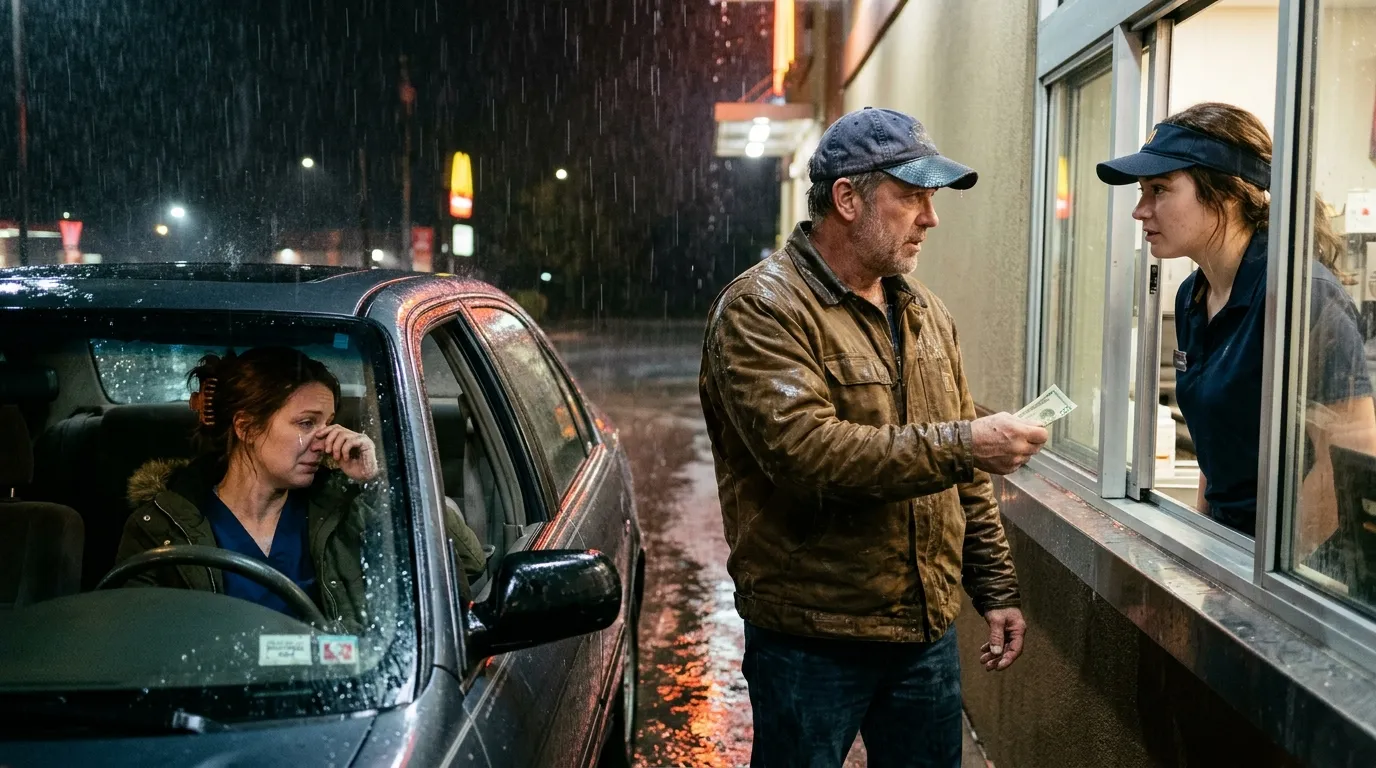
Over real coffee by the river, Noah shared his yellow crayon while Tessa admitted just how close she had come to never making it home.
Once he was absorbed in drawing a dinosaur with human teeth, Tessa met my eyes. “Tell me the real number. How much did losing those shifts cost you?”
I stirred my black coffee even though there was nothing in it. “Please don’t. I’m not taking money from someone who works fourteen-hour shifts with a kid to feed.”
“I picked up an extra shift to pay for a transmission repair,” she said evenly. “I’m not secretly rich because I wear a hospital badge and cry in public. Tell me.”
So I did. Not every detail, just the raw math—my rent, my nearly empty savings account, the electric shutoff amount. The booth went very quiet. Outside, the gray river rolled past without caring.
“So one act of kindness cost you groceries and maybe your lights,” Tessa said.
“When you put it like that, it sounds dramatic.”
“When I put it like that, it sounds accurate.”
She leaned back and rubbed her eyes, her anger aimed straight at the online circus. “People are picking teams like it’s a blood sport. The nurse is a saint, the worker is a hero, the truck guy is America, the manager is evil. None of them know I almost drove off the road ten minutes before I pulled into your lane.”
My hand froze on my mug. “What?”
“I nodded off at a red light for just a second,” she whispered. “The truck behind me tapped his horn, and I jerked awake so hard I thought I was going to be sick. I’m not telling you that to make you feel noble. I’m telling you because that coffee wasn’t symbolic. It actually mattered.”
Noah glanced up from his dinosaur. “Mom says ‘symbolic’ when she means weird adult stuff.”
We both laughed, though the weight stayed right underneath it. That was when I finally told her out loud that corporate had asked me to meet with district on Monday.
“Warm Window Nights”
Monday afternoon found me back in that cramped office. Denise sat beside me. Our district supervisor, Brent Hollis, joined us on a tablet propped up against a plastic napkin dispenser—because corporate polish works just fine over video if you lean it next to the ketchup packets.
Brent had gleaming teeth and the smooth voice of a man who had never once begged for overtime. He said my name too warmly, thanked me for my “service under pressure,” and announced that the company wanted to “honor the spirit of what happened.”
He already had a press statement drafted. A local campaign. A pilot program they were calling—he actually said these words out loud—Warm Window Nights.
All they needed was a quick thirty-second video for regional social media. I would talk about how our store “long embraced small acts of care,” how the chain believed “everyone deserves to be seen,” and how “team discretion and guest generosity work best together.” In return, I would get a one-time recognition bonus, my regular shifts back, and the chain would donate five hundred dollars to a local charity.
I glanced at Denise. Her face was completely blank, the mask you practice when you cannot afford to lose your paycheck. Then I looked back at Brent.
“Did our store long embrace small acts of care?” I asked.
He offered a patient smile. “We’re speaking to culture, not procedure.”
“So that’s a no.”
Then came the hook hidden inside the gift. If I filmed the video and signed a digital agreement promising not to speak to media or “misrepresent company policies,” my written warning would be reconsidered. If I declined, the warning stayed in my file, and my reduced schedule remained “pending operational needs.”
Soft blackmail. Polished enough to stay legal, sharp enough to hurt. Five hundred dollars and a branded hashtag to rewrite our worst night into a commercial.
And for half a terrible second, I almost said yes. That is the truth people in comment sections never grasp: principles sound wonderful until your power bill is due. Integrity is effortless when your refrigerator is full. I needed the bonus. I needed my hours. Even five hundred dressed-up dollars would buy real food.
“I need time,” I told him.
Brent’s smile cooled just a fraction. He knew time was another luxury broke people didn’t get much of.
That night, I sat alone in my car behind a discount pharmacy, staring at my own steering wheel while a local radio show debated whether workers should be allowed to “override policy for compassion.” Listening to thousands of strangers argue, it finally clicked. The fight had never been about coffee. It was about deserving. People adore kindness when it goes to someone photogenic—a tired nurse in scrubs, a sweet child, a widow with exact change. Let the wrong person ask, let them have a rough voice or a nice phone or need help twice, and suddenly everybody turns into an accountant of mercy.
The Man in the Pickup Truck
Three days later, right around sunset, the bell above our front door chimed. The man from the rain walked in—dry jacket this time, baseball cap tucked in his hand. He waited patiently until the line cleared, stepped up to the counter, and said, “I believe I owe you a sandwich count.”
I laughed before I could stop myself. “So it really was you.”
He held out a rough, warm hand. “Cal Mercer.”
He told me his daughter had shown him Tessa’s post, and he’d threatened to dismantle her porch swing if she typed a single comment under it. He bought a plain black coffee, waited until my break, and slid a brown paper sack across the corner booth—a turkey sandwich and an apple.
“Not charity,” he said. “Trade. For listening.”
Then he told me about his wife, Marlene. She had survived those twelve days in intensive care—everyone had called it a miracle. Three months later, a blood clot took her right in their kitchen while he was outside warming up his truck. He had never learned the last name of the night nurse who had held her hand, never gotten the chance to thank her properly.
“I’ve spent the last year learning how many things in this country only keep running because exhausted women keep showing up while everyone else talks big,” Cal said quietly, staring into his cup. “That post made people feel nice for five minutes. Nice is cheap.”
He tapped the tabletop with one thick finger. “Useful is harder.”
The 2:07 Board
That was how the 2:07 Board was born—not in my drive-thru, not with a slogan, and nowhere near a corporate camera.
Cal’s sister, Lena, owned a small neighborhood laundromat two blocks from the trauma center and directly across from a twenty-four-hour bus stop. Night nurses, janitors, line cooks, delivery drivers, parents with sleepy kids, and cold teenagers passed those doors every single night. Lena already kept a free coffee urn humming on a folding table in the back. Cal simply mounted a wooden corkboard on the wall beside it, set down a glass jar, and pinned up a plain handwritten sign:
2:07 BOARD
Leave what you can.
Take what you need.
No questions.
No proof.
No photos.
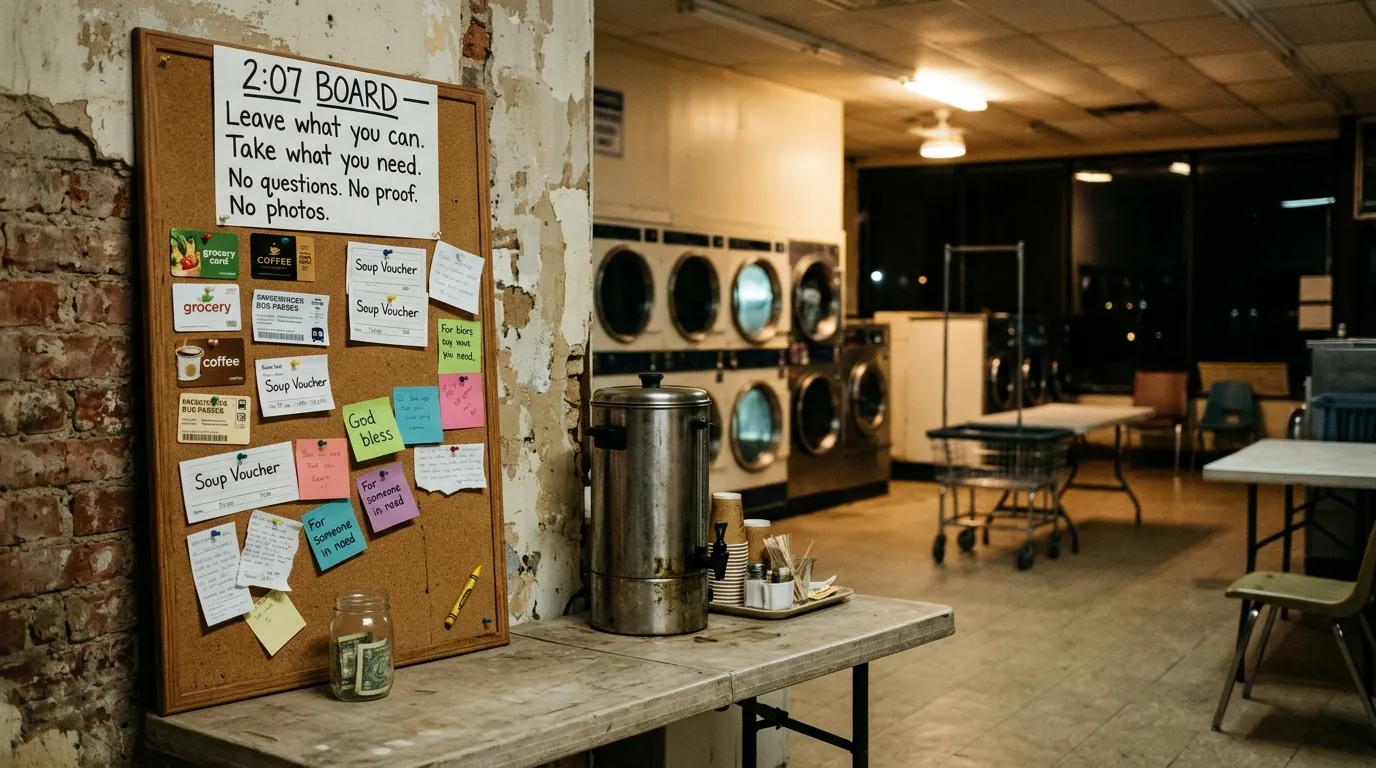
No corporate logos, no launch events, and no ID checks—just a corkboard, a coffee urn, and Noah’s yellow crayon pinned in the corner.
Tessa cried the first time she saw it, laughing through tears near the detergent aisle. She brought the first stack of cards: coffee, hot soup, bus fare, kids’ breakfasts, laundry tokens. A gas station owner down the block donated five-dollar fuel slips because he was tired of watching people pat their pockets at the pump hoping money would magically appear. I pinned Noah’s yellow crayon right into the bottom corner.
By the end of week one, the board was half full most evenings and half empty by sunrise—which meant it was working.
In that first month, I learned what internet commenters never see: real need rarely looks dramatic. Sometimes it looks like a man in clean work boots grabbing a soup card before a double shift. Sometimes it looks like a college student with flawless eyeliner taking bus fare and crying in the bathroom because she was stretching one tank of gas across three jobs. Sometimes it looks like a delivery dad taking two kids’ breakfasts and lingering as if waiting for permission to explain himself. We never asked.
Then, four Fridays in a row, a skinny teenage boy in a worn hoodie came in right after midnight and took two meal cards—one soup, one breakfast—without a word. On the fourth Friday, Lena voiced the worry that always creeps in when generosity meets repetition: “What if he’s just working the system?”
Online, someone had already complained about seeing a guy with a “nice phone” take gas cards, as if a hand-me-down phone meant your lights weren’t about to be shut off. I thought of how easily strangers could have looked at Tessa’s scrubs and car and decided she didn’t qualify for grace.
The next Friday, I got there early—not to catch the boy, just to see him without the stories adults were writing about him. At 12:11 a.m., he walked in, reached for the same two cards, and froze when he nearly bumped into me. The instant flash of fear on his face broke my heart. That is what interrogation does: it turns every doorway into a checkpoint.
“I’m sorry,” he blurted out. “I can put one back.”
“You don’t have to,” I said gently. “I just wanted to make sure you knew the coffee urn is free, too.”
He clutched the cards tightly, then lowered his eyes. “My mom works nights at the care home on Dixon,” he said quietly. “She gets off at six. The buses got cut back, so I bring her breakfast when she walks home because she’s too tired to cook.”
His name was Jordan. He looked embarrassed—not for taking food, but for having to explain. “People online said you guys should check IDs,” he murmured. “My friend said if you start doing that, I should stop coming because Mom would be mad.”
“We’re not checking anything, Jordan,” I promised him. “I’m glad you take two.”
When I told Tessa, Cal, and Lena later, the laundromat went dead silent. That was the real sickness underneath all of it—not just hunger or debt, but the endless audition struggling people are forced to perform just to earn a little help.
Ownership Versus Relief
By week six, corporate found the board. Brent and a polished regional communications director met me at an overpriced tea shop with a bigger offer: five thousand dollars in matching funds, printed cards, signage, a launch event, and a press photographer. My hours would be restored, my write-up erased, and a training promotion put on the table. All they wanted was a small corporate logo on the board, quotes from me and Tessa, and the public story that it all began in “collaboration with a store committed to compassionate service.”
Five thousand dollars wasn’t a theory. It was real groceries, real bus passes, real relief with teeth in it.
That night, after the laundromat closed, the four of us sat around the folding table beneath a single lost child’s sock resting on top of Machine Nine. Lena pointed out how many people five thousand dollars could feed. Cal called it hush money—a flood you don’t invite into your living room. And Tessa named the deepest truth of all.
“A logo changes the room,” she said softly. “A photographer changes the room. The families struggling the hardest at the hospital aren’t the loud ones. They’re the ones trying to shrink smaller than their own grief. The second help looks public and branded, those are the exact people who vanish.”
There was no clean answer. Just relief versus dignity. Usefulness versus ownership.
Right then, my phone buzzed with a text from Denise: Can you talk after your shift tomorrow. Privately.
The next night, she met me out by the dumpsters where fast-food workers go to cry or breathe cold air. No manager voice. No clipboard. Just Denise, hands shoved in her coat pockets, holding out three folded twenty-dollar bills.
“For your electric bill,” she said.
When I tried to refuse, she sighed. “This is why broke people stay exhausted—protecting our dignity until we freeze.” Then she told me the rest. Her son had severe asthma; one missed inhaler meant an ER bill she couldn’t survive. A year earlier, she had let a hungry kid walk out with two sandwiches after his card declined, got reported, and received a final warning from district.
“When I told you to move the line,” Denise said, her voice thin in the cold air, “it wasn’t because I didn’t hear her. It was because I did—and I knew exactly what helping her would cost.”
Suddenly, the whole story shifted. There were no cartoon villains here—just scared people caught at different gears of the same machine. Before she walked away, she glanced back and added, “And before you think I’m secretly noble, yes, I’ve been putting cash on that board every Friday under my daughter’s initials. Turns out I prefer kindness when district can’t track it.”
At 3:12 a.m., I paid my electric bill online. At 3:18, I cried in the dark—because sixty dollars didn’t fix my life, yet it saved my lights anyway, and receiving can be harder than giving.
The next morning, I called Brent and told him no. When he argued they were offering partnership, I answered simply, “No. You’re offering ownership.”
Three days later, the chain fired me for “repeated policy noncompliance and operational misalignment.” Denise had to run the termination meeting with red-rimmed eyes. I signed the papers, handed over my visor, and emptied my locker: one pen, a hair tie, and Tessa’s yellow-flower card.
Outside, Cal was already idling in his truck across the lot. He rolled down his window and asked only, “You hungry?”
At the laundromat, the board was packed with cards and a note reading, For whoever is having the kind of week that makes your hands shake. When Tessa walked in with Noah in superhero pajamas, he looked at my empty hands and asked, “Did the mean coffee people fire the apple juice lady?” Tessa tried to say it was complicated, and Noah looked straight at me and said, “That usually means yes.”
I laughed until it cracked right down the middle and turned into ugly, hot, exhausted crying in a folding chair by the detergent. Nobody tried to hush me. After a few minutes, Noah climbed into my lap and pressed the yellow crayon into my palm like it could mend whatever had broken.
Surviving in Public
When word leaked online that I’d been fired, the internet caught fire all over again. People demanded boycotts, lawsuits, Denise’s full name, and TV interviews. I had one last choice to make: hand the crowd a clean little villain to tear apart, or tell the messier, truer story.
That night, I borrowed a laptop at the folding table and posted three paragraphs on the 2:07 Board’s page—never naming the chain, never naming Denise, never mentioning Brent.
“A lot of people are asking for names because that feels like action. I understand that. But the truth is uglier and more ordinary than one bad person. The woman at the window was tired. The nurse in the car was tired. The man in the truck was grieving. The manager was scared. I was broke. That is the story. A lot of the cruelty in this country doesn’t come from monsters. It comes from tired people enforcing rules they didn’t write because they can’t afford the cost of breaking them.”
“If you want to help, stop asking who deserved the coffee. Start asking why so many people are one declined card away from humiliation. Stop asking for heroes. Leave bus fare. Leave soup. Leave room for people to need things without performing for you.”
“And if you ever build anything good, please keep it small enough that someone ashamed can still walk in.”
Some commenters were furious that I didn’t burn the company down. Others quietly showed up. A school secretary dropped off fifty dollars in bus passes for “the kid taking breakfast to his mama.” An elderly man mailed a book of stamps. An overnight office cleaner started leaving neat little hygiene kits. And one week later, Denise walked in on her day off—no initials, no hiding—and tucked an envelope under the board: For the next person who did the right thing and got punished for it. Neither of us ever mentioned it.
Three months later, I started working days at the trauma center family desk. Tessa had lined up the interview, Lena helped me buy nonslip shoes, and Cal fixed the rattle in my car and acted insulted when I tried to thank him twice. My job isn’t glamorous—visitor badges, directions, blanket vouchers, cafeteria slips—but it is honest work.
Once a week, I still stop by the laundromat. The board shifts with the seasons: gloves and soup in winter, allergy medicine and bus fare in spring, cheap notebooks during exams, cold water and a box fan in the summer heat. No ribbon cuttings. No logos. Just neighbors refusing to let each other disappear.
One rainy October night, Jordan walked in wearing a crisp work polo instead of his worn hoodie. He took one soup card and dropped a folded bill into the jar. His mom had moved to day shift, and he was starting an HVAC program in January.
“I used to think taking stuff from here meant we were failing,” he told me, rubbing the back of his neck. “Now I think maybe it just meant we were surviving in public.”
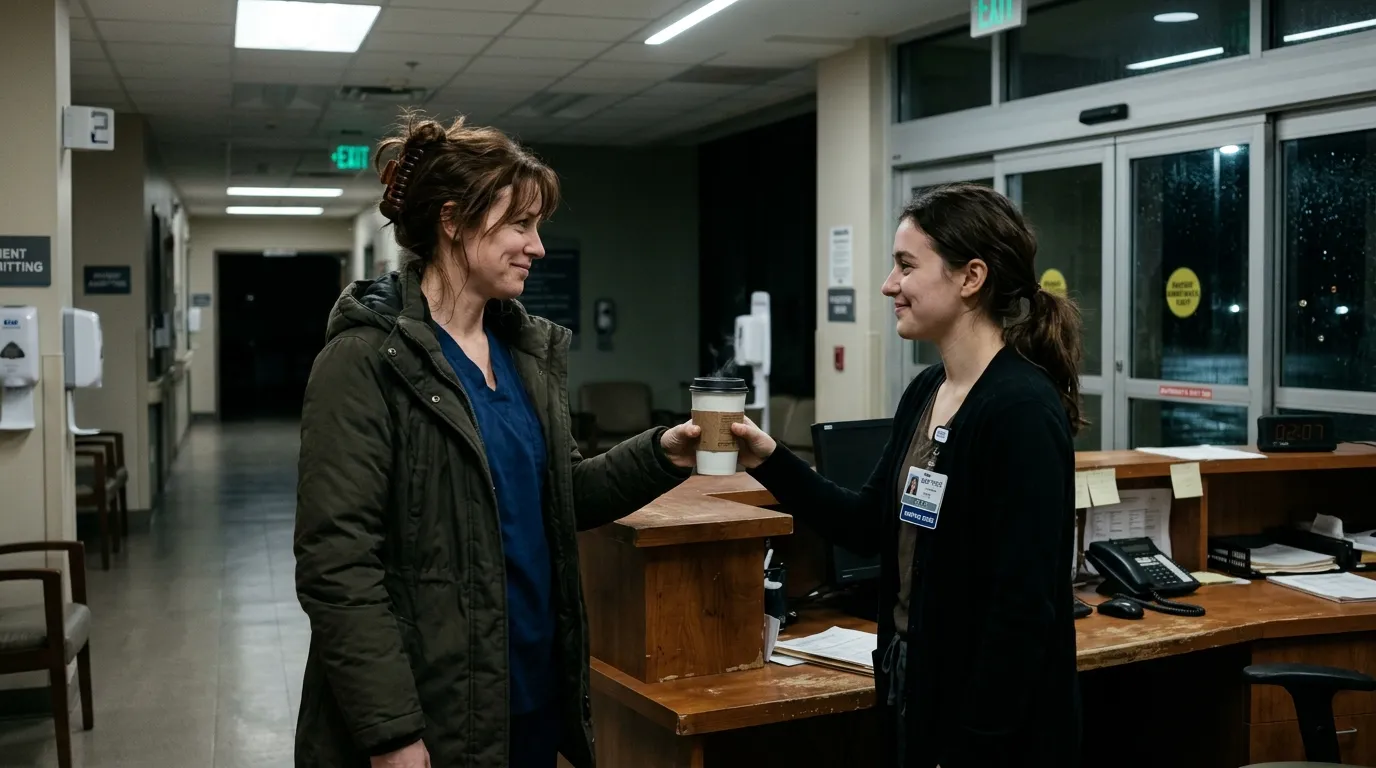
Three months later, at 2:07 a.m. in a quiet hospital hallway, Tessa brought two coffees—proof that sometimes, people actually stop.
Not long ago, at 2:07 a.m. on a Tuesday, I was locking up the side door of the family desk when Tessa came hurrying down the hallway—same quick steps, same coat over blue scrubs, same tired eyes. Only this time, she was carrying two steaming paper cups.
“For the drive home,” she said, holding one out.
We stood under the humming hallway lights watching steam curl against the cold air from the automatic doors.
“Do you ever wonder what would’ve happened if that man in the truck had just kept driving?” she asked softly.
“All the time,” I said. “Maybe that’s why it matters. Because most of the time, people do keep driving.”
She held my gaze for a long, quiet second. “And sometimes they don’t.”
I still think about that first cold comment sometimes: If you can’t afford coffee, make it at home. Maybe that sounds sensible from a warm kitchen with the electricity still humming. But there are nights when coffee isn’t just coffee. It is a bridge across the last six miles. It is the warmth sitting in your cup holder while your hands finally stop shaking. It is proof that somebody saw you near the edge and didn’t force you to prove why you were hurting.
I never found out whether every person who pulled a card off that corkboard passed the deserving test of a comment section. I learned something much harder—and much better: sometimes the risk of being taken advantage of is far smaller than the cost of making one more exhausted human being audition for mercy. And sometimes, a person makes it through one more dark drive home simply because somebody stopped in the rain.