
What foam in urine can indicate, and when should you consult a healthcare professional?
Many people have noticed foam in their urine at some point and dismissed it without much concern. It’s often thought to be normal, a result of urinating forcefully, dehydration, or simply “something that always happens.” However, when this foam is abundant, persistent, and appears repeatedly, it may be sending a silent warning about your kidney health.
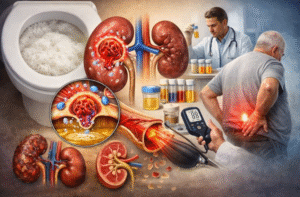
Excessive foam in urine is not a minor issue. In medicine, it’s often the visible manifestation of a problem that isn’t immediately apparent: protein loss through the kidneys.
Why does urine become foamy?
Proteins have a special characteristic: they bind water and generate foam, similar to what happens with soap or egg white. Normally, the kidneys function as an extremely fine filter that eliminates toxins and excess fluids while retaining valuable substances like proteins.
When this filter is damaged, proteins begin to leak into the urine. When you urinate, these proteins produce a denser, more persistent foam that doesn’t disappear quickly. It’s important to clarify that a small amount of occasional foam can be normal. The warning sign appears when the foam is:
Difficult to dissipate
It’s not an isolated incident, but a recurring pattern.
Proteinuria: More than a sign, an early warning
The presence of protein in the urine, known as proteinuria, is not a disease in itself. It’s evidence that something is damaging the kidney’s structure. It can be compared to an ultra-fine sieve that begins to crack: what it was supposed to retain starts to leak out.
The worrying thing is not only that proteinuria exists, but how common it is, especially in people with risk factors. In those with high blood pressure, up to one in three may experience some degree of protein loss in their urine. In people with diabetes, between 30% and 40% will develop kidney damage during their lifetime.
Furthermore, in people with obesity, metabolic disorders, or those over 50, the prevalence increases silently.
The big problem: it doesn’t hurt and it doesn’t give any warning.
Initial kidney damage doesn’t cause pain or obvious symptoms. That’s why many people only find out when the disease is already advanced. Proteinuria is just the tip of the iceberg: the real damage may be progressing without the patient noticing.
This often happens because these signs aren’t always actively sought during routine medical checkups, and because the body doesn’t send a clear alarm in the early stages.
Who should pay special attention?
Some people shouldn’t wait until they notice foam in their urine to take action. The risk is higher if you:
Have high blood pressure
Have diabetes
Have a history of kidney disease
Have had autoimmune diseases
Frequently use anti-inflammatory drugs (such as ibuprofen, naproxen, or diclofenac)
Have obesity or metabolic syndrome
In these cases, protein loss can begin long before any visible symptoms appear.
The relationship between high blood pressure and kidney damage
High blood pressure puts constant pressure on the kidneys. This increased pressure impacts the delicate renal filtration system day after day. At first, the kidneys resist. Over time, this sustained pressure deforms the internal filters, known as glomeruli.
When the glomerulus is damaged, it loses its ability to filter properly. It becomes more permeable and allows proteins to leak out, which not only indicates damage but also accelerates its progression. This creates a vicious cycle: more damage, more protein loss, and further kidney deterioration.
How to Detect the Problem Early
Proteinuria can be detected before the damage becomes severe. Simple and accessible tests allow for its early identification, such as:
Urinalysis
Albumin/creatinine ratio
Quantification of protein in urine
Kidney function test
Microalbuminuria is an early sign, comparable to smoke before a fire. It’s the ideal time to intervene and stop the damage from progressing.
Tips and Recommendations
Don’t ignore persistent foam in your urine.
If you have high blood pressure or diabetes, request regular urine tests, even if you feel well.
Keep your blood pressure and glucose levels under control.
Avoid frequent and unnecessary use of anti-inflammatory medications.
Adopte healthy lifestyle habits consistently, not just for short periods.
Have regular medical checkups, especially if you have risk factors.
Persistent foam in the urine can be an early warning sign of kidney damage that is still reversible. Listening to these signals early allows you to protect a vital organ before the problem becomes irreversible. Ignoring it, on the other hand, can mean discovering the damage when it’s too late. Taking care of your kidneys today is investing in your quality of life for the future.