PART 1
“Daddy, why are they laughing?”
My six-year-old daughter, Penny, squeezed my hand as laughter spread across my parents’ dining room.
She wore a plain navy-blue dress she had chosen that morning. At home, she had spun in front of the mirror with the biggest smile.
“Daddy, do I look like a princess?”
“You look like the most beautiful princess in the world, sweetheart.”
Now she stared down at that same dress, wondering what was wrong with it.
My sister Whitney raised her champagne glass and called across the room.
“Everyone! I’d like you to meet my messy niece!”
Several relatives laughed. Whitney pointed at Penny’s clothes.
“Look at those simple clothes! I suppose when you grow up without much money, you never really learn how to dress properly.”
More laughter followed, but she wasn’t finished.
“Well, at least she’s learning how to deal with disappointment early. Dressed like that, what kind of future could she possibly expect?”
Penny went still. Her mother had died recently, and she was only beginning to find joy in ordinary things again.
Then I noticed my parents laughing too. My father leaned back, smiling, while my mother covered her mouth.
They were laughing at their own granddaughter.
“Daddy?” Penny whispered.
I knelt beside her and forced my voice to stay calm.
“They’re just being silly, sweetheart.”
Whitney rolled her eyes when she saw my face.
“Oh, come on! Relax. It’s only a joke.”
I had heard enough. I was about to take Penny home when a chair scraped loudly against the marble floor.
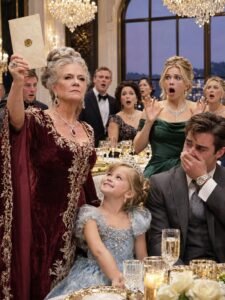
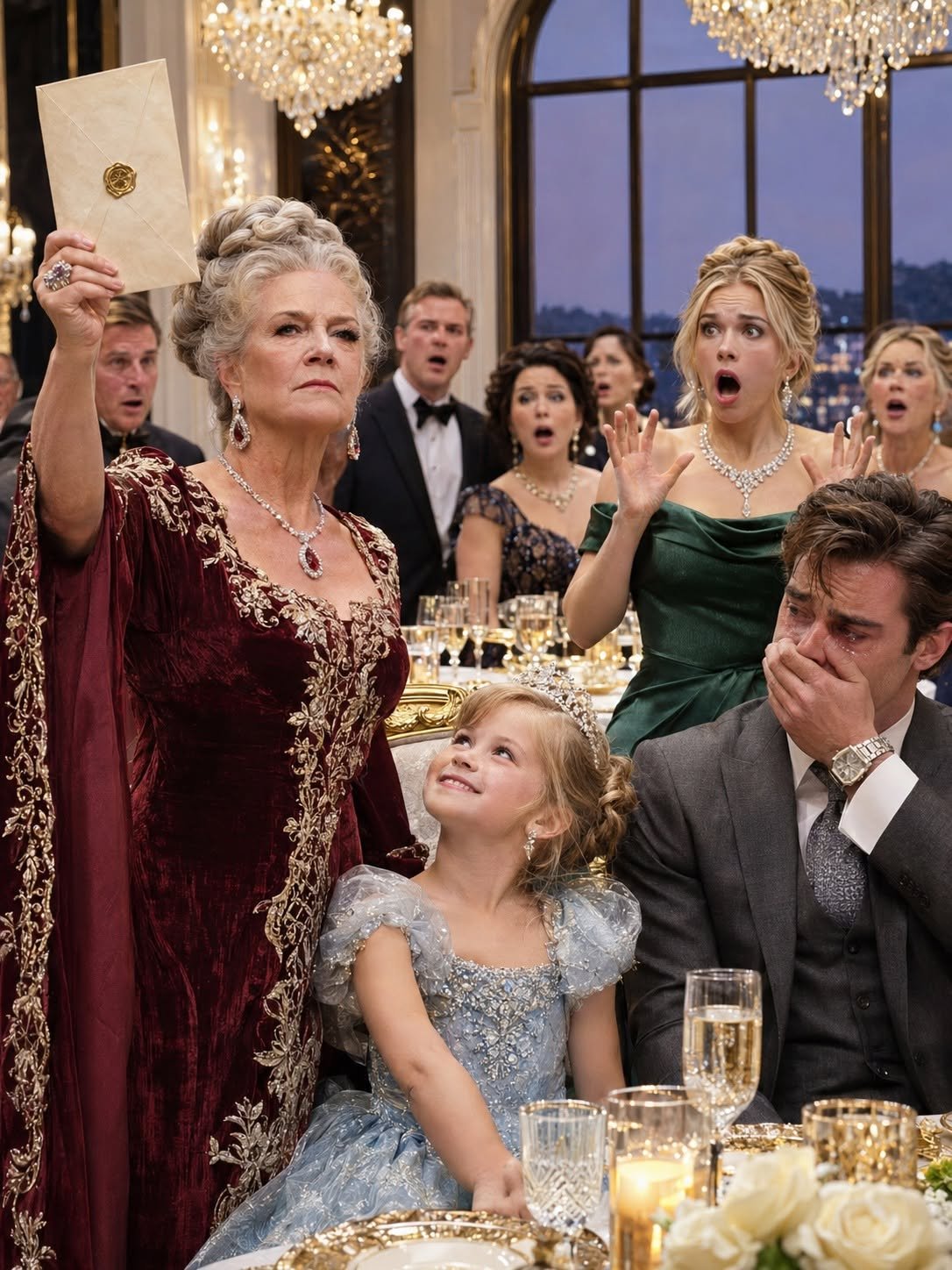
At the end of the table, my eighty-two-year-old grandmother stood up.
Grandma had silver hair and a small frame, but she had spent decades building a company worth hundreds of millions. When she spoke, people listened.
She placed her teacup down and looked directly at Whitney.
“Well,” she said with a faint smile, “since Whitney decided to introduce my great-granddaughter tonight, I think this is the perfect opportunity to tell everyone who she truly is.”
Whitney stopped smiling.
“Penny, sweetheart. Come here.”
My daughter glanced at me. I nodded, and she walked over to Grandma.
Grandma rested a gentle hand on her shoulder. Her eyes moved from my sister to my parents and the relatives who had laughed.
For years, I had been the family disappointment. I hadn’t joined my father’s business or chased the money and status Whitney loved.
After my wife died, raising Penny became my priority. We lived modestly, and my family never let me forget it.
But Grandma had been watching.
“This little girl,” she announced calmly, “is the only person in this family who will inherit my company.”
The room went silent.
My father’s smile vanished. Whitney almost dropped her glass.
“What?”
Grandma didn’t hesitate.
“Every share. Every property. Every dollar.”
Whitney gave a strained laugh.
“That isn’t funny, Grandma.”
“I never joke about business.”
My father sat forward.
“Mother, perhaps this isn’t the right time to discuss legal matters.”
“Oh, I believe it’s the perfect time.”
Grandma looked around the table.
“I’ve spent twenty years watching this family. I’ve seen how some of you treat people who have less money. I’ve watched you make others uncomfortable simply because you believe their circumstances somehow make them less important.”
Her gaze settled on Whitney.
“Tonight confirmed everything I needed to know.”
“I was joking!” Whitney snapped.
“Then explain what was funny about making a child uncomfortable.”
Whitney opened her mouth, but nothing came out.
My mother hurried to intervene.
“But Penny is only six! She obviously can’t manage a company!”
Grandma smiled slightly.
“She won’t have to. There are qualified professionals who can manage the business.”
Then she looked at my mother.
“But Penny will own it.”
Whitney jumped to her feet.
“This is ridiculous! You’re changing everything because of one thoughtless joke?”
“No, Whitney.”
Grandma reached for a leather folder beside her chair.
“I made this decision long before tonight.”
She opened it and withdrew a thick cream-colored envelope. My parents leaned forward, and every eye followed her hands.
“The legal trust documents,” Grandma said.
Then she placed the envelope directly in front of me.
My throat went dry. Everyone stared at the sealed envelope, waiting to hear what it meant.
PART 2
What Was Really Inside
“Open it, Ben,” Grandma said.
My name is Ben Calloway, and my hands were not steady.
The flap came up with a dry crackle. The first thing I pulled out was not a legal document. It was a small, folded square of lavender paper, soft at the creases, the kind of stationery my wife used to buy by the dozen.
I knew the handwriting before I read a word.
Ben,
If Peg gave you this, then I was right about the dinner, and I’m sorry I’m not there to hold your hand through it.
Becca had been gone eleven months.
I looked up. Grandma, whose name is Margaret Hollis and whom everyone but me called Mrs. Hollis in meetings, watched me with an expression I had never seen on her face. It was not triumph. It was something closer to apology.
“Your wife came to see me,” she said quietly. “Three weeks before she was admitted to hospice. She asked me not to tell you until the right moment. I think she knew there would be a moment.”
My father shifted in his chair. “Mother, what is this?”
“Sit down, Richard.”
He sat.
I read the letter silently, because I couldn’t have done it aloud.
You know I audited for a living before Penny came along. Peg asked me to look at something for her, quietly, as a favor. I wish I had been wrong about what I found.
Someone at Hollis Home Goods has been borrowing from the employee pension reserve for years. Small amounts at first. Then not small. It’s all in the second envelope, with every transfer, every signature, every date. I’m telling you because Peg needs someone she can trust, and because I will not be around to see that Penny’s name is protected.
Don’t be angry at your family tonight. Be angry tomorrow, if you must. Tonight, just take our girl home and hold her.
I love you both more than the whole company.
Becca
I folded the paper and pressed it flat against my chest.
Across the table, nobody was laughing. Nobody was even breathing loudly.
Penny had wandered back to my side. She leaned against my leg, and I lifted her into my lap without a word.
“Daddy, are you sad?”
“A little. But it’s a good kind of sad. It’s from Mommy.”
Her eyes went wide. “Mommy wrote you a letter?”
“She did.”
Penny smoothed her navy dress over her knees, and I noticed, for the first time that evening, the small stitched flower on the inside of the collar. Becca had sewn it there before Penny’s last birthday. So even when she’s wearing plain clothes, she’d told me, she’s wearing something made with love.
I’d forgotten. Penny hadn’t.
Grandma lifted a second, thinner envelope from the folder and slid it down the table, not toward me, but toward Whitney.
“You may want to read that one first,” she said.
Whitney didn’t touch it. “What is it?”
“Page one is a summary. Page two is a list of withdrawals from the pension reserve under your signature. Page three is a loan agreement with your name and your father’s, dated four years ago, for two point three million dollars. No interest. No repayment schedule. No board approval.”
My father went the color of old paper.
“Mother, those funds were bridged. It was a temporary arrangement. Whitney’s boutique group needed capital, and we intended to restore every cent.”
“For four years?”
“Business is complicated.”
“It is,” Grandma agreed. “That’s why I hired people who understand it.”
She nodded toward the doorway. I hadn’t noticed the two people standing just inside the hall, a woman in a gray suit and a man holding a slim leather case. They stepped forward.
“Counsel for the Hollis Family Trust,” the woman said. “And an independent forensic auditor.”
Whitney finally found her voice, and it came out as a hiss. “You set us up.”