Xueli Abbing’s life began with a moment of profound rejection that could have easily defined her as a tragedy.
Born in China with albinism, she was abandoned at the doorstep of an orphanage by parents who feared her “different” appearance would make her an outcast.
In some cultures, myths and superstitions about albinism are so extreme that children like Xueli are stigmatized or even physically hunted because of the belief that their bodies possess mystical properties.
Despite this dark beginning, orphanage staff gave her the name Xueli, which translates to “snow-white beauty,” a title that honored her uniqueness long before she was old enough to embrace it herself.
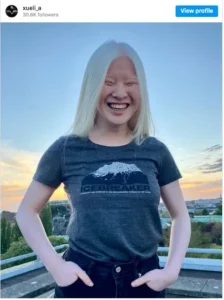
To understand Xueli’s physical reality, one must look at the biology of her condition. Albinism is an inherited genetic trait that occurs when the body produces little to no melanin, the pigment that gives color to the skin, hair, and eyes.
This lack of pigment is not just an aesthetic trait; it results in extreme sensitivity to UV light and significant vision impairment, as melanin is crucial for the development of the optic nerves.
Because her parents both carried the recessive gene without showing symptoms themselves, Xueli’s birth was a visual anomaly in her hometown, highlighting a complex intersection of genetics and deep-seated cultural misunderstanding.
Her life took a hopeful turn when she was adopted by a Dutch family who encouraged her to see her condition as a source of strength rather than a curse.
By the age of 11, Xueli was discovered by a designer who wanted to showcase “perfect imperfections” on the runway, launching her into the high-stakes world of fashion. Her breakthrough came in 2019 when she was featured in Vogue Italia, one of the most prestigious magazines in the world.
This moment was more than a personal victory; it represented a global shift in representation, proving that the fashion industry was finally starting to make room for models who challenged traditional, rigid beauty standards.
Now sixteen years old, Xueli has transformed her modeling platform into a powerful tool for global advocacy. Because of her limited vision, she often explains that she perceives people through their voices and character, leading to her core belief that inner beauty far outweighs any physical trait.
She is a vocal activist for the safety of people with albinism worldwide, fighting to end the violence and stigma that still plague many communities today. By insisting on being referred to as a “person with albinism” rather than just a diagnosis, she is teaching the world that her worth comes not from the pigment she lacks, but from the resilience she carries.