PART 1
—I don’t care that he’s old, Mom. I care that you’re asking me to sell myself.
Valeria said it with a broken voice, standing beside the bed where her mother was struggling to breathe, hooked up to a small oxygen concentrator that was already failing more than it helped.
The room smelled of dampness, cheap syrup, and desperation. Outside, in the working-class neighborhood on the outskirts of Puebla, dogs were barking and the neighbor had the television blasting, as if the world were not collapsing on top of them.
Her mother closed her eyes for a second before answering.
—I’m not selling you, daughter. I’m begging you not to let us drown.
On the table were hospital bills, overdue receipts, her brother Mateo’s unpaid school tuition, and a prescription they had no way to afford. Valeria was twenty-two, worked by the day at a small diner, and even so, it was not enough for even the basics. They had spent months eating the same things, stretching coins, pretending that “tomorrow” would be different.
Then the proposal appeared.
Don Ramiro Saldaña, a widowed businessman, owner of ranches, warehouses, and land. In his sixties, enormous, slow to walk, always sweating, with a rough voice that seemed to come from the bottom of a well. He was looking for a wife. Not a companion or a mistress. A wife. Formal. Legal. With a house, a driver, private doctors, and a clear promise: the girl’s family would never lack anything again.
—People say he’s strange, but reliable —her mother murmured—. And that he never leaves unprotected the people he chooses to protect.
Mateo punched the wall.
—That’s not protection! That’s buying her!
But two days later, it was he who came home from school with the news that he would be expelled if they did not pay before the end of the month.
Valeria accepted a week later.
The wedding was held at an old hacienda near Atlixco. Everything was too elegant for her: the white floral arrangements, the string music, the gleaming tableware, the people looking at her as if trying to guess how much her dress cost and how much her dignity cost.
When she reached the altar, she saw him waiting for her.
Don Ramiro was wearing a custom dark suit. He had a thick neck, a heavy face, a sunken chest beneath the fine fabric. His smile was kind, but it made Valeria’s stomach tighten into a knot. She felt no joy. She felt cold.
—From today on, your family will be my responsibility —he told her in a low voice, while the priest continued the ceremony—. You won’t have to suffer over money anymore.
Valeria wanted to answer “thank you,” but the word burned in her throat. She only nodded.

That night, in the huge room assigned to her in the hacienda, she sat on the edge of the bed without taking off her earrings. Rain beat against the large windows. She did not cry because she was afraid of her husband. She cried from the shame of having done exactly what she had sworn she would never do.
The following days were strange.
Don Ramiro hardly touched her. He was respectful, quiet, observant. He made sure her mother’s medicine was taken care of, had Mateo’s school paid for, and ordered the house where they lived to be remodeled. The employees treated her like the lady of the house, but always with a strange caution, as if they knew something she did not.
And then the details began.
Don Ramiro’s hands did not look like those of an elderly man. They were firm, smooth, without spots or tremors. Sometimes his back straightened too much. His voice changed slightly when he thought no one was listening. One afternoon during dinner, Valeria dared to ask him:
—How old are you really?
He let out a calm smile.
—Old enough to recognize when someone is carrying the whole world on their shoulders.
The answer unsettled her more than if he had given her a number.
That same night, one of the housemaids told her quietly while serving her tea:
—Ma’am, don’t be frightened if the master sometimes does things you don’t understand. Everything he does… has a reason.
Valeria did not sleep. Near midnight, she stepped out into the corridor overlooking the garden, looking for air.
And there she saw him.
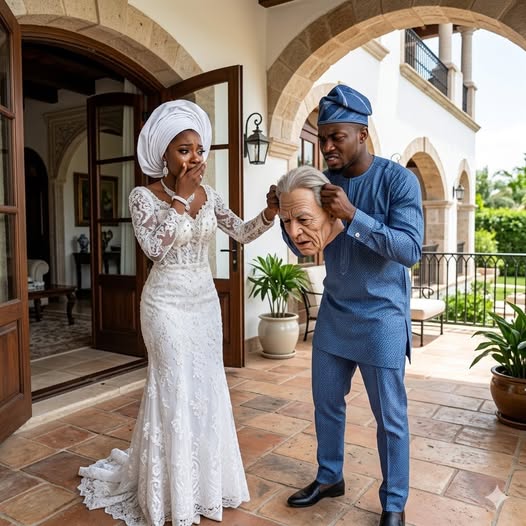
Don Ramiro was standing with his back turned under the dim light of a stone lamp. He raised both hands to his neck… and began peeling the skin off his face.
Valeria covered her mouth so she would not scream.
Because what fell to the floor was not makeup.
It was a mask.
And beneath that rich old man was the face of a young man.
One she had seen before in magazines, in business news, on billboards all over the city.
In that instant, she understood that nothing she had lived through was real… and she could not believe what was about to happen.
PART 2
—Don’t come any closer —Valeria whispered, stepping back until she hit a column—. Who are you?
The man raised his hands as if trying to calm a wounded animal.
Without the mask, he looked no older than thirty-two. Tall, straight-shouldered, strong-faced, with a trimmed beard and a gaze far too clear to belong to the heavy, tired man she had married. There was no more sweat, no more slowness, no more broken voice. Only a stranger.
—My name is Julián Ferrer —he finally said—. And yes, all of this is going to sound insane to you.
Valeria felt anger before fear.

—Julián Ferrer? The owner of the Saldaña-Ferrer group? The one who’s everywhere talking about investments and foundations?
He nodded.
—Don Ramiro existed. He was my grandfather. He died three years ago. The company kept using his image as a symbol. I… used his identity for another reason.
Valeria let out a bitter laugh.
—To make fun of me?
—No.
—Then what for? To see how cheaply a poor woman can be bought?
That one hurt him. It showed on his face.
Julián lowered his eyes for a moment before answering:
—Because I no longer knew who I could trust.
He told her everything while standing beneath the corridor, as the wind carried the smell of wet earth. For years, every woman who came close to him knew perfectly well who he was. Some pretended to love him. Others pretended to be humble. All of them wanted something. His last name, his connections, his fortune, his position. He had lived surrounded by rehearsed smiles and empty promises.
So he designed an absurd test. A sick one, even. He wanted to present himself as a man no one would choose out of vanity: old, uncomfortable, without charm. Someone only a woman with real need… or a real heart would accept.
—And when I saw you with your mother at the clinic —he said—, when I heard you arguing with the doctor because you didn’t want them humiliating her for not being able to pay… I knew you were different.
Valeria felt her legs tremble.
—You investigated me?
—Yes.
—You had people follow me?
—Only to make sure of who you were and that no one else was forcing you into this.
—That doesn’t make it better —she snapped—. It makes it worse.
Her eyes filled with tears, but this time they were not tears of helplessness. They were tears of humiliation.
—I said yes for money —she said, her voice breaking—. Not out of kindness. Not out of love. I accepted because my mother was dying and because my brother was about to leave school. Do you know what it feels like to hear your family tell you to marry a stranger as if it were the only way out?
Julián took a step toward her.
—I do know that I saw you sacrifice yourself for them.
—No! —she shouted—. You saw a scene. You didn’t see what’s happening inside me. I’m not the noble woman you imagined. I’m a desperate woman who sold herself.
For the first time since she had met him, he seemed not to have an answer prepared.
—Valeria…
—Don’t call me that as if you know me.
She ran to her room, locked the door, and spent the entire night crying on the floor. The next morning, she sent for her mother, but did not tell her the whole truth. How could she explain that the old man she had married was not old at all, that he was actually a young and powerful man who had turned her poverty into a moral test?
A few days of unbearable tension passed inside the hacienda. Julián did not insist. He did not seek her out alone again. He gave her space. Somehow, that made her feel even worse.
A week later, Valeria left.
She left behind the dress, the jewelry, the black card, and even the phone they had given her. She rented a small room in the city, found work at a stationery store, and decided to start from scratch. She wanted to feel again that something in her life belonged to her.
Then, one afternoon, a suited man came into the store and handed her an ivory-colored envelope.
Inside there was only a letter.
“Valeria:
I do not need a perfect woman or a spotless story. I need someone capable of feeling, even when she makes mistakes. Next Sunday I will be at the church where we were married. Not as Don Ramiro. As Julián. Without masks. Without tests. If you do not come, I will understand and I will not look for you again.”
She read the last line three times.
And when she looked up, she knew that whatever decision she made that Sunday was going to break her heart… or give it back to her forever.
PART 3
Sunday dawned gray, with that light chill that sometimes falls over Puebla before noon. Valeria told no one where she was going. Her mother saw her leave and only squeezed her hand, as if understanding that some answers a woman had to seek on her own.
The church was almost empty.
No luxurious arrangements. No musicians. No curious guests. Only a few lit candles and the soft echo of footsteps over the old floor.
Julián was waiting for her in front of the altar.
He wore a simple white guayabera shirt and dark pants. No bodyguards. No expensive watches. No Don Ramiro persona. And even so, what surprised Valeria most was not seeing him young, but seeing him vulnerable. For the first time, he looked like a man who was truly afraid.
When she approached, he did not smile right away.
—I thought you wouldn’t come.
—So did I —she answered.
There was a long silence. Not uncomfortable. Honest.
Valeria tightened her grip on the envelope she still held in her hand.
—I came because I needed to look at you without lies between us —she said—. And because I’m tired of feeling ashamed for wanting to save my family.
Julián swallowed.
—You shouldn’t be ashamed. I was the one who turned your need into a test. I was cruel. Even if my reasons came from my own wounds, I hurt you. And no apology can erase that.
She had not expected to hear that. Maybe that was why she began to cry.
—I lied too —she said—. I kept telling myself it was a noble sacrifice, but deep down I knew I was making a decision for money. And when I found out who you really were, I didn’t feel lucky. I felt miserable. Because I thought you had seen the worst in me.
Julián shook his head.
—I saw a woman doing something terrible for a painful reason. That doesn’t make her bad. It makes her human.
Valeria closed her eyes. For weeks, she had been waiting for someone to condemn her or absolve her. But what she received was something harder: understanding.
—What if I make a mistake again? —she asked quietly.
—Then we’ll have to face the mistake with the truth —he answered—. But this time without disguises, without traps, and without turning love into an exam.
The priest, who had remained at a distance, approached in silence. There was no ceremony prepared. Just a simple conversation, a discreet blessing, and two people standing before the altar, deciding whether they wanted to begin something real after having started in the worst possible way.
—The first time I got married, I did it out of fear —Valeria said, looking Julián in the eyes—. This time I don’t want to do it out of need or guilt. I only want to do it if we are going to treat each other with the truth, even when it hurts.
—I promise you that —he replied.
And then she gave him her hand.
There was no applause. There was no celebration. But in that moment, she felt something she had not felt in the hacienda, nor at the lavish wedding, nor in front of the money: peace.
A year later, they returned together to the neighborhood where Valeria had grown up. Her mother was breathing better now. Mateo had gone back to school and was talking about going to college. But that was not the most important thing.
With Julián’s support, Valeria created a fund for young women in extreme situations: scholarships, legal advice, medical help, and job support so that no one would ever have to choose between her dignity and her family’s survival.
The opening was simple. Several girls came up to thank her. Some were crying. Others could barely meet her eyes.
Valeria spoke to them without rehearsed speeches, in the same voice she had once used to beg for discounts at a pharmacy.
—Don’t accept a cage just because it comes covered in gold —she told them—. And if life ever pushes you into making a bad decision, don’t believe that means you no longer deserve a second chance.
Julián watched her in silence, with a mixture of pride and regret that would never disappear completely. Because they both knew that love had not erased what had happened. It had transformed it into something useful.
That night, on the way home, Valeria looked out the car window at the streets where she had once felt she was worth nothing.
And at last she understood that true wealth was not marrying a powerful man or escaping poverty.
It was that after hitting rock bottom, there could still be enough truth left in the heart to begin again.