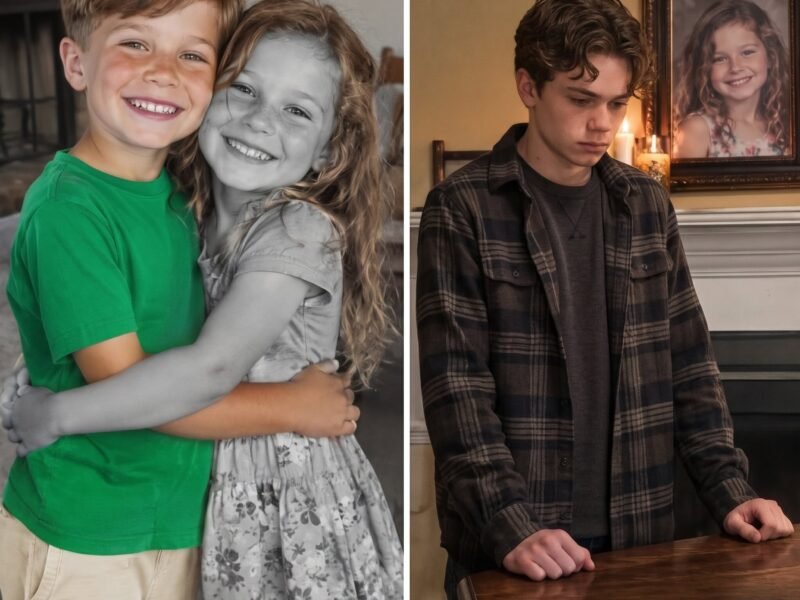
The morning of my 63rd birthday,
I made myself a promise. I would not spend the day watching my phone.
I said that out loud, standing at the kitchen counter in my house coat with both hands wrapped around a mug of Earl Gray, watching the October light come thin and gold through the window above the sink.
I had two apple pies to bake. I had a backyard full of leaves. I had a whole quiet Saturday ahead of me.
And I was not going to sit there like some hopeful child, eyes fixed on a screen, waiting for Garrett to remember.
So I rad the backyard for an hour until the bags were fat and tied at the curb.
I made the pies from scratch, the lattis crust ones my mother taught me when I was 12 years old in a kitchen in St. John’s that smelled like cinnamon and woods.
I sorted the recycling, wiped down the baseboards in the front hall, paid my hydro bill online.
Every 40 minutes or so, I glanced at the phone on the kitchen table. Just a glance, nothing more. The way you check the weather, even though you already know it’s going to rain.
By 2 in the afternoon, a message from my dentist about a cleaning. One from my neighbor Pat about a block association meeting. An automated reminder from the pharmacy.
Nothing from my son.
By 4:00, I stopped pretending I wasn’t waiting.
I sat down at the kitchen table with my tea, and I looked at the phone. Honestly, the way you look at something you’ve been circling around all day.
The pies were cooling on the rack. The leaves were bagged. There was nothing left to do with my
hands, and I was done inventing tasks.
At 4:47, the screen lit up.
Garrett’s name.
Even now, I can feel that involuntary lift of the heart, that ridiculous unguarded little lurch.
I was 63 years old. I had buried a husband. I had rebuilt an entire life by myself in the years since.
And I sat at my own kitchen table feeling nervous as a girl on Christmas morning because my son had finally sent me a message.
I opened it.
No happy birthday, Mom. No greeting of any kind. Just a screenshot of a resort bill and four lines of text.
“Hey, Mom. Madison got stung by something at the pool, and we had to use the clinic here. Also, the swim-up bar charged us for the whole cabana by mistake. It’s almost $900 altogether. Can you e
transfer me today? I’ll pay you back next week.”
I read it twice.
Then I set the phone down very carefully. The way you put down a glass that’s cracked but hasn’t shattered yet.
He was at an all-inclusive resort in Varadero.
The $600 a month I sent them for the kids’ expenses had, without question, made room in their budget for that trip.
Garrett and Madison were lying in Cuban sunshine. And the only reason he had thought of me today,
on my birthday, while I sat alone beside pies that no one was coming to eat, was a bill he needed
covered.
I understood something in that moment with a precision that felt almost physical, like a bone settling back into a socket it had been out of for a long time.
I was not a mother to my son.
I was infrastructure, a utility he had been drawing from so steadily for so long that he had forgotten it ran on anything at all.
I picked up my phone. I opened my bank’s app.
Garrett had been listed as a secondary account holder on my Checkwing account for 5 years. It started when he lost his logistics job and needed grocery access.
And that arrangement hadly never ended. The way water keeps finding the same groove in the ground.
I went into the settings and removed him.
Four taps.
Then I opened my Interact e transfer history.
The standing transfer was there. $600 a month every first, deposited into their joint account under the memo line “household help.”
I canled it.
Then I went through the rest.
The $200 I sent separately for their car insurance. The $150 that went to Madison’s mother, Gail, who babysat the grandchildren.
A transfer I’d started as a thank you two years ago, and that had quietly calcified into a permanent
line on my ledger.
Gone.
I set the phone face down, went to the refrigerator, and opened the bottle of Ontario Reeseling I’d been saving since September.
I knew what came next.
I had perhaps an hour.
The first call came at 5:19.
I watched Garrett’s name flash across the screen and let it ring through to voicemail.
Madison called from her own phone, then Garrett again.
By the time I had finished my first glass and was cutting into one of the pies, there were 17 missed calls, and the phone was buzzing so steadily, I turned it upside down on the table.
After supper, I tapped the voicemail icon and listened while I washed my dishes.
Garrett’s voice came through strained and loud.
“Mom, what is going on? My access is completely gone. Did something happen with the account? Call the bank right now. This is a problem.”
Not a single word asking whether I was all right. Not one syllable of recognition about what day it
was.
Madison’s message was next.
“Rosemary, the e transfer didn’t come through. And Garrett says the account access is gone. I don’t know what you think you’re doing, but we have clinic bills to pay, and this is extremely inconvenient.”
I dried my hands on the dish towel.
I typed a single text to both of them and hit send.
“The account changes are intentional. The transfers are cancelled permanently. This is not a banking error. Enjoy the rest of your trip.”
I turned on do not disturb and went to bed.
I slept better than I had in years.
They were home 4 days later, a day ahead of schedule.
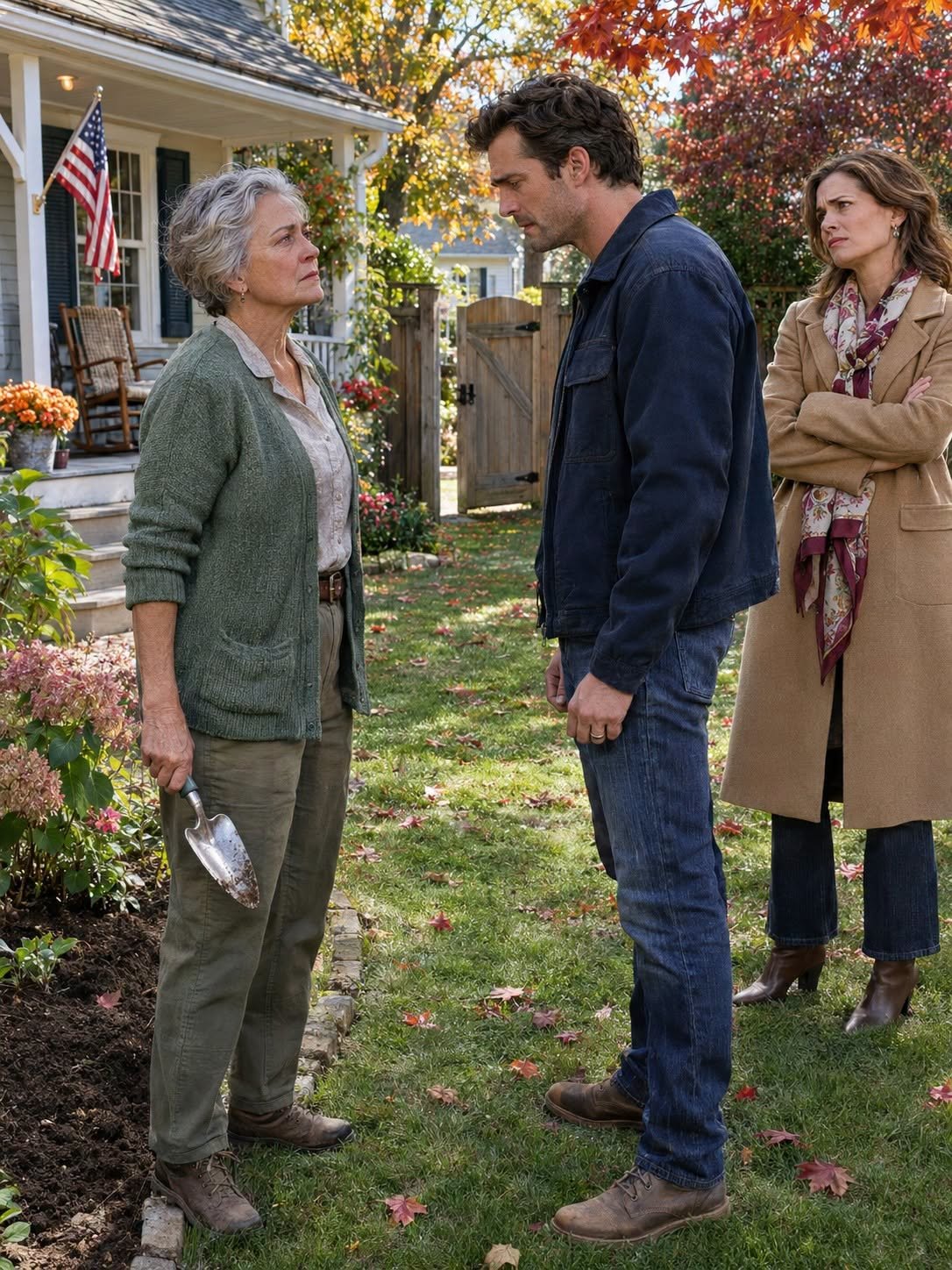
I was turning over the garden bed for winter when I heard the side gate scrape open.
I finished pushing the trowel through the soil before I straightened and turned.
Garrett was standing at the edge of the patio, jaw set tight in the way he’d inherited from his father.
Madison was a step behind him, still in her fall coat, arms crossed under her chest like a woman who had rehearsed this.
She was wearing the silk scarf I’d given her for Christmas two years ago.
I noticed that and felt nothing particular about it.
“Mom.” Garrett’s voice was careful. “We need you to explain what happened.”
“Good morning,” I said. “How was Cuba?”
“Don’t.”
He stepped forward.
“You cut us off completely. We had to put everything on Madison’s credit card. We came home from
vacation into debt.”
“You went on vacation into debt?” I said, not unkindly.
I was simply the part of it you’d stopped thinking about.
Madison moved to his side.
“Rosemary,” the reasonable voice she used when she wanted to control the temperature of a room. “You’ve been helping us. That’s what family does. You can’t pull it away without warning because you had a bad day.”Plan Family Trips
“I had a birthday,” I said. “And you are right. I gave you no warning, but you gave me no birthday wish. So, I think we’re even on surprises.”
Garrett opened his mouth and closed it.
For a moment, I saw something move across his face.
Guilt perhaps, or just the embarrassment of a man who knows he has been caught behaving badly and cannot find the right angle to argue his way out of it.
Madison filled the silence.
“This is you using money as a weapon because you felt ignored.”
“The money is mine,” I said. “I was never using it as anything. You simply assumed it would always flow in your direction.”
I set down my gardening gloves.
“I’m going inside to make lunch. You’re both welcome to come in and talk, or you can come back another time.”
I walked inside.
Garrett followed.
Madison came as far as the kitchen doorway, leaned against the frame, and watched.
I put the kettle on.
He sat across from me at the kitchen table, and he looked tired in a way that had nothing to do with
the flight.
He was 41 years old, and he looked like a man who had been running a tab he’d never fully looked at.
“Mom,” he said quietly. “We count on that money. The kid’s school fees, the insurance. Madison and I
both work, but after rent, it’s not… It doesn’t leave much.”
I made the tea.
I put a mug in front of him.
Then I went to the desk in the hallway and came back with a folder I had put together three nights
before, sitting at this same table with my reading glasses and a yellow highlighter.
I laid it in front of him.
“That is every transfer I have made to the two of you in the last four years,” I said. “I highlighted the ones that were supposed to be one-time emergencies.”
He opened it slowly.
I watched his eyes move across the first page.
The monthly transfers were easy to see, years of them stacked in tidy rows, but the individual entries told the real story.
October 2021, $2400.
Garrett told me his truck needed emergency work. I later found out from his friend Dale that he had also had custom running boards installed at the same shop visit.
March 2022, $3,600.
Madison said the furnace had failed, which was true, but the model they chose was considerably
more expensive than necessary.
June 2023, $15.
Garrett said it was for Charlie’s hockey season. Registration and gear combined.
A receipt he had left on my counter showed the actual sporting goods purchase had been $380.
The highlighted rows went on for three pages.
The total at the bottom was $46,200.
Garrett closed the folder.
He didn’t say anything for a long moment.
“I hadn’t added it up,” he said finally.
“Neither had I,” I replied. “Because you never asked for it all at once. A few hundred here, a thousand there. I kept saying yes because it was easier than asking whether I should, and because every time I even hesitated, Madison would mention the children.”
I paused.
“I’m not saying this to punish you. I’m saying it because you’re sitting across from me looking genuinely surprised by that number, and you deserve to know what shape this thing actually has.”
He looked at the closed folder for a long time.
Then Madison straightened in the doorway, told him she would wait in the car, and left.
The front door closed with a flat, definitive sound.
Garrett and I sat in the kitchen for another half hour.
He didn’t ask me to turn anything back on. He didn’t argue.
He just sat there turning his mug in his hands.
That was something.
I called a locksmith the next morning.
All three exterior locks were replaced by noon.
I kept two keys.
I did not make a copy for Garrett.
When they had moved to their rental the previous year, he had returned his key. Or so I believed.
Smadison had held on to hers.
I knew because the hook in the hallway had been empty since her last visit.
On Wednesday afternoon, I was upstairs when I heard the front door handle rattle.
The scrape of a key finding a lock that no longer matched it.
A pause, then again, then two sharp knocks.
I walked downstairs and opened the door.
Madison was on the porch with a canvas tote bag.
She had her hair done.
She was dressed with intention, the way a person dresses when they have a specific outcome in
mind.
“Your lock is stuck,” she said.
“It’s not stuck. It’s new.”
Something moved behind her eyes.
“I came for Charlie’s dinosaur bin and his extra rain boots. He’s been asking about them.”
“I’ll put them on the porch tomorrow morning. Come by whenever you like.”
“I’d rather just come in and grab them myself.”
The smile that assumed it would get what it wanted.
“It’ll only take a minute, Rosemary.”
“Not today,” I said.
Her eyes moved past me into the hall.
I knew what she was looking at.
My mother’s cabinet, visible from the door, and inside it, the set of hand painted serving pieces my mother had carried from Newf Finland to Ontario when my parents moved west 40 years ago.Get Parenting Tips
Madison had been looking at those pieces for years.
In the specific way people look at things, they are already mentally arranging in their own homes.
“Those are going to Fern,” I said.
She looked back at me.
“My daughter, I’ve already had it written into my will.”
I held the door.
“I’ll have Charlie’s things on the porch by 9 tomorrow. Drive safe.”
I closed the door.
I stood in the hallway with my hand on the new lock for a moment.
And then I walked to the kitchen and put the kettle on because it felt like the right thing to do.
My phone rang that evening.
Fern.
I answered before the second ring.
Her voice came through warm and a little windb blown, the way it always sounds when she spent a day outside.
“Mom, happy birthday. I am so sorry. We were 3 hours from cell service the whole week. The forestry
survey ran long, and then I got a flat on a logging road north of Smithers. It has been a week and a
half.”
I sat on the bottom stair and laughed.
A real laugh, the kind that comes from low in the chest without asking permission.
“Sweetheart, it is so good to hear your voice.”
We talked for an hour about the survey, about the mountains in October when the larches turn, about her colleagues border collie, and then carefully about Garrett.
“He called me,” she said. “He said you’d gone off the deep end and frozen them out without any reason.”
“What did you tell him?”
“I told him I’d been watching this happen for 4 years, and I was surprised it took you this long.”
She paused.
“Mom, you weren’t cutting them off. You were finally putting down something that had been getting
heavier every single month. How are you?”
“Honestly,” I said. “I feel lighter. I feel like I can breathe all the way to the bottom.”
“Good,” she said firmly. “Keep the locks changed. And mom, don’t let them use the kids as leverage. That’ll be the next thing.”
She was right.
It was.
The text from Madison came on a Sunday morning 10 days later.
A photograph of Charlie and Sophie at the kitchen table with their coloring books.
Below it:
“The kids keep asking about Grandma. It breaks my heart to have to explain why things are so strained. We’d love to bring them over, but with everything so tight right now, the drive across the city is hard to manage. Maybe we can figure something out for the holidays. We’ll see.”
I read it standing at the counter.
I read it twice.
10 years ago, that message would have reached inside my chest and found exactly what it was looking for.
I would have sent a transfer before I had my coat on, apologizing for causing difficulty, buying my
way back to Sunday dinners and school concerts, and the particular joy of watching my grandchildren eat the pie I’d made just for them.
But the woman reading it this October morning had been doing a different kind of accounting, not of money.
Of Christmases, I’d driven gifts to their door because they were too busy to come to me.
Of phone calls where I asked to speak to the children and was given two rushed minutes before Madison announced they had somewhere to be.
Of a birthday spent waiting beside cooling pies while my son lay in Caribbean sunshine and forgot I
existed until he needed something covered.
My grandchildren were behind a tollgate.
Madison was waiting for me to pay.
If I paid, they would learn exactly what she was teaching them.
I would not let that be my legacy to them.
I typed back:
“Give them both my love. I’m here whenever they want to visit or call. They know grandma’s number. I hope you all have a good week.”
No money offered.
No apology attached.
I put the phone in my cardigan pocket and went out to the garden.
The last thread to cut was the truck.
3 years earlier, Garrett’s credit had been badly damaged.
Several missed payments during a stretch between jobs.
He needed a vehicle, and the financing rate he qualified for a loan was punishing.
I co-signed the loan.
My name went on the ownership documents alongside his.
He made the monthly payments consistently enough that I had mostly stopped thinking about it as something that touched me.
In October, I received a notification from the finance company.
A payment had been missed.
I waited 12 days.
The notice came again.
The grace period was nearly finished, and if it lapsed further, it would register on my credit file.
I did not call Garrett.
On a gray Tuesday morning, I drove to the dealership, walked into the finance manager’s office, and
explained that I was the co-owner and I was surrendering the vehicle.
The early surrender penalty was just over $1,000.
I paid it by debit and signed the paperwork.
The finance manager asked how I was getting home.
“I’ll call a cab,” I said.
I sat in the back seat on the way home and watched the city go by through the window, the orange and rust trees, the neat bungalows of the West End, a Tim Hortons on every second corner.
And I felt something I can only describe as the particular lightness that comes not from gaining
anything, but from finally fully setting something down.
November came, and the tree out front went bare, and I converted the spare room into a painting studio.
It had been holding for six years the residue of other people’s visits.
Two bags of Garrett’s old hockey gear. A box of Matt Madison’s offseason coats. A stack of Charlie’s
outgrown picture books I’d been meaning to donate to the library.
I cleared every bit of it out.
Moved in a secondhand easel I found at an antique market on King Street and bought myself a
starter set of oil paints from the art supply shop two blocks over.
I was not good.
The first things I made looked like something produced during a fever by someone who had only been told about painting secondhand.
I didn’t care.
The room smelled of linseed oil and the warm mineral quality of pigment, and I spent an hour there every afternoon, and it was entirely mine in a way that nothing in my house had been for years.
Fern flew home for the holidays.
We made a standing rib roast on Christmas Eve and ate at the table with my mother’s plates laid out on the good linen.Find Recipes
And we talked about her work and her plans and a man she’d met at a conference in Colona who seemed worth knowing better.
We put on an old Anne Murray record and stayed at the table until nearly midnight with our tea.
Not because there was anything left to solve, but because we were simply enjoying being in the same room.
Garrett sent a card, a store-bought card with a printed verse inside, signed in his own handwriting.
“Merry Christmas, Mom. Love, Garrett, Madison, Charlie, and Sophie.”
It arrived 4 days before Christmas.
I put it on the mantle next to the candles.
It was the first thing he had sent me in 4 years that did not have a request attached to it.
I called to thank him.
He answered on the third ring.
“Hey, Mom.”
His voice was careful in a way I didn’t recognize.
Tentative, the way a person sounds when they’re not entirely sure of their footing.
“I got the card.”
I told him it was kind.
“Thank you.”
A pause.
“How are you doing?”
“Very well, actually,” I said. “I’ve taken up painting. I’m terrible at it so far, but I look forward to it every day.”
A longer pause.
“That’s good. I’m glad.”
He cleared his throat.
“Mom, I’ve been doing a lot of thinking since the fall. I owe you an apology. Not about the money, about your birthday. I didn’t call. I didn’t even think of it until later that same night. And by then, I told
myself it was too late. And I just… I let it go. That wasn’t right.”
I sat with that for a moment.
63 years old, and the weight of a sentence like that from your child is something that does not diminish with age.
If anything, it sharpens.
“No,” I said simply. “It wasn’t.”
“I’m sorry, Mom.”
“I know,” I said. “I believe you.”
We did not fix everything in that phone call.
I do not expect we will fix it in the next several calls or the ones after that.
Some things that break under a certain kind of sustained pressure do not reassemble into the same shape.
I have made my peace with that.
What I also know is this.
I spent years quietly funding a version of my son’s life that I was never fully invited into.
I confused purchasing proximity with being loved.
I bought access and told myself it was belonging.
The day I stopped paying, I stopped pretending.
And in the months that followed, alone in my house with my garden and my reling and my genuinely terrible oil paintings, I found out what I actually had.
A daughter who calls when she can find a signal and talks for an hour when she does.
A kitchen that still smells like cinnamon on October afternoons.
A room of my own, smelling of linseed oil, where nothing is asked of me and nothing needs to be explained.
And on a quiet February morning, a text from Garrett.
“Mom, Charlie, and Sophie made cards for you at school. Is it okay if I drop them in your mailbox this week?”
No dollar amount, no transfer needed.
Just a question asked plainly with the space for me to answer however I chose.
I typed back:
“Of course, I’ll be home all week.”
I set the phone on the windowsill and went back to my easel.