Part 1
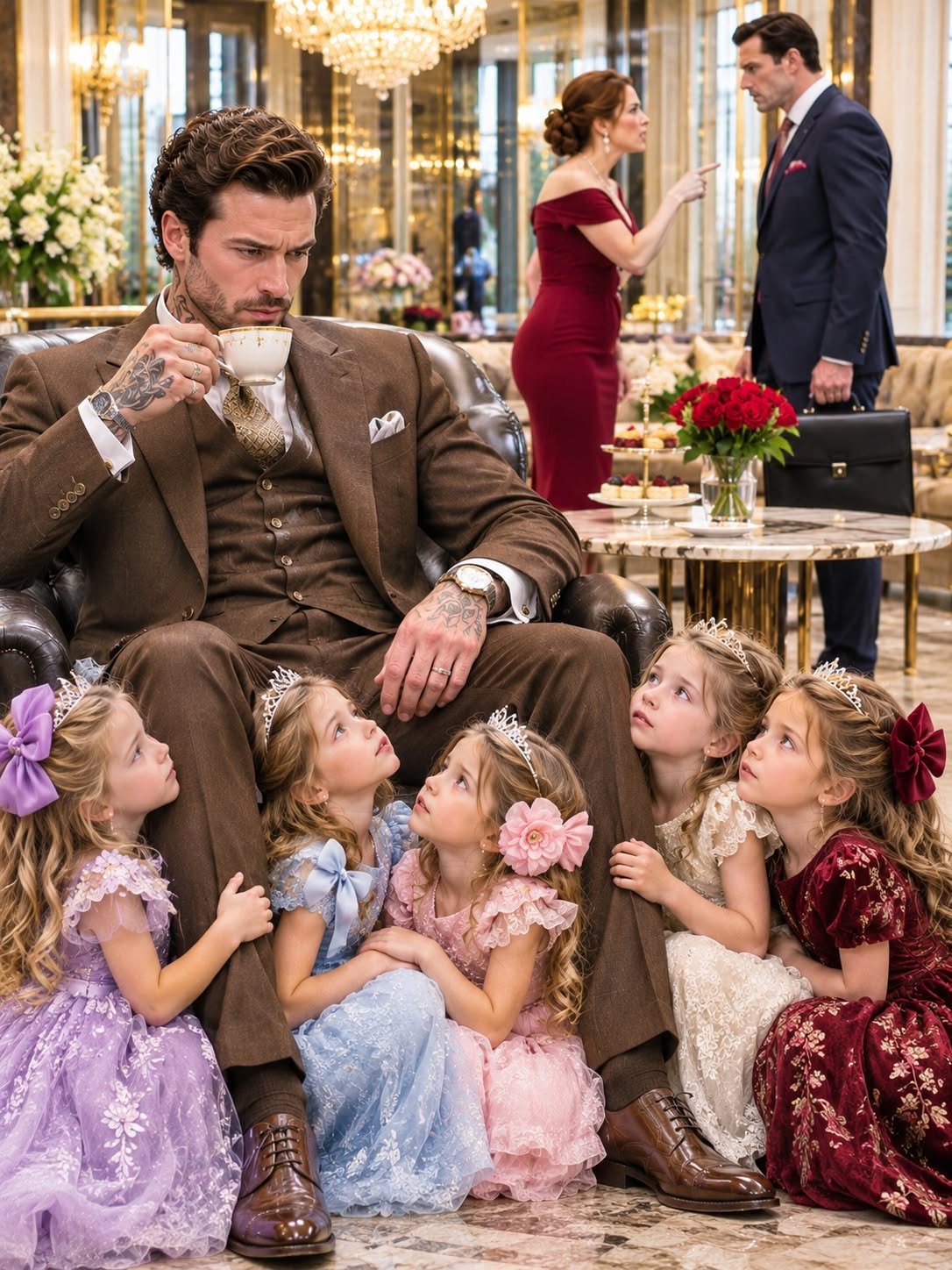
The first girl appeared beneath my table so quietly I almost thought my eyes were playing tricks on me. Then another frightened face appeared beside hers, followed by a third, and finally a fourth.
My hand froze halfway to my teacup. All four wore matching navy coats and cream-colored ribbons, yet their expressions couldn’t have been more different.
One looked terrified. Another looked furious, the third seemed seconds from crying, and the smallest had wrapped both hands around my pant leg as if letting go might mean something terrible.
“Please,” she whispered again.
Most people in Chicago knew exactly who I was. Alexander Hayes wasn’t a name strangers approached casually, because behind closed doors, I controlled businesses, territory, information, and men who understood that betraying me carried consequences.
Fear was familiar to me.
But fear in a child’s eyes was different.
“Are you girls lost?” I asked quietly.
Four heads shook at once. The smallest glanced toward the café entrance, then tightened her grip on me.
“Our mom is over there.”
I followed her gaze and saw a woman in a charcoal-gray suit standing near the doorway with two men. Her dark auburn hair was pinned neatly behind her head, and although she carried herself with elegance and authority, I recognized what her eyes were doing.
She was searching.
For them.
“You should go back to your mother,” I said.
“No.”
All four answered together, so quickly that something cold settled in my stomach. Before I could ask another question, the smallest girl looked straight into my eyes.
“Pretend you’re our father.”
For several seconds, the noise of the café seemed to vanish.
I’d spent years watching adults lie, manipulate, threaten, and betray one another for money or power. But these children weren’t trying to gain anything from me.
They were trying to escape something.
“Why?” I asked.
One girl swallowed hard. “Because Mr. Mercer says we need one.”
“But we don’t want him,” another added.
My eyes shifted toward the men standing beside their mother. “Which one is Mr. Mercer?”
The angriest girl pointed.
“Him.”
I studied him carefully. “What did he do?”
“He told Mommy she was difficult,” one girl whispered.
Another lowered her voice. “He said nobody trusts women who can’t keep a husband.”
“He says our family looks broken,” the third added.
Then the smallest stared up at me, her fingers still twisted into my pants.
“And he said he could fix us.”
Something inside me changed.
“Did he hurt any of you?”
They shook their heads.
“Did he threaten you?”
This time, nobody answered immediately.
Finally, one girl whispered, “He told Mommy she would marry him eventually. He said we should start getting used to calling him Dad.”
My fingers tightened around the edge of the table.
I knew intimidation. I knew exactly what kind of man spoke as if another person’s future already belonged to him.
At home, my son Miles was the only person who knew there was still a man beneath my reputation. After losing his mother years ago, he became the reason I remembered that some things mattered more than territory, money, or power.
And suddenly, looking into those four frightened faces, I remembered the fear I had once seen in Miles’s eyes.
Children didn’t understand influence or reputation.
They understood who made them feel safe.
And somehow, these four had chosen me.
I slowly placed my teacup on the table.
“Okay.”
Four startled faces turned toward me.
“Okay what?” the smallest asked.
I looked across the café at Mr. Mercer standing beside their mother, then down at the children hiding beneath my table. For the first time in years, someone was asking Alexander Hayes for something that had absolutely nothing to do with his empire.
“Okay,” I whispered. “I’ll be your father.”
The smallest girl’s face changed instantly, but before she could answer, footsteps started moving toward our table.
Slowly.
Deliberately.
I lifted my eyes.
Mr. Mercer was coming straight toward me.
Chapter 2: The Audit of the Hidden Trust
By two in the morning, the top floor of the Hayes Logistics Tower in downtown Chicago was locked down.
Outside the private elevators, a dozen Hayes Security operators in dark suits guarded the corridors. In the executive rest suite, thirty-two-year-old Imogen Whitlock, widow of my late business associate Graham Whitlock, sat wrapped in a cashmere blanket, tears of relief running down her face as she watched her four daughters sleep in the next room beside my son, Miles.
In the central study, around a long black granite table, sat me, corporate attorney Bridget Colton, my head of security Tobias Reed, and two federal forensic accountants.
Bridget opened three red-sealed binders and slid ledgers, recorded calls, and property records across the granite.
“Alexander, Imogen,” she said, crisp and fast. “The audit into Victor Mercer, Delphine Sterling, and the Whitlock-Ames Maritime Trust is complete.”
I stood at the window overlooking Lake Michigan, jacket off, sleeves rolled to the elbow, my jaw tight. “Explain it.”
Bridget tapped the first binder.
“Two hundred million dollars. Over three years, Victor Mercer moved that sum out of Graham Whitlock’s estate, through the trust, into shell accounts in Panama co-owned by Delphine Sterling.”
She turned to the second.
“The coercion. Recovered messages and a recorded call show that Mercer hired private investigators to follow Imogen and her daughters. He threatened to petition for emergency guardianship, to have the girls placed with the state, unless Imogen married him and signed over her controlling interest.”
She opened the third.
“And the charter. The original trust documents show that Imogen and her four daughters, June, Wren, Elena, and Tilly, hold sixty percent of the voting interest in the entire Midwest logistics network Mercer was about to absorb. Tomorrow’s assembly was where he planned to ratify it.”
The room was quiet.
“He threatened to take her children,” I said, “and force her to marry him, while living off her late husband’s legacy.”
“Alexander,” Imogen said softly. “I didn’t know any of this. I only knew he kept telling me I couldn’t manage alone.”
I crossed the room and knelt in front of her chair. It was not something I did, and the men at the table looked at the wall.
“He wanted you to feel helpless because you were raising four girls on your own,” I said. “You aren’t. Tomorrow, we show this city who actually owns what he’s been stealing.”
Chapter 3: The Assembly at the Grand Concourse
At ten the next morning, the mahogany assembly hall on the fortieth floor of the Chicago Financial Center was full.
More than four hundred developers, shipping executives, judges, and board members had gathered beneath crystal chandeliers for the annual Midwest Logistics and Heritage Assembly.
Near the head of the raised table, in a navy suit with a silver pen in his hand, sat Victor Mercer. Beside him, in a crimson dress, sat Delphine Sterling, smirking at the front row as they prepared to sign the documents that would fold the Whitlock berths into Mercer Equity.
“Gentlemen,” Victor said into the microphone, his voice smooth, “today we ratify the administrative takeover of the Whitlock-Ames berths, in light of Mrs. Whitlock’s regrettable inability to manage family assets…”
The oak doors flew open.
Four hundred conversations stopped.
Down the red-carpeted aisle walked Tobias Reed and four federal marshals, and between them, me.
On my arm, in a dark emerald suit, her auburn hair falling in waves, walked Imogen Whitlock.
And beside us, in matching emerald dresses with cream ribbons, holding hands, walked June, Wren, Elena, and Tilly, with my son Miles at the end of the line, trying very hard to look dignified.
Around Imogen’s neck hung her late husband’s emerald family pendant.
Victor Mercer dropped his pen. It clattered across the mahogany and rolled onto the floor. Delphine stood so fast she knocked her champagne over her dress.
“Alexander Hayes?” she stammered. “What is this? She’s just a widow!”
“She’s the chairwoman of the Whitlock-Ames Trust, Delphine,” I said, my voice carrying across the hall. “And she owns everything you came here to take.”
Bridget stepped forward and placed a stack of court-stamped papers in Victor’s shaking hands.
“A federal order enforcing the trust deeds and restoring full control to Imogen Whitlock and her daughters,” she read. “Arrest warrants for Victor Mercer and Delphine Sterling on charges of extortion, wire fraud, identity theft, and embezzlement. And a freeze on every asset held under Mercer Equity.”
“This is unlawful!” Victor shouted, as marshals moved in with handcuffs. “Alexander, you can’t do this for a woman and four brats!”
I looked at him for a long moment.
“I’m not doing it for a woman and four brats,” I said. “I’m doing it because those girls asked me for help, and nobody else in this room would give it.”
The cuffs clicked. Victor and Delphine were led out through the hall in front of every camera in the building.
Chapter 4: What Happened at the Table
I should explain how it began.
When Victor Mercer reached my table that night, he stopped and looked at me with the practiced smile of a man who had never been told no.
“Excuse me,” he said. “I think my fiancée’s daughters are under your table.”
“They’re mine,” I said.
The smile slipped. “I’m sorry?”
“My daughters.” I didn’t raise my voice. I never do. “I’d like to know why a stranger is chasing them through a restaurant.”
Behind him, their mother, Imogen, had gone white. One of the men beside her took a step forward, and I met his eyes. He stopped. People in Chicago know my face. He knew it too.
“Mr. Hayes,” Victor said, recovering. “I didn’t know. There’s been a misunderstanding. These are the Whitlock girls.”
“Are they?” I looked down at the four faces peering out from beneath the tablecloth. “I was told they were mine. Girls, is this man your father?”
“No,” said all four.
Victor laughed, thin and quick. “Children have imaginations.”
“Evidently.” I stood. “Imogen, would you join us? I don’t believe we’ve met.”
She came slowly, one hand pressed to her chest, and sat across from me. I introduced myself. She said her name was Imogen Whitlock. She said her husband had died eighteen months earlier, and that Mr. Mercer had been helping with the estate.
She said it carefully, the way people speak when someone is listening who shouldn’t be.
“Mr. Mercer,” I said, “I think you should leave.”
“This is a private matter between myself and Mrs. Whitlock.”
“It stopped being private when four children hid under my table.” I smiled slightly. “Go home, Victor. If you have business with this family, you can discuss it with my attorney.”
He looked at me, and I watched him weigh it. A man like Victor measures everyone by what they can do to him. He measured me, and he left.
It took Imogen another twenty minutes to stop shaking.
“I didn’t know what to do,” she said finally. “He’s been at my house every night. He told me I’d lose the girls. He told me he knew people in family court.”
“Does he?”
“I don’t know,” she whispered.
I called Bridget Colton from the café, and by dawn, a forensic team was reviewing every file in the Whitlock estate.
Chapter 5: The Little One
The smallest of the four was named Tilly. She was five and a half, and she did not let go of my pant leg for almost an hour.
I took them all, with Imogen, to the penthouse above my office that night. I told myself it was for safety. Tobias had men on every floor, and Mercer’s people had been watching Imogen’s house.
My son Miles, fifteen and unimpressed by almost everything, came out of his room in pajamas to find four little girls in my living room eating cereal at midnight.
He looked at them. He looked at me.
“Dad,” he said. “What did you do?”
“I volunteered.”
“For what?”
“Fatherhood. Briefly.”
Miles considered that for a long moment, then went to the kitchen and returned with a stack of bowls.
“Does anyone want milk?” he asked, with great solemnity.
The oldest, June, narrowed her eyes at him. “Are you in charge?”
“No.”
“Then who is?”
Four small heads turned toward me.
“Apparently,” I said, “I am.”
Tilly climbed into my lap without asking and fell asleep against my shirt before I could say anything else.
I looked down at the top of her head and felt something I’d stopped feeling years earlier. It wasn’t power. It was the quiet weight of being trusted.
Chapter 6: The Widow
Imogen did not trust me at first, and she was right not to.
For two weeks, she watched me the way you watch a stray dog that has been kind. She checked the locks. She asked where I’d been. She never let the girls out of her sight.
On the fifth night, she found me in the kitchen at two in the morning, standing over a pot of tomato soup.
“You cook,” she said.
“Badly.”
“Is that what you do at night? Cook for children you don’t know?”
“I don’t sleep much.” I stirred. “Miles told me to try soup. He says it helps.”
She sat down at the counter. For a moment, she said nothing.
“Graham used to do that,” she said finally. “Cook at night, when he couldn’t sleep. Everyone thought he was hard. He wasn’t.”
“What was he?”
“Tired.” She smiled slightly. “He loved those girls more than anything. I thought if he died, nobody would ever look after them again. And then Victor appeared, so helpful, so kind, so patient.”
“And so profitable.”
“Yes.” She looked at me. “I’m sorry I didn’t see it.”
“You saw enough,” I said. “You were hunting for your daughters when they hid. A woman who doesn’t see anything doesn’t do that.”
She was quiet for a long time.
“They chose you,” she said at last. “Out of everyone in that café. I keep thinking about it. Why you?”
I thought about the question honestly.
“I don’t know,” I said. “Maybe they could tell I wasn’t afraid of him.”
“Were you?”
“No,” I said. “But I was afraid of what would happen if I looked away.”
Imogen reached over and, without a word, took the spoon from my hand and tasted the soup.
“It needs salt,” she said.
It was the first time she had smiled at me.
Chapter 7: The Trial
The trial lasted five months.
Victor Mercer was convicted of extortion, wire fraud, identity theft, and embezzlement, and sentenced to nineteen years in federal prison. Delphine Sterling received eleven. Nearly all of the two hundred million dollars was recovered and returned to the Whitlock-Ames Trust, where it belonged.
June, then seven, refused to testify. Wren, who was six and had more courage than the rest of us put together, insisted.
“I’ll tell them,” she said. “He said Mommy was broken. She’s not.”
A child psychologist, Dr. Reyes, worked with her for weeks. On the day, Wren sat in a small room with the judge, a stenographer, and her mother, and told the court exactly what Victor had said, word for word, in her careful, serious voice.
The judge, a woman with silver hair and a patient face, listened without interrupting. When Wren finished, she said, “Thank you, Wren. You’ve been very brave.”
“I know,” said Wren. “Can I have a cookie?”
The judge laughed out loud. So did the stenographer. Imogen put her face in her hands.
I waited in the hallway with the other three girls, and Miles, who had come straight from school and who held Tilly’s hand the entire time without being asked.
When it was over, Wren came out and walked straight to me.
“Did I do it right?”
“You did it perfectly,” I said.
“Good.” She tugged on my sleeve. “You can be our father now, if you want. You don’t have to pretend.”
I knelt in the corridor of the Dirksen Federal Building, in a three-thousand-dollar suit, and could not say a word.
Final Part
Imogen and I did not rush.
I want that on the record, because people assume that stories like this end quickly. It took a year. I stopped being anyone’s idea of a threat, which was harder than it sounds. I sold three of the businesses I’d inherited and wound down several I could not defend in daylight. Tobias started a legitimate security firm and hired the best of my men. I learned the names of Imogen’s daughters’ teachers, the schedule of the school bus, and the correct way to braid a ribbon, which I did badly and was told so, frequently.
Imogen reorganized the trust with Bridget’s help and became its chair in fact, not just on paper. She was good at it. Better than good. She had spent eighteen months being told she couldn’t manage, and it turned out she’d been managing a great deal.
We were married on a Saturday in June, in a small ceremony at a lakeside church in Evanston. The four girls were bridesmaids, in emerald dresses with cream ribbons. Miles, now sixteen, stood beside me as best man and, in a rare lapse of cool, cried through the vows.
Tilly carried the rings. She marched down the aisle with great solemnity, gripped them in both fists, and announced loudly to the congregation, “I picked him.”
The church laughed. Imogen laughed. I could not see the pastor through my own eyes.
At the reception, in the back garden, June found me alone beside the hydrangeas.
“I have a question,” she said.
“Go ahead.”
“When we hid under your table, did you really think you were going to be our father?”
I thought about it.
“No,” I said honestly. “I thought I was going to help four frightened kids for one night.”
“And?”
“And I was wrong.”
She nodded, with the seriousness of a nine-year-old reviewing a contract.
“I’m glad you were wrong,” she said. Then, after a pause: “Dad.”
It was the first time she had used the word. She said it quickly, as if testing the floor.
I put my hand on her shoulder. I didn’t trust my voice.
That night, after the guests had gone, I stood in the doorway of the room where the girls had fallen asleep in a pile, ribbons still in their hair, Tilly clutching the empty ring pillow, Miles asleep in a chair with a blanket tucked around him by someone, I suspect Wren.
Imogen came up beside me and slipped her hand into mine.
“Do you ever think about it?” she asked quietly. “What would have happened if they hadn’t chosen your table?”
“All the time.”
“What do you think would have happened?”
I looked at the five children asleep in a room I had once believed I had no right to enter.
“I think I’d still be the man who was afraid of what would happen if he stopped,” I said. “And you’d still be alone with a man who told you to be grateful.”
She leaned her head against my shoulder.
“Instead,” she said.
“Instead.”
Outside, the lake wind moved through the open window, smelling of cut grass and rain.
Chicago knew me for years as a man you did not cross. It is a useful reputation. It protected many things, and it cost many others.
But on a Tuesday night in a café on Wabash Avenue, four little girls looked at every adult in that room and chose the one they thought would not look away.
They were right about that.
Nothing I have built, owned, or feared has ever mattered as much.
THE END