The Cart
My hands were shaking.
I stood in the Walmart parking lot on a Saturday afternoon in October with four bags of groceries hanging off my wrists and stared at my van.
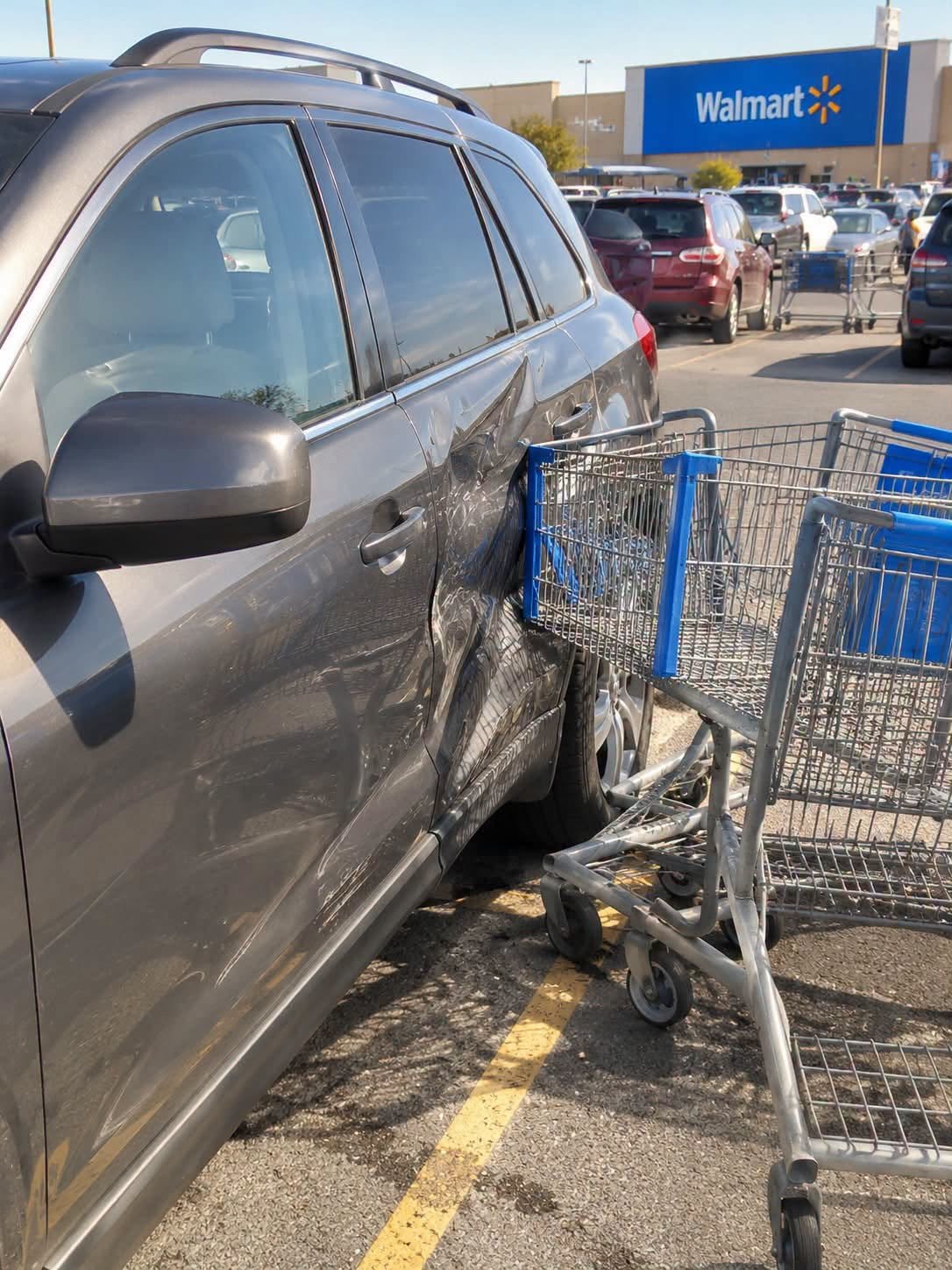
A shopping cart was jammed against the driver’s side door.
Not resting against it. Not rolled into it by the wind. Jammed. Wedged at an angle so the front corner of its metal frame was pressed deep into the panel just below the window. The door was
dented inward like somebody had punched it with a fist the size of a basketball.
Long silver scratches ran from the dent all the way back to the sliding door. Three of them. Parallel. Deep enough that I could see primer underneath the blue paint.
The side mirror was cracked.
I set the grocery bags down on the asphalt.
A carton of eggs. Milk. Two pounds of ground beef. Josie’s Goldfish crackers. Ben’s chicken
nuggets in the shape of dinosaurs. A birthday card for my mother-in-law.
I walked around the cart. Slowly. Like it might move.
I touched the dent.
It was deep. Deeper than it looked. The metal was cold and buckled under my fingers.
It was a 2014 Honda Odyssey.
Blue. One hundred and sixty-one thousand miles. A cracked cup holder. A permanent smell of
apple juice in the back row that no amount of shampoo could fix. Josie’s name scratched into the plastic of the third-row seat with a paper clip when she was five.
It wasn’t worth much. Maybe six thousand dollars.
But it was my father’s.
He bought it new in 2014. The year Josie was born. His first grandchild. He drove it off the lot in Springfield and straight to the hospital and parked it in the loading zone and walked into my
room with a car seat already installed in the back.
“For the baby,” he said. “She’s going to need a good ride.”
He drove that van for eight years. To every one of Josie’s birthday parties. To Ben’s T-ball games.
To Silver Dollar City every summer. To the hospital in the fall of 2022, when his heart started failing.
He died in January of 2023.
He left me the van.
I’d kept it perfect.
Not perfect, exactly. It was a minivan with two kids. But I’d kept it the way he would have. Oil
changed every three thousand miles. Tires rotated. Washed every other Sunday.
Not one dent. Not one scratch. In three years.
Until now.
I looked up.
And I spotted her.
She was standing about sixty feet away. At the end of the next row. Next to a white Buick
LaCrosse with the trunk open.
Fifties. Bleached blonde hair teased up high. Big sunglasses pushed up on her head. A purple velour tracksuit. Gold hoops.
The same woman.
The woman from the cart corral.
She was watching me.
And she was smiling.
When our eyes met, she laughed.
Out loud. I could hear it across the parking lot. A short, sharp, satisfied laugh.
She raised one hand.
And she waved.
That’s when I decided she was going to learn a very harsh lesson about consequences.
I left my groceries where they were.
And I started walking straight toward her.
But I need to back up.
To forty-five minutes earlier.
My name is Amanda Pruett. I’m thirty-four years old.
I’m an art teacher at Pershing Middle School in Springfield, Missouri. I teach six periods a day of seventh and eighth graders. Clay. Watercolor. Charcoal. I spend most of my day getting acrylic
paint out of the carpet and telling thirteen-year-olds that yes, abstract art is real art, and no, you can’t just draw a circle and call it done.
I’m married to Jake. He’s a mechanic at a Ford dealership on Glenstone. We’ve been married
eleven years.
We have two kids. Josie, who’s nine and wants to be a marine biologist even though we live eight hundred miles from the ocean. And Ben, who’s six and wants to be a dinosaur.
Last Saturday, I stopped at the Walmart on Battlefield Road to buy groceries.
Just a normal Saturday. Jake had the kids at a birthday party at the trampoline park. I had two hours. I’d made a list. I always make a list. My father taught me that. A man without a list buys
three things he doesn’t need and forgets the one he went for.
I parked in my usual spot. Row F. Near the cart return. I always park near the cart return so I don’t have to walk my cart across the whole lot.
I walked to the entrance.
There were carts lined up in the corral outside the doors. Twenty of them, maybe. Nested together in two long rows.

I grabbed the one on the end.
“Excuse me!”
The voice came from behind me. Sharp. Loud.
“That was MY cart!”
I turned around, completely confused.
A woman was standing about six feet away. Fifties. Bleached blonde. Purple velour tracksuit. Big
gold hoops. Sunglasses on top of her head.
She was glaring at me.
At my hand. On the cart.
I looked at the cart. Then at the corral. At the other nineteen identical carts nested right beside us.
“I’m sorry,” I said. “Were you reaching for this one?”
She rolled her eyes.
Hard. Like a teenager.
“I was walking toward it,” she snapped. “I was walking right toward it. And you just grabbed it. Right in front of me.”
“I didn’t see you,” I said. “I’m sorry. There are plenty of—”
“You selfish little brat!” she said.
I stopped.
Brat. I was thirty-four years old. I had two kids. I had a mortgage. I had gray hairs I’d started plucking.
“Some people,” the woman said, loud enough for everyone near the entrance to hear, “have
absolutely no manners.”
I couldn’t believe it.
A grown woman. Screaming. Over a shopping cart. With nineteen identical carts sitting right there.
People were looking. An older man pushing a cart out of the store stopped and stared. A young mother with a baby on her hip pulled her toddler a little closer.
I took a breath.
“Ma’am,” I said. Calmly. The voice I use with eighth graders who throw clay. “You can take the next one.”
I gestured at the corral. At the nineteen carts.
That only made her angrier.
Her face went red. Then darker red. Almost purple. To match the tracksuit.
“Oh, so now you’re telling me what to do?” she yelled.
She took a step toward me.
“You think you can just take whatever you want? Because you’re young? Because you’re pretty? Because you think the world owes you something?”
“Ma’am, I don’t think—”
“People like you,” she said. Jabbing her finger at me. “People like you have no idea. No idea what it’s like. You just take and take and take.”
Everyone was watching now.
A Walmart employee came out through the automatic doors. A young guy. Maybe nineteen. Skinny. Red vest. A name tag that said ELI. He was holding a long rope of nested carts he’d been
bringing in from the lot.
He let go of the carts.
“Is everything okay here?” he asked.
The woman turned on him.
“This girl,” she said, pointing at me, “stole my cart.”
Eli looked at me. Then at the woman. Then at the corral full of carts.

“Ma’am,” he said carefully. “There’s a lot of carts.”
“That’s not the point!”
I looked at the woman.
At her red face. Her jabbing finger. Her purple tracksuit.
I thought about arguing.
I thought about saying you’re being ridiculous. About saying it’s a shopping cart, lady, get a grip.
About saying I’m not a brat, I’m a thirty-four-year-old woman with a mortgage and a minivan.
I didn’t.
I wasn’t about to ruin my one free Saturday afternoon arguing with a stranger about a shopping cart.
I took my hand off the cart.
“Here,” I said. I pushed it toward her. “Take it. It’s yours.”
She stared at me.
I pulled another cart out of the corral. The next one in line. Identical.
“Have a good day,” I said.
And I walked inside.
I figured she’d find another cart and forget the whole thing.
People have bad days. I have bad days. Maybe her husband yelled at her that morning. Maybe she got a bill she couldn’t pay. Maybe her dog died.
I’d taught middle school for twelve years. I knew what it looked like when somebody was carrying
something heavy and swinging it at whoever was closest.
I didn’t take it personally.
I went shopping.
About forty minutes later, I finished.
I went through self-checkout. Eggs. Milk. Ground beef. Goldfish. Dinosaur nuggets. The birthday card. A bag of the good coffee Jake likes. A bottle of wine for me.
I pushed my cart out through the automatic doors. Into the parking lot.
I didn’t see the woman anywhere.
I’d forgotten about her already.
I walked down Row F toward my van.
And as I got closer, something looked terribly wrong.
That’s when I saw the cart.
I want to be honest about what I felt.
Standing in that parking lot. Looking at the dent in my father’s van. Seeing her sixty feet away. Laughing.
I felt rage.
Pure, white-hot rage. The kind I hadn’t felt since the night my father died. When the doctor at Cox South walked into the waiting room and said I’m sorry and I wanted to tear the building down
with my bare hands.
I wanted to scream at her.
I wanted to take that cart and shove it into the side of her white Buick. Over and over. Until the
paint peeled.
I wanted her to feel what I felt.
I left my groceries on the asphalt.
I started walking toward her.
Fast.
She saw me coming.
She stopped laughing.
She slammed her trunk shut. She hurried around to the driver’s side of the Buick. She fumbled with her keys.
I was thirty feet away.
Twenty.
And then I stopped.
Right there. In the middle of Row G. Between a pickup truck and a Kia.
I stopped walking.
Because I heard my father.
My father was a county sheriff’s deputy for twenty-six years. Greene County. He retired in 2010 and spent his last years fishing and spoiling his grandkids and driving that blue van.
When I was sixteen, a girl at Kickapoo High keyed my first car. A 1998 Corolla. Long scratch down
the whole side. Because I’d been nominated for homecoming court and she hadn’t.
I came home screaming. I wanted to go to her house. I wanted to key her car back. I wanted to slash her tires.
My father sat me down at the kitchen table.
“Mandy,” he said. “Listen to me. You want to hurt her. I get it. But if you go over there and key her car, what happens?”
“She’ll know how it feels.”
“And then she’ll key yours again,” he said. “And you’ll slash her tires. And she’ll throw a brick through your window. And it never ends. Because you both decided you’re the one who gets to
be the judge.”
He tapped the table.
“You want a lesson about consequences?” he said. “Let the consequences do the teaching. Not

you.”
So I stopped.
In the middle of Row G.
I took out my phone.
The woman got her driver’s door open. She was halfway into the Buick.
I held up my phone.
I took a picture.
Of her. Of the car. Of the license plate.
MISSOURI. HVL-8432.
She saw me do it.
She froze.
“What are you doing?” she said.
Her voice wasn’t loud anymore. It was sharp. Nervous.
I didn’t answer.
I took another picture. Of her face this time.
Then I turned around.
I pointed at the light pole at the end of Row F. Twelve feet up. Where a small black dome hung under the light fixture.
A camera.
I pointed at the light pole at the end of Row G. Another dome.
I pointed at the building. At the roofline. Where there were four more.
“Walmart has cameras on every pole in this lot,” I said.
My voice was calm. I don’t know how. My hands were shaking so hard I could barely hold my phone.
“High-definition,” I said. “Recording twenty-four hours a day. They show every car. Every cart. Every person.”
The woman stared at me.
“I’m going to walk inside,” I said. “And I’m going to ask Asset Protection to pull the footage from Row F. From the last forty minutes. And then I’m going to call the police.”
She laughed.
Not the same laugh as before. A shaky one.
“Prove it,” she said. “Go ahead. Prove it was me. Carts roll into cars all the time. It’s windy.”
“It’s not windy,” I said.
There wasn’t a breath of wind. It was seventy-two degrees and perfectly still.
“Carts don’t roll uphill,” I said. “My van’s parked on a slope. The cart’s on the high side. It didn’t roll there. Somebody pushed it.”
The woman looked at my van.
She looked at the cart jammed into the door.
She looked at the camera on the light pole.
Her face changed.
Then a voice came from behind me.
“Ma’am?”
I turned around.
It was Eli. The skinny kid in the red vest. From the cart corral.
He was standing at the end of Row F. Next to a long rope of nested carts he’d been collecting.
He was holding his phone.
“I saw it,” he said.
The woman went white.
“I was getting carts,” Eli said. “Over by the garden center. I saw her push a cart into your van.” He swallowed. “Three times. She backed it up and rammed it. Three times. And then she kicked it. To wedge it in.”
“That’s a lie,” the woman said. “He’s lying. He’s a kid. He doesn’t know what he saw.”
Eli looked at her.
“I recorded the last time,” he said.
He held up his phone.
He played it.
Fourteen seconds. Shaky. Zoomed in from across two rows.
A woman in a purple velour tracksuit. Standing next to a blue Honda Odyssey. Holding a shopping cart by the handle.
She pulled it back.
And she slammed it forward. Into the driver’s door.
The sound came through the phone speaker. A metal crunch.
Then she kicked the back of the cart. With her white sneaker. Twice.

Then she looked around.
And walked away.
The video ended.
The parking lot was very quiet.
The woman got into her Buick.
She slammed the door. She started the engine.
She backed out of her spot so fast she almost hit the pickup truck behind her. She peeled out of Row G. Toward the exit on Battlefield Road.
She was gone.
I stood in the parking lot.
Eli walked over to me.
“Are you okay?” he asked.
I looked at him.
Nineteen years old. Skinny. A red vest. An earbud in one ear. A pimple on his chin.
“Why did you record it?” I asked.
He shrugged.
“My mom always says if you see something messed up, you get proof,” he said. “She says nobody believes kids like me unless there’s proof.”
He looked at the van.
“I’m sorry about your car,” he said. “It’s a nice van.”
“It was my dad’s,” I said.
He didn’t say anything for a moment.
Then he went and got my groceries off the asphalt. All four bags. He carried them over and set them next to me.
“Your eggs are okay,” he said. “I checked.”
I called the police.
Springfield Police Department. Non-emergency line.
An officer came in about twenty minutes. Officer Dana Whitfield. Forties. Short brown hair. Calm. She’d done this a hundred times.
She looked at the van. At the dent. At the cart, still wedged in the door. She took photos.
She watched Eli’s video. Twice.
She took my statement. And Eli’s.
Then she went inside with me to Asset Protection.
The Asset Protection manager was a man named Roger. Sixty. Gray mustache. Former Marine. He had a little office in the back of the store with eight monitors on the wall.
He pulled the footage from the Row F camera.
We watched it together. Me. Officer Whitfield. Roger. Eli standing in the doorway.
At 2:14 p.m., my van pulled into Row F.
I got out. I walked toward the store.
At 2:15, I was at the cart corral. Off camera.
At 2:19, the white Buick LaCrosse pulled into Row G.
The woman got out.
She didn’t go into the store.
She stood next to her car.
Looking toward the entrance.
Waiting.
At 2:31, she walked to the cart corral by the garden center.
She took a cart.
She pushed it across Row G. Into Row F. Straight to my van.
She looked around. Once. Twice.
Then she pulled the cart back.
And slammed it into my driver’s door.
On the camera footage, from above, you could see the van rock on its springs.
She pulled it back again.
Slammed it again.
Again.
Then she kicked the back of the cart. Hard. Twice. Wedging it into the dent.
She walked back to her Buick.
She opened the trunk.
She stood there.
Waiting.
For me.
She waited forty minutes.
On the camera, you could see her. Standing by her trunk. Checking her phone. Looking toward the entrance. Every thirty seconds.

Forty minutes.
Just to see my face.
Roger paused the footage.
He sat back in his chair.
“Twenty-two years in loss prevention,” he said quietly. “Four years before that in the Corps. I’ve seen a lot of things.”
He looked at the screen. At the woman in the purple tracksuit. Frozen. Standing by her trunk.
“I’ve never seen somebody wait forty minutes to watch the damage land,” he said.
Officer Whitfield ran the plate.
HVL-8432. White Buick LaCrosse. Registered to Sherry Lynn Dunlap. Fifty-seven. An address in Republic. Fifteen minutes west.
She called it in.
“Criminal mischief,” she told me. “Property damage over seven hundred fifty. That makes it a Class E felony in Missouri. Do you want to press charges?”
I stood in Roger’s little office.
I looked at the screen. At Sherry Lynn Dunlap. Frozen in the act of kicking the back of the cart into my father’s van.
I thought about my father.
Let the consequences do the teaching. Not you.
“Yes,” I said.
Jake picked me up.
The van was drivable. Barely. The driver’s door wouldn’t open. I had to climb in through the passenger side. The mirror was cracked. The window wouldn’t roll down.
But I didn’t want to drive it.
I called Jake. He came straight from the trampoline park with the kids in his truck.
Josie saw the van through the windshield.
She started crying.
“Grandpa’s van,” she said. “Mom. What happened to Grandpa’s van?”
Jake looked at it for a long time.
He’s a mechanic. He’s looked at a thousand dents.
He walked around it. He ran his hand along the scratches. He opened the passenger door and looked at the inside of the driver’s door panel. He tried to roll down the window.
“The door’s bent,” he said quietly. “The frame. The window regulator’s broken. The mirror’s shot.
And the paint—”
He shook his head.
“Thirty-two hundred,” he said. “Maybe more. If the frame’s bent, we’re looking at replacing the
whole door.”
Ben was looking at the cart.
Officer Whitfield had pulled it out of the dent. It was standing next to the van now. The front
corner of its frame was bent.
“Did the cart do it?” Ben asked.
“A lady did it,” I said. “With the cart.”
Ben frowned.
“Why?”
I didn’t have an answer.
“Because she was angry,” I said finally.
Ben thought about that.
“At the van?”
“At me,” I said.
“Why was she angry at you?”
I looked at my son.
“I don’t know, buddy,” I said. “I really don’t know.”
I found out eleven days later.
The detective called on a Wednesday. Detective Raymond Cole. Springfield PD. Property crimes.
“Mrs. Pruett,” he said. “Sherry Dunlap was arrested on Monday. At her home in Republic. She’s been charged with felony criminal mischief.”
“Okay,” I said.
“Her attorney contacted the prosecutor yesterday,” he said. “The Greene County Prosecutor’s Office. They’ve asked about something.”
“What?”
“Restorative justice,” Detective Cole said. “There’s a program. For first-time offenders. Nonviolent property crimes. Instead of going to trial, the offender meets with the victim. In a supervised
setting. With a facilitator. They talk. The offender takes responsibility. They agree on restitution. If they complete it, the felony gets reduced to a misdemeanor.”
I didn’t say anything.

“It’s completely voluntary,” he said. “On your part. If you say no, it goes to trial. She’ll probably plead guilty. The video’s pretty clear.”
“Why would I want to meet her?”
Detective Cole was quiet for a moment.
“Her attorney says there are circumstances,” he said carefully. “That might help you understand what happened.”
“What circumstances?”
“I can’t tell you that,” he said. “That’s for her to tell you. If you agree to meet.”
I almost said no.
I sat at my kitchen table with the phone against my ear and almost said no.
I didn’t want to understand. I didn’t want circumstances. I wanted her to pay for my father’s van. I wanted a judge to look at that video and say guilty.
I wanted her to learn a harsh lesson about consequences.
But I thought about Ben.
Why was she angry at you?
I don’t know, buddy. I really don’t know.
“Okay,” I said. “I’ll meet her.”
The meeting was two weeks later.
At the Greene County Justice Center. A small conference room on the third floor. A round table. Six chairs. A box of tissues. A pitcher of water.
The facilitator was a woman named Grace Okafor. Sixties. Gray locs. Reading glasses on a beaded
chain. She’d been doing restorative justice for fifteen years.
She met me in the hallway before.
“Mrs. Pruett,” she said. “Thank you for doing this. I want you to know you can leave at any time. If
you feel uncomfortable. If you need a break. If you want to stop.”
“Okay.”
“And I want you to know,” Grace said, “that nothing she says today excuses what she did. That’s
not what this is for.”
“Then what’s it for?”
Grace looked at me.
“It’s for understanding,” she said. “So you can decide what happens next. With your eyes open.”
Sherry Dunlap was already in the room.
She looked different.
The purple tracksuit was gone. The gold hoops were gone. The teased-up blonde hair was flat. Pulled back in a plain ponytail. Gray at the roots. She was wearing a beige cardigan and black slacks.
She looked older. Smaller.
She looked terrified.
Her attorney was sitting next to her. A young man in a cheap suit. Public defender.
She looked up when I came in.
She didn’t say anything.
She looked down at her hands.
I sat down across from her.
Grace sat at the head of the table.
“Thank you both for being here,” Grace said. “Sherry. Would you like to start?”
Sherry didn’t say anything for a long time.
She stared at her hands. They were folded on the table. Shaking.
She was wearing a wedding ring.
A plain gold band. Worn thin.
“I’m sorry,” she said finally. Very quietly. “I’m sorry about your van.”
I didn’t say anything.
“I’m sorry I called you a brat,” Sherry said. “I’m sorry I screamed at you. I’m sorry I—”
She stopped.
“I’m sorry I waited,” she said. “To watch.”
“Why?” I said.
My voice came out harder than I meant.
“Why would you do that?” I said. “It was a shopping cart. There were twenty of them. I gave it to
you. I pushed it to you and said take it. And you went out to the parking lot and found my van and slammed a cart into it three times. And then you stood there for forty minutes. Waiting. To watch my face.”
Sherry flinched.
“It was my father’s van,” I said. “He bought it the day my daughter was born. He died three years ago. It’s the only thing I have left that he drove.”
Sherry put her hand over her mouth

.
Grace looked at Sherry.
“Sherry,” she said gently. “Can you tell Amanda what you told me? About that day?”
Sherry took a long, shaky breath.
“My husband’s name was Gordon,” she said.
“We were married thirty-one years,” Sherry said. “He was a long-haul trucker. Thirty years.
Springfield to Dallas. Springfield to Memphis. Springfield to Denver. He was gone a lot. But when he was home, every Saturday, we went to Walmart.”
She looked at the table.
“The one on Battlefield,” she said. “Every Saturday. For twenty years. It was our thing. It sounds stupid. It wasn’t stupid. It was ours.”
I didn’t say anything.
“He always got the cart,” Sherry said. “Every time. We’d walk up to the corral and he’d say, Allow me, my lady. And he’d pull one out for me. Like a gentleman. Like it was a carriage. Every Saturday. For twenty years.”
Her voice cracked.
“He’d pick the best one,” she said. “He’d test the wheels. He’d pull one out and push it back and forth and if it squeaked, he’d put it back and try another. He said I deserved a cart that didn’t
wobble.”
“Gordon died in August,” Sherry said.
My stomach went cold.
“August twenty-third,” she said. “A Saturday. At Walmart.”
I stared at her.
“In the parking lot,” Sherry said. “Row F. By the cart return.”
She couldn’t look at me.
“We’d finished shopping,” she said. “He’d loaded the groceries into the car. Like always. And he said, I’ll take the cart back, Sher. Like always. He walked it to the corral at the end of Row F.”
Row F.
Where I always park.
“He was pushing it into the corral,” Sherry said. “And he just—stopped. And he put one hand on
his chest. And he looked back at me. At the car. And he went down.”
She was crying now.
“Heart attack,” she said. “Massive. He was dead before the ambulance got there. Right there. On
the asphalt. Next to the cart return. With his hand still on the cart.”
The room was silent.
I couldn’t breathe.
Grace slid the box of tissues across the table to Sherry. Sherry didn’t take one.
“I hadn’t been back,” Sherry said. “Since August. Not once. I couldn’t. I’d been going to the Price Cutter in Republic. Driving twenty minutes out of my way. Because I couldn’t go back to that
parking lot.”
She took a breath.
“That Saturday,” she said. “Two weeks ago. When I saw you. It was the first time I went back.”
“I’d been sitting in my car,” Sherry said. “For an hour. In Row G. Trying to make myself get out. Trying to make myself walk to the corral and get a cart. By myself. For the first time. Without him.”
She wiped her face with the back of her hand.
“I finally got out,” she said. “And I walked to the corral. And there was one cart on the end. Pulled out a little bit from the others. Like somebody had just pulled it out and left it.”
She looked at me.
“And I thought,” she said. “I swear to God, I thought. That’s the one. That’s Gordon’s. He pulled it out for me.”
I put my hand over my mouth.
“I know it’s crazy,” Sherry said. “I know it was just a cart. I know. But I’d been sitting in my car for an hour. And I was so tired. And I missed him so much. And it was right there. Pulled out. Waiting
for me. Like he used to.”
She was crying so hard she could barely talk.
“Allow me, my lady,” she whispered.
“And then you grabbed it,” she said.
I didn’t say anything.
I couldn’t.
“I know you didn’t know,” Sherry said. “I know you didn’t see me. I know you didn’t mean anything. You were just getting a cart. Like a normal person on a normal Saturday.”
She shook her head.
“But in that second,” she said, “you were taking him. From me. Again. And I just—”
She stopped.
“I just snapped,” she said.
“I screamed at you,” Sherry said. “I said horrible things. Selfish. Brat. No manners. I don’t even know where they came from. And you were so calm. You said ma’am, you can take the next one. And you pushed it to me. And you said take it.”
She looked at me.
“And I couldn’t take it,” she said. “Because it wasn’t his anymore. You’d touched it. It was just a cart.”
“I went back to my car,” Sherry said. “I sat there. I was shaking. I was so angry. Not at you. Not really. At Gordon. For dying. At God. At the parking lot. At everything.”
She looked at her hands.

“And I saw your van,” she said. “In Row F. Right by the corral. Right where—”
She couldn’t finish.
“Right where he died,” I said quietly.
Sherry nodded.
“Right in that spot,” she said. “The exact spot where I’d parked. That day. In August. Where I sat and watched him walk the cart back.”
“I don’t know what happened,” Sherry said. “I got out of the car. I took a cart from the garden center corral. I walked to your van. And I just—”
She put her face in her hands.
“I wanted somebody else to feel it,” she said through her fingers. “Just once. I wanted somebody else to come out of that store and find something broken in that parking lot. Something they loved. I wanted somebody else to stand in Row F and feel like the world had ended.”
“And then I waited,” Sherry said. “Forty minutes. I stood by my trunk and waited. I told myself I was waiting to see if you’d notice. If you’d care.”
She lifted her head.
“I think I was waiting to see if anybody else could feel what I was feeling,” she said. “I think I needed to see somebody’s face fall apart. The way mine did. In August.”
“And when you came out,” Sherry said, “and saw it. And your face—”
She stopped.
“I laughed,” she said. “God forgive me. I laughed. Because for one second, I wasn’t the only one.”
Nobody said anything for a long time.
Grace sat very still at the head of the table.
The public defender was staring at the wall.
I sat across from Sherry Dunlap with my hands flat on the table.
I thought about my father.
January of 2023. Cox South Hospital. Room 412.
I was sitting next to his bed. Holding his hand. His heart had been failing for four months. The
doctors said days.
I went down to the cafeteria to get coffee. Fifteen minutes. I’d been awake for thirty hours.
When I came back, he was gone.
He died while I was getting coffee.
I drove home that night in his van.
The blue Odyssey. With Josie’s name scratched into the third-row seat.
I parked in the driveway.
And I sat in the driver’s seat. With my hands on the steering wheel where his hands had been.
And I screamed.
I screamed until my throat bled.
The next morning, I went to the grocery store.
Hy-Vee on Sunshine Street. For milk. For the kids.
A man in the produce section bumped my cart with his. By accident. He said sorry.
And I turned around and told him to watch where the hell he was going.
I’d never said anything like that to a stranger in my life.
He stared at me. He walked away.
I stood in the produce section and shook.
I’d forgotten that.
I’d forgotten that until this moment. Sitting across from Sherry Dunlap in a conference room at the Greene County Justice Center.
I’d forgotten that grief makes you into somebody you don’t recognize.
That it makes you want to break things.
That it makes you want somebody else to hurt.
So you’re not the only one.
“Sherry,” I said.
She looked up.
“My father died while I was getting coffee,” I said.
She didn’t move.
“In the hospital,” I said. “Three years ago. I went down to the cafeteria for fifteen minutes. I’d been awake for thirty hours. When I came back, he was gone.”
Sherry put her hand over her mouth.
“I wasn’t there,” I said. “I wasn’t holding his hand. I was in line at a cafeteria buying a coffee I never drank.”
My voice broke.
“The next morning,” I said, “I screamed at a stranger in a grocery store. Because he bumped my cart.”
Sherry stared at me.
“I’m not telling you that to make you feel better,” I said. “I’m not telling you it’s okay. It’s not okay.”
I took a breath.
“You smashed my father’s van,” I said. “On purpose. You stood there and laughed. My daughter cried when she saw it. My son asked why somebody would do that and I didn’t have an answer.”

“I know,” Sherry whispered.
“You’re going to pay for it,” I said. “Every dollar. Thirty-two hundred. The door. The mirror. The paint. The window.”
“I know.”
“And you’re going to tell the judge what you did,” I said. “Out loud. In a courtroom. Every second of it.”
“I know,” Sherry said. “I will.”
“But I understand,” I said.
Sherry looked at me.
She didn’t say anything.
She just started crying.
Not the way she’d been crying. Not angry. Not ashamed.
Something else.
Like something had been let out.
Grace slid the tissues across the table again.
This time, Sherry took one.
We talked for two hours.
About Gordon. About my father. About Row F.
About the Price Cutter in Republic and the Hy-Vee on Sunshine Street.
About driving twenty minutes out of your way so you don’t have to see a parking lot.
About sitting in your car for an hour trying to make yourself get out.
“Do you have anybody?” I asked. Toward the end. “Kids? Family?”
Sherry shook her head.
“We never had kids,” she said. “We tried. It didn’t happen. Gordon’s brother lives in Oregon. My
sister passed in 2019.”
“Friends?”
Sherry looked at her hands.
“Gordon was my friend,” she said. “Thirty-one years. He was gone so much. When he was home, I didn’t need anybody else.”
She looked up.
“I haven’t talked to anybody in three months,” she said. “Not really. Not like this. You’re the first person I’ve told about the cart. About allow me, my lady.”
Grace cleared her throat.
“There’s a grief support group,” she said quietly. “At Mercy Hospital. Tuesday nights. For people who’ve lost spouses.”
Sherry didn’t say anything.
“I’m not saying it’s part of the agreement,” Grace said. “I’m just saying it’s there.”
Sherry looked at me.
I didn’t say anything.
That wasn’t mine to decide.
We wrote up the agreement at the end.
Grace typed it on her laptop. We both read it. We both signed it.
Restitution: $3,240.00. Payable to Amanda Pruett. In monthly installments of $270, beginning November 1, for twelve months.
Community service: 80 hours. To be completed within six months.
Letter of apology: To be written by Sherry Dunlap to Amanda Pruett and her children, Josie and Ben.
Upon successful completion, the felony charge of criminal mischief will be reduced to a Class A
misdemeanor.
Sherry signed it.
Her hand was shaking.
She put down the pen.
She looked at me.
“Can I ask you something?” she said.
“Okay.”
“The kid,” she said. “In the red vest. At the cart corral. Who recorded me.”
“Eli,” I said.
“Eli,” Sherry said. “Is he in trouble? For filming me? I don’t want him to get in trouble.”
I looked at her.
“No,” I said. “He’s not in trouble. Walmart gave him an award. For employee of the month.”
Sherry almost smiled.
“Good,” she said. “He did the right thing. I want to tell him that.”
The letter came three weeks later.
In the mail. A plain white envelope. Addressed in careful handwriting.
To Amanda, Josie, and Ben Pruett.
I read it at the kitchen table. Then I read it to Josie and Ben.
Dear Amanda, Josie, and Ben,
My name is Sherry. I’m the lady who broke your van.
I want to tell you I’m sorry. I’m sorrier than I’ve ever been about anything.
Josie, your mom told me you cried when you saw it. Because it was your grandpa’s. I’m so sorry I made you cry. I know what it’s like to lose somebody you love. I didn’t mean to make you feel that way about your grandpa’s van.
Ben, your mom told me you asked why I did it. That’s a good question. A really good question. I’ve been thinking about it for three weeks.
Here’s the truest answer I have.

I was very sad. My husband died. And I didn’t know what to do with how sad I was. So I did something bad. I tried to make somebody else feel as sad as me.
That doesn’t work, Ben. It never works. It just makes two sad people instead of one.
I hope you never do it. I hope when you’re sad, you find somebody to talk to instead.
Amanda, thank you for listening to me. You didn’t have to. You had every reason not to. You told me about your dad. And the coffee. I’ve thought about that every day since.
I started going to a group on Tuesday nights. At Mercy. For people whose husbands and wives died. There’s a man there named Walt whose wife died in a grocery store too. A Hy-Vee. In the bread aisle. We sat next to each other last week. We didn’t say much. But it helped.
I’m doing my community service at the Ozarks Food Harvest. Sorting donations. Eight hours every Saturday.
I’m going to pay you back every dollar.
I’m so sorry about your grandpa’s van.
— Sherry
P.S. Please tell Eli thank you for me. Tell him his mom is right. Proof matters. Nobody would have
believed what I did without it. And I needed somebody to know what I did. Even if I didn’t know it at the time.
Ben listened to the whole thing.
When I finished, he was quiet.
“She was sad,” he said finally.
“She was very sad.”
“Like you were when Grandpa died?”
I looked at my son.
“Yes,” I said. “Like I was when Grandpa died.”
Ben thought about that.
“Did you break anything?” he asked. “When Grandpa died?”
I didn’t answer right away.
“No,” I said. “But I yelled at a man in a grocery store. Because he bumped my cart.”
Ben’s eyes went wide.
“You yelled at somebody?”
“I did,” I said. “It was a long time ago. I was very sad. And I didn’t know what to do with it.”
Ben looked at Sherry’s letter.
“It just makes two sad people instead of one,” he read slowly.
“That’s right,” I said.
Josie took the letter.
She read it again. By herself.
Then she got up from the table. She went to her room.
She came back with a piece of construction paper. And her markers.
She sat down. She started drawing.
“What are you making?” I asked.
“A card,” Josie said. “For Sherry.”
It took her an hour.
When she was done, she showed me.
It was a drawing of a blue minivan. With GRANDPA’S VAN written on the side. And a big dent in the door that she’d colored in black.
Next to the van, she’d drawn two stick figures. A tall one with yellow hair. And a short one with brown hair.
Holding hands.
Above them, in purple marker:
I’M SORRY YOUR HUSBAND DIED.
MY GRANDPA DIED TOO.

IT’S OKAY TO BE SAD. JUST DON’T BREAK STUFF.
— JOSIE
I mailed it.
The payments came every month.
On the first. Like clockwork. Two hundred and seventy dollars. A check. In the same careful handwriting.
In the memo line, every month, she wrote something.
November — For the door.
December — For the mirror.
January — For the window.
February — Happy Valentine’s to your family.
March — Walt and I went to lunch after group. Cracker Barrel. He told me about his wife.
Jake fixed the van.
He did it himself. At the Ford dealership. After hours. On Saturdays. He ordered a new door from a salvage yard in Joplin. Same color. Same year. He hung it. He replaced the window regulator. He
replaced the mirror.
He painted the scratches.
It took him six weeks.
When he was done, you couldn’t tell.
Except for one thing.
On the inside of the new door, where the panel meets the frame, there was a little piece of the old
door Jake had saved.
A strip of blue metal. Three inches long. With one of the scratches on it.
He’d riveted it inside. Where you can only see it when the door is open.
“Why’d you keep that?” I asked.
Jake shrugged.
“I don’t know,” he said. “Felt wrong to throw it all away. Your dad would’ve kept it.”
He was right.
My father kept everything.
The last payment came in October.
A year after the Walmart.
Two hundred and seventy dollars. October — Paid in full.
But there was something else in the envelope.
A note.
Amanda,
This is the last one. Thirty-two hundred and forty dollars. Every penny.
I finished my community service in April. Eighty hours. I kept going. I’m still at the Food Harvest every Saturday. They made me a shift lead.
The judge reduced my charge in May. Like the agreement said. I stood up in court and told him
everything. The cart. Row F. Gordon. Forty minutes. All of it. Out loud. Like you said.
He said it was the most honest statement he’d heard in twenty years on the bench.
Walt and I still go to group. And lunch after. Cracker Barrel every Tuesday. He orders the chicken
and dumplings. Every time. Gordon used to order the meatloaf.
I wanted to ask you something.
Gordon died a year ago in August. At Walmart. On Battlefield. In Row F.
I’ve been back to that store four times since. With Walt. He helps me. But I still can’t get a cart. I stand at the corral and I can’t make myself pull one out. Walt has to do it.
I’m going to try again on Saturday. October 18th. At two o’clock.
I don’t know why I’m telling you this.
Maybe because you were the one who was there.
— Sherry
I read it three times.
I put it down on the kitchen table.
I looked at Jake.
He’d read it over my shoulder.
“You going?” he asked.
I went.
Saturday, October 18th. Two o’clock.
I parked in Row F.
My father’s van. Blue. A new door. A riveted strip of the old one inside.
I parked in my usual spot. Near the cart return.
I got out.
I walked to the entrance.
Sherry was standing by the cart corral.
Alone. No Walt.
She was wearing jeans and a gray sweater. Her hair was short now. Cut close. Natural gray. No
more bleached blonde.
She was standing in front of the corral. Looking at the carts.
Not touching them.
Her hands were in her pockets.
She didn’t see me at first.
I stood a few feet away and watched her.
She took her hand out of her pocket. She reached toward the cart on the end.
She stopped. An inch away.
Her hand was shaking.

She put it back in her pocket.
“Sherry,” I said.
She turned around.
She saw me.
Her face crumpled.
“You came,” she said.
“You told me two o’clock,” I said.
“Walt couldn’t make it,” she said. “His daughter’s in town. I told him I’d be fine.”
She looked at the corral.
“I’m not fine,” she said.
I walked over to the corral.
I stood next to her.
We looked at the carts together. Twenty of them. Nested in two long rows. Identical.
“He used to test the wheels,” Sherry said quietly. “Every time. He’d push it back and forth. If it squeaked, he’d put it back.”
“My dad did that too,” I said.
Sherry looked at me.
“Really?”
“Every time,” I said. “He said a squeaky cart was a sign of bad character.”
Sherry laughed.
It was the first time I’d heard her laugh since Row G.
It wasn’t sharp this time. It wasn’t cruel.
It was just a laugh.
I reached into the corral.
I pulled out the cart on the end.
I pushed it back and forth. Twice. Listening.
No squeak.
I turned it around.
I held it out to her.
“Allow me, my lady,” I said.
Sherry stood very still.
She looked at the cart.
She looked at me.
Her eyes filled up.
She put her hand over her mouth.
She didn’t say anything for a long time.
Then she reached out.
She put both hands on the handle.
Right where mine had been.
Right where Gordon’s always were.
“Thank you,” she whispered.
We went inside.
Together.
She pushed the cart.
I walked next to her.
We went down every aisle. She had a list. She told me Gordon used to make the lists. She said she’d never made one in thirty-one years. She said she was getting better at it.
In the cereal aisle, she stopped in front of a box of Grape-Nuts.
“He ate these every morning,” she said. “Every single morning. For thirty-one years. I hate Grape-Nuts. They taste like gravel.”
She picked up a box. She put it in the cart.
“I don’t know why I’m buying them,” she said.
“Yes, you do,” I said.
She looked at me.
She left them in the cart.
At checkout, she paid.
Then we walked out to the parking lot together.
Row G. Her white Buick.
She loaded her groceries into the trunk.
She stood there. Holding the empty cart.
She looked at the cart return at the end of Row F.
Where Gordon died.
“I’ll take it back,” I said. “If you want.”
Sherry looked at the cart return for a long time.
“No,” she said finally. “I’ll do it.”
She pushed the cart across Row G. Into Row F. Past my father’s van.
She walked to the cart return at the end of the row.
She stood there. In front of it.
Right where Gordon fell.
She didn’t move for a long time.
Then she pushed the cart into the corral.
Gently.
It rolled in and nested against the others.
She stood there with her hand on the handle.
Then she let go.

She walked back to me.
Her face was wet. But she was standing up straight.
“I did it,” she said.
“You did it,” I said.
“First time,” she said. “Since August. I took the cart back.”
She looked at the cart return.
“He always took the cart back,” she said. “I’ll take it back, Sher. Every time. For twenty years.”
She wiped her eyes.
“I finished it for him,” she said.
We stood in the parking lot for a while.
Row F. In the October sun.
Next to my father’s van.
Sherry looked at it.
“Jake fixed it,” I said. “My husband. He’s a mechanic.”
She walked over to it. She looked at the driver’s door. She ran her hand along the paint. Where the
dent used to be.
“You can’t even tell,” she said.
“Open the door,” I said.
She looked at me.
She opened it.
She looked at the inside of the door. At the riveted strip of blue metal. Three inches long. With
one long silver scratch across it.
She stared at it.
“Jake saved it,” I said. “From the old door. He said it felt wrong to throw it all away.”
Sherry touched the scratch.
Very lightly. With one finger.
“That’s mine,” she said quietly. “I did that.”
“You did,” I said.
“Why would you keep it?”
I thought about it.
I thought about my father. At the kitchen table. When I was sixteen. Let the consequences do the teaching. Not you.
I thought about Ben. Did you break anything? When Grandpa died?
I thought about Josie’s card. IT’S OKAY TO BE SAD. JUST DON’T BREAK STUFF.
“Because it happened,” I said. “And it mattered. And you paid for it. Every dollar. And you stood
up in court and told the truth.”
I looked at the scratch.
“I don’t want to forget that,” I said. “Any of it. The part where you broke it. Or the part where you
fixed it.”
Sherry closed the door.
Gently.
She stood there with her hand on it.
“Amanda,” she said. “Can I ask you something?”
“Okay.”
“That day,” she said. “When you came out. And saw the van. And saw me laughing. You started walking toward me.”
“I did.”
“You were so angry,” Sherry said. “I could see it. Your face. You were coming to hurt me. I was sure of it.”
“I was,” I said.
“Why did you stop?”
I looked at the cart return at the end of Row F.
“My dad was a sheriff’s deputy,” I said. “For twenty-six years. He saw a lot of people who wanted
to hurt somebody back.”
Sherry didn’t say anything.
“When I was sixteen,” I said, “a girl keyed my car. I wanted to key hers back. He told me if I did, it
would never end. Because we’d both decided we got to be the judge.”
I looked at her.
“He said, Let the consequences do the teaching,” I said. “Not you.”
Sherry was quiet for a long time.
“The consequences taught me a lot,” she said finally.
“I know.”
“The arrest,” Sherry said. “The video. The courtroom. The thirty-two hundred dollars. The eighty hours.”
She looked at me.
“But that’s not what taught me the most,” she said.
“What did?”
She looked at the cart return.

“A woman whose father died while she was getting coffee,” Sherry said. “Who sat across a table from the person who smashed his van. And said I understand.”
I didn’t know what to say.
So I didn’t say anything.
We just stood there.
Next to the van.
In Row F.
Sherry comes to Walmart every Saturday now.
Two o’clock.
Sometimes with Walt. Sometimes alone.
Sometimes I’m there too. Not on purpose. Just because it’s Saturday. And Row F is where I park.
When I see her at the corral, I pull out a cart. I push it back and forth twice. Listening for a
squeak.
I hand it to her.
“Allow me, my lady,” I say.
She takes it.
Every time, she laughs.
Josie asked me once why I’m nice to the lady who broke Grandpa’s van.
We were in the car. The van. Driving home from school.
“Because she paid for it,” I said.
“But she broke it on purpose,” Josie said. “She was mean. She laughed.”
“She was,” I said. “And she had to face what she did. In front of a judge. In front of me. She had to pay every dollar. She had to work eighty hours for free.”
Josie thought about that.
“So she learned a lesson?” she said.
“She learned a lesson,” I said.
“Did you?”
I didn’t answer right away.
I looked in the rearview mirror. At my daughter. Nine years old. Sitting in the second row of her grandfather’s van. With her name scratched into the plastic of the seat behind her.
“Yeah,” I said. “I did.”
“What was it?”
I thought about it.
“That everybody who breaks something,” I said slowly, “is carrying something broken.”
Josie was quiet.
“That doesn’t make it okay,” I said. “It never makes it okay. They still have to fix it. Every dollar.
Every time.”
I looked at the road.
“But you can’t help somebody fix it,” I said, “if you won’t look at what’s broken.”
Josie didn’t say anything for a while.
Then she said, “Grandpa would’ve liked that.”
“Yeah?”
“He always said everybody has a story,” Josie said. “Even the bad guys. Especially the bad guys.”
I looked at her in the mirror.
“He said that?”
“When he took me fishing,” Josie said. “At Table Rock. I asked why he became a sheriff. He said because somebody had to listen to the bad guys’ stories. So they could figure out how to stop being bad guys.”
I pulled into the driveway.
I turned off the van.
I sat there for a minute. With my hands on the steering wheel. Where his hands had been.
Then I opened the driver’s door.
The new door. The one Jake hung.
And there, on the inside, where only I could see it, was the strip of the old one.
Three inches of blue metal.
One long silver scratch.
People ask me sometimes about the woman at Walmart.
The one who screamed at me over a shopping cart. Who smashed my father’s van and stood there laughing.
They want to hear about the harsh lesson. The consequences. The arrest. The courtroom.
And I tell them about that.
But then I tell them about Row F.
About a man named Gordon who said allow me, my lady every Saturday for twenty years.
About a cart that was pulled out just a little bit from the others. That a grieving woman thought was waiting for her.
About forty minutes standing by a trunk. Waiting to see if anybody else could hurt the way she
did.
About a sheriff’s deputy who told his sixteen-year-old daughter to let the consequences do the teaching.
The consequences taught Sherry Dunlap a lesson.
Thirty-two hundred and forty dollars. Eighty hours. A courtroom. A judge.
She paid every penny.
But the consequences didn’t teach her how to pull a cart out of the corral.
Somebody had to stand next to her for that.
That’s the thing about harsh lessons.
They teach you what you did w

rong.
They don’t teach you how to stop hurting.
You need somebody else for that.
Somebody who’s been in the parking lot too.
Somebody who knows what it’s like to come back to the place where everything broke.
And push the cart back to the corral.
And let go.