My Twin Sister Disappeared 40 Years Ago—Then My Granddaughter Walked Into My Kitchen Wearing Her Sweater
For almost forty years, I lived with a question that never stopped haunting me.
What happened to my twin sister?
Her name was Laura, and she disappeared on the night of our sixteenth birthday. There was no goodbye, no explanation, and no sign of where she had gone. My parents searched for her, the police investigated, and our family spent years hoping she would somehow return.
But she never did.
At least, that was what I believed.
Until one ordinary afternoon, when my eight-year-old granddaughter walked into my kitchen wearing a sweater I recognized immediately.
It was Laura’s sweater.
And what I discovered hidden inside it would uncover a family secret that had been buried for decades.
The Sweater From My Past
I was standing in the kitchen, drying dishes, when my granddaughter Sophie came running through the door.
“Grandma, look what I got!”
I turned around with a smile, but the moment I saw her, the plate slipped from my hands and shattered against the floor.
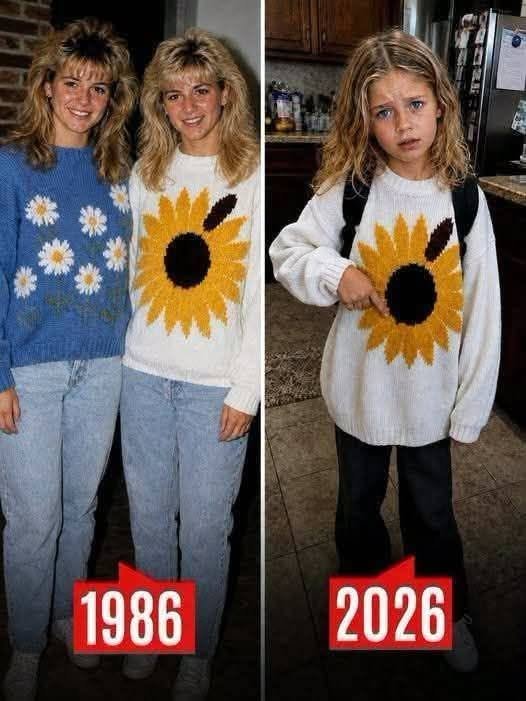
Sophie was wearing a cream-colored sweater with a large yellow sunflower knitted across the front.
Near the bottom of the flower was one unusual detail: a single brown petal.
My heart began racing.
I knew that sweater.
Forty years earlier, my mother had knitted two matching sweaters for my sister and me as a birthday present. Mine had white daisies, while Laura’s had a huge yellow sunflower.
Mom had accidentally used brown yarn for one of the petals. She had offered to fix it, but Laura refused.
“Leave it, Mom. That makes mine special,” she had laughed.
Now that same sweater was standing in front of me.
“Sweetheart, where did you get this?” I asked.
Sophie explained that a woman named Dolly, who worked as a cleaner at her school, had noticed her feeling cold in the hallway and offered her the sweater.
I carefully examined the collar.
There, beneath the faded stitching, were two tiny red letters.
L.M.
Laura’s initials.
My hands began trembling.
Then Sophie said something that made my heart stop.
“Dolly told me you should look underneath the flower.”
I turned the sweater inside out and carefully examined the sunflower. Near the bottom, I noticed a tiny hidden opening.
I gently loosened the stitching.
Something small and hard slipped into my palm.
It was a wooden sunflower.
I recognized it immediately.
My father used to carve little wooden flowers for us when we were children. He had made me a daisy and Laura a sunflower.
But I remembered something else.
On the night Laura disappeared, I had seen Dad standing outside our house, holding that very wooden sunflower.
I had asked him where he got it.
He never answered.
For forty years, I had wondered what happened to my sister.
Now I had a clue.
And I wasn’t going to ignore it.
The Woman Who Knew My Name
The next morning, I drove to Sophie’s school and asked to speak with Dolly.
When she finally appeared, she stopped as soon as she saw me holding the sweater.
Then she looked directly into my eyes.
“You must be Emelia.”
I was shocked.
We had never met.
“How do you know my name?” I asked.
She glanced toward the school office before answering.
“Could we talk somewhere private?”
“No. I want answers.”
I held up the wooden sunflower.
“Who gave you this sweater?”
“My mother.”
“What’s your mother’s name?”
Dolly looked down.
Then she whispered one word.
“Laura.”
For a moment, I couldn’t move.
“Your mother is Laura?”
She nodded.
“Is she alive?”
“Yes.”
I felt my knees weaken.
My twin sister was alive.
The girl I had spent almost my entire life searching for was somewhere in the same town.
I struggled to control my emotions.
“Why did she leave?”
Dolly explained that Laura had been in love with a young man named Thomas. My father strongly disapproved of their relationship.
On the night of our sixteenth birthday, Thomas had come to our house. His family was preparing to leave town, and he wanted Laura to go with him.
My father discovered them outside.
According to Dolly, he became furious and told Laura that if she walked away with Thomas, she should never expect to return home.
Laura left anyway.
She was sixteen, frightened, stubborn, and convinced that love would be enough to build a new life.
But the biggest shock was still waiting.
“Did my mother ever try to come home?” I asked.
Dolly nodded.
“Yes. She returned in 1992.”
I stared at her.
“She came back?”
“She was twenty-two. I was only two years old. She brought me with her and knocked on your family’s door.”
My heart started pounding.
“Who answered?”
Dolly looked at me.
“Your father.”
I felt sick.
“What happened?”
“He refused to let her come inside. He told her everyone had finally started healing and that returning would only reopen old wounds.”
I couldn’t believe what I was hearing.
For forty years, my father had told us he had never seen Laura again.
But he had.
He had seen her standing at our door with a little girl in her arms.
And he had sent her away.
The Truth My Father Buried
I drove straight to the nursing home where my ninety-year-old father lived.
He was sitting in his favorite chair, watching television, when I entered.
“Emelia! What a surprise.”
I didn’t smile.
Instead, I placed the wooden sunflower on the table in front of him.
His expression changed instantly.
“Where did you find that?” he asked.
I unfolded the sweater and placed it beside the charm.
“Did you see Laura again after she disappeared?”
He looked away.
“No.”
“Don’t lie to me, Dad. She came back in 1992.”
His face grew pale.
For several seconds, he remained silent.
Then his shoulders dropped.
“Yes,” he finally admitted.
I pulled a chair closer.
“Tell me everything.”
He explained that Laura had arrived at the house with her little daughter. She wanted to return, apologize, and rebuild her relationship with the family.
But he refused.
“Why?” I asked, struggling to hold back my tears.
He stared at his hands.
“Life had finally become peaceful again. Your mother was sleeping better. You had started building your own life. I didn’t want everything to become painful again.”
I couldn’t believe his answer.
“Peaceful? Mom spent years crying for Laura. I spent my life wondering where she was. What peace are you talking about?”
He lowered his head.
Then he finally admitted the truth.
He had been ashamed.
He had believed Laura’s decision to leave with Thomas made him look like a father who had failed to raise his daughter properly.
His pride had become more important than his family.
“I thought she would eventually understand,” he whispered.
“Understand what? That her own father wouldn’t let her come home?”
He began crying.
I asked him whether my mother knew Laura had returned.
He shook his head.
“Did you tell her?”
“No.”
“Did you tell Laura that I had spent years looking for her?”
“No.”
“Did you tell her that Mom never stopped hoping she would return?”
He couldn’t answer.
Then I asked the question that hurt the most.
“Did you tell Laura that I hated her?”
He looked at me with tears in his eyes.
“I told her you had suffered because she left.”
I stood up.
For years, I had believed my father was another victim of Laura’s disappearance.
Now I understood that he had helped keep us apart.
“You didn’t protect this family, Dad,” I said quietly. “You made decisions for everyone because you couldn’t admit you were wrong.”
He reached for my hand.
“Emelia, I’m sorry.”
I looked at him.
“I love you, but that doesn’t make what you did acceptable.”
Then I walked out.
Laura Wasn’t Sixteen Forever
The following morning, I returned to Sophie’s school and asked Dolly to speak with me.
She looked worried when she saw me.
“How was your father?” she asked.
“He admitted everything.”
She lowered her eyes.
I could see how much she wanted me to forgive her mother.
But I needed her to understand something.
“My father was wrong,” I said. “He should never have turned Laura away when she came home.”
Dolly nodded.
“But Laura also made choices.”
Her expression changed.
“She was sixteen when she left. I understand that. She was young, and she believed she was following the person she loved.”
I paused.
“But she didn’t remain sixteen forever.”
Dolly said nothing.
“She turned twenty-two. Then thirty. Then forty. She had years to find me.”
“She was ashamed,” Dolly explained. “She was afraid you hated her.”
“How could she know that if she never asked?”
Dolly’s eyes filled with tears.
I continued.
“She could have written a letter. She could have called. She could have found me after Dad was no longer living in that house. She could have tried once.”
“I know,” Dolly whispered.
I understood that Laura had suffered too.
She had been rejected by her father, struggled through life, and carried the pain of a broken family.
But I had suffered as well.
I had lost my sister without understanding why. My mother had died without knowing the truth. And I had spent decades carrying questions that someone could have answered.
I wasn’t going to pretend everything was simple just because Laura was alive.
Dolly reached into her coat and handed me a folded piece of paper.
It contained Laura’s phone number.
“She wants you to call,” she said.
I stared at the number for a long time.
Then I carefully folded the paper and placed it in my purse.
“Tell her I know the truth now.”
Dolly nodded.
“Tell her I know why she left. Tell her I know Dad refused to let her return.”
I paused before adding one final thing.
“Also tell her that I know she had many years afterward when she could have reached out herself.”
Dolly began crying.
“Will you call her?”
“Not today.”
Then I looked directly at her.
“And please don’t use Sophie as a way to bring us together again. She is a child. She shouldn’t have to carry our family’s problems.”
Dolly promised she understood.
For the first time, I felt that the next decision belonged to me.
Three Weeks of Silence
Three weeks passed.
Laura didn’t call.
She didn’t visit.
And I didn’t dial the number in my purse.
I expected the silence to hurt as much as it had when I was sixteen, but something was different this time.
I knew she was alive.
I knew where she had gone.
I knew why my father had sent her away.
Most importantly, I finally understood that the truth was not as simple as I had once imagined.
My father had allowed pride to destroy a second chance.
Laura had allowed shame and fear to keep her away for decades.
And I had spent years waiting for answers that neither of them had given me.
During those weeks, I visited Dad once.
He apologized again and admitted that he had thought about Laura on every birthday.
He also confessed that he had almost told my mother the truth several times, but each passing day made the confession harder.
Eventually, years of silence became another secret he was afraid to uncover.
I listened.
I didn’t forgive him immediately.
Perhaps one day I would.
But I understood that forgiveness didn’t mean pretending nothing had happened.
It meant deciding how much of the past I was willing to carry into the future.
The Door I Finally Opened
One Sunday afternoon, Sophie was sitting at my kitchen table, coloring pictures of flowers.
Laura’s sweater was folded beside me.
I had carefully washed it by hand and repaired the small opening beneath the sunflower.
Sophie looked up.
“Grandma?”
“Yes, sweetheart?”
“Are you still waiting for your sister?”
I looked at the sweater.
For almost forty years, waiting had been part of my life.
I had waited for Laura to return.
I had waited for the police to find answers.
I had waited for my father to explain what happened.
I had waited for my mother to stop crying.
And I had waited for someone to tell me the truth.
I gently shook my head.
“No, sweetheart. I’m not waiting anymore.”
Sophie looked confused.
“But don’t you want her to come back?”
“Of course I do.”
“Then why aren’t you waiting?”
I smiled and touched the sunflower on the sweater.
“Because there’s a difference between making room for someone to return and stopping your own life until they do.”
She thought about that for a moment before returning to her drawing.
I looked at the little wooden sunflower and remembered the two girls who had once worn matching birthday sweaters.
I remembered Laura laughing in the kitchen.
I remembered Mom’s smile.
I remembered how certain we had been that nothing could ever separate us.
I couldn’t change what had happened.
I couldn’t give my mother the truth before she died.
I couldn’t make my father open the door differently in 1992.
And I couldn’t turn Laura back into the sixteen-year-old girl who had walked out of our house.
But I could decide what happened next.
If Laura came to my door tomorrow, I would open it.
I would listen to her story.
I would ask the questions I had carried for decades.
I might cry. I might become angry. I might need time before I could call her my sister again.
But I would give her the chance my father had once refused to give.
And if she never came, I would still be okay.
I placed the sweater inside a drawer, not hidden away in an old box, but somewhere I could see it whenever I wanted.
Then I sat beside Sophie.
She was drawing a beautiful field of sunflowers. Most of the petals were yellow, but one was brown.
I laughed softly.
“What’s funny, Grandma?” she asked.
I pointed toward the flower.
“Nothing, sweetheart. I just think it’s perfect.”
For forty years, I believed my life could only become whole when my sister returned.
Now I understood that some things cannot be repaired exactly as they were.
Some people make mistakes.
Some doors are closed by anger, and others remain closed because nobody finds the courage to knock.
But I had finally stopped blaming myself for choices I never made.
And I had stopped allowing the past to decide how I would live tomorrow.
I still hoped my sister would come home one day. But for the first time in forty years, I wasn’t standing by the door waiting for her. I was finally living my own life.