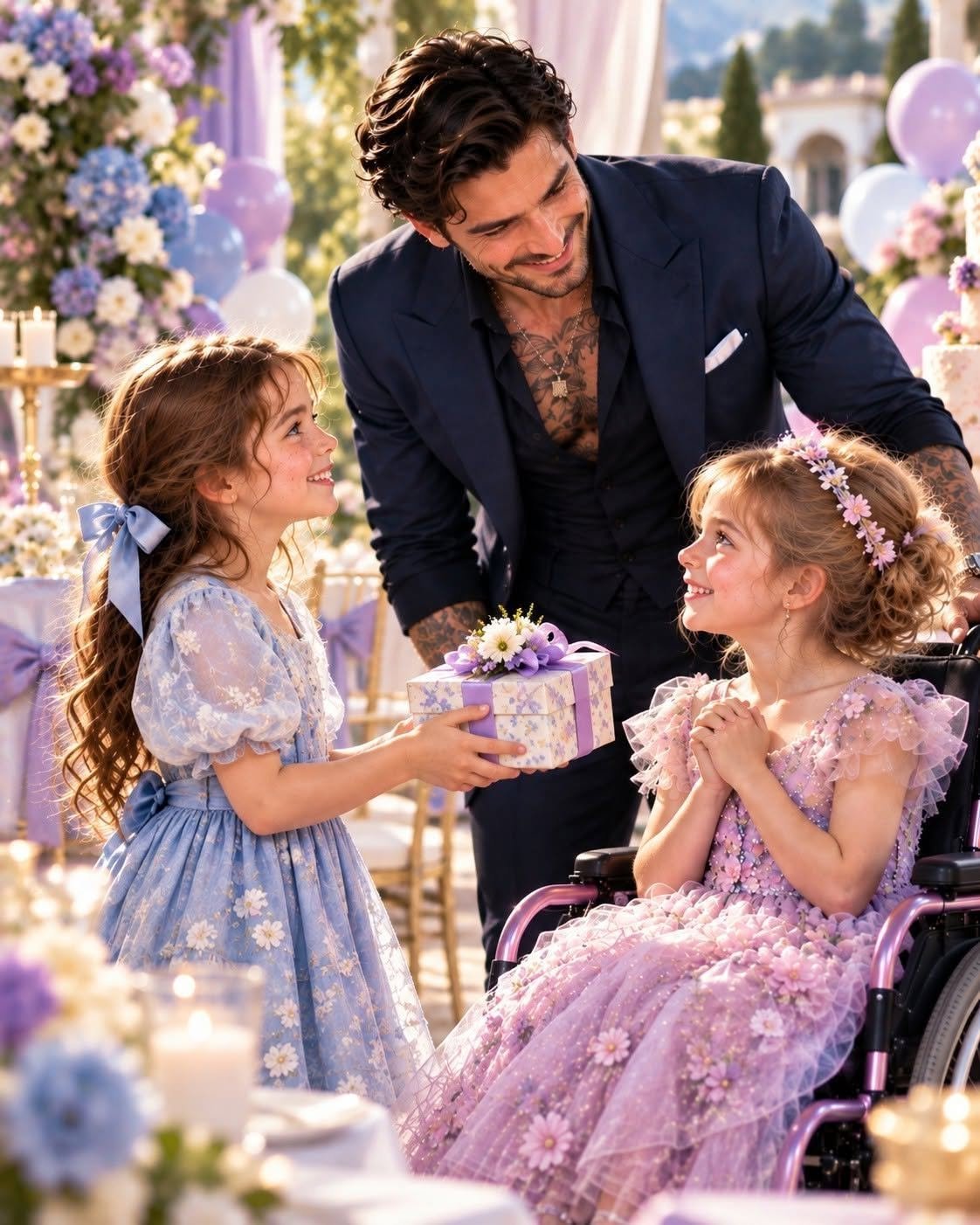
Twenty-eight chairs waited at my daughter’s birthday party, and almost every child invited had abandoned her.
I was Grant Hawthorne,
a man powerful enough to terrify half of Seattle,
yet I couldn’t force anyone to genuinely care about my little girl.
Then security called about a poor,
unknown child standing outside my gates,
and what she was carrying made me forget every rule that had kept my family alive.

PART 1
My name is Grant Hawthorne.
In Seattle,
grown men trembled when I entered a room.
But on my daughter’s birthday,
I stood helpless before twenty-eight empty chairs.
I’d spent a fortune transforming our garden into a galaxy.
Golden balloons.
Glittering stars.
A towering cake with Nova’s name written across it.
She’d been counting down to this day for weeks.
Then the cancellations began.

“Another family backed out,
sir,” my housekeeper whispered.
“How many now?”
“Sixteen.”
I knew why.
Some parents feared my reputation.
Others didn’t want their children playing with a little girl in a wheelchair.
I could’ve made one phone call and filled every chair.
But I couldn’t force anyone to love my daughter.
Upstairs,

I heard Nova speaking to her caregiver.
“If nobody comes,
can we still sing Happy Birthday?”
My heart broke.
I stepped inside.
“There’s my birthday star.”
Nova smiled,
then looked down at her wheelchair.
“Daddy,
is it because I can’t walk?”
I knelt beside her.
“What do you mean,
sweetheart?”
“Maybe the other kids don’t want to play with someone like me.”
I swallowed hard.
“There’s nothing wrong with you,
Nova.”
She touched my cheek.
“I know,
Daddy.
I just wish they knew.”
Outside,
the magician performed for an audience of one.
My employees clapped.
Nova tried to smile.
But I saw her secretly counting the empty chairs.
“Boss,” Vincent whispered,
“I can call those parents.”
“No.”
“They need to learn some respect.”
I looked at my daughter.
“Respect isn’t friendship.
She deserves children who actually want to be here.”
Then Vincent’s earpiece crackled.
“Unknown girl at the east gate.
About nine years old.
Alone.”
I frowned.
“What’s she carrying?”
“A brown paper bag.”
Minutes later,
I stood before a tiny girl wearing worn sneakers and a faded denim jacket.
She looked straight at me.
“Are you Nova’s daddy?”
“Yes.”
She hugged the paper bag tighter.
“My name is Sky.”
Then she whispered something that made my blood run cold.
“I brought something for Nova.
But please don’t let the guards throw it away.”
PART 2: The Gift Inside the Paper Bag
For a moment,
no one moved.
The garden lights glowed behind us,
turning the evening mist silver.
Somewhere near the fountain,
a wind chime gave a soft,
uncertain note.
Sky stood on the other side of the gate with her shoulders hunched against the cold,
both hands wrapped around the paper bag as if it contained something fragile—or something she was afraid to lose.
Vincent shifted beside me.
“Sir,
we should bring her inside the gate.”
Sky’s eyes flicked toward him,
then back to me.
“Only if you promise nobody will take it.”
“I promise,” I said.
Vincent looked at me,
surprised.
He had worked for me long enough to know that promises were not words I used lightly.
I crouched so we were closer to the same height.
“You’re safe here,
Sky.
You can keep holding the bag.
No one is going to take it from you.”
She studied my face.
“Do you promise like a real promise?”
“Yes.”
“Not like when grown-ups say something just so you stop asking?”
A dull ache moved through my chest.
“Like a real promise.”
After another moment,
she nodded.
I opened the gate myself.
Sky stepped through cautiously.
Her sneakers were damp,
and the cuffs of her jeans were dark with rain.
She couldn’t have been more than nine,
perhaps ten.
Her hair had been tied into two uneven braids,
one secured with a blue elastic and the other with a piece of yellow ribbon.
Her denim jacket was too thin for the weather and had been mended at one elbow with careful,
crooked stitches.
She kept the paper bag pressed against her stomach.
“Where are your parents?” I asked gently.
Her fingers tightened around the folded top.
“I came alone.”
“That wasn’t what I asked.”
She looked toward the road beyond the gate.
“My mom is working.”
“At this hour?”
“She works late.”
“Did she know you came here?”
Sky didn’t answer immediately.
That answer told me enough to be concerned,
but not enough to assume anything.
Vincent stepped forward.
“We should call someone.”
Sky flinched.
“Please don’t call the police.”
“No one said anything about police,” I replied.
“People always say that after they call.”
Her voice was calm,
but the fear beneath it was unmistakable.
I glanced at Vincent,
then back to Sky.
“We won’t call anyone without explaining what’s happening.
But we need to know that you’re safe.
That’s important.”
She nodded once,
though she didn’t seem convinced.
From the garden,
music drifted toward us.
The magician had started another trick for Nova,
who was watching from beside the cake table.
When she saw Sky,
her eyes brightened.
“Daddy?” she called.
Sky turned toward the sound.
For the first time since arriving,
her expression softened.
“That’s Nova?”
“Yes.”
“Can I give it to her now?”
I looked at the bag.
“What is it?”
“A birthday present.”
“Did you make it?”
She nodded.
“Then I think she’d like that.”
We walked across the garden together.
I stayed close enough to help if Sky needed it,
but not so close that she felt escorted.
Vincent followed a few paces behind,
speaking quietly into his earpiece.
I heard him ask someone to prepare warm milk and find a clean sweater.
Nova watched Sky approach with open curiosity.
Her caregiver,
Mrs. Alvarez,
moved behind her wheelchair,
but Nova reached back and touched her wrist.
“It’s okay,” Nova said.
“She’s coming to see me.”
Sky stopped in front of her.
Up close,
she looked even smaller beside Nova’s chair.
The garden had been arranged for a crowd of children,
but now the decorations seemed too bright and too large,
as though they belonged to another party taking place somewhere far away.
“Hi,” Nova said.
“Hi.”
“I’m Nova.”
“I know.”
“Daddy said your name is Sky.”
Sky nodded.
Nova glanced at the paper bag.
“Is that for me?”
Sky held it out with both hands.
“I made it.
I didn’t have money for a store present.”
Nova reached for it,
then looked at me.
“Can I open it?”
“You can,” I said.
She carefully unfolded the top.
Inside was a small wooden box,
no bigger than a paperback book.
It had been sanded smooth,
though not perfectly.
Someone had painted tiny stars across the lid in different shades of blue and silver.
A moon sat in one corner,
slightly lopsided but charming.
Nova lifted it out.
“It’s beautiful,” she whispered.
Sky watched her face.
“There’s something inside.”
Nova opened the lid.
A soft melody began to play,
delicate and slightly uneven.
It sounded like a music-box version of “Twinkle,
Twinkle,
Little Star.”
Beneath the mechanism was a folded piece of paper and a small silver charm shaped like a star.
Nova picked up the note.
“What does it say?”
Sky looked down.
“You can read it.”
Nova unfolded the paper.
The letters were written in pencil,
large and careful.
For the girl who knows the sky is bigger than any room.
Happy birthday.
—Sky
Nova read it twice.
Then she pressed the note against her chest.
“I love it.”
Sky’s mouth parted slightly.
“You do?”
“It’s my favorite present.”
The words seemed to surprise everyone,
including me.
Sky looked at the other gifts stacked near the cake table—bright packages wrapped in expensive paper,
each one purchased by someone who had not come.
Then she looked back at the little wooden box.
“Really?”
“Really,” Nova said.
“Did you make the stars?”
“My mom helped me cut the wood.
I painted them.”
“They’re not all the same size.”
“I know.”
“That’s why I like them.”
Nova smiled,
and something changed in Sky’s face.
The guardedness didn’t disappear,
but it loosened.
Mrs. Alvarez brought a tray of food,
and Vincent returned with a warm sweater that belonged to one of the household staff.
Sky hesitated before accepting it.
“You can keep it until you’re warm,” I said.
“Do I have to give it back?”
“No.”
She slipped it over her jacket.
The sleeves covered most of her hands.
Nova noticed.
“You look like you’re wearing a blanket.”
Sky glanced down.
“It’s soft.”
“It’s a very good sweater,” Nova said solemnly.
Sky nodded.
“Then I’ll take care of it.”
The magician,
who had been waiting near the fountain with a deck of cards,
approached with a hopeful smile.
“Would you two like to see a trick?”
Nova looked at Sky.
“Do you like magic?”
Sky’s eyes moved to the cards.
“Sometimes.”
“That sounds like you don’t.”
“I like it when I know how it works.”
The magician laughed.
“That makes you a difficult audience.”
“I’m a good audience,” Sky said.
“I just don’t like being fooled.”
Nova leaned toward her.
“Daddy says surprises are different from being fooled.”
I glanced at my daughter.
“I said that?”
“You said it when Mrs. Alvarez hid my wheelchair gloves.”
“I was trying to help you find them.”
“You found them.”
“Eventually.”
Sky’s expression softened again.
The magician began a trick,
and soon both girls were watching his hands.
Nova guessed incorrectly three times and applauded anyway.
Sky kept her eyes narrowed,
studying every movement.
When the magician finally revealed the card,
she pointed at his sleeve.
“You put it there before you started.”
He stared at her.
Nova burst into laughter.
The sound moved through me with surprising force.
It was the first unguarded laugh I had heard from her all afternoon.
For the next half hour,
the party became something quieter and more genuine.
There were no twenty-eight children,
no loud games,
no parents making polite conversation while watching the clock.
There was only Nova,
Sky,
the magician,
Mrs. Alvarez,
and a few members of the household staff who gradually stopped pretending they were working.
Sky helped Nova choose the music for the cake.
When everyone sang,
Sky joined in softly,
her voice blending with Nova’s.
Nova blew out the candles while Sky held the box safely on her lap.
Afterward,
Nova pushed a slice of cake toward Sky.
“Do you like chocolate?”
“Yes.”
“Then you have to try this.”
Sky looked at me before taking the plate.
“Go ahead,” I said.
She ate one careful bite,
then another.
A small smear of chocolate appeared at the corner of her mouth.
Nova reached for a napkin and handed it to her.
Sky wiped her face.
“My mom likes chocolate cake,” she said.
“Will you take her a piece?” Nova asked.
Sky’s expression changed.
“I don’t know if she’ll be home.”
“Then you can save it.”
Mrs. Alvarez immediately wrapped two slices and placed them in a small container.
Sky watched the process with visible relief.
I stood several feet away,
pretending to check my phone while listening to every word.
There was something about this child that didn’t fit together.
She was polite,
but wary.
She understood the difference between kindness and obligation.
She had walked through the city carrying a handmade gift,
yet she was more worried about a sweater than about her own safety.
And she had known Nova’s name before arriving.
When the girls began examining the music box again,
I stepped toward Vincent.
“Find out where she came from.”
He lowered his voice.
“Already working on it.
The gate cameras show her walking from the east side of the avenue.
She appears to have come from the bus stop near Harrow Street.”
“Alone?”
“Yes.”
“Any adult with her?”
“No.”
“Have someone check the route discreetly.
No uniforms.
I don’t want to frighten her.”
Vincent nodded.
“And contact Elena Park.”
He gave me a questioning look.
“Elena is a family-services attorney,” I explained.
“She can advise us on the right way to proceed.”
“Should I call the authorities?”
“Not yet.
We need to understand the situation first.
If the child is in danger,
we act immediately.
If she isn’t,
we don’t turn a scared girl into a case file simply because she came to our gate.”
Vincent’s expression softened.
“I understand.”
I looked at Sky.
She had removed the paper from the box and was showing Nova how to fold it into a tiny star.
Nova’s hands were slower,
and the first attempt collapsed.
Sky didn’t laugh.
She simply unfolded another sheet and tried again,
moving more carefully this time.
“Like this,” she said.
“You press here.”
Nova concentrated.
The second star held.
She lifted it proudly.
“I did it.”
“You did.”
“Can we make enough to fill your box?”
Sky glanced at the music box.
“It’s yours.”
“You gave it to me.
That means I can decide what to do with it.”
Sky looked at her for a long moment.
Then she nodded.
“Okay.”
The afternoon had slipped into evening by the time the last staff member cleared the tables.
The empty chairs remained arranged in their neat rows,
but they no longer seemed like an accusation.
Nova had asked to bring three of them closer to the fountain so that she and Sky could decorate them with paper stars.
I found myself watching the girls rather than the gate.
There was a strange comfort in seeing Nova speak to someone who didn’t know my name,
my business,
or the rumors that followed our family.
Sky treated her like another child—not a fragile symbol,
not a problem to solve,
not the daughter of a man people feared.
Just Nova.
When the stars were finished,
Nova looked toward me.
“Daddy,
can Sky stay for dinner?”
I opened my mouth,
then paused.
Sky’s shoulders rose slightly,
as though she expected the answer to be no.
“I think she can,” I said.
“If she wants to.”
Sky looked at the wrapped cake in her lap.
“My mom might worry.”
“We can help you contact her.”
She lowered her gaze.
“I don’t have a phone.”
“We can use mine.”
Sky’s fingers folded into the sleeves of the borrowed sweater.
“She doesn’t answer when she’s working.”
“What does she do?”
“Cleans offices.”
“Where?”
“Different places.”
“Do you know where she is tonight?”
Sky nodded.
“At the Mercer Building.”
A chill went through me.
The Mercer Building was one of the properties owned by Hawthorne Holdings.
The lower floors housed several law firms and private financial offices.
The cleaning company contracted there employed dozens of people,
most of whom I had never met.
“Your mother works at the Mercer Building?”
“Sometimes.”
“Is she there now?”
“I think so.”
“Why do you think so?”
“Because she left this morning and said she would be there until late.”
I sat in the chair beside Nova.
“Sky,
how did you know to come here?”
She glanced at Nova,
then at the music box.
“My mom told me.”
“What did she tell you?”
Sky was quiet for so long that the only sound was the ticking of the music box.
Finally,
she said,
“She said if I ever needed help,
I should find Mr. Hawthorne.”
The words landed heavily.
“Why would she say that?”
“I don’t know.”
“Did she say my name?”
“She said Hawthorne.”
That was not an answer.
It was also the first time I sensed that the evening might not be a coincidence.
“What is your mother’s name?”
Sky’s eyes dropped to the wooden box.
“Lena.”
“Lena what?”
She hesitated.
“Lena Vale.”
I knew the name.
Not personally,
but from records.
Lena Vale had worked for Meridian Cleaning Services for almost four years.
Her employment file had crossed my desk two months earlier because she had been recommended for a permanent position at one of our newer properties.
The request had been delayed when the company changed contractors.
I remembered the name because the personnel report had included a note: reliable,
punctual,
no disciplinary issues.
“Does your mother know you’re here?” I asked.
Sky shook her head.
“She told me not to come unless I needed help.”
“Did you need help?”
Her face tightened.
“I needed to give Nova the present.”
“That doesn’t explain why you came alone.”
Sky looked at the darkening garden.
“Mom was upset this morning.”
“About what?”
“I don’t know.”
“Was she upset with you?”
“No.”
“Did something happen?”
Sky picked up one of the paper stars and turned it between her fingers.
“She found a letter.”
“What kind of letter?”
“I don’t know.
It was in her bag.
She read it,
then she sat on the kitchen floor.”
Nova’s expression had become serious.
“Was your mom crying?”
Sky nodded.
“Did she tell you what the letter said?”
“She said someone had been looking for her.”
A quiet settled over us.
I kept my voice calm.
“Who?”
“She didn’t say.”
“Did anyone come to your home?”
“No.”
“Did anyone follow you here?”
“I don’t think so.”
Vincent,
standing near the veranda,
heard the change in my tone.
He discreetly touched his earpiece.
Sky looked at me.
“Am I in trouble?”
“No.”
“Is my mom?”
“No.
Not from anything you’ve told me.”
“Then why do you look like that?”
I glanced down at my hands.
Because I had spent years learning to recognize danger in silence,
in unexplained delays,
in people who appeared where they shouldn’t.
But this did not feel like the threats I was accustomed to.
It felt more personal,
and somehow more vulnerable.
“I’m trying to understand,” I said.
Sky seemed to accept that.
A few minutes later,
Vincent approached.
“Mr. Hawthorne,
Elena is on her way.
Also,
our driver checked the bus stop.
The route Sky took is straightforward.
No one followed her.”
“Good.”
He looked toward Sky.
“And the Mercer Building?”
“We’re confirming whether Lena Vale clocked in.”
Sky’s head lifted.
“She did.”
Vincent paused.
“How do you know?”
“She called me from the lobby before work.”
“You spoke with her today?”
Sky nodded.
“She said she was sorry she couldn’t come to Nova’s party.”
That surprised me.
“How did she know about the party?”
“Mom knows your housekeeper.
Mrs. Alvarez gave her the invitation.”
I looked at Mrs. Alvarez,
who was gathering plates nearby.
She nodded slowly.
“Lena has cleaned the east wing several times,” she said.
“She’s a very kind woman.
She told me her daughter loved stars.”
That explained the wooden box,
but not the letter.
“Did she say anything else?” I asked.
Mrs. Alvarez frowned,
searching her memory.
“She asked whether you were at home.”
“Why?”
“She didn’t say.”
Before I could respond,
Vincent’s phone vibrated.
He read the message,
then looked at me.
“Lena Vale clocked in at six forty-two this morning,” he said.
“But she left the Mercer Building at eleven twelve.”
“Did she return?”
“No.”
“Where did she go?”
“We’re checking the cameras.”
Sky’s fingers closed around the paper star.
“She went home,” she said.
“Why?”
“Because she called me.”
“What did she say?”
Sky’s voice became smaller.
“She said I should stay inside and lock the door.”
Every instinct in me wanted to ask more questions,
but Nova reached across the space between them and placed her hand over Sky’s.
“You can stay here tonight,” she said.
Sky looked at her.
“Can I?”
Nova looked at me.
I had faced difficult decisions in boardrooms and courtrooms,
with millions of dollars at stake and people waiting for me to make the wrong choice.
None of them had prepared me for the trust in two children’s eyes.
“Yes,” I said.
“You can stay until we know your mother is safe and you have somewhere safe to go.”
Sky exhaled,
almost soundlessly.
Elena arrived twenty minutes later.
She came through the side entrance carrying a leather folder,
her dark hair pulled into a practical knot.
She had advised our family during Nova’s medical treatment and knew how to be reassuring without making false promises.
She spoke with Sky privately in the library while Nova and I waited outside.
Through the closed doors,
I could see Sky sitting on the edge of a sofa,
the borrowed sweater hanging around her small frame.
Elena sat across from her,
not taking notes until Sky seemed comfortable.
Nova leaned against my arm.
“Is Sky in trouble?”
“No.”
“Is her mom?”
“I don’t know.”
“Daddy?”
“Yes?”
“Why do grown-ups always say they don’t know when they do know something?”
I looked down at her.
“Because sometimes knowing part of something isn’t the same as understanding all of it.”
She considered this.
“Like when you knew my wheelchair had a flat tire but didn’t know who did it?”
“That
PART 3: The Gift Inside the Paper Bag
I read the words twice.
Grant Hawthorne knows the truth about Daniel.
The photograph trembled slightly between my fingers—not from fear,
but from the sudden return of a memory I had spent years refusing to examine too closely.
A construction site in South Lake Union.
Rain striking the unfinished steel framework.
Daniel Vale standing across from me with a red folder tucked beneath his arm and exhaustion in his eyes.
He had said,
“If something happens,
you’ll understand what this means.”
I had thought he was being dramatic.
Three days later,
he disappeared.
“Daddy?” Nova’s voice drew me back.
I lowered the photograph.
Sky stood beside the table,
watching my face with the careful attention of a child who had learned to measure adults by what they did not say.
“Do you know him?” she asked.
“Yes.”
“Daniel?”
I looked at her.
“I knew a man named Daniel Vale.”
“Was he my father?”
“I don’t know.”
That answer hurt her.
I could see it in the way her chin lowered,
though she tried to hide the disappointment.
“But you knew him.”
“Yes.”
“Why didn’t Mom ever tell me?”
“That may be something you should ask her when she’s here.”
“She won’t tell me.”
“You don’t know that.”
Sky folded her arms inside the sleeves of the borrowed sweater.
“She says some things are safer when they stay forgotten.”
The sentence struck closer than it should have.
I turned the photograph over again.
The cut edge where the third face had been removed was clean and deliberate.
Whoever had done it had not torn the picture in anger.
They had used scissors.
The brass key remained in the compartment.
“Sky,” I said,
“did your mother tell you where this key goes?”
She shook her head.
“She said you would know.”
“I don’t.”
The words came out more sharply than I intended.
Sky flinched.
I immediately set the photograph down.
“I’m sorry.
I’m not angry with you.”
“I know.”
“No,
you don’t.
You shouldn’t have to guess what adults mean.”
She looked at me with an expression so familiar that it stopped me.
Nova wore that same look whenever she was trying to decide whether my frustration belonged to her.
It was the look of a child who had learned to make herself smaller around uncertainty.
I knelt beside Sky.
“This isn’t your fault.
None of it.”
She nodded,
but her eyes remained fixed on the key.
Elena moved closer.
“Perhaps we should let her rest,” she said gently.
“The answers can wait until morning.”
Sky’s fingers curled around the edge of the table.
“What if my mom doesn’t come back?”
The question was quiet,
but it filled the room.
Elena crouched beside her.
“Your mother is an adult,
Sky.
She may be delayed or dealing with something she hasn’t been able to explain yet.
We’ll find her,
and we’ll make sure you’re not alone while we do.”
“People say that when they don’t know where someone is.”
“I know,” Elena said.
“So I won’t promise that we know what will happen.
I will promise that we’ll keep looking and that you’ll be included in what happens next.”
Sky studied her.
“Really?”
“Really.”
That was why I trusted Elena.
She never mistook reassurance for certainty.
Vincent entered the library,
his expression controlled but concerned.
“Mr. Hawthorne,
we located the vehicle Lena used this morning.”
“Where?”
“Parked behind the Mercer Building.
It hasn’t moved since eight forty-five.”
Sky’s face tightened.
“Then she’s still there?”
“Not necessarily,” Vincent said.
“Her car may have remained while she left with someone else.”
“Did the cameras show her?”
“Not yet.
The security system was undergoing maintenance between ten fifty and eleven thirty.
We’re reviewing the available footage.”
“Who authorized the maintenance?”
“A contractor called Northstar Systems.”
The name tugged at another memory.
“Northstar handled security upgrades at the Harrow Street project,” I said.
Vincent nodded.
“The same company.”
“What do we know about them?”
“Not enough yet.”
“Then find out.”
He started to leave,
but I stopped him.
“Quietly.
No one approaches the building until we understand what we’re looking at.”
Vincent hesitated.
“If Lena is inside—”
“We contact the building manager and the cleaning supervisor.
We don’t send a team storming through the offices.
This is an investigation,
not an operation.”
His jaw shifted,
but he nodded.
“I’ll handle it.”
After he left,
Sky looked at me.
“Are you going to find my mom?”
“Yes.”
“Because she told me to come here?”
“Because she’s your mother and you deserve to know where she is.”
Sky’s eyes moved to Nova.
“And because I gave her the music box?”
Nova reached across the table and took her hand.
“Daddy would find her anyway.”
Sky looked at me again.
I didn’t know whether that was true.
My resources could locate people,
retrieve records,
and uncover details others wished to conceal.
But finding someone was not the same as helping them feel safe enough to return.
Still,
I said,
“Yes.
I would.”
Mrs. Alvarez prepared the guest room beside Nova’s.
Sky resisted at first,
saying she could sleep on the sofa,
but Nova insisted that the room had the best view of the garden.
“You can see the moon from the window,” she said.
“Does it always look that big?”
“Only when you’re awake late.”
“Are you awake late often?”
“Sometimes.
Daddy says I need more sleep.”
“Do you listen?”
“Sometimes.”
Sky glanced at me.
“I’m beginning to understand.”
Nova laughed.
The sound eased something inside me.
As Mrs. Alvarez guided them upstairs,
I remained in the library with Elena and the photograph.
She examined the brass key without touching it.
“It’s old,” she said.
“Probably for a file cabinet or storage box.”
“Or a safe.”
“Did Daniel have access to anything on Hawthorne property?”
“Hundreds of people did.”
“That isn’t what I asked.”
I looked toward the dark windows.
Daniel had been a site supervisor for Marlowe Construction,
one of the companies involved in building a waterfront complex we acquired six years earlier.
The project had suffered delays,
missing materials,
and a dispute over expense reports.
Daniel had insisted that someone was falsifying safety records and diverting funds through subcontractors.
The company’s owners accused him of theft.
He denied it.
I had reviewed the documents and decided the matter was an internal dispute.
We terminated the contract,
settled the financial claim,
and moved on.
Then Daniel vanished.
His car had been found near the ferry terminal.
His employer said he had abandoned his position.
Lena,
according to the records,
had moved apartments and stopped responding to calls.
I had assumed she wanted privacy.
Maybe I had simply accepted the explanation that required the least from me.
“Tell me everything you remember,” Elena said.
I gave her the facts as I knew them.
Daniel had been intelligent,
meticulous,
and difficult to intimidate.
He had kept handwritten notes even when everyone else used digital records.
He had complained that invoices were being approved by someone outside the normal chain of command.
“I met him once at the construction site,” I said.
“He asked for a private conversation.”
“What did he say?”
“He said he had proof that someone was manipulating the project accounts.”
“Did he name anyone?”
“No.”
“Why not?”
“He said he didn’t know who could be trusted.”
Elena’s gaze shifted to the photograph.
“And yet he trusted you.”
“I’m not sure he did.”
“Then why leave a message saying you knew the truth?”
“I may have known more than I understood.”
That was the part I had never admitted aloud.
The day Daniel disappeared,
I received an envelope at my office.
Inside was a photocopy of a payment ledger and a note with three lines:
Ask who approved the emergency transfers.
Ask why the night crew was paid twice.
Ask who changed the records.
I had given the materials to our legal department.
They reported that the ledger was incomplete and impossible to authenticate.
The project’s accounting manager insisted the transfers were legitimate.
Marlowe’s owners threatened litigation.
A week later,
Daniel’s file was closed.
I had let it go.
Not because I believed he was guilty,
but because too many other problems demanded my attention.
My father had been ill.
Nova had just begun treatment for the condition that would eventually take away her ability to walk.
I had told myself that the matter belonged to lawyers and investigators.
Perhaps it had belonged to courage.
“Did you keep the envelope?” Elena asked.
“I don’t know.”
“That means yes or no?”
“It means I’ll find out.”
I called my office and asked my assistant to search the archived case files.
While we waited,
the house became quiet.
Rain began tapping against the library windows,
soft at first,
then steadier.
Elena placed the photograph on the table.
“The third person may be the key.”
“I agree.”
“Do you recognize the clothing?”
I studied the image.
Daniel wore a reflective vest over a flannel shirt.
Lena stood beside him in a dark coat.
The third person’s shoulder remained visible where the face had been cut away.
A tailored black sleeve.
A silver watch.
On the wrist,
a narrow band of blue.
I leaned closer.
“That bracelet.”
“What about it?”
“I’ve seen it before.”
“On whom?”
I searched my memory.
At the construction site,
several executives had visited during the dispute.
Marlowe’s chief financial officer.
The project architect.
A representative from the city.
My own general counsel.
Then I remembered a woman standing beside the temporary office trailer,
holding a clipboard while Daniel argued with someone inside.
“Marian Rusk,” I said.
Elena frowned.
“Who is that?”
“She was my father’s executive assistant.”
“Your father’s?”
“By then,
she had become chief administrative officer of Hawthorne Holdings.”
“Did she work on the project?”
“Not officially.”
“But she was there.”
“Yes.”
“Why?”
“I don’t know.”
The answer felt different this time.
Not incomplete.
Avoided.
Marian Rusk had worked for my father for nearly thirty years.
After his death,
she remained with the company and advised me through the transition.
She knew every internal system,
every investment,
every person who mattered.
She had been the one to tell me the Daniel Vale dispute was not worth pursuing.
I had trusted her judgment without asking enough questions.
My phone rang.
It was my assistant.
“We found the archived envelope,” she said.
“It was stored with the Marlowe settlement documents.”
“Read me the contents.”
“There’s the payment ledger,
the note you mentioned,
and a small sealed packet.”
“What’s in the packet?”
“I haven’t opened it.”
“Bring everything to the house.”
There was a pause.
“Sir,
the packet is addressed to you.”
“Bring it.”
When I ended the call,
Elena was watching me.
“Do you think this is connected?”
“I think Daniel tried to leave a trail.”
“And Lena found part of it.”
“Maybe.”
“Then we need to be careful.
If she believes someone is searching for her,
she may be afraid to contact anyone.”
“What should we do?”
“Start with the truth.
Not all of it at once.
But enough to show her that you’re not hiding what you know.”
I looked toward the ceiling,
where the children were likely still speaking in low voices.
“Sky has spent her life hearing that some things are safer forgotten.”
“Then don’t make her forget more.”
My assistant arrived forty minutes later with a banker’s box and a sealed envelope.
I opened the box in front of Elena.
The ledger contained columns of payments,
vendor names,
dates,
and handwritten annotations.
Several transfers had been marked with small blue dots.
The ink was faded but recognizable.
Daniel’s handwriting.
The amounts were not large individually.
Together,
they formed a pattern: emergency payments made after midnight,
each one sent to shell companies connected to temporary labor contracts.
At the bottom of the last page,
Daniel had written:
The names change.
The account doesn’t.
The sealed packet was heavier than paper should have been.
I opened it carefully.
Inside was a memory card and a single handwritten sentence.
**If you are reading this,
ask Marian what happened to the night ledger.**
Elena went still.
I read the sentence again.
“Who is Marian?” she asked.
“Marian Rusk.”
“Your former executive?”
“She still advises the board.”
“Does she know about the packet?”
“I don’t know.”
“Then don’t tell her yet.”
I picked up the memory card.
The label bore a date from six years earlier—the same week Daniel vanished.
Before we could examine it,
a sound came from the hallway.
Sky stood just beyond the library door.
She was holding the music box against her chest.
“You know Marian,” she said.
I stood.
“Yes.”
“Is she the person my mom was afraid of?”
“I don’t know.”
Sky’s eyes filled,
though no tears fell.
“Mom said not to trust anyone who worked for the old Hawthorne family.”
The words struck with such force that Elena moved closer to her.
“Did your mother say Marian’s name?”
Sky shook her head.
“She said there was a woman who knew where my father went.”
“Did she tell you your father was Daniel?”
“She said Daniel was my father.”
It was the first time Sky had spoken with certainty.
I glanced at the photograph.
“Did she tell you he was alive?”
Sky pressed her lips together.
“She said she didn’t know.”
The room seemed to narrow around us.
Elena guided Sky to a chair.
“Sky,
your mother may have been trying to protect you from information she didn’t fully understand.”
“But she said Mr. Hawthorne could tell me.”
I sat across from her.
“I may be able to tell you some things.
But I don’t want to give you an answer before I know it’s true.”
“Adults always want proof.”
“Proof matters when someone’s life is part of the question.”
“What if the truth makes everything worse?”
“Sometimes it does make things difficult.”
Sky looked down at the music box.
“Then why look for it?”
I thought of Nova upstairs,
of the empty chairs,
of the way she had asked whether children avoided her because she couldn’t walk.
I thought of how easily I had accepted silence when silence was convenient.
“Because not knowing can hurt too,” I said.
Sky nodded slowly.
That night,
she slept in the guest room while Nova remained awake beside the window,
watching the rain.
I found her there after midnight.
“You should be in bed,” I said.
“So should you.”
“I’m checking on you.”
“I’m checking on Sky.”
“She’s asleep.”
“Are you sure?”
“Yes.”
Nova looked at me.
“Are you scared?”
The question was so direct that I almost denied it.
“A little.”
“Because of the photograph?”
“Because of what it might mean.”
She turned her chair toward the window.
“Sometimes when I’m scared,
I imagine the worst thing so it won’t surprise me.”
“That sounds exhausting.”
“It is.”
I knelt beside her.
“You don’t have to carry this.”
“Neither do you.”
I smiled faintly.
“That’s not how being a father works.”
“Maybe it should be.”
I rested my forehead against hers.
For a while,
neither of us spoke.
Then the security system chimed downstairs.
Vincent’s voice came through my phone.
“Sir,
we’ve received an alert from the Mercer Building.”
“What kind?”
“Someone accessed the maintenance corridor using a master credential.
The building manager says the person entered the records room.”
“Do we have a description?”
“Only partial camera footage.”
“Send it to me.”
A still image appeared on my screen.
The figure was blurred by the angle and poor lighting.
Dark coat.
Slim build.
One hand raised near the face.
On the wrist was a silver watch.
Beneath it,
a narrow blue band.
I stared at the image.
“Grant?” Vincent asked.
I looked toward the guest room.
“Lock down the house discreetly.
No alarms,
no panic.
Have someone verify that Sky is still asleep.”
“Already doing it.”
“And Vincent?”
“Yes?”
“Find Marian Rusk.
Don’t confront her.
Just find out where she is.”
A message arrived seconds later.
Marian Rusk left her residence at 11:48 p.m.
Her phone is off.
I looked down at the memory card in my hand.
Then another message appeared.
**Sir,
we accessed the Mercer Building records room.**
One file is missing.
“What file?” I asked.
Vincent’s reply came after a long pause.
“Daniel Vale’s personnel file.”
My grip tightened around the phone.
From upstairs came the faint sound of the music box beginning to play.
But Sky was asleep.
I ran toward the guest room.
The door stood open.
The bed was empty,
the borrowed sweater folded neatly on the pillow.
On the windowsill lay the brass key.
And beneath it,
written in careful pencil,
were five words:
She took me to Daniel.