“At twelve years old, I sent one desperate text asking my aunt for $20 because my baby brother was crying from hunger and there wasn’t a drop of milk left in our refrigerator. I checked the number three times before pressing send, but somehow I still got it wrong, and my message landed on the phone of Lorenzo Moretti, one of Detroit’s most feared mafia bosses.
My name is Emily Carter, and by twelve, I already understood things children shouldn’t have to understand.
We lived in a worn-down house on the edge of Detroit where winter wind slipped through cracks around the windows. Some nights, I went to bed wondering whether morning would bring breakfast or another empty kitchen.

Mom cleaned houses for a living.
She left before sunrise and often returned after dark with aching feet, rough hands, and a back that constantly hurt. Somehow, she still walked through our front door smiling because she never wanted Noah and me to see how scared she was.
Noah was my one-year-old baby brother.
He didn’t understand overdue bills or empty cabinets.
He only understood when his stomach hurt.
That afternoon, he started crying.
Not fussing.
Not whining.
Crying from hunger.
I held him against my chest and gently rocked him.

“It’s okay, Noah. I’ll find something for you.”
I had no idea how.
Still, I carried him into the kitchen and searched.
I opened the cabinets once.
Then twice.
Then a third time, as if food might somehow appear because I needed it badly enough.
Nothing.
I checked the drawers.
Empty.
Finally, I opened the refrigerator.
Cold air touched my face.
That was all it contained.
I stared inside while Noah cried against my shoulder, and a lump rose in my throat. I wanted to sit on the kitchen floor and cry with him, but I couldn’t.
If I fell apart, who would comfort him?
Then I remembered Aunt Lisa.
She didn’t have much either, but sometimes she helped Mom when things became desperate. Twenty dollars might not have seemed like much to other people, but that afternoon it felt like the difference between my brother eating and going hungry.
I found Mom’s old phone on the counter.
Its screen was cracked, and it took forever to respond, but it worked.
My fingers trembled as I typed.
“Aunt Lisa, can you send me $20? I need to buy milk for Noah. I promise I’ll pay you back. Please.”
I read the message three times.
Asking for help embarrassed me, especially because I had nothing with which to repay her. But Noah’s cries were becoming weaker, and embarrassment suddenly felt like a luxury.
I checked the number.
Then I pressed send.
For a few seconds, nothing happened.
I put the phone down and kissed Noah’s forehead.
“She’ll help us.”
Then the phone buzzed.
My heart jumped.
I grabbed it, expecting Aunt Lisa’s name.
Instead, the screen showed an unfamiliar number.
The message contained only five words.
“Emily, who is baby Noah?”
My stomach dropped.
I checked the number again.
One digit was wrong.
I hadn’t texted Aunt Lisa.
Panicking, I typed, “I’m sorry. Wrong number. Please ignore it.”
The reply came almost immediately.
“Wait.”
I froze.
Another message appeared.
“Don’t apologize. Is your brother hungry right now?”
I stared at those words, suddenly frightened that I had told a complete stranger too much.
What I couldn’t possibly know was that the stranger reading my message wasn’t simply wealthy.
His name was Lorenzo Moretti.
He was one of the most feared mafia bosses in Detroit, a man whose name could silence a crowded room and whose black cars were recognized long before anyone saw his face.
Yet that afternoon, Lorenzo wasn’t looking at an enemy’s name.
He was staring at a message from a twelve-year-old girl asking for twenty dollars to buy milk for her baby brother.
For several seconds, he said nothing.
Then Lorenzo Moretti reached for his car keys.
PART 2
Lorenzo Moretti did not drive directly to the address Emily eventually gave him.
He knew better than that.
A twelve-year-old girl had accidentally texted a stranger. The last thing she needed was that stranger appearing unexpectedly at her front door, no matter how sincere his intentions might be.
Instead, Lorenzo drove three blocks from his office to Bellini’s Market, a small neighborhood grocery store that had survived three recessions, two ownership changes, and the arrival of a giant supermarket less than a mile away.The owner, Frank Bellini, was standing behind the register when Lorenzo entered.
Frank looked up.
“Mr. Moretti.”
“Frank.”
Something in Lorenzo’s expression made the older man straighten.
“What do you need?”
Lorenzo took out his phone.
“Milk. Baby food. Formula, if they need it. Eggs. Bread. Fruit. Vegetables. Chicken. Rice. Pasta. Cereal.”
Frank blinked.
“That’s quite a list.”
“Add whatever a family with a twelve-year-old girl and a one-year-old boy might need for a week.”
Frank studied him for a moment.
“Everything all right?”
Lorenzo looked toward the shelves.
“I received a wrong-number text.”
Frank waited.
Lorenzo offered no further explanation.
After knowing him for nearly twenty years, Frank understood when not to ask questions.
“Address?”
Lorenzo showed him.
Frank’s eyebrows rose slightly.
“That neighborhood?”
“Yes.”
“I can have Joey deliver it.”
“Have Maria go with him.”
Frank nodded. His wife often helped with deliveries to elderly customers and families who needed assistance.
Lorenzo pulled several bills from his wallet.
Frank stared at the money.
“That’ll buy groceries for a month.”
“Then buy groceries for a month.”
“Lorenzo—”
“Please.”
That word surprised Frank more than the money.
He quietly accepted it.
Twenty minutes later, Emily heard a knock.
She was sitting with Noah on the living-room floor. After her accidental conversation with the stranger, she had grown nervous and stopped answering his questions.
She had given him only the neighborhood at first.
Then he had written:
“I’m not coming to your house. I’d like a grocery store to send you what Noah needs. You don’t have to give me your address if you’re uncomfortable.”Emily had hesitated.
Noah, meanwhile, had finally exhausted himself from crying and fallen asleep against her.
She had stared at his small face.
Then she had sent the address.
Now somebody was knocking.
Emily’s heart began pounding.
She approached the door but did not open it.
“Who is it?”
A woman answered.
“Bellini’s Market, sweetheart. Grocery delivery.”
Emily frowned.
“We didn’t order groceries.”
“They’re already paid for.”
Emily opened the door only as far as the chain allowed.
A woman about her mother’s age stood outside wearing a red Bellini’s Market jacket. Beside her was a teenage boy holding two grocery bags.
Behind them, the back of a small delivery van was open.
It was filled with more bags.
Emily stared.
The woman smiled gently.
“My name is Maria. My husband owns Bellini’s. Somebody asked us to bring these.”
“How much?”
“Nothing.”
“But—”
“Already paid.”
Emily looked from Maria to the van.
“How many groceries are there?”
Maria glanced over her shoulder.
“Well…”
The teenage boy laughed.
“A lot.”
For the first time that afternoon, Emily almost smiled.
Then she remembered something important.
“Wait here.”
She closed the door.
Maria heard the chain slide free.
When Emily opened it again, she remained cautious.
“My mom says never let strangers inside.”
“That is an excellent rule,” Maria said immediately. “We’ll leave everything right here on the porch.”
Emily relaxed.
Together, Maria and her son carried bag after bag to the porch.
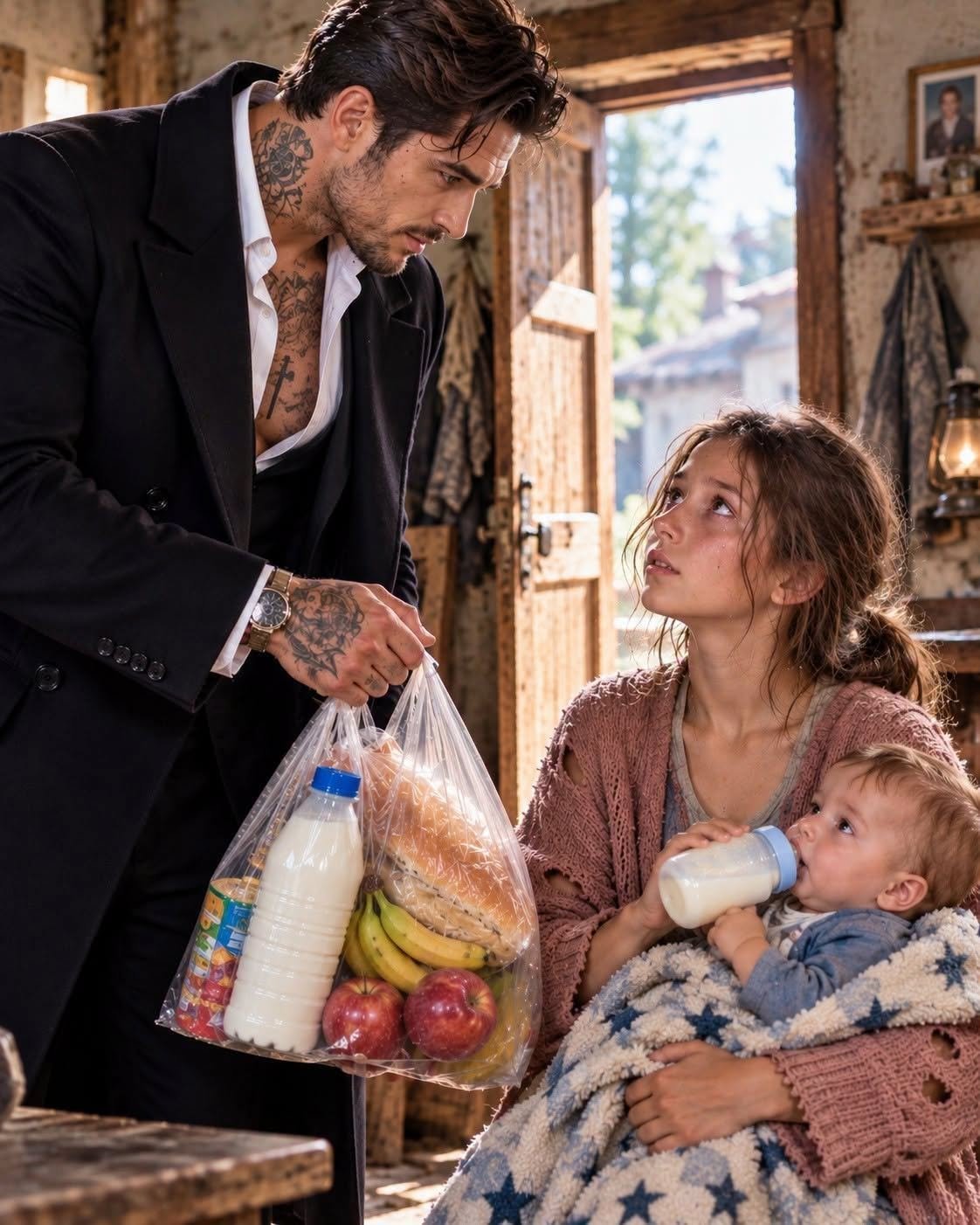
Milk.
Bread.
Eggs.
Bananas.
Apples.
Vegetables.
Chicken.
Rice.
Pasta.
Oatmeal.
Cheese.
Cereal.
Baby food.
Diapers.
Formula.
Even a small bag of chocolate-chip cookies.
Emily stared at the growing collection.
“Did he buy the whole store?”
Maria laughed.
“Not quite.”
When they finished, Maria handed Emily a receipt.
The bottom read:
PAID IN FULL.
Emily looked at it.
“Who paid?”
Maria paused.
“A man who said a little boy shouldn’t have to wait for dinner because somebody typed one number wrong.”
Emily looked down.
She did not know what to say.
Maria seemed to understand.
“You don’t owe anybody anything, sweetheart.”
Those words mattered.
Emily nodded.
“Thank you.”
“You’re welcome.”
When the van disappeared, Emily carried the bags inside one at a time.
By the time she finished, the refrigerator looked unlike anything she could remember.
There was actual food on every shelf.
She prepared Noah’s milk carefully, following the directions exactly as her mother had taught her.
A few minutes later, Noah sat safely in his high chair, drinking contentedly.
Emily pulled a chair beside him.
She watched his eyelids grow heavy.
The tight feeling inside her chest finally loosened.Then she looked at the cracked phone on the counter.
There was another message.
“Did the groceries arrive?”
Emily typed:
“Yes.”
Then:
“Thank you.”
She hesitated before adding:
“My mom is probably going to be mad.”
The response came a minute later.
“Why?”
“She doesn’t like owing people.”
Lorenzo stared at the message from behind the wheel of his parked car.
That answer felt strangely familiar.
He typed:
“Then tell her she owes me nothing.”
Emily replied:
“She might not believe that.”Lorenzo almost smiled.
“She sounds sensible.”
Emily looked toward the front window.
The sun was beginning to fall behind the bare trees.
Mom would be home soon.
That realization brought a new worry.
How exactly was she supposed to explain a refrigerator full of groceries purchased by an unknown man?
At 6:18, Sarah Carter’s old Ford pulled into the driveway.
Emily saw it through the window and immediately stood.
“Okay,” she whispered to herself. “Just tell the truth.”
Sarah entered carrying her cleaning bag.She looked exhausted.
Her brown hair had escaped its ponytail, and there were faint circles under her eyes.
“Hi, baby.”
She kissed Emily’s forehead before walking toward Noah.
“And how is my handsome little—”
She stopped.
Her gaze moved toward the kitchen.
Then toward Emily.
Then toward the kitchen again.
“Emily?”
Emily swallowed.
“Yes?”
“Why are there six grocery bags on the table?”
Emily remained silent.
Sarah stepped farther inside.
She opened the refrigerator.
Her face changed.
“Emily.”
“There are actually more in the cabinets.”Sarah slowly closed the refrigerator.
“Where did this come from?”
Emily clasped her hands together.
“It’s a weird story.”
Sarah’s exhaustion vanished immediately.
“What happened?”
“I texted Aunt Lisa.”
“Okay.”
“Except I didn’t.”
Sarah frowned.
“What does that mean?”
“I typed one number wrong.”
Sarah stared.
Emily spoke faster.
“I asked for twenty dollars because Noah was hungry and there wasn’t milk and I knew you were working and I didn’t want to bother you and Aunt Lisa sometimes helps, but I got the number wrong and this man answered.”
Sarah went pale.
“You gave a stranger our address?”
“Not at first.”
“Emily.”
“He promised he wasn’t coming here. He had a grocery store deliver everything.”
Sarah pressed her fingers against her forehead.
“Emily, honey, you cannot give strangers our address.”
“I know.”
“No matter how nice somebody seems.”
“I know.”
“You don’t know who people are.”
Emily looked down.
“I was scared Noah wouldn’t eat.”
Sarah stopped.
The anger disappeared as quickly as it had come.
She looked at her daughter.
Advertisement
Really looked.
Emily was twelve.
Yet somehow Sarah had allowed life to place adult worries on those narrow shoulders.
Sarah crossed the kitchen and wrapped her arms around her.
“Oh, sweetheart.”
“I’m sorry.”
“No.”
Sarah closed her eyes.
“No, I’m sorry.”
Emily leaned against her.
“I didn’t know what else to do.”
“You should have called me.”
“You were working.”
“I would have come home.”
“But then you might lose another client.”
Sarah’s eyes opened.
That sentence hurt more than she expected.
Because Emily had understood too much.
Sarah pulled back.
“You are not responsible for keeping my clients.”
Emily said nothing.
“You are not responsible for paying bills.”
Silence.
“And you are not responsible for making sure this family survives.”
Emily’s eyes filled.
“Then who helps you?”
Sarah had no immediate answer.
She touched her daughter’s cheek.
“I’m the mother.”
“That doesn’t mean you shouldn’t get help.”
For a moment, Sarah simply stared at her.
Children sometimes saw truths adults spent years avoiding.
Noah dropped his cup.
It bounced across the kitchen floor.
The sound broke the tension.
Sarah picked it up and kissed his hair.
“First,” she said, “we are going to figure out who sent all this.”
Emily brought her the phone.
Sarah read the conversation carefully.
The stranger had never asked anything inappropriate.
He had not requested photographs.
He had not asked Emily to hide the conversation.
In fact, one message specifically read:
“Please show these messages to your mother when she gets home.”Sarah felt some of her fear ease.
Then she reached the final text.
There was a name.
“If your mother wants to speak with me, my name is Lorenzo Moretti.”
Sarah froze.
Emily noticed.
“Mom?”
Sarah read the name again.
“You know him?”
“No.”
But her answer came too quickly.
Emily had inherited her mother’s ability to notice things.
“You made a face.”
“I didn’t.”
“You definitely made a face.”
Sarah put the phone down.
She knew the name.
Everyone who had lived in certain parts of Detroit long enough knew the Moretti name.
Some stories were probably exaggerated.
Some were probably not.
But none of them explained why Lorenzo Moretti had bought groceries for her children.
Sarah immediately dialed the number.
Lorenzo answered on the second ring.
“Hello?”
“This is Sarah Carter.”
He sat straighter.
“Emily’s mother.”
“Yes.”
“I’m glad you called.”
“I need to understand what happened.”
“Your daughter sent me a message intended for her aunt.”
“I know that part.”
“She asked for twenty dollars.”
“And you sent enough groceries to fill my kitchen.”
There was a pause.
“Yes.”
“Why?”
Lorenzo looked through his windshield.
Because twenty dollars had seemed insulting once he understood the situation.
Because the desperation in Emily’s message had reminded him of things he rarely allowed himself to remember.
Because there had been a time when his own mother counted coins at a kitchen table.
Instead he said simply, “Because I could.”
Sarah sighed.
“That isn’t an answer.”
“It’s the truthful one.”
“My daughter is twelve.”
“I understand.”
“She gave our address to somebody she doesn’t know.”
“That worried me too. It’s why I sent a grocery store rather than going myself.”
Sarah was quiet.
That answer surprised her.
“I appreciate that.”
“You should still talk to her about giving strangers personal information.”
“I already did.”
“Good.”
Sarah looked at the refrigerator.
“This is too much.”
“It’s groceries.”
“It’s hundreds of dollars.”
“You don’t owe me anything.”
“I don’t take things from people I don’t know.”
Lorenzo almost responded immediately.
Then something stopped him.
Carter.
He looked at the message again.
Sarah Carter.
Something about the name bothered him.
Not negatively.
Familiarity.
“Mrs. Carter?”
“Yes?”
“Can I ask you one question?”
“That depends.”
“Was your husband named Michael?”
Sarah’s fingers tightened around the phone.
The kitchen suddenly seemed very quiet.
Emily was watching her.
“How do you know my husband’s name?”
Lorenzo did not answer immediately.
A memory had opened.
Snow falling across Woodward Avenue.
Flashing ambulance lights.
His mother’s frightened voice.
A young paramedic kneeling beside her.
A handwritten note Lorenzo had kept for years.
Michael Carter.
Lorenzo leaned back against the seat.
“Mrs. Carter…”
Sarah’s voice hardened with confusion.
“What does Michael have to do with you?”
Lorenzo looked down at his hand.
There were moments when the past seemed buried.
Then sometimes, without warning, it knocked.
“I think,” he said slowly, “your daughter may have texted someone who has been trying to find your family for a very long time.”
Sarah stopped breathing for a second.
“What are you talking about?”
“I knew your husband.”
Sarah looked toward the framed photograph sitting on the living-room shelf.
Michael was smiling in his paramedic uniform, one arm around Sarah.
The picture had been taken seven years earlier.
Before Noah.
Before illness.
Before life narrowed into bills and survival.
“How?”
Lorenzo spoke quietly.
“Not the way you probably think.”
Sarah said nothing.
“My mother’s name was Elena Moretti.”
The name meant nothing to her.
“She had a medical emergency during a snowstorm,” Lorenzo continued. “Your husband was the paramedic who answered the call.”
Sarah sat down.
“That could have been anyone.”
“No.”
His certainty unsettled her.
“It was Michael.”
“How can you be sure?”
“Because my mother talked about him until the day she died.”
Sarah’s hand moved unconsciously to her mouth.
Lorenzo continued.
“And because I still have something your husband wrote.”
Sarah looked at Emily.
Her daughter was staring back, confused.
“What did he write?”
Lorenzo glanced toward the old leather folder lying on the passenger seat beside him.
He had taken it from his office safe fifteen minutes earlier, although he had not fully understood why.
Inside was a yellowed piece of paper.
Seven years old.
Written in Michael Carter’s handwriting.
Lorenzo closed his eyes.
“I think this is something you should see rather than hear over the phone.”
Sarah’s instincts immediately returned.
“I’m not comfortable with you coming here.”
“I understand.”
Another pause.
“We could meet somewhere public.”
“Where?”
“Bellini’s Market. Tomorrow afternoon. Bring whoever you want.”
Sarah looked at Emily.
“Why have you been looking for us?”
Lorenzo turned toward the folder.
“Because Michael asked my family for one thing.”
“What?”
Lorenzo hesitated.
“Not money.”
Sarah waited.
“He asked us to make him a promise.”
The words seemed to settle into the kitchen.
Sarah looked again at her husband’s photograph.
Michael had been gone four years.
Yet suddenly a stranger had appeared carrying a story from a part of his life she had never known.
“What promise?”
Lorenzo’s answer came quietly.
“One that I failed to keep.”
THE PROMISE MICHAEL CARTER NEVER TOLD HIS FAMILY ABOUT
PART 3
Sarah barely slept.
Not because she feared Lorenzo Moretti.
She told herself that several times.
What kept her awake was Michael.
For four years, Sarah had learned to live with the strange permanence of loss.
At first, everything reminded her of him.
The coffee mug he always used.
A jacket forgotten in the hall closet.
Songs playing unexpectedly in grocery stores.
The dent in the garage door he had promised to fix.
Eventually, those reminders became gentler.
Michael moved from being an open wound to something quieter—a presence woven through the family instead of standing painfully outside it.
Emily still talked about him.
Noah, born long after Michael was gone, knew him only from photographs and stories.
Sarah had thought she knew every important chapter of her husband’s life.
Now Lorenzo Moretti had opened a door she did not know existed.
At breakfast, Emily watched her mother stir the same cup of coffee for nearly two minutes.
“Mom?”
Sarah looked up.
“Yes?”
“You’re thinking about Dad.”
Sarah stopped stirring.
“How do you know?”
“You always look at the window when you’re thinking about him.”
Sarah glanced at the window.
Emily smiled faintly.
“I guess I do.”
“Are we meeting the man?”
Sarah hesitated.
“Yes.”
Emily’s eyebrows lifted.
“You said not to meet strangers.”
“We’re meeting him in a public place. Aunt Lisa is coming too.”
That seemed to satisfy her.
Mostly.
“What promise did Dad make him?”
“I don’t know.”
“Do you think it’s bad?”
Sarah reached across the table.
“No.”
“How do you know?”
“Because your father wasn’t perfect, but he was a good man.”
Emily considered this.
“Can somebody be both?”
Sarah smiled.
“Every good person is both.”
At two o’clock, Sarah parked outside Bellini’s Market.
Lisa was already waiting.
She climbed into Sarah’s car carrying two coffees.
“I brought reinforcements.”
Sarah accepted one.
“You think coffee counts as reinforcements?”
“In this family, absolutely.”
Lisa Carter—Sarah’s younger sister by three years—was practical, outspoken, and rarely impressed by anybody.
When Sarah had called the night before and explained what happened, Lisa’s reaction had been immediate.
“You are not meeting a Moretti by yourself.”
Sarah had pointed out that they were meeting in a grocery store in the middle of the afternoon.
Lisa had replied, “Excellent. Then I can buy tomatoes afterward.”
Now she looked toward the market entrance.
“You sure?”
“No.”
“Good. Me neither.”
Emily stayed with Maria Bellini inside near the bakery counter, where she had already been introduced to Maria’s granddaughter Sofia.
Noah was with Sarah’s elderly neighbor, Mrs. Greene.
Sarah wanted this first conversation to be between adults.
Lorenzo arrived alone.
That surprised Lisa.
He wore a dark wool coat over a plain gray sweater.
No entourage.
No dramatic entrance.
No visible attempt to be impressive.
He approached slowly and stopped several feet away.
“Mrs. Carter?”
Sarah nodded.
“This is my sister, Lisa.”
“Ms. Carter.”
Lisa crossed her arms.
“I hear you buy groceries for strangers.”
“Apparently.”
“You do that often?”
Advertisement
“No.”
Lisa narrowed her eyes.
At last Lorenzo almost smiled.
“I understand your concern.”
“Good.”
Sarah touched her sister’s sleeve.
“Lisa.”
“I’m being polite.”
“For you, perhaps.”
Lorenzo gestured toward a small seating area near the store café.
“May we?”
They sat.
Lorenzo placed an old leather folder on the table.
Sarah looked at it immediately.
“You said you knew Michael.”
Lorenzo nodded.
“Briefly.”
“Tell me.”
For a moment, his expression changed.
The public reputation Sarah had heard about seemed very far away.
What remained was simply a son remembering his mother.
“It was January,” Lorenzo began. “Seven years ago. One of the coldest nights that winter.”
Elena Moretti had been seventy-one.
Stubborn.
Independent.
And entirely convinced that winter weather applied to everybody except her.
“She had gone to evening Mass,” Lorenzo said. “Against my advice.”
Lisa glanced at Sarah.
“Our mother would have done the same thing.”
Sarah nodded.
Lorenzo continued.
“On her way home, she became dizzy outside a pharmacy. A passerby called an ambulance.”
Michael had been one of the responding paramedics.
Elena insisted she was fine.
Michael apparently disagreed.
Sarah could picture the scene immediately.
Michael had possessed a particular patience with stubborn people.
Perhaps because he was one.
“He convinced her to go to the hospital,” Lorenzo said. “She was frightened but pretending she wasn’t.”
“That sounds familiar,” Sarah murmured.
Lorenzo looked at her.
“Michael noticed.”
“How?”
“He called me.”
Sarah frowned.
“Paramedics don’t usually call family themselves.”
“He found my number in her phone because she kept asking whether somebody had told me.”
Sarah smiled despite herself.
“That sounds like Michael.”
“At the hospital, he stayed a few minutes longer than he had to.”
“Also Michael.”
“He told her jokes.”
Sarah looked down at the table.
“He told terrible jokes.”
“The worst.”
Sarah laughed before she could stop herself.
So did Lorenzo.
For one brief moment, Michael seemed alive between them.
Then Lorenzo’s face grew serious.
“My mother had a heart condition we didn’t know about.”
Sarah’s smile faded.
“The doctors caught it because she went to the hospital that night.”
“She was okay?”
“For three more years.”
Sarah nodded slowly.
“I’m sorry.”
“Thank you.”
Lorenzo opened the folder.
“My mother tried to give Michael money afterward.”
Sarah actually laughed.
“Oh, that would have gone badly.”
“It did.”
“What did he say?”
“That if she wanted to thank him, she could do something kind for somebody who couldn’t repay her.”
Sarah became still.
Michael had said versions of that before.
Never dramatically.
Usually when Sarah teased him about giving away more time than they could afford.
Lorenzo removed a folded sheet of paper.
“My mother was persistent.”
“I can tell.”
“So Michael wrote something for her.”
He slid the paper across the table.
Sarah did not touch it at first.
Then she unfolded it carefully.
The handwriting immediately tightened her throat.
Michael.
The crooked M.
The way his lowercase letters leaned slightly to the right.
She read.
Elena,
You don’t owe me anything. I was doing my job.
But if you insist on paying me back, do this instead:
Someday you’ll meet someone who needs help and hates asking for it. Help them anyway, but don’t make them feel small for needing it.
That’s the whole deal.
—Michael Carter
Sarah read the note twice.
Lisa leaned closer.
Her eyes filled.
“That’s him,” she whispered.
Sarah nodded.
Completely.
Lorenzo let them have the silence.
Finally Sarah asked, “Why were you looking for us?”
“My mother remembered Michael.”
“That still doesn’t explain it.”
“No.”
Lorenzo folded his hands.
“After she died, I found that note with her important papers.”
Sarah looked at him.
“She had written something on the back.”
Sarah turned the paper over.
A second handwriting appeared.
Elena’s.
Lorenzo, if you find this someday, remember there are debts money cannot settle.
Find Michael. Thank him properly.
And if he ever needs anything, do not embarrass him by calling it charity.
Sarah stared at the sentence.
Lorenzo continued.
“I tried to find him.”
“When?”
“Three years ago.”
Sarah calculated quickly.
“That was after…”
“Yes.”
After Michael died.
“How did you learn?”
“Public records.”
Sarah folded the note.
“But you could have found us.”
“I found an old address.”
“We moved.”
“I know that now.”
Sarah and the children had left their previous apartment after rent increased.
They had changed phone numbers soon afterward.
Life had scattered their paper trail.
“I hired somebody to locate relatives,” Lorenzo admitted, “but there were multiple Michael Carters in Michigan, and I wasn’t certain I had the correct family. Eventually other things demanded my attention.”
“You stopped looking.”
“Yes.”
There was no excuse in his voice.
Only fact.
Sarah studied him.
“And yesterday Emily accidentally texted you.”
“Yes.”
“You expect me to believe that?”
Lisa asked the question Sarah had been thinking.
Lorenzo reached for his phone.
He placed it on the table.
“The number Emily typed is my personal number.”
Lisa looked at the screen.
“Your personal number happens to be one digit from mine?”
Sarah turned toward her.
Lisa gave her number.
They compared.
One digit.
Exactly as Emily had said.
Lisa leaned back.
“Well.”
Lorenzo nodded.
“I had roughly the same reaction.”
Sarah stared at Michael’s handwriting.
She wanted to accept the strange coincidence.
Part of her resisted.
After years of struggling, accepting help had become difficult.
Help often came with questions.
Advice.
Pity.
Expectations.
Lorenzo seemed to understand.
“I am not here to rescue you, Mrs. Carter.”
Sarah lifted her eyes.
“Good.”
“I suspect you would make that unpleasant.”
Lisa coughed into her coffee to hide a laugh.
Sarah almost smiled.
Lorenzo continued.
“But I would like to honor what my mother asked me to do.”
“By giving us money?”
“No.”
That answer surprised her.
“What, then?”
“I don’t know yet.”
Sarah frowned.
“Then why meet?”
“To give you the note.”
He slid the folder toward her.
“And to apologize.”
“For what?”
“For believing generosity is always about providing something.”
Sarah waited.
“Emily asked for twenty dollars,” Lorenzo said. “I responded by buying far more than she requested. It was well intentioned, but your daughter told me something important.”
“What?”
“That you don’t like owing people.”
Sarah looked toward the bakery counter.
Emily and Sofia were decorating cookies with Maria.
For once, Emily looked exactly twelve.
Lorenzo followed her gaze.
“She seems like a remarkable kid.”
“She shouldn’t have to be remarkable all the time.”
Sarah’s voice came out softer than intended.
Lorenzo understood immediately.
“No.”
Sarah swallowed.
“She worries about bills.”
Lisa reached for her hand.
“She notices when I skip dinner,” Sarah said. “She knows which clients pay late. Yesterday she worried I would lose work if she called me.”
Lorenzo remained quiet.
Sarah looked down.
“I thought I was protecting her.”
“Maybe you were doing the best you could.”
Sarah gave him a tired smile.
“That sounds like something people say when they don’t know what else to say.”
“It probably is.”
That made her laugh.
The tension eased.
Then Lorenzo said, “What would actually help?”
Sarah’s instinctive response was ready.
Nothing.
Instead, she stopped.
Because Michael’s note sat between them.
Help them anyway, but don’t make them feel small for needing it.
“I need better work,” she admitted.
Lorenzo said nothing.
“I’m not asking you for a job.”
“I know.”
“My cleaning clients cancel. Some pay late. And if I get sick, I don’t earn anything.”
“What did you do before?”
“Before what?”
“Before cleaning houses.”
Sarah looked surprised.
“I worked in medical billing.”
Lorenzo leaned forward slightly.
“For how long?”
“Five years.”
“Why did you stop?”
“When Michael died, Emily was eight. Our childcare situation changed. The clinic where I worked moved farther away. Cleaning gave me flexible hours.”
“Do you still know the work?”
“I imagine insurance companies have invented several new ways to make everybody miserable, but yes.”
Lisa laughed.
Lorenzo considered something.
“The Moretti Community Health Center needs billing staff.”
Sarah’s expression immediately changed.
“No.”
“I haven’t offered you anything.”
“You were about to.”
“I was about to suggest you apply.”
“That’s the same thing.”
“No.”
His tone remained calm.
“You would interview with the office manager. She has no reason to do me a personal favor and would probably be irritated if I asked.”
“You own it?”
“My family foundation funded part of it. A nonprofit board runs it.”
Sarah stared.
“You have a family foundation?”
Lisa asked, “Are you disappointed?”
“I’m confused.”
“That’s fair.”
Lorenzo looked back at Sarah.
“The position exists whether you apply or not.”
“What hours?”
“Nine to four, Monday through Friday.”
Sarah’s attention sharpened despite herself.
“Benefits?”
“Yes.”
“Salary?”
He named a range.
Sarah sat back.
It was significantly more than she made cleaning houses.
“I’m rusty.”
“Then perhaps they won’t hire you.”
Lisa gave Lorenzo an approving glance.
“That is surprisingly reassuring.”
Lorenzo shrugged.
“I’m attempting not to rescue anyone.”
For the first time, Sarah smiled at him without suspicion.
“I’ll think about it.”
“That is all I’m suggesting.”
The conversation might have ended there.
But when Sarah returned home, she opened the leather folder again.
Behind Michael’s note was another paper she had not noticed at the market.
It was an old photocopy of a newspaper clipping.
LOCAL PARAMEDICS RECOGNIZED FOR WINTER RESCUE EFFORTS.
Michael’s name appeared among six others.
Sarah smiled.
Then something handwritten in the margin caught her attention.
Not Lorenzo’s writing.
Not Elena’s.
Michael’s.
A phone number.
And beneath it:
Ask Daniel about the education account. Emily should have it someday.
Sarah’s smile disappeared.
Daniel?
She knew only one Daniel in Michael’s life.
Daniel Reeves had been Michael’s closest friend.
His former ambulance partner.
And Emily’s godfather.
Sarah had not spoken to him in nearly four years.
Not since Michael’s funeral.
She read the sentence again.
Education account.
Emily should have it someday.
Sarah’s pulse quickened.
Michael had never told her about an education account.
Never.
She called Lisa.
“Are you still driving?”
“Yes. Why?”
“I found something.”
“What?”
Sarah read the sentence.
Lisa went quiet.
“Who is Daniel?”
“You remember Michael’s old partner.”
“The tall guy from the funeral?”
“Yes.”
“What education account?”
“I don’t know.”
“Did Michael have savings somewhere?”
“Not that I knew about.”
Sarah sat at the kitchen table.
For years she had wondered whether she had missed something in the chaotic weeks after Michael died.
Papers.
Insurance forms.
Old accounts.
But every official search had led nowhere.
“What are you going to do?” Lisa asked.
Sarah looked at the number.
“Call him.”
She dialed.
The number was disconnected.
She searched online.
Daniel Reeves had moved.
No current address appeared.
That evening, after Emily went to bed, Sarah sent Lorenzo one message.
“There was writing in the margin of the clipping.”
His reply arrived minutes later.
“What writing?”
She sent a photograph.
For nearly ten minutes, he did not respond.
Then the phone rang.
Sarah answered.
“I’ve seen that name before,” Lorenzo said.
“Daniel?”
“Yes.”
“Where?”
There was a rustle of paper.
“I went back through my mother’s files.”
Sarah stood.
“And?”
“There’s an envelope here.”
“What envelope?”
“It has Michael’s name on it.”
Sarah’s heart beat faster.
“Open it.”
“I already did.”
“What does it say?”
Lorenzo hesitated.
“There’s very little inside.”
“Lorenzo.”
“A bank name.”
Sarah gripped the phone.
“And a date.”
“What date?”
“The week before Michael died.”
Sarah stopped moving.
Lorenzo continued carefully.
“And there are four words written underneath.”
Sarah whispered, “What words?”
He read them.
“For Emily when ready.”
Sarah sank slowly into a chair.
For four years, she had believed Michael had left behind only memories, photographs, and the family he loved.
Now a wrong-number text had uncovered a promise.
Then a note.
And now, somewhere in Detroit, there might be something Michael had quietly prepared for his daughter.
Something he had never lived long enough to explain.
WHAT MICHAEL LEFT BEHIND WAS WORTH MORE THAN MONEY
PART 4
The bank listed on Elena Moretti’s paper no longer existed under the same name.
Sarah learned that the following morning.
It had merged twice.
The original branch had closed.
Its accounts had been transferred through two different financial institutions.
Ordinarily, Sarah might have become discouraged.
But for the first time in years, she was not facing a difficult problem alone.
Lisa made calls during her lunch break.
Lorenzo asked his attorney—not to interfere, he emphasized, but simply to determine which institution had inherited the old bank’s records.
Sarah contacted the state’s unclaimed-property office.
And Emily knew none of it.
Sarah deliberately kept the search away from her.
Whatever Michael had left, she did not want her daughter building expectations around it.
Instead, Emily returned to school, helped Sarah make dinner, and spent most evenings constructing elaborate towers for Noah out of plastic blocks.
The grocery delivery changed something subtle inside the Carter house.
Not because the refrigerator was full.
Because for the first time in months, Sarah was able to think farther ahead than tomorrow.
She completed an application to the Moretti Community Health Center.
Then almost deleted it.
Lisa stopped her.
“You want the job?”
“I want a job.”
“That job specifically?”
Sarah looked at the computer screen.
Nine to four.
Health insurance.
Paid leave.
Steady income.
“Yes.”
“Then submit it.”
“What if they only interview me because of Lorenzo?”
“Did he fill out your résumé?”
“No.”
“Did he work five years in medical billing?”
“No.”
“Did he spend the last four years cleaning three-story houses while raising two children?”
Sarah frowned.
“That qualification seems less relevant.”
“I think it demonstrates excellent cardio.”
Sarah laughed.
“Submit it.”
Sarah did.
Three days later, the clinic manager called.
Her name was Denise Harper.
She spoke quickly and seemed perpetually busy.
“I have an opening Tuesday at ten or Thursday at two.”
Sarah blinked.
“For an interview?”
“Yes.”
Sarah had not expected it so quickly.
“Thursday.”
“Bring references.”
“I will.”
“And Mrs. Carter?”
“Yes?”
“I understand you know Mr. Moretti.”
Sarah’s stomach tightened.
“Somewhat.”
“He specifically asked not to be involved in your application.”
Sarah was silent.
Denise continued, “I appreciated that.”
“So did I.”
“Thursday at two.”
When the call ended, Sarah smiled.
Then cried for approximately thirty seconds.
Then became irritated with herself for crying.
Then called Lisa.
“I got an interview.”
Lisa screamed loudly enough that Sarah moved the phone away from her ear.
“You haven’t gotten the job yet,” Sarah reminded her.
“I know. I’m practicing.”
Thursday came.
Sarah wore the navy-blue blouse she usually saved for parent-teacher conferences and important appointments.
Advertisement
Emily stood in the hallway inspecting her.
“You look professional.”
“Thank you.”
“Also nervous.”
“Less thank you.”
Emily straightened her mother’s collar.
“You’ll get it.”
“You don’t know that.”
“No.”
Emily smiled.
“But I know you.”
Sarah kissed her forehead.
The interview lasted forty-five minutes.
Denise asked technical questions.
Sarah missed one.
Answered most.
Admitted when she did not know something.
Explained how she had handled insurance claims, scheduling conflicts, patient accounts, and billing disputes at her former clinic.At the end, Denise closed the folder.“You’ve been out of the field four years.”
“I know.”
“We changed software last year.”
“I can learn software.”
“You’d need training.”
“I’m willing.”
Denise studied her.
“Why do you want to return?”
Sarah had rehearsed several polished answers.
She abandoned all of them.
“Because flexibility helped my family survive,” she said. “But survival isn’t the same as stability. My children need stability. So do I.”
Denise nodded once.
“That’s a better answer than most.”
Sarah left without knowing whether she had succeeded.
Outside, she found a message from Lorenzo.
Not asking about the interview.
He had kept his promise to stay out of it.
Instead:
“We found Daniel Reeves.”
Sarah stopped walking.
She called immediately.
“Where?”
“Grand Rapids.”
“Why did he disappear?”
“He didn’t exactly disappear. He remarried and moved. His number changed.”
“Have you spoken with him?”
“No.”
“Why not?”
“Because this is your family.”
Those five words mattered.
Sarah sat on a bench outside the clinic.
“Send me his number.”
He did.
For ten minutes, Sarah stared at it.
Then she called.
A man answered.
“Hello?”
Sarah’s throat tightened.
“Daniel?”
A pause.
“Yes?”
“It’s Sarah Carter.”
Silence.
Then:
“Sarah?”
His voice changed completely.
“Sarah, my God.”
She closed her eyes.
“Hi, Daniel.”
“I’ve thought about calling you a hundred times.”
“You could have.”
“I know.”
There was shame in his answer.
“Why didn’t you?”
Another pause.
“Because I didn’t know how.”
Sarah looked across the parking lot.
“You were Michael’s best friend.”
“I know.”
“You disappeared after his funeral.”
“I know.”
“You stopped answering.”
“I know.”
Frustration rose.
“Could you say something besides ‘I know’?”
Daniel exhaled.
“Yes.”
He sounded older than she remembered.
“When Michael died, every conversation with you felt like I was standing in his place.”
Sarah listened.
“You and Emily would look at me, and all I could think was that Michael should have been there instead.”
“That wasn’t our fault.”
“No.”
“Then why did you punish us?”“I wasn’t punishing you.”
“It felt like it.”
Daniel became quiet.
“I’m sorry.”
Sarah had imagined this conversation before.
In some versions she shouted.
In others she hung up.
Now that it was actually happening, she felt mostly tired.
“Did Michael set up an education account for Emily?”
The silence on the other end changed.
Sarah knew immediately.
“You know something.”
“Yes.”
“What?”
“Michael and I started accounts for our kids.”
Sarah’s heart raced.
“Michael never told me.”
“He planned to.”
“When?”
“After he had enough saved that he thought it mattered.”
Sarah closed her eyes.
Of course.
Michael had hated making promises before he could fulfill them.
“How much?”
“Not much at first.”
“How much, Daniel?”
“About five thousand dollars when he died.”
Sarah’s shoulders fell slightly.
Not disappointment.
Relief.
Five thousand dollars was meaningful.
But it was not some unbelievable fortune.
It sounded like Michael.
Careful.
Practical.
Earned a little at a time.
“Where is it?”
“That’s complicated.”
Sarah sighed.“Everything seems complicated.”
Daniel almost laughed.
“The account was opened under a custodial arrangement. Michael named me successor custodian because he wanted it kept separate until Emily was older.”
Sarah sat straighter.
“You controlled my daughter’s money?”
“Technically, yes.”
Anger flashed through her.
“And you never told me?”
“I tried.”
“When?”
“After the funeral.”
“I don’t remember that.”
“You were handling insurance paperwork, medical bills, the apartment lease. Emily was barely sleeping. I decided it could wait.”
“For four years?”“No.”
His voice softened.
“I wrote to you the next spring.”
“I never got anything.”
“I sent it to the apartment.”
Sarah had already moved.
Daniel continued.
“When it came back, I called your old number. Disconnected. Then my own life…”
He stopped.
“Got complicated,” Sarah finished.
“Yes.”
Neither spoke for several seconds.
“Is the money gone?”
“No.”
Sarah held her breath.
“I transferred it into an age-appropriate custodial investment account,” Daniel said. “I’ve never touched it.”
“How much is there now?”He told her.
Sarah stared across the parking lot.
It was not enough to make Emily wealthy.
Not enough to solve every problem.
But enough to change possibilities.
Enough to cover a meaningful part of community college or university.
Enough to let Emily imagine choices Sarah had feared she could never give her.
Sarah wiped her eyes.
“Why didn’t you try harder to find us?”
Daniel’s answer came quietly.
“I should have.”
There was no excuse.
No elaborate justification.
“I was ashamed that I’d waited so long. And the longer I waited, the harder calling became.”Sarah understood that more than she wanted to.
Human beings sometimes built prisons out of embarrassment.
One missed call became a month.
A month became a year.
A year became silence.
“What happens now?”
“I transfer custodianship to you.”
“Can you?”
“Yes.”
“Then do it.”
“I will.”
Sarah paused.
“Daniel?”
“Yes?”
“I’m still angry.”
“I know.”
“And I don’t forgive you just because you apologized.”
“I understand.”
“But Emily remembers you.”
Daniel’s breath caught.
“She does?”
“Yes.”
“She was eight.”“She remembers you teaching her to ride a bicycle.”
He laughed softly.
“Michael actually taught her. I just ran behind pretending to hold the seat.”
“She remembers you.”
Silence.
“Would it be all right if I sent her a birthday card someday?”
Sarah thought carefully.
“Start with a letter.”
“Okay.”
“Then we’ll see.”
“Thank you.”
After the call, Sarah remained on the bench.
The autumn air smelled faintly of rain.
She opened Michael’s note on her phone.
Help them anyway, but don’t make them feel small for needing it.
For years, Sarah had treated independence like armor.
Michael had understood something she had forgotten.
Accepting help did not erase strength.
Sometimes it allowed strength to last longer.
Her phone rang.
Denise Harper.
Sarah answered.
“Hello?”
“Mrs. Carter?”
“Yes.”
“We finished calling your references.”
Sarah gripped the phone.
“I see.”
“I’d like to offer you the billing coordinator position.”
Sarah closed her eyes.
The parking lot blurred.
Denise continued talking about salary, onboarding, benefits, and a start date.
Sarah barely heard half of it.
“Yes,” she finally said.
“You’d like to accept?”
“Yes.”
A laugh escaped her.
“Yes, I would.”
That evening, Sarah made spaghetti.
Nothing fancy.
But she added garlic bread and opened the bag of salad that Emily always complained tasted “too green.”
Lisa arrived with cupcakes.
“You bought cupcakes?” Sarah asked.
“I planned ahead.”
“You didn’t know I’d get the job.”
“I knew you’d eventually give me a reason to eat cupcakes.”
Emily entered carrying Noah.
“What happened?”
Sarah looked at her daughter.
“I got the job.”
Emily screamed.
Noah screamed because Emily screamed.
Lisa screamed because apparently she had been waiting all day to do it again.
Sarah laughed until tears filled her eyes.
After dinner, Sarah sat with Emily at the table.
“There’s something else.”
Emily’s expression became serious.
“What?”
“It’s about Dad.”
Sarah explained the education account.
Not every adult complication.
Not Daniel’s guilt.
Not the missed letters.
Only what mattered.
“Your dad started saving money for you.”
Emily stared.
“For college?”
“For whatever education you choose.”
“How much?”
Sarah told her.
Emily’s mouth opened.
“That’s ours?”
“It’s yours.”
Emily looked toward Michael’s photograph.
“He did that?”
“Yes.”
“Why didn’t he tell us?”
“He was probably waiting until he thought he had saved enough.”
Emily smiled sadly.
“That sounds like Dad.”
Sarah reached across the table.
“It does.”
Emily looked down.
“Do I have to go to college?”
Sarah laughed.
“No.”
“Good.”
“But you do have to finish seventh grade first.”
“That seems unfair.”
“Extremely.”
A week later, Lorenzo visited the house for the first time.
This time Sarah invited him.
He arrived carrying nothing.
Sarah noticed immediately.
“No groceries?”
“I’ve learned.”
“Good.”
Emily answered the door.
The first time she saw him in person, she studied him with open curiosity.
“You’re the wrong-number guy.”
Lorenzo nodded solemnly.
“I’ve been called worse.”
Sarah raised an eyebrow.
“Not stories for children.”
“Understood.”
Emily grinned.
Noah, now fascinated by strangers’ shoelaces, immediately attempted to untie Lorenzo’s shoe.
Lorenzo looked down.
Noah stared back.
Neither moved.
Finally Lorenzo said, “I believe I’m being robbed.”
Emily laughed.
“Give him your shoelace and nobody gets hurt.”
“Emily.”
“What? I’m kidding.”
Lorenzo carefully moved his foot.
Noah followed.
Soon everyone was laughing.
They drank coffee at the kitchen table.
Sarah returned Elena’s note.
Lorenzo pushed it back.
“You keep it.”
“It belonged to your mother.”
“And Michael wrote it.”
Sarah considered.
“Then Emily should have it someday.”
“I think my mother would agree.”
Lorenzo looked around the kitchen.
It was still worn.
The cabinets still needed repainting.
Cold air would probably continue finding its way through the old windows until Sarah could afford repairs.
Nothing had magically transformed.
And yet everything felt different.
There was food.
There was a steady job beginning Monday.
There was an education account Michael had quietly built for his daughter.
There was Lisa, who now stopped by every Wednesday whether Sarah asked or not.
There was even Daniel, cautiously returning through letters instead of dramatic apologies.
Most importantly, Emily seemed lighter.
One afternoon, Sarah noticed her doing homework at the kitchen table without periodically checking the refrigerator.
That small thing almost broke Sarah’s heart.
Months passed.
Sarah became good at her new job.
Then very good.
She learned the new software faster than expected.
Denise eventually promoted her to senior coordinator.
Lorenzo never mentioned having introduced her to the opportunity.
Sarah appreciated that.
Emily joined the school newspaper.
Her first article was about the neighborhood food pantry.
When Sarah read it, she noticed something.
“You didn’t put our story in here.”
Emily shrugged.
“It’s not about us.”
Sarah smiled.
“No?”
“It’s about people needing help sometimes.”
“And?”
“And people acting weird about asking.”
Sarah laughed.
“You’re twelve going on forty.”
“I’ll be thirteen next month.”
“Please don’t remind me.”
On Emily’s thirteenth birthday, a letter arrived from Daniel.
Emily read it privately.
Later she asked Sarah, “Can I write back?”
Sarah looked at her.
“Do you want to?”
“Yes.”
“Then write back.”
Forgiveness, Sarah was learning, did not always arrive as one grand moment.
Sometimes it was a door opened two inches.
Then four.
Then enough for someone to stand on the other side and ask whether they might come in.
Daniel eventually visited.
He cried when he saw Emily.
Emily cried too.
Then, embarrassed by all the crying, she asked him whether he still knew how to fix bicycles.
He did.
That afternoon they repaired hers together in the driveway.
Sarah watched through the window.
She was not ready to forget the years of silence.
But she was ready to stop letting them decide every year that came afterward.
As for Lorenzo Moretti, he became something Sarah never expected.
Not a rescuer.
Not a mysterious benefactor.
A family friend.
He came to Noah’s second birthday with a wooden train.
When Sarah complained that it was too expensive, Lorenzo showed her the receipt.
Twenty dollars.
Exactly.
Emily immediately understood.
She looked at him.
“Seriously?”
Lorenzo looked innocent.
“What?”
“Twenty dollars?”
“It seemed appropriate.”
Sarah laughed.
Even Lorenzo smiled.
Later that evening, after everyone left, Emily sat on the porch steps beside her mother.
The Detroit air had turned cool.
Inside, Noah pushed his wooden train across the floor, making engine noises.
Emily leaned against Sarah.
“Mom?”
“Hmm?”
“Do you ever think about what would have happened if I typed Aunt Lisa’s number right?”
Sarah considered.
She thought about Lorenzo.
Elena’s note.
Michael’s account.
Her new job.
Daniel.
All of it had begun with one incorrect digit.
“I try not to.”
“Why?”
“Because then I start thinking everything happened because of a mistake.”
“Didn’t it?”
Sarah shook her head.
“No.”
Emily waited.
“The wrong number opened a door,” Sarah said. “But people still had to decide whether to walk through it.”
Emily considered that.
“So I opened the door.”
“You opened one.”
“Lorenzo opened another?”
“Yes.”
“Dad opened one years ago without knowing?”
Sarah smiled.
“I think he did.”
Emily looked through the living-room window at Michael’s photograph.
“I miss him.”
“So do I.”
“Do you think he’d be happy?”
Sarah put an arm around her.
“With what?”
“Us.”
The question caught her.
Sarah looked at their house.
The same old porch.
The same cracked walkway.
The same neighborhood.
But she no longer saw only everything that needed fixing.
She saw the place where Noah had learned to walk.
Where Emily did homework at the table.
Where Lisa arrived without knocking.
Where groceries once appeared on the porch because a stranger decided to answer a message instead of ignoring it.
She saw a home.
“Yes,” Sarah said.
“I think he’d be very happy.”
Emily smiled.
“Even though I texted a stranger?”
“He would give you a forty-five-minute lecture about internet safety.”
Emily groaned.
“Definitely Dad.”
“Then he’d probably thank you for taking care of Noah.”
“I didn’t really do anything.”
Sarah turned toward her.
“You asked for help when somebody you loved needed it.”
Emily looked down.
Sarah remembered Michael’s handwriting.
Someday you’ll meet someone who needs help and hates asking for it.
Help them anyway.
Perhaps Michael had believed those words were meant for Elena Moretti.
Perhaps Elena believed they were meant for Lorenzo.
Lorenzo thought they were meant for Sarah and her children.
But Sarah had begun to suspect that kindness rarely belonged to only one person.
It moved.
One choice into another.
One family into another.
Sometimes across years.
Sometimes through grief.
And sometimes through a cracked old phone and a single wrong digit.
That winter, Sarah replaced the broken seals around the windows with money she earned herself.
She paid the heating bill before it was due.
She started putting fifty dollars from every paycheck into savings.
Not much.
But enough to make a beginning.
One snowy evening, Emily opened the refrigerator.
It was full.
She stood there for a moment longer than necessary.
Sarah noticed.
“You okay?”
Emily nodded.
“Yeah.”
“What are you looking for?”
Emily smiled.
“Nothing.”
Then she closed the refrigerator.
Noah ran through the kitchen behind her, laughing while dragging his wooden train.
Sarah watched them.
She thought about the afternoon Emily had stood in that same spot staring into emptiness.
The memory no longer felt like a warning.
It felt like a mile marker.
They had been there.
They were not there anymore.
The phone buzzed on the counter.
Emily glanced at it.
A message from Lorenzo.
“Tell your mother I found a twenty-dollar bill in my coat and I’m considering an irresponsible investment in cookies.”
Emily laughed.
She typed back:
“Only if they’re chocolate chip.”
A second later:
“Negotiable.”
Sarah shook her head.
“What?”
“Wrong-number guy.”
Sarah smiled.
Outside, snow began falling over Detroit.
Inside, the windows held out the cold.
Dinner simmered on the stove.
Noah laughed.
Emily sat at the kitchen table doing homework.
And Sarah Carter, who had spent years believing strength meant carrying everything alone, finally understood something Michael had apparently known all along.
A family was not measured by how little help it needed.
It was measured by the love people gave, the love they allowed themselves to receive, and what they chose to pass forward when life finally gave them enough to share.
Some promises took years to keep.
Some families found one another by accident.
And sometimes the smallest request—
twenty dollars,
a little milk,
one frightened message—
could remind several people that no act of kindness was ever truly lost.
It simply waited for someone to carry it forward.