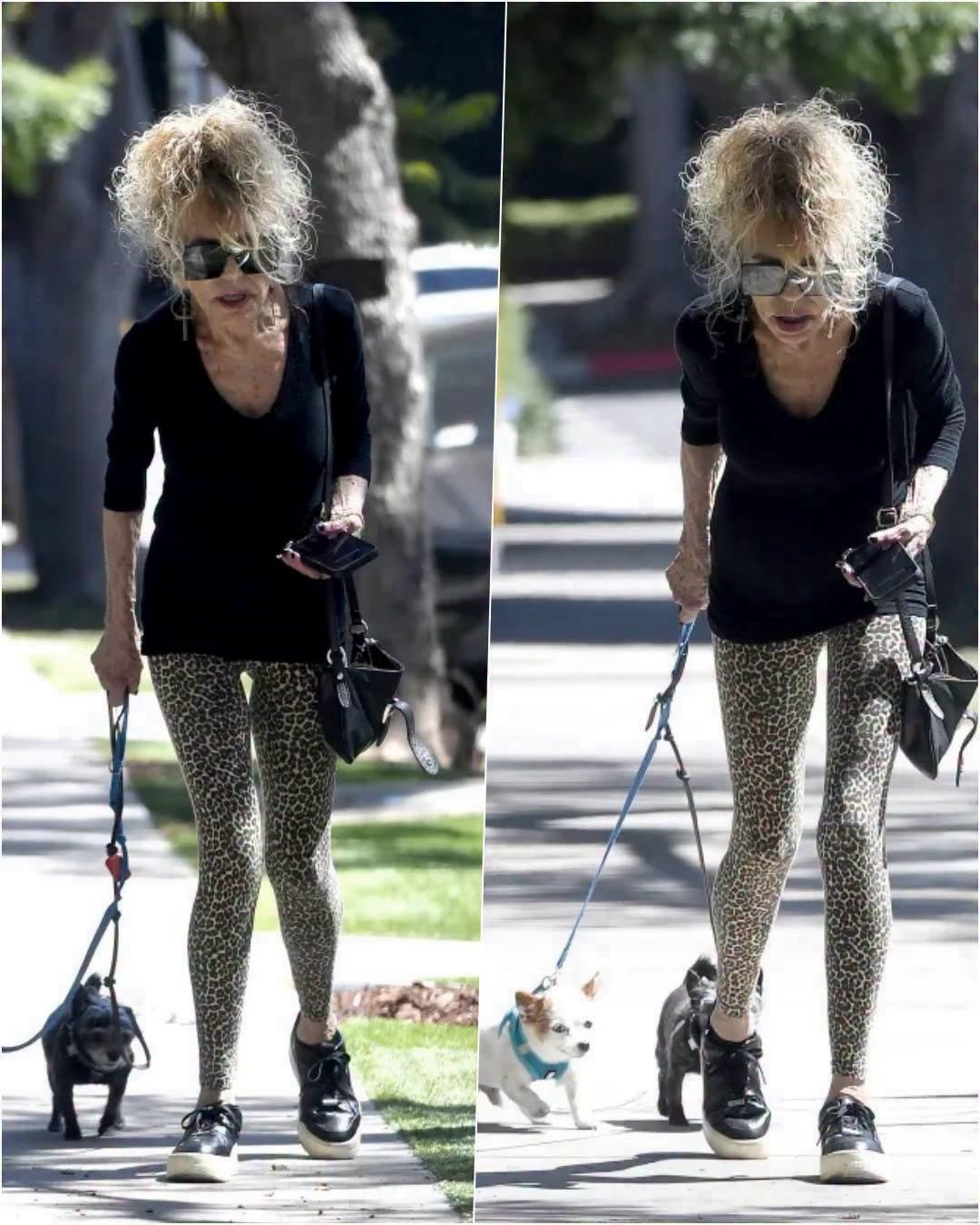
Captured recently by paparazzi lenses during a quiet, unassuming afternoon stroll, one of Hollywood’s most vibrant and unforgettable leading ladies looks worlds away from the dazzling, larger-than-life superstar who once commanded every major red carpet in America.
Dressed comfortably in loose, dark clothing and keeping a remarkably low profile, she blends seamlessly into the everyday neighborhood crowd without a hint of the glitz, flashing cameras, and high-fashion glamour that defined her peak years in the spotlight.
Most younger passersby walking right past her on the sidewalk today would never suspect they just crossed paths with a fearless cinema trailblazer whose signature cascading curls, megawatt smile, and unmistakable, infectious laugh helped define the golden era of late 1960s and 1970s filmmaking.
While these rare, candid street photos show an ordinary woman enjoying a peaceful moment away from the public eye, the extraordinary six-decade career standing behind her remains one of the most fascinating survival and success stories in entertainment history.
Born Samille Diane Friesen on January 4, 1937, in Tacoma, Washington, she grew up in the Pacific Northwest with a fierce creative spark and even was crowned Miss West Seattle in her youth before setting her sights on the bright lights of Los Angeles.
Upon arriving in Hollywood in the late 1950s, legendary producer Jerry Wald spotted her raw charisma and helped give her a striking new screen name inspired by the explosive energy he saw in her personality.
She spent her early twenties paying her dues in the studio system, making memorable guest appearances on classic television staples like Have Gun – Will Travel, Bat Masterson, 77 Sunset Strip, and Hawaiian Eye, while also taking the stage on Broadway opposite Jayne Mansfield.
However, right as her early career was gaining momentum, she abruptly stepped away from acting for several years to focus on her personal life, leading many Hollywood insiders to assume her brief time in the industry was already over.
When she finally decided to return to the screen in the late 1960s, she did not merely ask for a second chance—she completely reinvented herself and took the film world by storm.
In 1969, director Paul Mazursky cast her as Alice in the groundbreaking cultural phenomenon Bob & Carol & Ted & Alice, a daring, sharp-witted comedy-drama alongside Natalie Wood, Robert Culp, and Elliott Gould that candidly explored modern marriage and shifting social morals.
Her fearless, scene-stealing performance turned her into an instant international sensation and earned her an Academy Award nomination for Best Supporting Actress, a New York Film Critics Circle Award, and two simultaneous Golden Globe nominations, including Most Promising Newcomer.
Throughout the 1970s, she proved she was a true powerhouse of New Hollywood, effortlessly jumping between gritty crime thrillers, biting mysteries, and razor-sharp comedies.
She held her own opposite Sean Connery in the 1971 heist thriller The Anderson Tapes, went toe-to-toe with Burt Reynolds in the action-packed detective film Shamus, and delivered a famously hilarious,
sharp-tongued turn as a Hollywood super-agent in the 1973 mystery classic The Last of Sheila.
Simultaneously,
she demonstrated fearless dramatic vulnerability in the acclaimed 1971 independent drama Such Good Friends, directed by Otto Preminger, which earned her another Golden Globe nomination for Best Actress.
Nearly a decade after her first Oscar nod, she reached an even higher career peak in 1978 when Warren Beatty cast her as the scheming, hilarious, and utterly unforgettable wife Julia Farnsworth in the beloved fantasy classic Heaven Can Wait.
Audiences and critics alike were captivated by her impeccable comedic timing, rewarding her with a Golden Globe Award for Best Supporting Actress and her second Academy Award nomination.
That exact same year, she charmed theatergoers worldwide alongside Peter Sellers as Simone Clouseau in the box-office smash Revenge of the Pink Panther.
As the 1980s arrived, she continued to dominate the big screen, singing and acting alongside country music legend Willie Nelson and Amy Irving in Honeysuckle Rose, and starring opposite Michael Caine and Christopher Reeve in the suspenseful adaptation of Deathtrap.
Yet, even at the absolute pinnacle of her stardom, she refused to let studio executives box her in solely as a glamorous leading lady or a comedic bombshell.
Determined to tell meaningful stories from her own perspective during an era when female directors were virtually shut out of mainstream Hollywood, she enrolled in the American Film Institute’s prestigious Directing Workshop for Women.
Her bold leap behind the camera made cinema history in 1976 with her deeply moving, forty-minute drama Number One, which delicately explored the loss of childhood innocence and curiosity.
When the Academy announced its contenders that year, Number One earned an Oscar nomination for Best Live Action Short Film, officially making her the very first Oscar-nominated actress in history to also be nominated by the Academy for directing.
Refusing to stop there, she spent years pouring her heart and soul into the 1990 feature drama The End of Innocence, a semi-autobiographical film about a woman healing from nervous exhaustion and family pressures that she courageously wrote, directed, and starred in herself.
Even as decades passed and generations of moviegoers changed, her magnetic screen presence allowed her to reinvent herself once again for late-1990s television audiences.
Starting in 1997, millions of viewers fell in love with her all over again as the sharp-witted, eccentric, and fiercely independent Judge Jennifer “Whipper” Cone on David E. Kelley’s cultural phenomenon Ally McBeal, a fan-favorite role she also brought over to the legal drama The Practice.
Behind all the professional triumphs and industry records, however, her private life was once the center of the most intense media whirlwind in Hollywood history.
In July 1965, when she was a rising 28-year-old actress, she married the ultimate icon of classic silver-screen sophistication, 61-year-old Cary Grant, in a secret Las Vegas ceremony that shocked the world and made them the most scrutinized couple on the planet.
In February 1966, their union blessed them with the greatest treasure of both their lives when she gave birth to their daughter, Jennifer Grant—the only child Cary Grant ever had.
Although the immense pressure of global fame, clashing lifestyles, and a 33-year age difference led to a turbulent and heavily publicized divorce in 1968, her devotion to raising and protecting her daughter remained the guiding compass of her life.
For more than four decades, she politely declined countless lucrative offers to talk about her famous marriage, choosing to guard their family’s privacy until she was truly ready to speak from a place of healing.
In 2011, she finally shared that unforgettable chapter of her youth in her New York Times bestselling memoir, Dear Cary: My Life with Cary Grant, offering the world a deeply compassionate, honest, and loving portrait of the complex man behind the tuxedoed movie star myth.
Most recently, she came full circle to honor his legacy for modern audiences by serving alongside her daughter Jennifer as an executive producer on the acclaimed 2023 biographical miniseries Archie, starring Jason Isaacs.
Beyond the soundstages, generations of sports fans also knew her as the ultimate die-hard Los Angeles Lakers supporter, spending more than thirty years cheering passionately from her courtside seat alongside Jack Nicholson through every championship era.
Honored with a star on the Hollywood Walk of Fame in 1983 and guided by a deep, lifelong spiritual faith, she has navigated every triumph and heartbreak in Tinseltown with unmatched grace, resilience, and joy.
While recent candid paparazzi snapshots capture only a quiet, ordinary moment in the life of an 89-year-old woman running everyday errands, no camera lens could ever dim the brilliance of what she has accomplished.
That extraordinary life, fearless creative voice, and enduring Hollywood legacy belong to none other than the one and only Dyan Cannon—a three-time Academy Award nominee, pioneering female director, devoted mother, and true American cinema treasure.
Did you guess it was Dyan Cannon before reaching the final reveal, and which of her iconic movies or television appearances do you remember best?
Share your thoughts and favorite memories of her in the comments below!