The garage door slipped against my shoulder just as Devlin pushed Elmer’s pickup toward it. I planted both feet and held it up while the truck rolled past me into the daylight.
“That door needs fixing,” I said.
“Lease ends Friday. They can fix it after four.” Devlin wiped his forehead and looked back into the rented garage. “I have to get it empty by then.”
It was eight o’clock on Monday, June 10, and he still had shelves to clear. Red dust lay along the running board of the 1957 pickup.
“Will it start?” I asked.
“We can try. First, I wanted to ask you something.” He reached into his shirt pocket for a folded sheet of paper. “Would you take it, Alva?”
I looked at the truck, then at him. “Take it where?”
“Anywhere you want. You drove Dad to his appointments when I couldn’t get away. He’d have liked you to have it.”
The paper was an agreement transferring the pickup and all its contents to me. Devlin had filled in our names but hadn’t signed it yet.
“What about the forty acres up on the mountain?” I asked. “Have you settled those?”
“They’re part of the estate. I want to keep the family name on that land.” He held the paper out to me. “The truck is separate.”
I took the agreement. Elmer had shown me the acreage once, pointing out the stand of pines and the place where his family was buried. I had supposed it would pass to Devlin.
“If you don’t want the pickup, there’s a man who’ll buy it for parts,” he said.
I ran my hand along the worn seat through the open window. Elmer had kept a folded blanket there for passengers, though he always claimed the heater worked fine.
“I used that blanket every trip,” I said.
“He told me you were hard to please.”
“He told me I was sensible.”
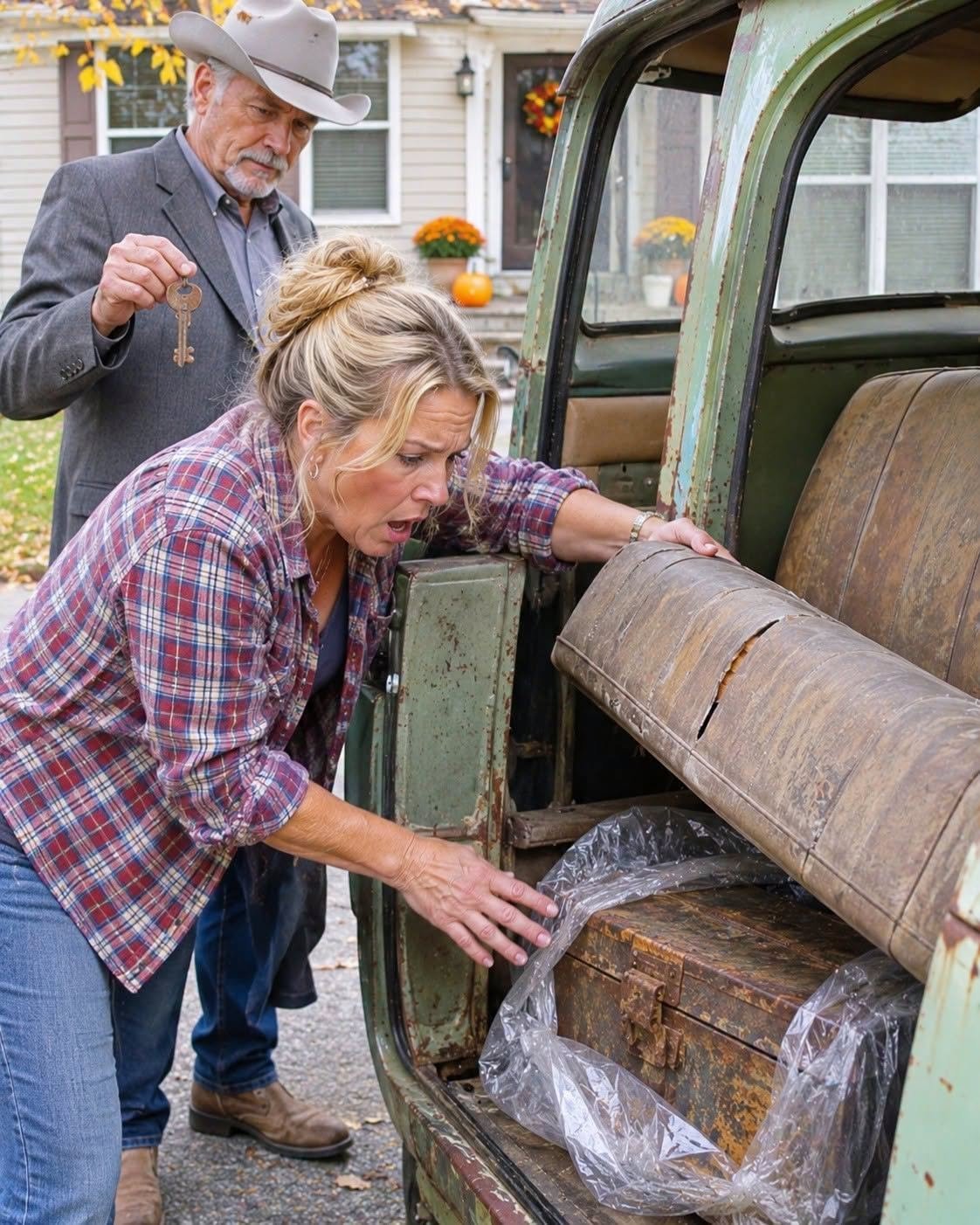
Devlin opened the cab door and tipped the seat forward. Behind it sat a metal box, bolted to the floor, with a small lock on the front.
“Does that come out?” I asked.
“I haven’t tried. You can deal with it.” He held up a brass key. “I found this with the truck papers. I don’t know what it fits.”
I had a little savings, meant for emergencies. Moving and storing the pickup would take some of it, but I couldn’t leave the truck here or see it sold for parts.
“I’ll take it,” I said.
Devlin gave me his pen. I signed the agreement on the hood, and he signed beneath my name. Then he climbed into the cab and turned the ignition.
The engine sputtered and stopped. On the second try, it caught. Devlin let it run, then shut it off and came back around the hood.
“I signed the whole truck over, Alva, not just the tires,” he said.
He laid the brass key across the signed words “all contents.”
I folded my copy and tucked it into my purse. Devlin reached for his own copy, then looked toward the pickup.
“Can you follow me home?” I asked. “I haven’t driven it in years.”
“I’ll bring my car. I need to get the toolbox out, too.”
By one o’clock, the pickup was in my driveway, and Devlin was pulling blankets from behind the seat. I spread one across the hood, and a shower of red dust fell onto my shoes.
“That one went everywhere with him,” Devlin said. “He kept it for picnics.”
“He kept it for naps. He used to claim he was checking the picnic table for ants.”
Devlin laughed and folded the blanket over his arm. Under it was another, thinner one, with a corner caught beneath the locked box. He gave it a tug.
“Leave that for me,” I said. “I’ll work it loose.”
He carried the first blanket around to the far side of the truck, where his father’s toolbox sat open on the pavement. I could hear him sorting wrenches into it while I eased the trapped corner free.
My mending basket was on the porch, with three pairs of trousers waiting for new hems. I had promised them for Wednesday, and I had planned to spend that afternoon at my sewing machine. I set the blanket beside the basket.
“Do you want these?” I called.
“You keep them. The toolbox is what I’d like.”
He had already put several tools inside. I had not looked through it, and I wasn’t about to ask him to empty it for me.
“The box behind the seat is bolted down,” I said. “Did Elmer ever mention it?”
“No. Dad made a chore out of putting anything where a person could reach it.”
I leaned into the cab and found two bolt heads at the base. The box was wedged against the back wall, with barely enough room to get a hand around it.
“Can it be taken out?” I asked.
“Probably. I don’t have time to start on it today.”
I took the brass key from my purse. Its teeth looked worn, and I had to angle my wrist to reach the lock. On the other side of the truck, a wrench knocked against the toolbox.
“That little key probably goes to the gas cap,” Devlin called. “He had an old locking one.”
The key slid in and turned smoothly. I moved the catch back into place without lifting the lid. The box needed proper support before I opened it.
“I’ve got the tools I came for,” Devlin said. The toolbox lid closed. “I’ll get those blankets out of your way.”
I slipped the key into my purse before he came around the truck.
Devlin lifted the toolbox by its handle and set it in his car. “I’ll bring the folding chairs over to the church tomorrow,” he said.
“I can help with those,” I said. He waved from the driver’s seat, and I watched until he turned the corner.
At nine Tuesday morning, Bertrand bent into the pickup while I held an umbrella over the open cab. I had called him the evening before, after a friend gave me his number.
“Is this the place you meant?” he asked, pointing below the dashboard.
“Elmer kept his registration there. Does that help?”
“It might.” Bertrand took a folded shop rag from his pocket and rubbed at a patch of grime. “I’m looking for the identification plate.”
I shifted the umbrella when rain began dripping onto his shoulder. “I thought that was part of the dashboard.”
“The plate tells us exactly which truck we’re looking at. If it’s still here, and still legible, that matters.”
His rag came away brown. Underneath, a corner of metal showed, with one screw holding it in place. Bertrand leaned closer.
“Can you read it?” I asked.
“Not yet. Hold that umbrella just another minute.”
I had spent enough mornings waiting for Elmer to find the right wrench to recognize a man who did not want to be hurried. Bertrand wiped the plate again, then gave a small nod.
“There it is. That plate is original. I would like the museum to see it.”
“A museum?” I asked. “Here in Pine Creek?”
“Denver. They’re considering an exhibit with working vehicles. This one may suit it, but I need to speak with them.”
He wiped his fingertips on the folded rag and looked along the running board, where red dust still clung near the back. I wondered whether the museum would want the truck with a locked box behind its seat.
“What would you pay for it?” I asked.
“I can’t give you a price today. I need to check restoration costs and find out whether the museum is interested.”
The umbrella tipped against the door frame. Bertrand caught it before it slid, and I thanked him. “It has a mind of its own,” I said.
“Then it belongs on an old truck,” he said. He handed it back and closed the cab door.
“What would it cost to move it?” I asked. “Devlin’s garage lease ends Friday at four, and I can’t keep it in this driveway.”
“I can take it to a rental bay for two hundred forty dollars. The fee has to be paid in advance, and it isn’t refundable.”
I had that much in savings, though I had meant to keep it there. I could ask Devlin about the garage, but his lease would still end on Friday.
“I’ll pay,” I said. I went inside for my checkbook and wrote the check at the kitchen table.
Bertrand tore a receipt from his pad. He pinned it beneath the windshield wiper.
“Would Wednesday morning suit you?” I asked Bertrand.
“It should. I will call before I move it.” He glanced at the cab. “Do you have someone to help with that box?”
“I can ask Ruth.” I thanked him and took my umbrella inside, leaving the truck where he could reach it.
At six that evening, I held a folding chair while Devlin nested another against it in the church fellowship room. Two volunteers were setting out cups for Saturday’s remembrance.
“Elmer used to insist on the padded chairs,” one woman said. “He claimed the metal ones made the sermons longer.”
“He wasn’t wrong,” I said, and she laughed.
Devlin lifted the stack onto a cart. “We need another row at the back. People will come early.”
I fetched two chairs from the closet. “Devlin, before we finish, could you confirm that our agreement included the box behind the seat?”
He set the cart brake with his shoe. “The box? I told you to take the truck.”
“I know. I wanted to be sure about the box itself.”
One volunteer stopped sorting cups. The other carried a sleeve of napkins to the table, though she stayed close enough to hear us.
Devlin rubbed the side of his face. “Alva, it’s truck clutter. We have serious estate matters to settle, including those mountain acres.”
“I wasn’t asking for the acres. I was asking about what came with the truck.”
“The land belongs to the estate,” he said. “The paper was meant to save you the trouble of buying the truck, not give you a claim on family land.”
I put the chair down and opened my purse. “The copy is right here. Could we look at the wording?”
Devlin waited while I unfolded it on the end of a table. A blue dress clipping slid from my purse and landed face down by his shoe.
One volunteer bent to pick it up, but Devlin moved the cart and the wheel stopped beside it. I reached down and retrieved the clipping myself.
I pointed to the line on the agreement. “It says the truck and all contents. Doesn’t that include the box?”
He glanced at the page, then waved his hand over it. “Those are details. I gave you a truck, Alva. Please do not make this into another estate matter.”
The volunteer with the cups turned toward the kitchen. The other took the stack of napkins from my side of the table without asking me to help.
“Please finish the chairs,” Devlin said.
I tucked the clipping back into my purse. The brass key was underneath, where I had left it. I did not mention it.
I folded the agreement into a smaller square.
One of the volunteers held out another chair, and I took it from her. Devlin kept his eyes on the stack until I left.
At ten the next morning, Ruth held a wrench against a bolt behind the pickup seat while I worked a second wrench underneath. Bertrand had moved the truck into the storage bay, and he had left us a workbench and a lamp.
“Is it turning?” Ruth asked.
“The wrench is. I cannot say the same for the bolt.”
She shifted her grip. “Try it now.”
The nut gave with a small pop. I backed it off and laid it beside the other three. Ruth climbed out of the cab, and together we lifted the box onto the workbench.
“I brought the key,” I said.
I took it from my purse and put it in the lock. It turned as smoothly as it had in my driveway. This time I lifted the lid.
An envelope lay on top, with my name in Elmer’s handwriting. Under it was an old leather folder, and beside the folder sat a small velvet bag, tied at the neck.
Ruth pointed to the envelope. “That is where I would start.”
I slipped a finger under the flap. The paper inside was folded twice, and I recognized the little hook Elmer put on the end of his capital A.
“My dear Alva,” I read. “Thank you for coming on Sundays and for sitting with me at the hospital.”
I stopped there. Ruth pulled the workbench stool closer, but I remained standing with the letter open.
“He always said the hospital coffee tasted like boiled socks,” I said.
Ruth smiled. “Did you bring him better coffee?”
“Every Sunday I could. He complained about mine, too.”
I looked down at the next line, but the words had blurred together on the page. I folded the letter back along its creases and held it over the envelope.
“Read the rest when you have a clear table, not on your knees in this cab,” Ruth said. “I can come by tomorrow morning.”
I touched the edge of the folder. “Will you look at whatever papers are in here?”
“Yes. My usual fee is three hundred dollars. I will tell you what I find, and what needs checking.”
Three hundred dollars would come out of the emergency fund. I had already paid for the bay, and I did not know what a careful reading of those papers might require.
“Eight o’clock?” I asked.
“I can make eight.”
I tucked the letter into its envelope and laid it beside the folder and the velvet bag. Ruth found a grocery sack under the workbench and opened it for me.
“Should I call Devlin?” I asked.
“The letter is addressed to you,” she said. “Let us see what the papers say first.”
I carried the sack home with the envelope, folder, and velvet bag inside.
I put the sack in the pantry, behind the flour, and shut the door. Ruth would be there in the morning, and I wanted a clear table when we looked at the papers.
At five, somebody knocked. Devlin stood on the porch with a covered casserole dish and a photograph tucked under his arm.
“I brought supper,” he said. “The church ladies sent enough food home with me to feed the whole block.”
I took the dish and set it on the counter. “Come in. What is that under your arm?”
He laid the photograph on the table. Elmer stood beside the pickup, one hand on the hood. He was young and straight backed, with a grin I had seen a hundred times.
“Was this after the Army?” I asked.
Devlin turned it over. A date was written on the back in Elmer’s neat hand, along with the words, “Home at last.”
“He wrote that himself,” Devlin said. “I found it in a drawer with his service papers.”
I put on coffee and found two clean cups. Devlin pulled out a chair but kept the photograph in his hand.
“He used to tell me how he fixed that truck,” he said. “I never could keep the parts straight.”
“He could name every bolt,” I said. “He once spent half an hour telling me why one had to go back in a certain way.”
Devlin gave a short laugh. “He would have called it a chore if somebody else asked him to explain it.”
I poured his coffee. He took a sip, then set the cup beside the photograph.
“Alva, I signed that paper without looking inside the truck. I had estate papers stacked all over my table, and I wanted one task finished.”
“You had plenty to do,” I said.
“I did. But I should have checked.”
He rubbed his thumb along the edge of the photograph. I remembered him at the fellowship room, asking me to finish stacking chairs while the volunteers listened.
“I thought if the truck stayed with us, I could still show him to my children,” he said.
“They could see it,” I said. “Bertrand is looking into a museum.”
“That could take it clear to Denver.” He looked up at me. “Why don’t I take it back for the family?”
The coffee was still hot enough to sting my tongue. For a moment I wanted to say yes and leave the casserole on the table between us.
“What about the box?” I asked.
“The box and whatever’s in it should stay with the truck. Bring both keys Saturday, when you come to the remembrance.”
Both keys. On Monday he had called the brass one a gas cap key.
“I can’t do that,” I said. “I need more time.”
His cup stayed where it was. He picked up the photograph and slid it beneath his arm.
“Keep the casserole,” he said. Then he took the photograph and left.
I put the casserole in the refrigerator and set the grocery sack on the kitchen table. The leather folder was still inside.
At eight the next morning, Ruth moved my breakfast plate aside and laid the folder in its place. I offered her the last piece of toast.
“Only if you don’t mind sharing the crumbs,” she said.
She opened the folder, and a paper with a notary’s seal slid halfway out. My name appeared on the first page, below Elmer’s.
“What kind of paper is that?” I asked.
“A deed.” Ruth drew it toward her and read the next line. “It names you as the person receiving the property.”
I sat down. “Which property?”
She turned the page and put her pencil beside the description. “Forty acres in the mountains. The date is June twelfth, nine years ago yesterday.”
Elmer had signed it, and a notary had signed below him. I read my name twice before I could make out the rest.
“Devlin said the land was part of the estate,” I said.
“He may believe it is.” Ruth tapped her pencil once beside the description. “I need the county recording reference before I can tell you what the county has on file.”
I pulled the letter from its envelope and unfolded it beside my plate. Ruth gave me room to read, then reached for the velvet bag.
“I’ll count these while you finish,” she said. “If that’s all right.”
I nodded. She tipped the coins onto the table and set them in short rows. I could hear each one touch the wood while I read Elmer’s words.
He thanked me for coming on Sundays, even when he had nothing better to offer than coffee and a game of cards. He thanked me for sitting with him during his hospital stays and bringing him the church bulletin.
Near the bottom, he had written that the land and the coins were mine to use as I chose. His handwriting grew smaller along the last line, but I could read every word.
“Twenty-two,” Ruth said. She picked up a coin and examined its date. “These look like gold coins, not tokens. The dates and weight fit, but an expert could tell you more.”
I laid the letter down. “Do you know what they’re worth?”
“No. I wouldn’t guess.” She gathered them carefully into the bag. “The deed is what we need to check first.”
I looked at Elmer’s signature again. Giving Devlin the truck back would not put these acres into the estate.
“Should I tell him about the paper today?” I asked.
“Let me check the county record first. The recording reference should show where this deed was filed. We need to see whether it matches.”
My remarks for Saturday were tucked under a dish towel on the counter. I moved them out of the way as Ruth lifted the deed, then placed it beside Elmer’s letter.
“Let me check the county record before you say what the papers mean,” Ruth said. She tapped her pencil beside the date.
“Will you be able to find it?”
“I’ll start with the recording reference. Keep the originals with you.”
At six, I brought my remarks to the fellowship room and found Devlin setting out cups. Two volunteers were unfolding tablecloths, and my name card stood at the place where I was to speak.
One volunteer handed me a cloth with a corner caught in its fold. “I’ve been looking for that corner since Tuesday,” she said.
I found it and shook the cloth out with her. Then I asked Devlin if we could talk by the doorway.
“I found papers in the box,” I said. “Ruth is checking them.”
His hand stayed on the cup he had picked up. “Do they have to do with the land?”
“There’s a record Ruth needs to look at first. I won’t hand you papers I haven’t had checked.”
He set the cup down. “You could at least let me see them.”
“The county office has records. Ruth will know what to ask for.”
“Those are details, Alva. My father kept his papers in that truck. They ought to stay with it.”
I smoothed my apron pocket with my thumb. “The truck is in the bay I paid for. It won’t be moved back to your garage.”
“It has to be out of there by four tomorrow, if I take it back.”
“Why do you want it back so badly?”
He looked past me at the table where his father’s photograph would stand. “I want his possessions together. I don’t know what’s in those papers, and there may be something valuable in that box.”
“Will you wait until Ruth checks the record?”
“No. I’ll ask Nora about getting the truck and its contents back.”
He walked to the speaking place and picked up my name card. I followed him as far as the end of the table. “Devlin, I already wrote what I wanted to say.”
“This is my father’s remembrance, and I decide who speaks.” He turned to the volunteers. “Alva won’t be speaking Saturday.”
One volunteer held the tablecloth in both hands. The other looked at my folded pages and asked if I needed an envelope for them.
“I have one in my purse,” I said. I slipped the remarks inside and closed the clasp. Devlin turned my name card face down beside the stack of cups.
I picked up my coat from the back of a chair. One of the volunteers held the door while I put my arm through the sleeve.
“Will you still come Saturday?” she asked.
“I haven’t decided,” I said. Devlin was gathering the programs at the other end of the table, and I went out before he looked up.
At ten Friday morning, I spread the deed and the original truck agreement across Ruth’s desk. She moved her coffee cup to the windowsill and picked up the phone.
“Certified recording copy,” she said when the county clerk answered. “Can I get one today?”
I watched her write the legal description on a yellow pad. Then she gave the clerk Elmer’s name and the date on the deed.
The clerk asked her to hold. Ruth covered the mouthpiece and pointed at the agreement. “You brought the original?”
“Both originals,” I said. “I’d like to keep them with me.”
The clerk came back on the line. Ruth listened, then wrote a time on her pad and tapped it once with her pencil.
“Ready by noon,” she said. “The certified copy costs eighteen dollars.”
I counted the bills out of my purse. Ruth tucked them into an envelope for the county office, and I folded the deed back into its leather folder.
“I’ll collect it,” she said. “What do you want to do after that?”
“Nora needs to see the papers. Will you come with me?”
Ruth nodded and reached for the phone again. “I’ll ask if she has room this afternoon.”
She called Nora’s office and gave her the names on the deed and the agreement. I sat close enough to hear Nora ask whether Devlin had been invited.
“He’s her client,” I said. “He ought to be there.”
Nora offered two o’clock and said she would contact him. Ruth wrote the appointment down, then pushed the pad toward me.
“I want his lawyer to read the same words we are reading,” I said.
Ruth put the pad beside my purse. “Bring the originals and the certified copy. She’ll need to see them.”
I picked up the receiver and called Bertrand at the bay. He answered with a clatter, then apologized for dropping a wrench.
“Could you put your offer in writing?” I asked. “And whatever the museum would agree to about displaying the truck?”
“I can work up the figures,” he said. “I still have to speak with them about the display.”
“Please don’t take the truck to Devlin.”
“It’ll stay right here,” he said. “I’ll call when I have the offer.”
Ruth found me a fresh envelope for the agreement. The flap wouldn’t stay down, so she lent me a piece of tape, already stuck to the edge of her desk.
I slid the agreement inside and wrote “2 p.m.” across the front.
Ruth held out her hand. “Let me check the deed once more before you put it away.”
She tapped her pencil beside the legal description. “The county copy should have that same description. We’ll put them side by side.”
At two, I laid the agreement, the deed, and the certified record on Nora’s table. Ruth sat beside me, with Devlin across from us. Nora drew the papers toward her.
Devlin looked at the county seal. “What is that?”
“The recorded deed,” I said. “Ruth collected the certified copy today.”
Nora turned the agreement toward the light. “First, I want to check both signatures.”
Devlin pointed at his name. “That’s mine. But I gave her the truck so it wouldn’t go for parts.”
Nora read from the page. “The 1957 pickup and all contents are transferred to Alva.” She looked down at his signature again. “Your signature transferred the truck and every item inside it.”
“That box was bolted to the cab,” he said. “I didn’t even know what was in it.”
“The box held Elmer’s letter and deed,” I said. “There were twenty-two gold coins in a bag.”
He looked at me. “You opened it?”
“The brass key opened it. I brought it today.” I took it from my purse and set it beside the agreement.
Nora checked my signature and Devlin’s. “Both are here. There is nothing missing from the agreement.” She moved the deed beside the certified copy.
Devlin leaned forward. “The land is a separate matter.”
“Yes,” Nora said. “I’m checking that now.”
She compared the names and the description of the forty acres, then put a finger on the date. “The county record matches the notarized deed. It was recorded, and Alva has accepted it.”
Ruth pushed her glasses up. “The recording reference matches, too.”
Devlin sat back. “Dad signed that nine years ago?”
“June 12, 2015,” Nora said. She took off her glasses. “The deed is valid. You have no legal claim against it, or against the written truck agreement.”
He reached across the table toward the key. I picked it up and closed my hand around it before his fingers got there.
“I’ll keep the truck until I decide what to do,” I said.
Devlin drew his hand back. “And the acres? What are you going to do with those?”
“There are forty of them,” I said. “I haven’t decided what to put there.”
Ruth offered me a paper clip for the county copy. It slipped from her fingers and landed near Devlin’s elbow. He picked it up and passed it to me without a word.
Nora slid the original deed across the table to me.
I put the deed back in its envelope and asked Nora whether she needed anything else.
“No,” she said. “Keep that copy with your other records.”
Devlin stood, but he did not reach for his coat. “Are you going to sell the land?”
“The tax bill is paid,” I said. “I haven’t decided.”
On Monday at three, Bertrand laid a sheet of paper on his workshop bench. His folded shop rag sat beside it, and the pickup stood behind us with its hood raised.
“I have the figures now,” he said. “Will you look at the offer first?”
The price was $85,000. I read it twice, then put my finger on the line below it. “Does that include taking care of the truck?”
“Yes. Restoration and transport are in my budget, not yours.” He pulled a second sheet from beneath the offer. “The museum signed this agreement on Friday.”
I looked for Elmer’s name. “Will they put it on the display?”
Bertrand wiped his fingertips on the rag and pointed to a paragraph. “Right here. Elmer’s name and his Army service. They also want to show the original identification plate.”
“Will they have room for a photograph?” I asked.
“They’ve left space. I can’t promise where until the exhibit is built.”
He showed me the budget he had prepared, with the purchase price, labor, and parts listed separately. The parts alone filled half a page. “That plate is staying with the truck,” he said. “I’d sooner replace my own teeth.”
I laughed, and then the workshop door opened. Devlin came in carrying the photograph I had asked him to bring. He held it by the edges, with Elmer and the pickup facing us.
Bertrand showed him the offer and the exhibit agreement. Devlin read both without sitting down.
“That’s a fair price,” he said. Then he turned to me. “Would you sell me the acres? I could pay in installments.”
“The road needs work before anyone builds up there,” I said. “I’ve decided to keep the land. I want to put up a cabin for my grandchildren.”
Devlin looked down at the photograph. “I thought I might have a chance to keep it in the family name.”
I smoothed my apron pocket with my thumb. “I’m sorry, Devlin. I’m keeping it.”
Bertrand picked up the exhibit agreement. “After the remembrance, do you want him barred from the display?”
“No,” I said. “He can visit the truck whenever the museum is open.” I handed Devlin the contact details. “Would you lend them the photograph?”
He studied Elmer’s face before answering. “Yes. I want it back when they’re finished.”
I signed Bertrand’s sale agreement. The letter, deed, and twenty-two coins were at home, where I had put them before offering him the truck.
Devlin set the photograph beside Bertrand’s folded shop rag.
Bertrand picked up a pencil and wrote the museum’s address on a card. “I can send word when the truck is ready to see.”
Devlin put the card in his shirt pocket. “Let me know about the photograph. I’ll want it back someday.”
“You will,” Bertrand said. “We’ll take good care of it.”
I gathered my copy of the sale agreement. Devlin held the workshop door for me, and I thanked him before I stepped outside.
On Saturday, May 10, 2025, my grandchildren carried their weekend bags into the new cabin while I stood in the yard with a folded dinner cloth. At five o’clock, Bertrand came up the path holding an envelope.
“Where should these go?” one of the children called from the doorway.
“Upstairs, wherever you can find a bed,” I said. “Leave your shoes where I won’t trip over them.”
Bertrand handed me the envelope. Inside was a photograph of the restored pickup in the Denver museum, with Elmer’s name on the display.
“The original identification plate is still there,” he said, pointing near the edge of the cab. “We cleaned it carefully.”
I held the photograph by its corners. “Did you find a place for Devlin’s picture?”
“Right beside the truck. He came to see it last month.”
One of the children came back out and leaned against my arm to look. “That truck is shiny,” he said.
“It wasn’t always,” I said. “There was red dust clear across the running board.”
Bertrand looked at my dress. “Is that the one from the catalog clipping on your kitchen table?”
“It is.” I lifted the blue fabric at the side so he could see it. “The hem needed taking up, but I managed.”
“It looks just right,” he said. “Where do you want this dinner?”
“Beside Elmer’s grave. Will you hold that end of the cloth?”
He took one corner, and we spread it on the grass beside the small family plot. I brought the warm dishes from the cabin, and Bertrand carried out the plates.
“There is room for another plate right here,” I said, pointing beside mine. I handed one to Bertrand and set another place near Elmer’s stone.
My granddaughter came out with napkins tucked under her chin. “I couldn’t carry the forks too.”
“I’ll get them,” her brother said, and he went back through the door before she could give him a job.
We sat down with our plates. Elmer’s place stayed empty, facing the cabin he had never seen. I wished I could show him the photograph Bertrand had brought.
My granddaughter set a napkin beside his plate, and I reached over to straighten it.
My blue sleeve brushed the cloth beside his plate.