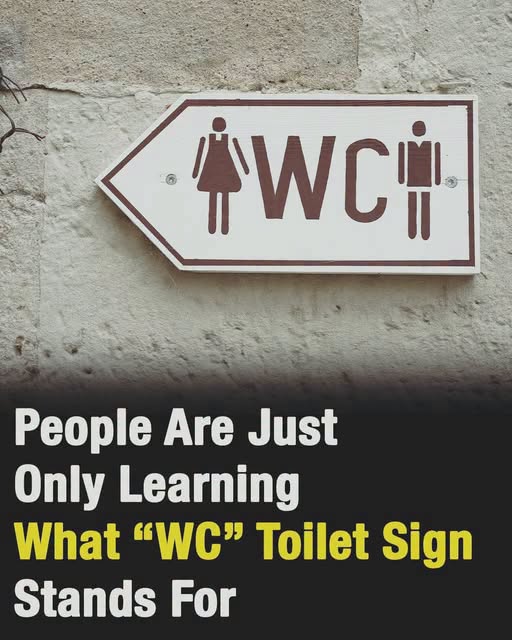
You have likely stood before a closed door in an airport or a bustling European train station, staring at the cryptic letters “WC” and wondering if you have found the right place or if you are about to walk into something entirely different.
It is a universal moment of hesitation that travelers face across the globe, yet few realize that these two simple characters are not just a label, but a relic of a revolution in human hygiene that changed the world forever.
The abbreviation “WC” stands for “Water Closet,” a term that emerged during the 19th century when indoor plumbing was transforming from a luxury into a necessity. In that era, a “closet” was not a place for clothes, but a small, private, enclosed space.
By adding a flushing mechanism powered by water, the “water closet” became the gold standard for sanitation, separating the act of waste disposal from the living areas of a home. Before this, families often relied on outdoor facilities, and the transition to indoor plumbing was a monumental shift that redefined privacy and public health.
As the world modernized, language evolved alongside it, creating a patchwork of regional terms. In the United States, we adopted “restroom” or “bathroom,” euphemisms that softened the reality of the room’s purpose. In Canada, “washroom” became the standard, while the British often prefer “toilet” or “loo.”
Yet, “WC” persisted as a neutral, international shorthand. It became the perfect solution for global travel, transcending linguistic barriers in airports and hotels where clarity is paramount. It is a functional, historical anchor in a world of shifting terminology.

The evolution of these terms reveals much about our changing social norms. Centuries ago, the topic was considered taboo, leading to the creation of indirect labels.
Today, we view these facilities as essential infrastructure, but the persistence of the “WC” sign reminds us of a time when the mere existence of an indoor flushing toilet was a marvel of engineering. It is a testament to how we have refined our daily lives to prioritize hygiene and comfort.
Whether you find yourself in a quaint European café or a massive international terminal, the “WC” sign remains a steadfast guide. It is more than just a direction to a room; it is a small, quiet piece of history that connects us to the early days of modern sanitation.
So, the next time you see those two letters, you can walk through the door with the knowledge that you are participating in a tradition of progress that has spanned generations, ensuring that no matter where you are in the world, you can always find the comfort of home.