William followed again, slower now, his chest tight.
The paved road narrowed. Asphalt gave way to gravel.
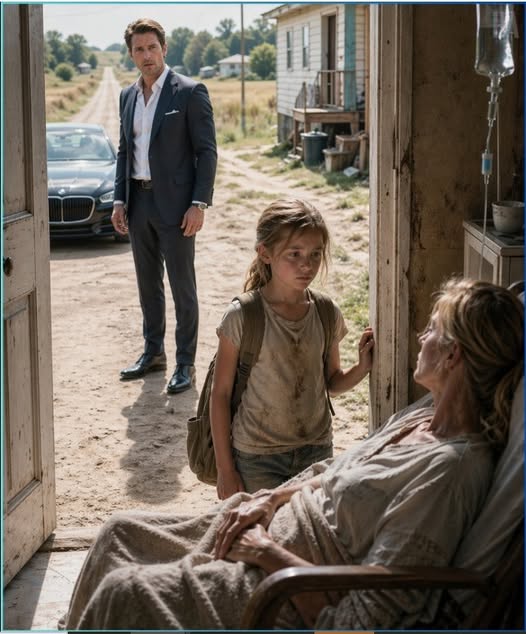
Gravel gave way to a dirt lane cut through low fields and bare trees. A leaning mailbox came into view, then a little clapboard house with a sagging porch and one window covered in plastic sheeting taped carefully along the edges.
It was not abandoned.
It was worse.
It was being held together.
Emma went inside.
William stopped where the lane widened and turned off the engine.
Through the front window, curtains parted just enough for him to see pieces of a life no child should have to carry.
A woman lay on the couch under a thin blanket. Pale. Tired. Not old, but worn down by something relentless.
Emma set the hot chocolate on the side table first.
“Mom,” she said softly, though William could not hear the word. He saw the shape of it.
The woman opened her eyes.
Emma helped her sit up. She placed the medicine beside a paper plate where pills had been lined up in careful little groups. Morning, noon, night. Like a nurse. Like a daughter. Like both.
Then Emma went to the kitchen and opened a can of soup.
William sat in his luxury SUV with heated seats, a leather steering wheel, and a phone full of missed calls from important men, watching an eight-year-old girl stir dinner for her sick mother.
For the first time in years, William Whitmore felt completely useless.

Part 2
The next morning, William went to Maple Creek Elementary.
Principal Nancy Harper received him in an office that smelled faintly of copier paper, peppermint gum, and old carpet. She was a woman in her late fifties with silver-streaked hair, sharp eyes, and the weary patience of someone who had spent three decades helping children no budget had ever properly protected.
“Emma Carter,” William said.
Nancy folded her hands on the desk. “What about her?”
“I’ve seen her walking.”
The principal’s face changed, but only slightly.
“She walks because she’s outside the bus route,” Nancy said. “Technically. The district line cuts off before her lane. We’ve filed requests. More than once.”
“She’s eight.”
“I know exactly how old she is.”
The words were not angry. They were tired.
William looked down. “Her mother?”

“Sarah Carter is doing her best,” Nancy said. “That is all I’ll say without permission.”
A knock sounded at the door. Ms. Thompson, Emma’s teacher, stepped in holding a stack of workbooks against her chest.
“I heard her name,” she said quietly.
Nancy nodded once.
Ms. Thompson looked at William. “Emma is the kind of child who apologizes when she falls asleep at her desk for thirty seconds. She’s never disruptive. Never complains. Always turns in her homework.”
Her mouth tightened.
“Last week she wrote a story about a girl who packed two lunches every day. One for herself and one for a queen who lived on a couch.”
William shut his eyes.
He did not write a check that day.
That surprised everyone who knew him, including himself.
Writing checks was easy. Clean. Efficient. It let him remain generous and distant at the same time. Since his wife, Catherine, died three winters earlier, distance had become the shape of his life. He funded scholarships, clinics, food drives, repairs to playgrounds he never visited.
He gave because giving was right.

But he rarely stayed long enough to be changed by it.
Emma Carter changed that.
On Wednesday evening, William went to the small white Baptist church off Main Street. Pastor Daniel Reed met him at the side entrance with a dish towel over one shoulder and sleeves rolled to his elbows.
“You here to donate,” Daniel asked, “or to work?”
William looked past him into the fellowship hall. Folding tables. Crockpots. Paper plates. Women carrying casseroles. Men stacking chairs. Children running where they had been told not to run.
“Whichever does less damage,” William said.