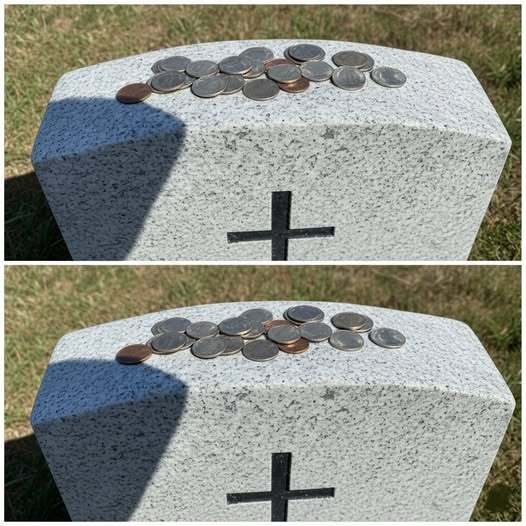
At first glance, a few coins resting on a gravestone might look like something forgotten or случайly dropped, easy to overlook among flowers and flags.
Yet within military cemeteries across the United States, those coins carry a meaning far deeper than their modest appearance suggests. They are not spare change, nor casual offerings. They are messages—quiet, deliberate, and deeply personal—left behind by those who remember.
This tradition, most often seen at the graves of fallen service members, transforms simple metal into a language of honor, remembrance, and connection, spoken without words but understood by those who know its meaning.
While the act of leaving coins for the dead traces back to ancient civilizations that believed payment was needed for passage into the afterlife, the modern American tradition took shape during the Vietnam War. That era was marked by deep political division, and many veterans returned home carrying grief that had no safe place to land.
Public mourning was complicated, and conversations about loss were often avoided. In that silence, a quiet ritual emerged. Veterans began leaving coins on the graves of fallen comrades as a private acknowledgment that said, “I was here. I remember you.” It allowed grief to exist without explanation, judgment, or debate, and over time, the gesture became an unspoken bond among those who had served.
Each coin left behind carries a specific meaning, turning the gravestone into a subtle record of shared experience. A penny simply signifies a visit, a sign that someone paused to remember. A nickel means the visitor trained with the deceased, sharing the early days of preparation and discipline. A dime indicates that the two served together during active duty, enduring the realities of service side by side.
A quarter holds the heaviest meaning of all. It tells the family that the person who left it was present when the service member died. These distinctions transform small coins into powerful statements of loyalty, memory, and sacrifice, understood instantly by those familiar with the code.
For families who come to visit, discovering these coins can be profoundly moving. Each one is evidence that their loved one has not been forgotten, that bonds forged in service endured long after uniforms were folded away. The coins speak of friendships tested by hardship and loss, and of people who still carry those memories years or even decades later.
In a world that often rushes past grief, this tradition slows time, offering a moment of quiet solidarity. It reminds us that honor does not always arrive with speeches or ceremonies. Sometimes, it arrives silently, resting on cold stone, carrying a message meant not for the world, but for the heart that knows how to read it.