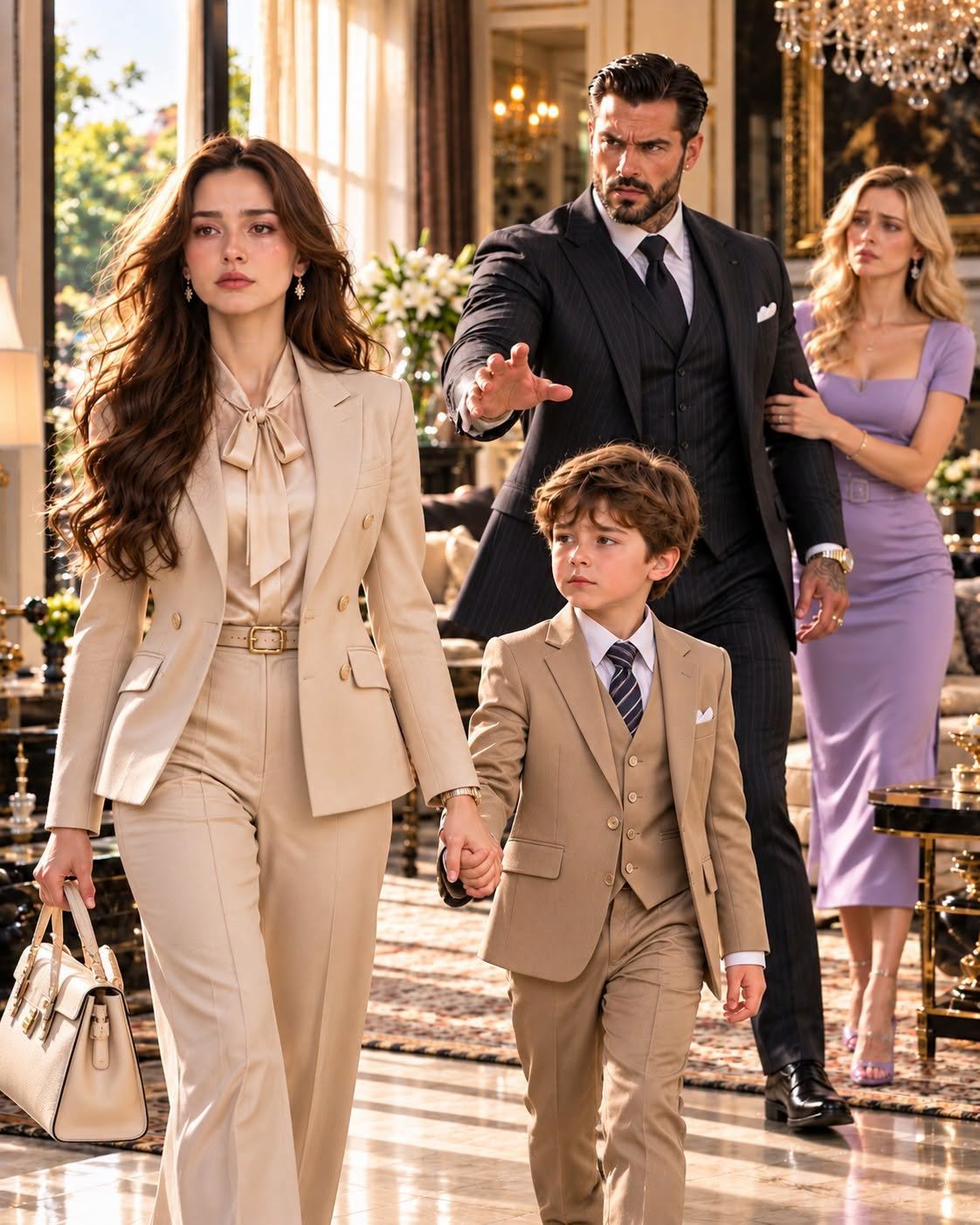
For several seconds after I said the words, no one moved.
“From this moment on, I’ll consider you dead too.”
The sentence remained in the room like a door that had slammed shut.
Alexander stared at me, and for once, he seemed unable to find the right command.
Ethan’s fingers tightened around mine.
I could feel him trembling, though he tried very hard not to show it.
Sophia lowered her face, clutching the handle of the soup container as if it were something that
could protect her from the silence.
Then Alexander said my name.
“Claire.”
I had heard him say it in anger, in exhaustion, in affection, and sometimes in the distracted tone he used when his mind was already somewhere else.
This time, it sounded almost uncertain.
I picked up the folder from the table.
“The divorce papers are in the study.”
His gaze dropped to it.
“You’re serious.”
“I’ve never been more serious about anything.”
“Where will you go?”
“Somewhere you can’t order me to stay.”
His expression hardened again, as though uncertainty had embarrassed him.
“You think leaving this house will solve everything?”
“No.”
I looked at Ethan.
“But staying here has solved nothing.”
Alexander’s eyes followed mine.
For a moment, I thought he might say something to our son, something gentle and necessary, but Ethan had already turned away from him.
That small movement hurt Alexander more than any accusation could have.
I saw it happen.
I also saw the wall rise over his face.
“Take the papers,” he said.
I nodded.
“And take whatever you need.”
“I don’t need anything from you.”
“That isn’t what I said.”
“It’s what you always mean.”
His mouth tightened.
Sophia finally spoke.
“Perhaps everyone should calm down before making decisions that cannot be undone.”
I turned toward her.
“You’re right.”
Her shoulders relaxed slightly.
“I should have made this decision years ago.”
The relief disappeared from her face.
Alexander looked at her sharply.
“Sophia, leave.”
She blinked.
“But I thought—”
“I said leave.”
There was no tenderness in his voice now.
Only irritation.
Sophia placed the soup on the table and picked up her purse.
Before she passed me, she paused.
“I never wanted your mother to suffer,” she whispered.
I looked at her.
“Then you should have given him the phone.”
Her eyes flickered.
For the first time, she did not pretend to misunderstand.
“I told you, he was sleeping.”
“You answered his phone.”
“He was exhausted.”
“My mother was dying.”
She glanced at Alexander.
He said nothing.
That silence was almost worse than his defense of her.

Sophia walked out without another word.
The front door closed behind her, and the house seemed to grow larger.
Or perhaps it was simply emptier.
Alexander remained near the table, his hands resting against the wood.
“What do you want from me?” he asked.
The question struck me because it sounded sincere.
I had spent years wanting his time, his honesty, his presence at ordinary dinners and school meetings and hospital rooms.
Now that he was finally asking, I could not give him an answer that would restore anything.
“I wanted you to come when she asked for you,” I said.
His eyes lowered.
“I didn’t know.”
“You knew she was ill.”
“I thought there was more time.”
“So did I.”
My voice broke, and I hated that it did.
Alexander looked toward the staircase.
“Ethan should not have heard this.”
“He heard your answer when you told him to apologize.”
“I was angry.”
“He was grieving.”
“I know.”
The words came out quietly.
They were the first words he had spoken that did not defend him.
I looked at him.
He seemed older than he had that morning.
Not weaker, exactly.
Just less certain that anger could carry him through every conversation.
“I’m taking Ethan to my mother’s house tomorrow,” I said.
His head lifted.
“The house by the lake?”
“Yes.”
“It’s been empty for years.”
“It still belongs to me.”
“I know.”
“Then you know I don’t need your permission.”
“I know that too.”
The answer surprised me.
Alexander pushed away from the table.
“When will you return?”
“I won’t.”
A muscle moved in his cheek.
“Claire, don’t make this more difficult than it has to be.”
“You made it difficult when you chose not to answer.”
“I didn’t choose that.”
“You chose to be there.”
His eyes met mine.
There was pain in them now, but pain did not erase responsibility.
“I was meeting someone.”
“Sophia?”
His silence answered.
I looked away.
“I don’t want details.”
“You deserve the truth.”
“Seven years ago, perhaps.”
He took a step toward me, then stopped.
“I never meant for you to find out this way.”
I almost smiled.
“There is no good way to find out that your husband has another woman.”
His expression shifted.
“We need to talk about this.”
“No.”
“Claire.”

“Not tonight.”
I picked up the folder.
“Tonight, I’m going upstairs with my son, and tomorrow I’m leaving.”
He stood there as though the house had changed beneath his feet.
Maybe it had.
For seven years, I had arranged my life around Alexander’s absences.
I had learned which evenings he would be late, which questions he would avoid, and how to tell from the sound of his key in the lock whether he wanted conversation or silence.
I had mistaken my ability to endure him for proof that our marriage was strong.
That night, I understood the difference.
When I entered Ethan’s room, he was sitting on the edge of his bed with his schoolbag still hanging from one shoulder.
He had been listening.
I knelt in front of him.
“Are you all right?”
He nodded too quickly.
“No.”
The honesty made my chest ache.
I reached for his hands.
“Neither am I.”
“Are we really leaving?”
“Yes.”
“Where will we go?”
“To Grandma’s house.”
His face crumpled at the mention of her.
“She won’t be there.”
“No.”
“Then why are we going?”
I pulled him against me.
“Because it belongs to her.”
He pressed his face into my shoulder.
For a while, neither of us spoke.
Outside the window, Chicago shone with distant lights, bright and restless.
The city had always made Alexander feel powerful.
It had made me feel protected.
Now, for the first time, it seemed to me that protection and confinement could look dangerously
similar.
The next morning, I packed only what we needed.
Clothes, schoolbooks, toiletries, a few photographs, and the small wooden music box my mother had given Ethan when he was born.
Alexander did not come upstairs.
I expected him to send someone after me.
Instead, when I carried the last suitcase to the front hall, I found him standing beside the door.
He wore a dark coat and held a set of keys.
“Your car is being prepared,” he said.
“I can drive.”
“The road by the lake may be icy.”
“I can drive carefully.”
“I’ll have someone follow you.”
“No.”
“It’s not a request.”
I set the suitcase down.
“Then you haven’t understood anything.”
His eyes narrowed.
“I’m trying to make sure you and Ethan arrive safely.”
“By putting one of your men behind us?”
“By making sure no one bothers you.”
“I don’t want your protection.”
“You may not want it, but that doesn’t mean you don’t need it.”
The old Alexander had returned.
The man who decided what was necessary and expected everyone else to accept his decision.
I took the keys from his hand.

“I’ll call if there’s a problem.”
“You won’t call.”
“I might.”
“You never call when you need help.”
“That is because you are never there when I need you.”
The words landed between us.
Alexander looked down at the keys in my hand.
“Claire, I didn’t know about your mother.”
“You knew about her illness.”
“I thought she had weeks.”
“So did I.”
His voice lowered.
“Why didn’t you call someone else?”
I stared at him.
“Because she asked for you.”
He closed his eyes briefly.
That was the first time I saw guilt reach him without being pushed there.
When he opened them again, his face was controlled.
But I had seen enough.
Ethan came down the stairs with his backpack.
Alexander turned toward him.
“Ethan.”
My son stopped on the last step.
His expression was guarded.
“I’m leaving with Mom.”
“I know.”
“Are you coming?”
The question was simple.
Alexander looked at me before answering.
“No.”
Ethan nodded, as if he had expected that.
“Grandma wanted you there.”
“I know.”
“You keep saying that.”
Alexander’s face tightened.
Ethan descended the remaining steps.
“I don’t want you to forget her.”
“I won’t.”
“You already did.”
I felt Alexander absorb the words.
He did not correct Ethan.
He did not demand an apology.
Instead, he reached into his coat and took out a small silver object.
It was a compass, old-fashioned and polished.
“I found this in my desk,” he said.
Ethan looked at it but did not take it.
“It belonged to me when I was young.”
“Why are you giving it to me?”
“So you always know which way home is.”
Ethan glanced at me.
I could not tell him whether accepting it was wise.
The decision had to be his.
After a moment, he took the compass.
“Home is where Mom is.”

Alexander looked as if the words had struck somewhere beneath the ribs.
“Yes,” he said.
His voice was almost inaudible.
“It is.”
We left before noon.
I drove north with both hands fixed on the steering wheel, while Ethan sat beside me and held the
compass in his lap.
For the first hour, we said very little.
The city thinned into long stretches of road, bare trees, and fields faded by winter.
When the lake finally appeared beyond the guardrail, Ethan leaned toward the window.
“It’s still frozen.”
“Not completely.”
Dark water showed through the pale surface in narrow, restless patches.
My mother’s house stood at the end of a gravel lane, small and blue-gray beneath the trees.
The paint had peeled near the porch.
The windows were dusty.
A wooden swing hung from two ropes, perfectly still.
Ethan climbed out of the car and looked around.
“It feels quiet.”
“It always did.”
“Did Grandma live here alone?”
“After your grandfather died.”
“Was she happy?”
I looked at the house.
“She was happy here.”
It was not the same answer.
He seemed to understand that.
Inside, the air smelled of cedar, old books, and the lavender soap my mother had always kept in the bathroom.
The furniture was covered with white sheets.
A calendar still hung on the kitchen wall, turned to the month she had gone into the hospital.
I stood beneath it until my vision blurred.
Ethan touched my sleeve.
“Mom?”
“I’m all right.”
He gave me the solemn look he had inherited from her.
“You don’t have to say that if you aren’t.”
I sat down at the kitchen table.
For seven years, I had told my son to be brave whenever he was afraid.
I had told him that courage meant standing straight, speaking clearly, and keeping tears from showing.
Now I understood how much of that lesson had come from my own fear.
“I miss her,” I said.
Ethan climbed into the chair beside me.
“Me too.”
“I’m sorry you had to watch her die.”
His eyes filled.
“She wasn’t scared.”
“How do you know?”
“She kept holding my hand.”
I covered my mouth.
“She told me to look after you.”
My breath caught.
“What else did she say?”
“She said you were stronger than you knew.”
I lowered my head.
Ethan placed his hand over mine.
“She said your heart would find its way.”
For a while, we sat in the quiet kitchen, holding on to each other while the frozen lake shifted

beyond the windows.
That evening, I made pasta because it was the only meal I could prepare without thinking.
Ethan ate half a bowl, then disappeared upstairs to unpack.
I washed the dishes slowly.
Without the staff, the large house in Chicago, or Alexander’s constant presence hanging over every room, the work felt strangely peaceful.
At nine, there was a knock at the door.
I froze.
No one knew we had arrived except Alexander.
I checked the window.
A dark sedan waited at the end of the lane.
The driver remained inside.
I opened the door only after looking through the glass.
A young man stood on the porch holding a cardboard box.
He wore a plain coat and carried himself with the cautious stillness of someone accustomed to
observing before speaking.
“Mrs. Moretti?”
“Yes.”
“My name is Daniel.”
“Daniel what?”
“Daniel Varga.”
The name meant nothing to me.
He held out the box.
“This was delivered to the Moretti residence earlier today.”
“I’m not at the Moretti residence.”
“I know.”
“Then why bring it here?”
“Because Mr. Moretti told me to.”
I did not reach for the box.
“Why didn’t he bring it himself?”
“He had a meeting.”
Of course he did.
“What is inside?”
“I wasn’t told.”
“Then take it back.”
Daniel glanced toward the sedan.
“He asked me to tell you that it came from your mother’s house.”
My hand tightened on the door.
“What?”
He placed the box carefully on the porch.
“It was found among the things being collected after the funeral.”
“My mother’s things are here.”
“Not all of them.”
“Who found it?”
“I don’t know.”
“Who sent you?”
“Mr. Moretti.”
I looked at the box.
It was sealed with brown tape, and my name had been written across the top in my mother’s handwriting.
Claire.
The letters were unmistakable.
My mother had written them with a slight tilt to the left, as though every word required more thought than she allowed anyone to see.
I opened the door wider and picked up the box.
It was heavier than it appeared.
“Did Alexander open it?”
“No.”
“Are you sure?”
Daniel met my eyes.
“I was told to deliver it sealed.”
His answer was careful.
Too careful.

I looked once more at the sedan.
The driver started the engine.
“Wait,” I called.
Daniel turned.
“Why did Alexander send this to me?”
“I don’t know.”
“Then ask him.”
“I don’t have that kind of relationship with Mr. Moretti.”
“What kind of relationship do you have with him?”
Daniel’s expression did not change.
“I work for him.”
He walked down the porch steps.
Before he reached the car, he looked back.
“Mrs. Moretti?”
“Yes?”
“If I were you, I wouldn’t open it tonight.”
The sedan disappeared into the darkness before I could ask why.
I carried the box into the kitchen.
Ethan came downstairs when he heard the door close.
“What is that?”
“It belonged to Grandma.”
He moved closer.
I placed the box on the table and cut through the tape with a kitchen knife.
Inside were several folded scarves, two old notebooks, a leather-bound journal, and a cream-colored envelope.
The envelope lay on top.
My name was written across it.
No stamp.
No date.
Only Claire.
I picked it up.
On the back, my mother had written one sentence.
Open this only when you are ready to know what I could not tell you.
Ethan looked at me.
“What does it say?”
I could not answer.
My hands had begun to shake.
I turned the envelope over.
The seal was intact.
Then I saw the photograph beneath it.
A younger Alexander stood beside my mother near the lake.
He was perhaps twenty-five, maybe younger.
His hair was longer, his face thinner, but there was no mistaking him.
My mother stood at his side with one hand resting lightly on his arm.
They were not posing like strangers.
They looked like people who had already shared a lifetime of secrets.
On the back of the photograph, written in my mother’s hand, were seven words.
He promised me he would protect you.
I looked toward the dark window, where the lake reflected a thin strip of moonlight.
Then I looked at the sealed letter.

Why had my mother known Alexander before I ever met him, and what had he promised her about me?