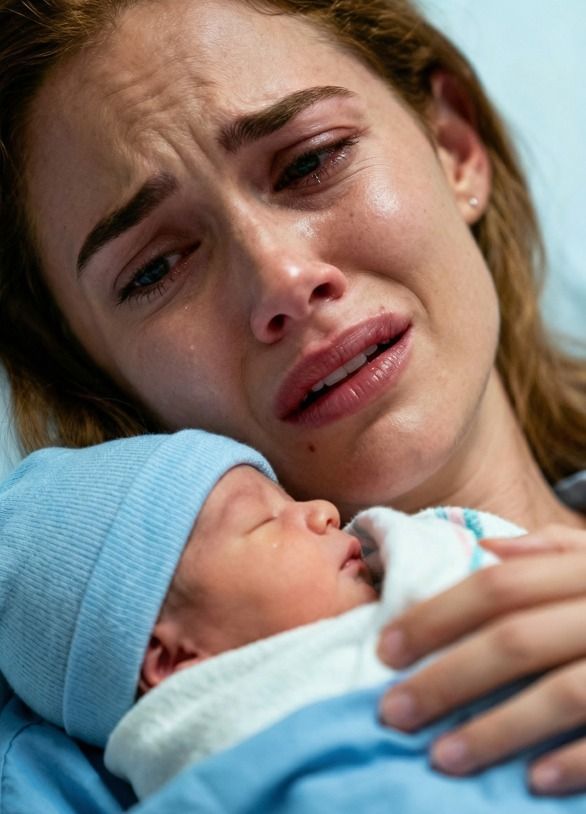
The moment my son entered the world, they placed him gently on my chest. He was warm, impossibly small, and very much alive. His tiny fingers curled instinctively against my skin, and for a brief, perfect second, nothing else existed. The pain of labor faded into the background, replaced by awe, relief, and a love so sudden it took my breath away.
Around us, the delivery room moved with quiet efficiency. Nurses adjusted blankets. A monitor beeped steadily. Someone congratulated us softly. I was exhausted, shaking, overwhelmed in the best possible way.
Then my husband spoke.
Ryan stood at the foot of the bed with his arms crossed. He didn’t come closer. He didn’t reach for the baby. He looked at our newborn, let out a crooked little smirk, and said, almost casually, “We should get a DNA test. Just to make sure he’s mine.”
The room froze.
A nurse stopped mid-step. The doctor’s expression hardened. I felt my chest tighten as if all the air had been pulled out at once. Instinctively, I pulled my baby closer, my arms tightening around him as tears rushed to my eyes.
“Ryan,” I whispered, my voice cracking. “Why would you say that now? Of all moments?”
He shrugged, as if he’d commented on the weather. “I’m just being careful. These things happen.”
“Not to me,” I said quietly. “Not to us.”
But he didn’t apologize. He didn’t backtrack. He didn’t even look embarrassed. He acted as though I were being unreasonable, as though my shock and pain were inconveniences rather than consequences of his words.
The nurse avoided my eyes. The pity in her expression hurt almost as much as the accusation itself.
The next day, Ryan doubled down.
He asked hospital staff to document his request. He repeated it loudly in the hallway when my mother visited, making sure others heard. When I begged him to wait, to give me time to recover, to let us get home and breathe, he dismissed me with a familiar line.
“If you have nothing to hide,” he said, “why are you upset?”
I agreed to the test.
Not because I owed him proof, but because I wanted his doubt crushed by facts. I wanted this stain on what should have been the happiest moment of my life erased, cleanly and permanently.
They took cheek swabs from all three of us. Me. Ryan. Our newborn, who whimpered softly in my arms, unaware that his very identity was being questioned before he was even a day old.
The lab told us the results would take a few days.
Ryan walked around like he’d won something. He told people he just wanted peace of mind. He smiled too easily. Slept too well. I lay awake at night staring at the bassinet, memorizing every sound my baby made, wondering how the man I married could look at us and see suspicion instead of wonder.
On the third day, my obstetrician’s office called and asked me to come in for a brief consultation.
Ryan didn’t come.
He said he was busy.
I strapped my baby to my chest and went alone, expecting a routine conversation. Maybe an awkward apology delivered through professional language. Maybe reassurance that everything was fine.
Instead, Dr. Patel walked into the room holding a sealed envelope, her face pale and tense.
She didn’t sit down.
She looked straight at me and said, in a low, steady voice, “You need to call the police.”
For a moment, I thought I’d misheard her.
“The police?” I asked, panic rising fast. “Why? Did Ryan do something?”
She placed the envelope on her desk without opening it. “I want to be very careful with my words,” she said. “This is not about relationship problems. This concerns a potential crime. And your baby’s safety.”
My heart began to pound so hard I could feel it in my throat. “Is the test wrong?” I asked. “Was there a mistake?”
“The DNA results are back,” she said gently. “They are not what anyone expected. The baby is not biologically related to your husband.”
For half a second, relief tried to surface. If that were true, Ryan would look foolish, and this nightmare might finally end.
But Dr. Patel’s expression didn’t soften.
“And,” she continued, “the baby is not biologically related to you either.”
The room tilted.
I grabbed the edge of the chair, my legs suddenly weak. “That’s impossible,” I whispered. “I gave birth to him.”
“I know,” she said softly. “I am not questioning your experience. But genetically, there is no maternal match. When results look like this, there are only two possibilities. A laboratory error, or a baby mix-up.”
My mouth went dry. “A mix-up? As in… switched babies?”
“It’s rare,” she said, “but it does happen. Especially during very busy shifts. We immediately verified the lab’s chain of custody. All samples were correctly labeled and processed.”
I pressed my hand to my chest, struggling to breathe. “So what does this mean?”
“It means law enforcement must be notified immediately,” she replied. “If this was an accidental exchange, we need to locate the other infant right away. If it was intentional, this becomes a criminal investigation.”
Without realizing it, I tightened my arms around the baby carrier. He slept peacefully, unaware that the ground beneath my life had completely given way.
“Are you saying someone took my baby?” I asked.
“I’m saying we don’t know yet,” she said. “And we can’t afford to wait.”
She slid her phone toward me. “I can stay with you while you call. Please don’t leave the building.”
My hands shook as I dialed. When the dispatcher answered, my voice sounded distant, like it belonged to someone else.
“I’m at Saint Mary’s Hospital,” I said. “My doctor told me to call. They believe my baby may have been switched.”
As I spoke, I saw two uniformed officers step off the elevator at the end of the hallway, walking toward us with purpose.
In that moment, one truth settled heavily in my chest.
Ryan’s cruel demand for a DNA test hadn’t just broken my heart.
It had opened the door to something far bigger, far darker, and far more terrifying than I could have ever imagined.
And this was only the beginning.