Alexander did not move for several seconds.
The house, with its soaring ceilings and perfect sunlight and echoing marble floors, seemed suddenly too large for him. The pride he had carried through the front door faded in front of his parents and sister, and in its place came something much quieter.
Confusion.
He crossed to the kitchen island slowly, as if he expected me to appear from behind one of the bare doorways and laugh at the prank. His shoes made sharp sounds against the floor. His mother’s suitcase wheels squeaked once, then stopped. Charlotte stood with both hands curled
around the strap of her handbag, the smile gone from her lips.
Alexander lifted the paperweight.
The folder opened under his hand.
From the driveway camera on my phone, I could not hear what he said at first. I sat in the back seat of a hired car two miles away, parked outside a small hotel with ivy climbing the brick walls and white curtains in every window. My assistant, Naomi, had insisted I not drive myself.
“You’ve had no sleep,” she had said. “And you’re shaking.”
“I’m fine.”
“You’re very impressive,” she replied, “but you are not fine.”
So I sat there, watching a silent feed of my own front hall as the man who believed he could claim my life began reading the proof that he could not.
Then the driveway camera picked up sound.
“What is this?” Charlotte asked.
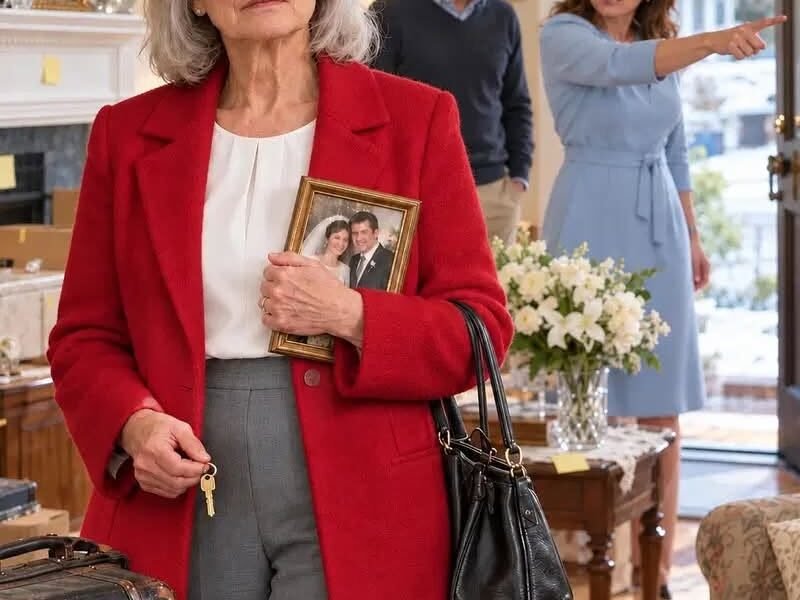
Alexander’s mother, Evelyn, stepped closer to the island. She was still wearing the cream cardigan she had worn in the airport photo Alexander sent that morning. Her face was pale in the glow from the kitchen windows.
Alexander turned one page. Then another.
His father, Robert, said quietly, “Alex?”
“It’s nothing,” Alexander snapped.

But his voice had changed.
That was the first unexpected thing.
Not the anger. I had expected anger. Not even the embarrassment. I had expected that too. What I had not expected was the tremor under his words, the tiny crack in the confidence that had frightened me the night before.
He read the deed once.
Then read it again.
Charlotte leaned over his shoulder. “Why is only her name on it?”
Alexander closed the folder too quickly. “Because she likes paperwork.”
Evelyn did not laugh.
She reached for the folder, and for a moment Alexander held it back. Mother and son stared at each other across the marble island. Something passed between them that I could not read from the camera: warning, history, maybe recognition.
Then Evelyn said, “Give it to me.”
He did.
I watched her sit at one of the island stools and remove her reading glasses from her purse. Robert set down the luggage. Charlotte wrapped her arms around herself and glanced toward the empty living room, where only the staged sofa remained beneath the wall of glass.
The room looked like a beautiful shell after the tide had gone out.
Evelyn read slowly. She did not react to the first few pages. Not the deed. Not the records. Not
even the company-sale transfer.
But when she reached the bank statements, her hand stopped.
“Alexander,” she said.
He walked away from the island, then turned back. “That account was shared.”
“No,” Evelyn said, and there was no softness in her voice now. “This says temporary access for moving expenses. And these withdrawals—”
“Mom.”

“Were for us?”
Charlotte’s head snapped up. “What?”
Robert took the page from Evelyn’s hand. His eyes moved over the numbers, and something in
his face folded inward.
Twenty thousand dollars.
Forty-three thousand dollars.
Sixteen thousand dollars.
Family assistance.
Emergency expenses.
Support for Charlotte.
Charlotte whispered, “You told me Victoria offered.”
Alexander said nothing.
The hotel doorman opened my car door, startling me.
“Ms. Vale?”
I lowered the phone, though my hands resisted leaving the screen. “Yes?”
“Ms. Price is waiting for you upstairs.”
Naomi stepped around from the front passenger seat and offered me her arm like I was ninety years old instead of thirty-eight and merely exhausted. I almost made a joke. Instead, I took it.
The hotel lobby smelled of coffee and lilies. Sunlight fell through tall windows onto old patterned
rugs. A woman near the fireplace laughed into her phone, and the sound made me flinch because normal life continued so carelessly while mine was splitting open.
My attorney, Maren Price, waited in a private conference room on the second floor. She was in her early fifties, silver-haired, composed, and famous for never wasting a sentence. On the table
before her sat a yellow legal pad, a laptop, and a cup of tea she had not touched.
She stood when I entered.

“Victoria,” she said, and the kindness in her voice nearly undid me.
I had expected legal strategy. I had prepared for paperwork, signatures, decisions. What I had
not prepared for was the way one gentle syllable could make my throat close.
“I left the folder,” I said.
“I know.”
“He’s home now.”
“I know that too.” Maren gestured to the chair across from her. “Sit down before courage starts charging you interest.”
That would have made me smile on any other day. Today, I sat because my knees had started to feel unreliable.
Naomi placed a paper cup of coffee beside me, then retreated to the corner with her tablet. She
had been with me for six years, from the last frantic growth stage of my company to the complicated months before the sale. She knew the language of investors and deadlines and private panic. She also knew when not to ask questions.
Maren opened her laptop. “The house is yours. The purchase funds are traceable to the sale of your premarital business interest, and you maintained those proceeds in a separate account. The deed is solely in your name. Alexander may try to create noise, but noise is not ownership.”
I breathed in for what felt like the first time since dawn.
“The withdrawals?” I asked.
“We’ll address them properly. I’ve already prepared letters to the bank and a preservation notice. You were wise to save the access history.” Maren paused. “But there is something else.”
I looked up.
She turned her laptop slightly.
On the screen was an old email chain. At first I did not understand what I was seeing. It was from
five years earlier, before the sale, before the house, before Alexander and I had learned to perform happiness for photographs. The sender was listed as D. R. Vale.
My father.
I stared at his name.
My father had died nine years before, long before my company became valuable enough for anyone to call me brilliant. He had been a math teacher with a dry sense of humor and a talent for

fixing broken lamps. He left behind a small savings account, three shelves of annotated books, and the belief that I could build something no one else yet understood.
“What is that?” I asked.
Maren’s expression softened. “Your father wrote to a colleague of mine shortly before he passed. He wanted advice about protecting your work if you ever married. Nothing was filed because you
weren’t engaged then, but he drafted notes. He was concerned that you trusted quickly.”
The conference room blurred at the edges.
My father had worried about everything. Whether my car tires had enough tread. Whether I
remembered to eat when I worked late. Whether the world would be kind to me if my ideas became valuable before I became cautious.
Maren scrolled.
There, in my father’s careful words, was a sentence that made my hand rise to my mouth.
My daughter believes love means sharing everything. I hope she learns that real love never asks her to disappear.
I had not cried when Alexander said the house belonged to him.
I had not cried while packing my life into boxes.
But at that sentence, tears slipped down my face before I could stop them.
Naomi moved toward me, then halted, unsure whether to comfort me or protect my dignity.
Maren looked down at her tea and gave me the privacy of pretending not to notice.
For years, I had mistaken endurance for strength.
Now, in a quiet hotel conference room, I understood that strength could also be letting love from
the past reach you when you had no defenses left.
My phone buzzed.
Alexander.
Then again.
Then again.
Maren glanced at the screen. “Do not answer yet.”
“I wasn’t going to.”
But I wanted to.
Not because I missed him. Not because I doubted myself. I wanted to hear how a man explained
the moment when certainty collapsed.
The phone buzzed once more. This time, a message appeared.
Victoria. Call me now. You are embarrassing me in front of my family.
A second later:
We need to talk like adults.
Then:
You can’t just leave.
And finally, after a pause long enough for him to read another page:
I didn’t know she would show them the bank records.
I stared at that last message.
“She?” I whispered.
Maren leaned forward. “What did he say?”
I turned the screen toward her.
Her eyes sharpened.
Naomi came closer.
“She,” I repeated. “Who is she?”
Maren held out her hand. “May I?”
I gave her the phone. She read the messages, then sat back slowly.
“That,” she said, “is worth preserving.”
The day shifted again.

Until that moment, I had thought the conflict was between Alexander and me. Greed dressed up as marriage. Entitlement dressed up as family duty. Painful, yes, but simple.
But one careless message had opened a door to something hidden behind the wall.
And Alexander had not meant to let me see it.
By late afternoon, the house had become the center of a storm that nobody inside had expected.
My attorney sent notice that Alexander had no authority to invite occupants into the property. The security company updated all codes and remote permissions. The bank froze the temporary
account while it reviewed the withdrawals. I arranged for my belongings to be moved into a furnished corporate apartment I kept for visiting executives, a place I had barely used except during board meetings.
At 5:40, Evelyn called me.
Not Alexander.
His mother.
I let it ring twice before answering.
For a moment, neither of us spoke.
Then she said, “Victoria, this is Evelyn.”
“I know.”
Her breath trembled. “I’m sorry to call. I don’t know what Alexander has told you about us.”
I looked out the apartment window. The city glowed gold under the lowering sun. Far below, cars moved through the streets like beads on invisible strings.
“He told me you were moving in today,” I said.
“He told us you invited us.”
I closed my eyes.
“He said you wanted to help Charlotte after the divorce,” Evelyn continued. “He said you felt the house was too large for two people. He said…” She paused. “He said you were excited to finally
have a real family around you.”
That landed somewhere tender.
Alexander knew exactly where to press. My mother had left when I was young. My father raised me alone, and after he died, I became very good at building companies and very bad at admitting holidays could feel lonely. The idea of a large family around a table had once seemed
beautiful to me.
Before it became a strategy used against me.
“I did not invite anyone,” I said.
“I believe you.”
Those three words surprised me.
I opened my eyes.
Evelyn’s voice lowered. “I need to tell you something, and I am ashamed that it took today for me to say it. Alexander has done this before. Not with a house. Not like this. But with stories. With money. With promises he makes in other people’s names.”
I sat down slowly on the edge of the bed.
“What do you mean?”
“He told Charlotte that you offered to pay for her legal bills. He told Robert and me that you insisted on helping with our medical expenses. When money appeared, we thought…” She swallowed audibly. “We thought you were generous beyond measure. I wrote you a thank-you
card, but Alexander said you disliked sentimental gestures and would be embarrassed.”
I remembered no card.
No mention of medical expenses.
Only Alexander complaining that his parents “never planned properly” and Charlotte “always made

emotional decisions.”
Evelyn continued, “Charlotte is devastated. She thought she was coming to stay with your blessing. Robert is furious, but mostly at himself. And I… I am trying to understand how my son learned to make everyone around him feel responsible for his lies.”
There was no performance in her voice. No demand. No attempt to soften Alexander’s actions into a misunderstanding. Just a mother standing in the wreckage of what she had not wanted to see.
“I’m sorry,” I said, though I did not know exactly what I was sorry for.
“So am I.” Evelyn exhaled. “We will leave tonight. Charlotte has a friend nearby. Robert and I will find a hotel.”
“You don’t have to tell me where.”
“I know.” Another pause. “But I wanted you to know we will not occupy your home. And Victoria?”
“Yes?”
“The folder you left…” Her voice broke. “It did more than prove ownership. It told the truth in a room where my son expected everyone to obey the story he wrote.”
After the call ended, I sat very still.
I had imagined Alexander returning to the house and discovering emptiness.
I had imagined his anger.
I had imagined legal letters and cold consequences and the satisfaction of removing myself from the reach of his certainty.
I had not imagined his mother apologizing to me.
I had not imagined Charlotte being deceived too.
I had not imagined that the people I thought were arriving as invaders had been brought there as pawns.
That night, sleep came in fragments.
At 2:10 a.m., I woke to rain against the apartment windows. The city outside had softened into a watercolor of streetlights and wet glass. My phone lay facedown on the nightstand, but I knew
there were messages waiting. Alexander had sent dozens. Some angry. Some wounded. Some almost tender in the way a locked door can sound like a plea when someone is on the wrong
side of it.
I did not read them.
Instead, I made tea in the small kitchen and opened the old email from my father again.
My daughter believes love means sharing everything.
I could hear his voice in it.

He used to leave notes in my lunch bag before debate tournaments.
Argue clearly. Breathe. Don’t let loud people borrow your certainty.
I smiled through tears.
“Dad,” I whispered to the empty apartment, “I wish I had listened sooner.”
But perhaps he had found a way to speak anyway.
The next morning brought rain, coffee, and Charlotte.
She called at 8:17.
I almost ignored the number. Then I remembered Evelyn’s voice and answered.
“Victoria?” Charlotte sounded smaller than I had ever heard her.
“Yes.”
“I’m outside your building. I know that is inappropriate. I’m not here to argue. I just…” She drew a breath. “I found something you need to see.”
A reasonable part of me wanted to refuse. The exhausted part wanted to crawl back under the
covers. But something in her voice carried the brittle urgency of a person who had spent the night sorting through the broken pieces of her own reality.
Twenty minutes later, we sat across from each other in the apartment lounge, a quiet room with
blue chairs and a fireplace that had not been lit in years. Charlotte looked nothing like the woman from the driveway camera who had checked her reflection before entering my house. Her hair was pulled back. Her eyes were swollen. She held a manila envelope on her lap with both hands.
“I owe you an apology,” she said.
“You were lied to.”
“I still liked the lie.” Her honesty startled me. She gave a sad, crooked smile. “That’s the part I’m not proud of. Alex said you wanted me there. He said you had more than enough. I told myself it was okay because you were rich and I was starting over and maybe life was finally being gentle with me.”
There was no accusation in it. Only the tired confession of someone who had been desperate for
a door to open.
“My divorce left me with debt,” she continued. “More than I told my parents. Alex knew. He said he could arrange help from you, but that you didn’t want a fuss. When he sent money, I believed him.”
“The sixteen thousand?”
She nodded, tears gathering. “I used some of it for legal bills and a deposit on a small rental. I can repay it. Not immediately, but I can.”
“This isn’t about punishing you.”
“I know. But it has to be about making it right.” She looked down at the envelope. “And that’s why
I brought this.”
She slid it across the table.
Inside were printed screenshots.
Messages from Alexander.
At first they looked like ordinary family updates. Then I read more closely.
Victoria won’t object once you’re already here.

She gets emotional, but I know how to handle it.
Don’t mention the money. She hates talking finances in front of family.
And then, dated three weeks earlier:
Once everyone is settled, she won’t make me look bad by throwing you out. Trust me.
The room went quiet except for the rain tapping the windows.
I read the last message twice.
Alexander had not acted on impulse.
He had planned the pressure. He had expected me to choose politeness over truth, discomfort over confrontation, silence over self-respect.
Charlotte watched me carefully. “There’s more.”
My hand tightened around the paper.
She reached into the envelope and removed one final page.
It was not a message from Alexander.
It was a photo of an old handwritten note on lined paper, yellowed at the edges.
“I found it last night,” Charlotte said. “Mom kept a box of things from when your father tutored Alex in high school.”
I looked up sharply. “My father?”
Charlotte nodded. “You didn’t know?”
The lounge seemed to tilt.
“My father taught math at Westbridge High,” I said.
“So did Alex go there for two years.” Charlotte’s brow furrowed. “He never told you?”
No.
He had told me he transferred schools often. He had told me almost nothing about those years
except that he disliked talking about them. I had never pushed. I had thought privacy was respect.
Charlotte touched the paper gently. “Mom said your dad helped him after he almost failed algebra. Alex was angry all the time back then. Dad traveled for work, Mom was overwhelmed, and
Alex acted like needing help was the same as being humiliated. Your father was one of the few adults he listened to.”
I unfolded the copy.
The handwriting was my father’s.
Alexander,
Being smart is not the same as being right. Being afraid is not the same as being powerless. One day you may find yourself standing beside someone stronger than you expected. Do not mistake her strength for something that diminishes yours.
Mr. Vale
I stopped breathing.
There it was: the final hidden thread, running beneath years of marriage without my knowledge.
Alexander had known my father.
Not in passing.

Not as a name on my childhood stories.
He had known him as a boy who needed help, and my father had seen enough in him to leave a warning disguised as encouragement.
Charlotte wiped her cheek. “Mom said Alex kept that note for years. Then one day he said Mr. Vale thought he was weak. But when Mom found the note, it didn’t say that at all.”
I stared at my father’s words until the ink blurred.
Do not mistake her strength for something that diminishes yours.
A strange sadness opened in me.
Not for the marriage. That had been cracking long before yesterday. But for the boy Alexander had been, the man he might have become, and the choice he had made instead. He had stood beside my strength and treated it as a threat. He had heard kindness as insult. He had turned old insecurity into control.
Charlotte leaned forward. “I’m not bringing this to excuse him.”
“I know.”
“I’m bringing it because I think he married you knowing who your father was.”
The words entered the room and stayed there.
I looked at her.
She continued, voice barely above a whisper. “He recognized your last name when you first met. I remember because he called Mom that night and asked if Daniel Vale had a daughter named Victoria. Mom thought it was sweet. Like fate.”
Fate.
Or unfinished business wearing a charming smile.
I remembered the first night I met Alexander at a charity event. His easy laugh. His attentive
questions. The way he seemed fascinated by my work, not intimidated by it. The way he said, “Victoria Vale. That’s a memorable name.”
I had thought it was flirtation.
Perhaps it had also been recognition.
Not love at first sight.
A doorway to a past he had never resolved.
The discovery did not make him monstrous. In a way, it made him painfully human. A man who had carried an old wound incorrectly, then built a marriage around proving he would never feel small again.
But understanding was not permission.
Compassion was not surrender.
I folded the paper carefully. “Thank you for bringing this.”
Charlotte nodded. “I’m going to send everything to your attorney.”
“That would help.”
“And I’m going to repay the money.”

“We’ll let the attorneys work out what’s fair.”
She gave a shaky laugh. “You sound calm.”
“I don’t feel calm.”
“What do you feel?”
I looked toward the rain-streaked window. Across the street, a little girl in a yellow coat jumped over puddles while her father held an umbrella above both of them, laughing when she splashed
his shoes.
“I feel,” I said slowly, “like I’ve been living inside a room with the curtains closed. And someone just opened them.”
Charlotte’s eyes filled again, but this time she smiled.
“Then I hope the view gets better.”
It did.
Not all at once. Healing rarely arrives like a parade. It comes in small, almost ordinary moments
that do not announce themselves as miracles.
It came when I met Maren to sign the first formal papers and did not tremble.
It came when the bank confirmed the account access had been misused and the withdrawals were
under review.
It came when Alexander moved out of the house under legal pressure, leaving behind two suitcases, a collection of watches, and an office drawer full of receipts that made Maren raise both
eyebrows and say, “Well. He has been careless in a useful way.”
It came when Evelyn mailed me a card after all.
Not an apology this time. Something simpler.
Thank you for telling the truth when silence would have been easier.
Inside the envelope, she included a photograph.
My father, younger than I remembered him, standing beside a teenage Alexander outside a
school gym. Alexander looked awkward and sullen, his arms folded too tightly. My father stood next to him with one hand on a stack of papers and the faintest smile on his face.
On the back, Evelyn had written:
Daniel Vale helped my son once. I am sorry my son forgot what help was meant to teach him.
I placed the photograph beside my father’s old email printout.
For three weeks, the legal process moved like weather: formal, heavy, necessary. Alexander’s messages shifted from anger to apology to accusation to nostalgia. I answered only through counsel until one afternoon Maren called.
“He wants a meeting,” she said.
“No.”
“I expected that answer.”
“Good.”
“He says he has something of your father’s.”
I stood in my office, staring at the city beyond the glass wall. My new team was smaller now. After the sale, I had promised myself a year off, but still I kept a small advisory company because I did not know who I was without problems to solve. On my desk sat fresh flowers Naomi had

placed there that morning without comment.
“What thing?” I asked.
“He claims it is a notebook.”
The word struck like a bell.
My father had kept notebooks everywhere: lesson plans, repair sketches, grocery lists, quotes from books, ideas for math puzzles. After he died, I found most of them in the garage, but one
was missing. A blue clothbound notebook I remembered from my teenage years. He had written in it during the months before his diagnosis. I had looked for it for years.
“Where did Alexander get it?”
“He says your father gave it to him.”
I closed my eyes.
A meeting was arranged in Maren’s office, not mine, not the house, not anywhere memory could weaken the boundaries I had built.
Alexander arrived ten minutes late.
That alone told me something. Even humbled, he wanted the room to notice his entrance.
But when he stepped inside, he looked older. His hair was uncombed at the edges. His eyes carried the dull fatigue of someone sleeping badly. He wore a navy jacket I had bought him for our fourth anniversary. I noticed that and felt nothing except a quiet ache for the woman who had once tried to dress hope as certainty.
Maren sat beside me.
Alexander sat across from us.
For a long moment, he only looked at me.
“Victoria,” he said.
I nodded once.
He placed a blue notebook on the table.
My breath caught.
The cloth cover was faded. One corner had been repaired with clear tape. My father’s initials, D.R.V., were written on the first page in black ink.

I touched it with two fingers, as though it might vanish.
Alexander watched my face. For the first time in weeks, he did not speak quickly.
“He gave it to me after I graduated,” he said. “He said it had notes that might help me understand discipline. I thought he was insulting me.”
I opened the notebook.
The first pages were math problems, then teaching reflections, then lists of books he wanted to read. Halfway through, the entries changed. They became letters he had never sent.
One was addressed to me.
My hands began to shake.
Maren noticed and slid a glass of water closer.
I read silently.
Victoria,
You are sixteen as I write this, and you have just told me you plan to build a company that will change how people use machines to understand language. I nodded seriously because you were serious, but after you went upstairs, I laughed until I cried. Not because I doubted you. Because I believed you so completely it frightened me.
The world will praise you when you win and question you when you protect what winning cost you.
Please remember this: generosity is beautiful, but it is not measured by how much of yourself you allow others to take.
Build the house you want, even if I am not there to see it.
Fill it with people who knock before entering.
Love,
Dad
I covered my mouth.

There were tears, but they did not feel like breaking. They felt like water reaching a place that had been dry for too long.
Alexander looked down at the table. “I read that letter years ago.”
I turned the page carefully.
“You knew,” I said.
“Yes.”
The word settled between us.
No excuse followed.
For once, he did not rush to explain himself into innocence.
“I was angry at him,” Alexander said. “Your father saw through me when I was a kid. He knew when I lied. He knew when I pretended not to care. When I met you, I told myself it was coincidence.
Then I realized whose daughter you were, and…” He swallowed. “I wanted to be the man he would have respected.”
“You could have tried being honest.”
His face tightened, but he did not argue.
“I know.”
“You turned my life into a test you were taking against a dead man.”
Maren’s eyes flicked toward me, not warning me to stop, only witnessing.
Alexander pressed his palms together. “At first I loved you. I did. Or I thought I did. You were brilliant and warm and so certain when you talked about your work. But every time you succeeded,
I heard his voice. Standing beside someone stronger than you expected. And I hated that it felt like losing.”
I looked at him carefully.
There was the unexpected truth, finally spoken.
Not that he had never loved me.
That love, in him, had become tangled with comparison until it could no longer breathe.
“I spent years trying to make myself smaller for you,” I said. “Not obviously. Not all at once. I stopped correcting details when you exaggerated your role in my company. I let you say ‘we’ because explaining the truth felt unkind. I apologized when my work intimidated you. I thought that was love.”
Alexander’s eyes reddened.
“It wasn’t,” I said.
“No,” he whispered.
“You didn’t lose me because I bought a house. You lost me because you walked into it and declared I no longer existed.”
He flinched, and this time I saw that the words reached him.
Not as humiliation.
As truth.
He reached into his jacket and removed a folded paper. Maren lifted her chin slightly, alert.
“It’s a signed acknowledgment,” Alexander said. “The house is yours. The money was withdrawn without proper permission. I will cooperate with repayment. I won’t contest occupancy. I won’t contact you except through attorneys.”
Maren took the paper, scanned it, and gave the smallest approving nod.
I looked at Alexander. “Why?”
He gave a brittle, tired smile. “My mother said if I left that office without telling the truth, she would never again let me confuse family with loyalty.”
Despite everything, a laugh almost escaped me. Evelyn, it seemed, had found her voice too.
Alexander stood.
“I’m sorry, Victoria.”
The apology was not enough. It could not restore the years, the trust, the mornings I had woken beside someone quietly rewriting my life.
But it mattered that he said it without asking me to comfort him.
I placed my hand on the blue notebook. “I hope you become someone who means that.”
He nodded.
At the door, he turned back once.

“Your father was right about you.”
Then he left.
Months passed.
The house remained empty for a while.
People assumed I would sell it. Naomi thought I should. Maren advised that I wait until the divorce settlement was complete. Charlotte, now in a small apartment above a bakery, sent repayment installments every month with notes that grew gradually less formal.
The first said:
Payment 1. Thank you for your patience.
The fourth said:
The bakery downstairs makes terrible espresso but excellent cinnamon rolls. That feels like an acceptable trade.
The seventh said:
I got the job. Actual benefits. Actual desk. Actual reason to buy a plant.
Somewhere between the fourth and seventh notes, we became something neither of us expected.
Not close exactly.
Not family in the easy way people say it when they want to skip the work.
But connected.
Evelyn and Robert moved into a modest condo near Charlotte, and one Sunday in spring, Evelyn invited me for lunch. I almost declined. Then I thought of my father’s line about people who knock before entering, and I went.
Evelyn served tomato soup and grilled cheese sandwiches as though the meal were a state occasion. Robert showed me the tiny balcony where he was attempting to grow basil. Charlotte arrived late with bakery cookies and a story about accidentally sending a spreadsheet to her entire office with the file name “please let this be right final final actual final.”
For the first time in a long time, I laughed until my face hurt.
Nobody mentioned Alexander until dessert.
Then Evelyn said, “He’s in counseling.”
I set down my tea.
“He’s also working,” Robert added. “A real job. Not consulting. Not advising. Working.”
Charlotte looked at me. “You don’t have to care.”
“I know.”
But I did care, in a distant human way. Not enough to return. Not enough to reopen a closed door. But enough to hope that a man who had caused harm might finally stop passing it forward.
“That’s good,” I said.
Evelyn’s eyes shone with gratitude because I had given her the only thing I could honestly offer: not forgiveness as a performance, but the absence of bitterness.
In early summer, the divorce finalized.
The process was quieter than people imagine endings to be. A conference table. Signatures. Copies. A judge’s approval. A legal sentence where a marriage had once been.
Afterward, I drove alone to the house.
I had not been there in weeks.
The long driveway curved beneath trees washed bright by afternoon sun. The little American flag
still hung beside the front door, though it had faded at the edges. The pool glittered blue in the backyard. Inside, the rooms smelled faintly of cedar and dust.
My footsteps echoed.
For a while, I stood in the kitchen where everything had changed.
The marble floor no longer looked like a battlefield. It looked like stone. Beautiful, expensive,
neutral stone. The house had not betrayed me. It had simply revealed who could stand inside it truthfully.
On the island, I placed my father’s blue notebook.
Then I walked from room to room, not imagining what had been taken, but what could begin.
A library in the east room.
Guest rooms that were actually offered, never imposed.
A long table in the dining room where people could bring stories without bringing claims.
And in the front room, with its tall windows and morning light, something unexpected came to me
whole.
Not a private retreat.
Not a monument to success.
A foundation.
Six months later, the Vale House opened.
The sign at the driveway was simple:
THE VALE HOUSE
A RESIDENCE FOR WOMEN REBUILDING AFTER MAJOR LIFE TRANSITIONS
It was not a shelter in the emergency sense. Others already did that work with expertise I respected. Vale House became a bridge for women who had survived the immediate storm and
needed time, quiet, legal guidance, career support, financial planning, childcare referrals, and a room where nobody made them feel foolish for not knowing what came next.
Naomi became the program director after pretending for exactly eleven days that she was “only helping temporarily.”
Maren volunteered one Saturday a month.
Charlotte taught a workshop called “Starting Over Without Apologizing for the Messy Parts,” which became so popular we had to move it to the dining room.
Evelyn organized Sunday lunches.
Robert’s basil mostly died, but his roses flourished along the fence.
Women arrived with labeled boxes, tired eyes, brave smiles, and children who pressed their noses to the glass doors to stare at the pool. We filled the library with books. We filled the pantry with food. We filled the front hall with the sound of people entering after being invited.
One evening in December, nearly a year after I had emptied the house, I stood in the kitchen while

rain tapped softly at the windows. A young woman named Priya sat at the island with her eight-year-old son, Leo, helping him build a cardboard model of a rocket for school. Charlotte was washing mugs at the sink. Evelyn was arguing cheerfully with Naomi about whether soup needed
more salt.
The house smelled of bread, cinnamon, and lemon cleaner.
Not fresh paint anymore.
Life.
The doorbell rang.
I opened it to find a courier holding a small package addressed in handwriting I recognized from legal documents.
Alexander.
My body went still.
Maren, who had arrived for dinner, appeared behind me. “Would you like me to take it?”
I shook my head.
Inside was a small wooden box and a letter.
The box contained a brass key.
Not to the house. I knew every key to the house.
This one was old, tarnished, and tied with a faded string.
The letter was brief.
Victoria,
I found this in the storage unit with the last of my school things. Your father gave it to me the day I graduated, along with the notebook. He said it opened a cabinet in his classroom where he kept extra supplies for students who needed help but were too proud to ask.
I kept it for years without understanding why.
I’m sending it back because I think you do understand.
I am not asking for anything. I only wanted you to have what was his.
Alexander
Beneath his letter was another folded note, brittle with age.
My father’s handwriting again.
For the student who thinks accepting help is defeat:
A locked cabinet is still useful only because someone with a key chooses to open it.
D.R.V.
I read it twice.
Then I began to laugh.
Softly at first, then with tears in my eyes, because my father had somehow crossed years, grief,
betrayal, and recovery to deliver one final lesson through the least likely messenger.
Maren smiled without asking to read it.
Charlotte dried her hands on a towel and came closer. “Good news or bad?”
I held up the key.
“Both,” I said. “Which means probably real.”
That spring, we framed the note and hung it near the front door of Vale House. Under it, on a small brass plaque, we engraved:
A LOCKED CABINET IS STILL USEFUL ONLY BECAUSE SOMEONE WITH A KEY CHOOSES TO OPEN
IT.
Women touched the plaque sometimes when they arrived. Not dramatically. Just a brush of fingers over words as they stepped into a house that did not ask them to prove their pain before receiving kindness.

On the first anniversary of Vale House, we held dinner in the backyard.
The pool reflected strings of warm lights. Children ran across the lawn with paper lanterns. Music drifted through the open doors. Naomi gave a toast so efficient it made everyone cry in under
four minutes. Maren pretended not to wipe her eyes. Robert presented a pot of basil that had, against all odds, survived. Charlotte announced she had been promoted and then immediately dropped a cupcake, which Leo declared “still five-second safe.”
At the long table beneath the lights sat women who had arrived as strangers and become
witnesses to one another’s becoming.
Evelyn stood beside me near the patio steps, watching Charlotte laugh with Priya.
“I used to dream of my family living in a house like this,” she said quietly.
I looked at her.
She smiled with sadness and warmth together. “I imagined the wrong version. I thought family meant everyone under one roof. Now I think it means everyone being safe enough to tell the
truth.”
Across the yard, Charlotte caught my eye and lifted her glass.
I lifted mine back.
Later, after dessert, I walked alone to the front of the house.
The little American flag had been replaced with a new one. The windows glowed from within. Voices floated through the rooms, layered and warm. I thought of the second night, of Alexander barefoot on the marble floor, of the words that had once cut through me.
This house belongs to me.
He had been wrong.
But so had I, in a way.
The house did not belong to Alexander.
It did not belong only to me either.
Not anymore.
It belonged to every woman who slept peacefully upstairs after months of fear. To every child who learned laughter could return. To every Sunday lunch, every legal clinic, every late-night cup of
tea, every trembling first step toward a life rebuilt with steadier hands.
It belonged to my father’s faith.
To Naomi’s fierce competence.
To Maren’s calm justice.
To Evelyn’s difficult honesty.
To Charlotte’s decision to repair what she could.
And yes, it belonged to the woman I had been on that first morning, packing boxes with shaking hands, choosing silence not because she was weak, but because she was finally listening to her
own strength.
I opened the front door and stepped inside.
The marble floor gleamed beneath the light. From the kitchen came laughter, then the scrape of a chair, then Leo’s voice asking whether rockets could have libraries in them. Someone answered that the best ones probably did.
I placed my hand on the wall, feeling the quiet solidity of the house around me.
For ten years, I had worked to buy a dream home.
It took losing the dream I thought I wanted to discover the one my father had been guiding me toward all along.
A house with doors that opened by choice.
A family built not by claim, but by care.

And a life that finally, fully, beautifully belonged to me.