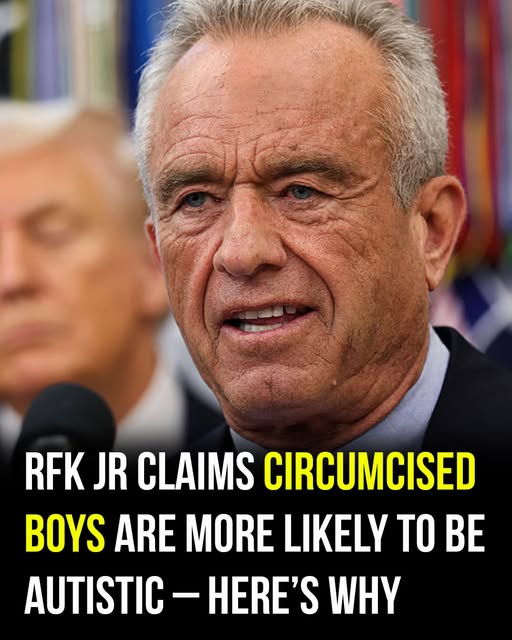
Health Secretary Robert F. Kennedy Jr. has once again found himself at the center of controversy after reviving one of his most disputed claims during a recent meeting with President Donald Trump and Cabinet officials.
Speaking at the gathering, Kennedy repeated his long-standing belief that the widely used pain reliever Tylenol may be connected to autism, despite acknowledging that no scientific proof currently exists to support the claim.
His comments immediately sparked renewed criticism from medical experts, advocacy organizations, and public health professionals who argue that such statements risk spreading misinformation about autism and maternal health.
The controversy follows remarks made only weeks earlier when Kennedy and Trump suggested that common medications taken during pregnancy could potentially contribute to autism in children.
Those suggestions were met with swift opposition from researchers and healthcare professionals.
Medical experts emphasized that existing studies have found no reliable evidence linking Tylenol or similar pain medications to autism. Major health organizations have repeatedly stated that current research does not support such a connection.
Tylenol manufacturer Johnson & Johnson also rejected the allegations, saying it strongly disagrees with claims that its product causes autism. Meanwhile, autism advocacy groups voiced concern that the comments could create unnecessary fear among expectant mothers.
Among the organizations responding was the National Autistic Society, which described the claims as dangerous, unscientific, and irresponsible.
The issue has attracted attention far beyond the medical community. Former President Barack Obama recently expressed concern about proposals from the current administration that he believes could negatively affect public health efforts.
Despite the criticism, Kennedy continued defending his position during the Cabinet meeting.
“Anybody who takes the stuff during pregnancy unless they have to is irresponsible,” Kennedy said.
He acknowledged that no definitive proof currently exists but argued that further studies are needed.
“It is not proof. We’re doing the studies to make the proof.”
The discussion became even more controversial when Kennedy referenced a social media video and appeared to make an inaccurate statement about pregnancy, claiming a woman was taking Tylenol while carrying “a baby in her placenta.”
Medical experts quickly pointed out that babies develop in the uterus, while the placenta is an organ that supports pregnancy.
Kennedy also suggested that political views may influence health decisions, describing one example as a case of “Trump derangement syndrome,” a remark that drew additional criticism.
He further revived another disputed theory involving infant circumcision and autism.
Kennedy claimed that boys who are circumcised as infants experience higher autism rates because Tylenol is sometimes administered afterward for pain relief.
The assertion appears to stem from a 2015 Danish study that identified a statistical correlation between circumcision and autism diagnoses. However, the researchers involved stressed that the findings did not establish a cause-and-effect relationship and included no data regarding pain medications.
Scientists have repeatedly warned that correlation alone does not prove causation, a distinction many experts say is essential when discussing complex conditions such as autism.
Kennedy’s latest remarks have reignited a broader debate about the responsibilities of public officials when discussing health issues.
Critics argue that government leaders should rely on established scientific evidence before making public claims, especially when those claims involve sensitive topics affecting families and children.
Supporters, however, contend that officials should be free to question existing research and encourage further investigation into possible causes of health conditions.
For many healthcare professionals, the central concern is that unproven theories can undermine public confidence in evidence-based medicine and distract attention from ongoing scientific efforts to better understand autism.
As the debate continues, one thing remains clear: Kennedy’s comments have once again placed the national conversation about autism, science, and public health squarely in the spotlight.