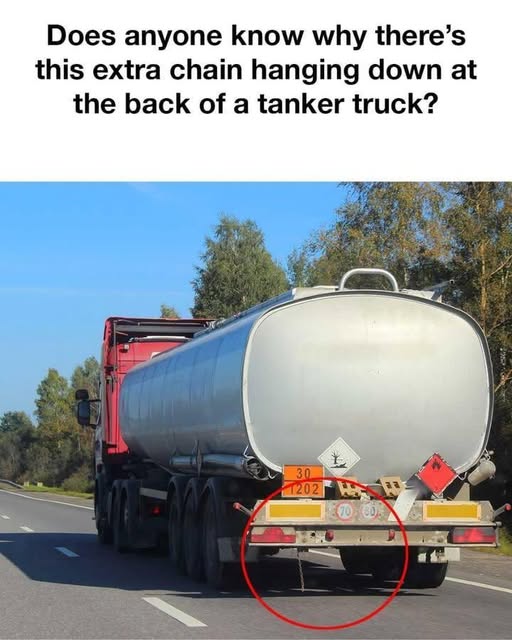
You’ve probably seen it a hundred times without really noticing: a tanker truck rolling down the road with a metal chain dangling from the back, lightly scraping the ground. It looks random—almost like something broke and nobody fixed it.
But that “extra” chain isn’t an accident. It’s one of the simplest, smartest safety features on the entire truck. And when you understand why it’s there, it changes how you see tanker trucks forever.
The Mystery Chain
That small chain at the back isn’t decoration—it plays a real role in safety.
The Purpose of the Extra Chain
The chain acts as a grounding device. In simple terms, it helps the truck safely “get rid of” static electricity.
As the tanker moves, two things can create static charge:
- Fuel movement inside the tank (liquid sloshing and flowing creates friction)
- Road motion and vibration (tires, air, and movement can contribute to charge buildup)
- Static electricity by itself isn’t rare or scary—we see it in everyday life. But on a fuel tanker carrying flammable liquids, even a tiny spark can be dangerous. The chain drags on the ground to give that charge an easy path into the earth, reducing the chance of a spark.
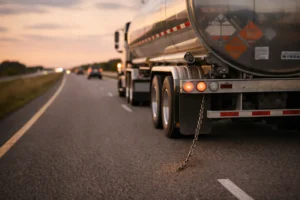
Static Electricity Explained
The chain provides a simple route for built-up charge to safely dissipate into the ground.
How This Became Standard Practice
In the early days of transporting fuel, static discharge accidents were more common than people realize. When fuel vapors are present, a small discharge can become a major incident.
Over time, safety rules and industry standards improved. One solution proved especially effective because it was simple: a chain that stays in contact with the ground while the truck is moving. No complicated electronics, no moving parts—just a reliable, low-tech safety layer that works in real-world conditions.
How Static Electricity Works in Tankers
Static electricity forms when surfaces touch and separate, creating an imbalance of electrical charge. Inside a tanker, moving liquid can create that same effect—especially when fuel flows or splashes.
If the charge builds up and has nowhere to go, it can discharge suddenly. If flammable vapors are nearby, that discharge can become the ignition source.
The chain helps prevent that scenario by offering a constant discharge path to the earth. Think of it like a pressure release valve—but for electricity.
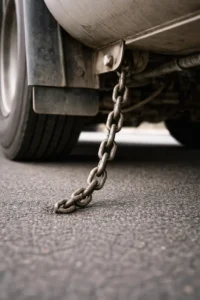
Grounding in Action
Continuous ground contact is the key—if the chain can’t touch the ground, it can’t do its job.
Modern Alternatives and Enhancements
Today’s tankers don’t rely on just one safety measure. The chain is important, but it’s often supported by additional protections, such as:
- Static grounding reels (retractable cables connected during loading and unloading)
- Anti-static additives mixed into fuels to reduce static buildup
- Special coatings and materials designed to minimize friction and charge generation
- Even with newer technology, many trucks still keep the chain because it’s simple, dependable, and always “on.”
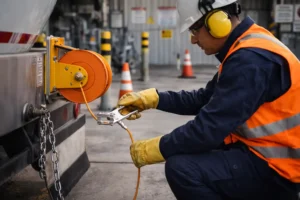
Modern Safety Layers
Grounding cables and other upgrades add protection, but the chain remains a reliable backup.
Common Misconceptions
- “It’s just leftover equipment.” No—this chain is an intentional safety feature.
- “It helps with braking or stabilizing.” Nope—its job is electrical grounding, not driving control.
- “It’s outdated.” Not really. Sometimes the simplest solutions stay around because they work.
Maintenance Matters
A grounding chain only works if it can do what it’s designed to do: touch the ground consistently. Over time, chains can wear down, corrode, or even snap.
That’s why routine inspections matter. Maintenance teams check that:
- The chain is long enough to maintain ground contact
- Links aren’t excessively worn or broken
Any damage is repaired quickly
A small chain might look unimportant—until you realize it’s part of a bigger safety system designed to protect the driver and everyone around the vehicle.
Conclusion
That extra chain hanging off the back of a tanker truck may look like a minor detail, but it plays a major role. By safely dissipating static electricity, it reduces the risk of sparks that could ignite flammable liquids.
It’s a powerful reminder that sometimes the smartest safety features aren’t high-tech—they’re the ones that quietly work every day, doing their job without asking for attention.