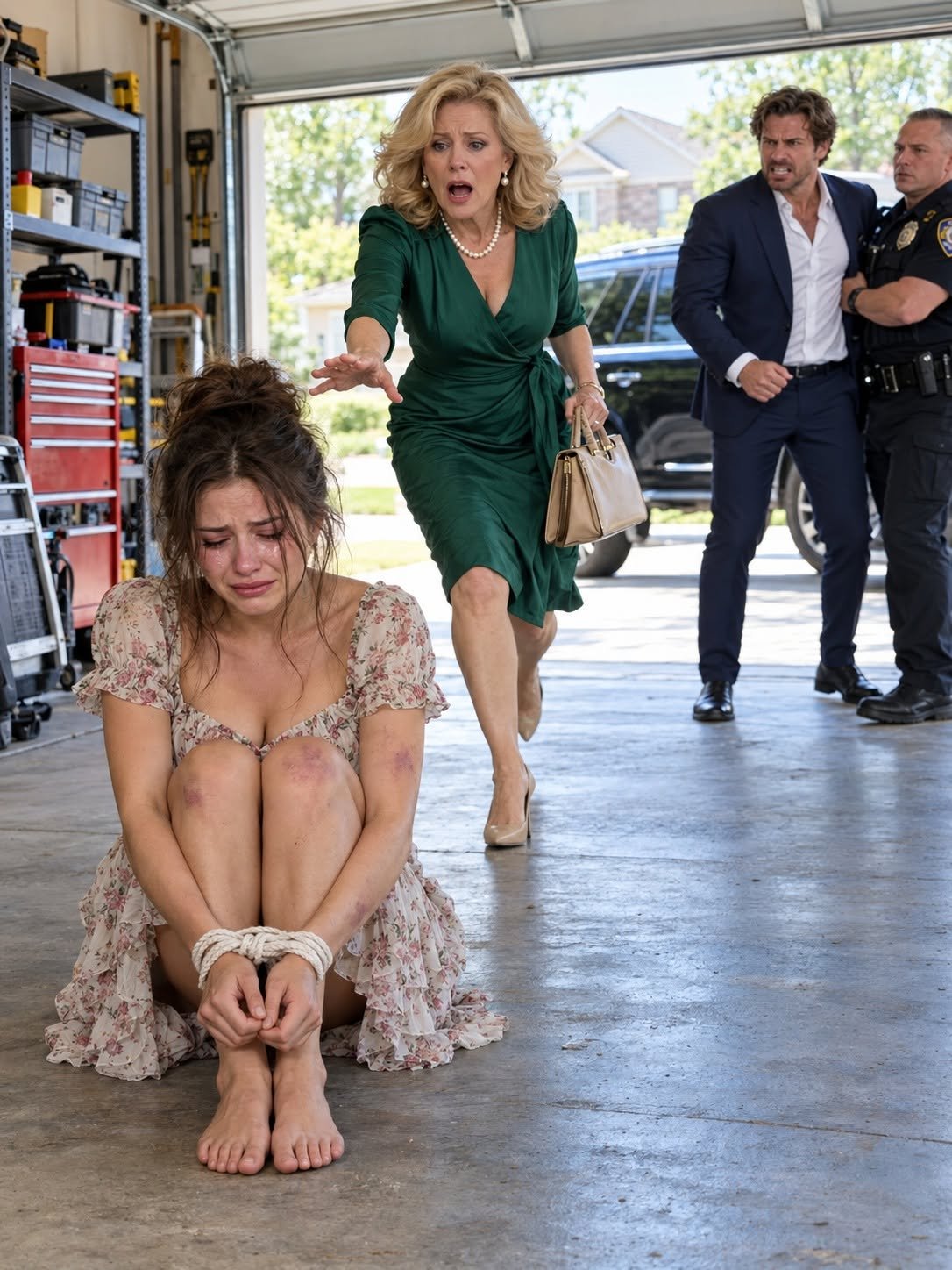
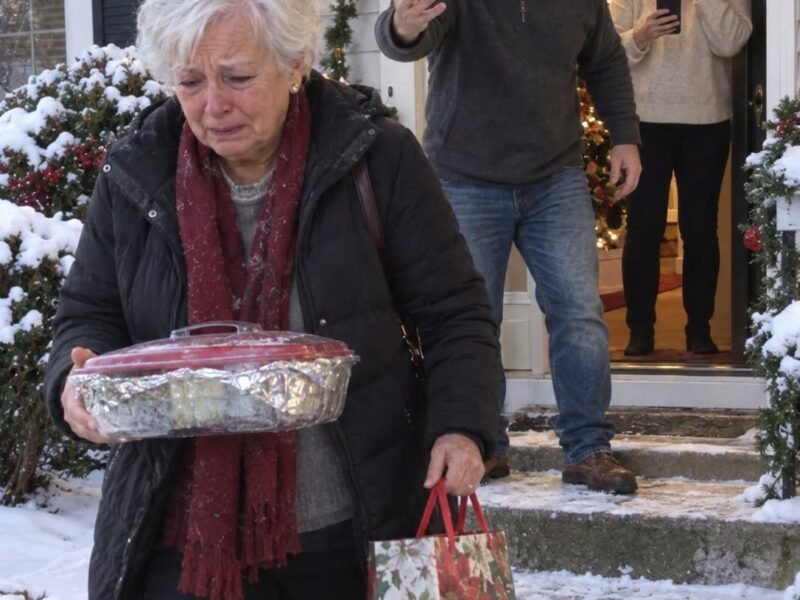
The first lie came wrapped in a smile. My son-in-law, Julian, stood in my daughter’s doorway with dry hair, clean hands, and my daughter’s wedding ring hanging from a chain around his neck.
Rain struck the porch roof behind me like a thousand fingers tapping a warning.
I looked past him into the house. The living room was too clean. Gwendolyn’s favorite blue coat was missing from the hook, but her running shoes sat by the stairs, soaked with mud. My daughter never traveled without those shoes. She said they were lucky.
“A retreat,” I repeated.
Julian folded his arms. He had always mistaken my quiet for weakness. At family dinners, he spoke over me, corrected me, called me “old-fashioned” whenever I noticed too much.
“She needed peace from your hovering,” Miriam said. “Poor girl could barely breathe.”
My daughter had called me two nights earlier. She hadn’t said much. Just, “Mom, can I come home if things get worse?”
Then the line went dead.
Now Julian stood in front of me, wearing my daughter’s ring like a trophy.
“Let me speak to her,” I said.
His smile thinned. “You don’t get to control my wife.”
Miriam laughed softly. “Go home before you embarrass yourself.”
I nodded once.
That surprised them.
I stepped back into the rain, got into my car, and drove away slowly enough for Julian to watch from the window. Then I turned the corner, parked beside a dark row of hedges, and shut off my headlights.
For thirty-one years, people had called me a librarian.
They were not wrong.
They simply did not know that before I retired, I had been the county’s chief evidence archivist, the woman prosecutors called when cases were missing one perfect detail. I knew how lies sounded. I knew how fear hid in silence.
And I knew my daughter.
I walked back through the rain.
At the rear of the house, behind the garage, I saw it.
A brand-new lock on the side door.
My breath stopped.
I pressed my lips near the wood and whispered, “Gwendolyn. If that’s you, knock.”
For one terrible second, there was nothing.
Then came three knocks.
Slow.
Weak.
Alive.
I did not scream. I did not break the lock. I did not give Julian the gift of warning.
I stepped back into the rain, took out my phone, and called 911.
“My daughter is locked inside her garage,” I said clearly. “Possible unlawful confinement. Her husband is inside the home. I heard her respond from behind the door.”
The dispatcher asked if I was safe.
“No,” I said. “But I am calm.”
Then I made a second call.
“Judge Whitaker,” I said when the familiar voice answered. “It’s Beatrice Vance. I need an emergency welfare response documented properly.”
Detective Miller clicked a mouse button on his desktop. Julian’s voice, raw with arrogance and malice, echoed through the small room.
“Sign the quitclaim deed, Gwen. It’s that simple. Your mother thinks you’re on a spiritual retreat. Miriam already backed up the story to your friends. Nobody is looking for you.”
Gwendolyn’s recorded voice followed, faint but distinct: “My mom knows my shoes. She’ll know.”
“Your mother is a retired clerk who files dusty papers,” Julian’s recorded laugh crackled through the speakers. “She’s powerless.”
Gwendolyn closed her eyes briefly, breathing in the steam from her tea. I did not look away from the monitor.
“The audio file is legally admissible under the emergency proxy agreement my daughter signed three years ago,” I added calmly. “And the physical evidence—the brand-new padlock, the duct tape residue, the mud on her running shoes, and the fresh injuries—aligns perfectly with second-degree kidnapping, aggravated domestic assault, and extortion.”
The detective leaned back, nodding slowly. “Your son-in-law is currently being held without bail. His mother, Miriam, was picked up an hour ago at her home. We found your daughter’s passport and primary credit cards hidden in Miriam’s vanity drawer.”
“Miriam was the architect,” Gwendolyn said, her voice raspy but steady. She set her cup down. “Julian was the muscle, but Miriam wanted the house. She lost her own condo to unpaid debts last winter. They planned to sell my property, put the proceeds into a joint trust under Julian’s name, and commit me to a private facility out of state using a falsified psychological evaluation.”
“They brought a doctor into this?” Miller asked, his eyebrows raising.
“A disgraced physician whose license was revoked in Florida five years ago,” I answered, sliding a printed dossier across the table. “I spent the two hours while Gwendolyn was being examined at the hospital pulling public records. He was paid ten thousand dollars via a wire transfer from Miriam’s secondary account yesterday morning.”
Detective Miller looked at the dossier, then looked up at me with something resembling awe. “You did all this tonight?”
“I had thirty-one years of practice, Detective,” I said softly. “People like Julian and Miriam always leave a paper trail because they believe they are too clever to be caught.”
Part 4: The Reckoning
By noon the following day, the rain had cleared, leaving behind a cold, brilliant sky over our coastal town.
I stood in the driveway of my daughter’s home, watching two uniformed officers load evidence bags into the trunk of a police cruiser. The new padlock on the garage door had been cut away, leaving a jagged scar on the white frame—a physical reminder of the trap my daughter had escaped.
A silver sedan pulled up to the curb. A well-dressed man stepped out, clutching a leather briefcase. It was Arthur Pendelton, the senior partner of the prestigious law firm where Julian worked as a junior tax consultant.
He approached me cautiously, his face pale. “Mrs. Vance? I’m Arthur Pendelton. I’m here on behalf of—”
“You are here to assess the damage to your firm’s reputation,” I interrupted, standing at the foot of the porch steps. “Your junior partner was arrested for felony kidnapping on firm time, using a firm-issued laptop to draft fraudulent property transfers.”
Pendelton winced. “Julian’s actions were entirely unauthorized, Mrs. Vance. The firm had no knowledge—”
“I know,” I said smoothly. “Which is why I sent a complete copy of the police report, the recorded audio files, and a draft of a civil lawsuit to your managing board at 8:00 AM this morning. If Julian is not terminated by 5:00 PM today, and if his access to my daughter’s financial records is not completely audited by an independent third party, the state prosecutor will receive a second package regarding the tax irregularities I noticed in Julian’s corporate expense accounts.”
Pendelton stared at me, his mouth slightly open. “Tax irregularities?”
“He’s been embezzling from your client retainer accounts for eighteen months to fund his mother’s lifestyle,” I said, handing him a single sheet of paper with a list of account numbers and dates. “I cross-referenced his public filings with his bank records while waiting for the grand jury paperwork. You might want to check your offshore escrow files.”
Pendelton looked at the sheet, his skin turning an ashen gray. He didn’t say another word. He simply turned around, got back into his sedan, and sped away.
Inside the house, Gwendolyn was sitting at the kitchen table, watching the sunlight stream through the high windows. The house was quiet now. The clean, artificial scent Miriam had brought into the home was slowly dissipating, replaced by the fresh breeze coming through the open windows.
I sat down across from her and placed a small brass key on the table.
“What’s this?” she asked.
“The key to my house,” I said. “The deadbolts have been changed, the security system is updated, and the garden is coming into bloom. You can stay as long as you need.”
Gwendolyn picked up the key, tracing its edges with her thumb. “I thought I was being strong by trying to handle him on my own, Mom. I thought if I just agreed to his demands, he’d stop being angry.”
“Abusers don’t want agreement, Gwen,” I said gently, reaching across the table to cover her hand with mine. “They want surrender. You were strong the moment you left that voicemail. You were strong the moment you knocked three times on that door.”
She looked up at me, her eyes filled with tears, but her smile was real. “He called you an old-fashioned librarian.”
I let out a soft, dry laugh. “Librarians are the keepers of truth, my dear. We organize chaos, we preserve history, and we know exactly where the bodies are buried.”
Final Part: The Archive of Peace
Six months later.
The trial never happened. Faced with an airtight mountain of digital audio, forensic evidence, financial paper trails, and testimony from a retired chief evidence archivist, Julian and Miriam accepted plea agreements.
Julian was sentenced to twelve years in state prison for felony kidnapping, extortion, and grand larceny. Miriam received seven years for conspiracy and fraud. The disgraced doctor who signed the falsified psychological evaluation lost his freedom as well, swept up in the systemic investigation that followed.
The house on Elm Street was sold. Gwendolyn used the equity to purchase a small, sunlit cottage three blocks from my own home.
On a quiet Tuesday afternoon, I walked up the stone path to her front porch. The rain from six months ago was a distant memory; today, the air smelled of lavender and salt water.
Gwendolyn opened the door before I could knock. She wore a pair of well-worn running shoes—the lucky ones, clean now and tied securely—and a dark green sweater. Her cheek was clear, her wrist healed, and her eyes held a calm, unshakable light.
“Ready for our run?” she asked, stepping out onto the porch.
“I’ll walk,” I reminded her with a smirk. “My archiving days may keep me sharp, but my knees still remember my age.”
She laughed—a bright, ringing sound that carried across the yard.
We walked together down the quiet coastal road, watching the gulls circle over the bay. For thirty-one years, I had believed my purpose was to document the worst moments of human history—to label the pain, seal the evidence bags, and lock the truth away in dark rooms so justice could be served.
But as I looked at my daughter walking freely beside me under the open sky, I realized something far greater.
The most important record I would ever keep was not stored in a courtroom vault or a police basement. It was written in the quiet morning coffee we shared, the sound of her laughter, and the simple, undeniable truth that she was safe, she was loved, and she was home.
Julian had thought my silence was weakness. He had thought my past was forgotten. But in the end, he had simply become another closed case, another finished file placed neatly on a shelf, never to harm my daughter again.
And as for me?
I am still a librarian. But today, the only story I am interested in preserving is the one where my daughter lives happily ever after.