The first thing I heard was my daughter laughing. It was a high, bright, delighted laugh, the laugh she used to have at six years old when her father chased her around the yard pretending to be a bear, and for one confused second, standing on the back porch of the lake house with a cake in my hands, I smiled too. Then I heard the crunch of metal and the low growl of a truck engine, and I
turned toward the boat ramp.
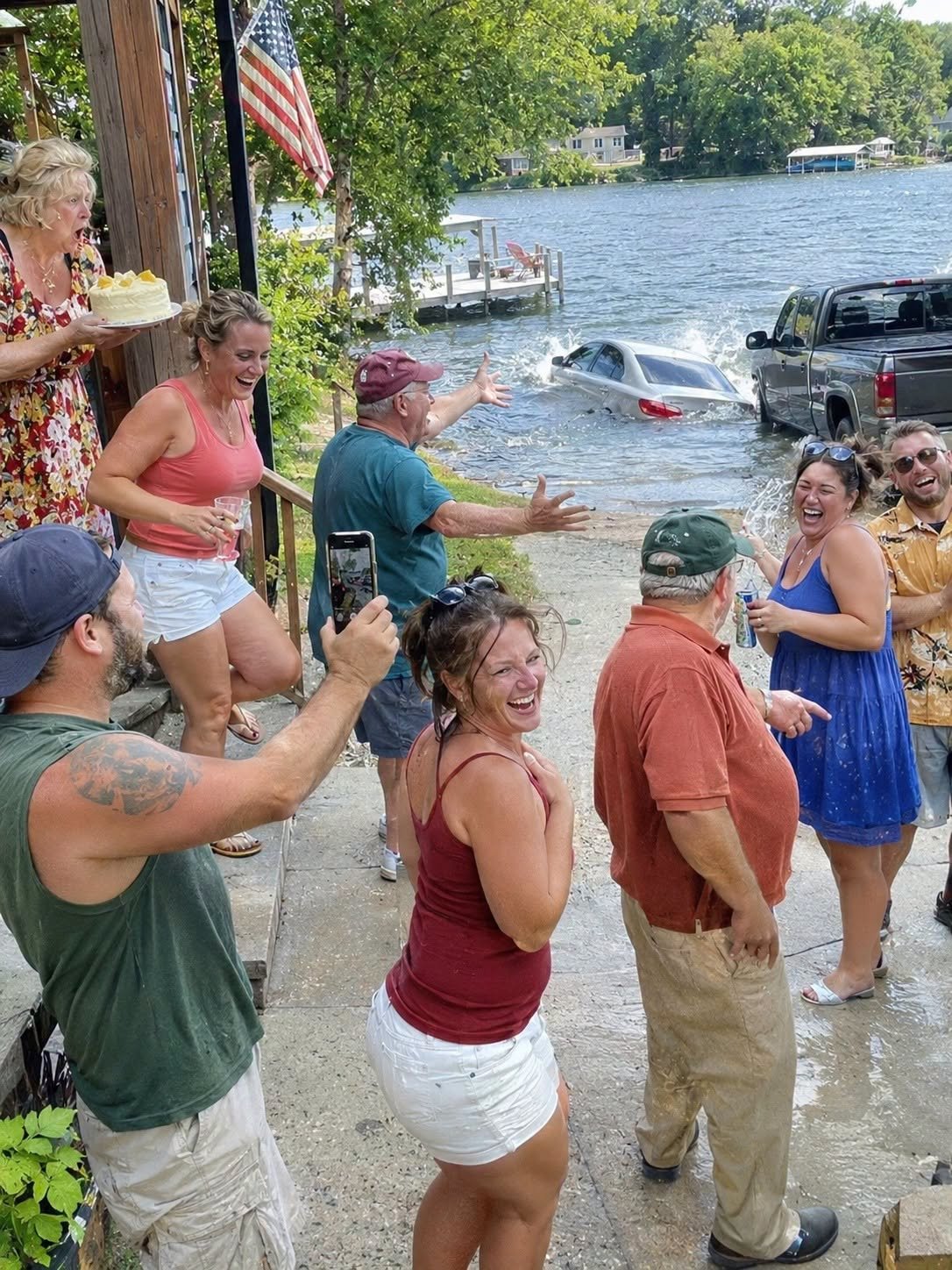
My Buick was rolling backward down the concrete. Ryan’s black pickup was nosed up against its front bumper, still creeping forward, and my car was picking up speed as the ramp steepened toward the water. It hit the lake with a slap and a spray, floated for a moment with its headlights pointed up
at the evening sky, and then the back end tilted down and the whole thing slid under the surface of Lake Lanier with a long, gurgling sigh. A circle of bubbles rose where it had been, and then even those stopped.
Thirty guests on the lawn burst into applause. Somebody whistled. Somebody shouted, “Ryan, you’re
a legend!” And I stood frozen at the top of the porch steps, holding the lemon cake I had baked for my daughter.
My name is Margaret Ellis, though everybody has called me Maggie since I was a girl. I’m sixty-eight years old, a retired elementary school librarian from Macon, Georgia, and that June evening I had
driven four hours up Interstate 75 and around Atlanta to my family’s little lake house on the north end of Lake Lanier. We were celebrating Lauren’s promotion. She had texted me three weeks before to say she’d been made a regional director at the medical billing company where she worked in Alpharetta, and she wanted the whole family at the lake to celebrate.
And the next morning, we were going to honor her father. Thomas would have turned seventy that Sunday. He died two years ago of a stroke, sitting in his woodshop with a chisel in his hand, and for two years, Lauren had not been able to bear the idea of a memorial. Last month, she finally called me and said she was ready. She wanted to say goodbye beside the lake where Thomas taught her to
swim.
I had believed her.
Ryan had spent the whole dinner mocking my Buick. It’s a 2008 LeSabre, champagne colored, with a hundred and ninety thousand miles on it and a dent in the back bumper from a grocery cart at the
Kroger. Thomas bought it for me the year Lauren graduated from high school. Ryan called it the Grandma Mobile. He asked if it ran on prune juice. He asked if I needed a permit to drive anything that old on the interstate. And every time, Lauren laughed. She laughed at every insult, leaning against her husband’s shoulder at the long picnic table on the lawn, while the guests passed the barbecue and the potato salad.
After dinner, Lauren came up to me on the porch and asked for my keys. The caterer’s van needed to back down to the dock to unload the dessert table, she said, and my car was blocking the way. Could she move it? I handed them to her without a second thought. She was my daughter.
I didn’t see her pass them to Ryan. I didn’t see him get into my car and put it in neutral at the top of
the ramp. I didn’t see him climb into his truck and nudge it forward, or hold up his phone in his other hand to film my face. I only saw the car go into the water.
I set the cake down on the porch railing. My hands were shaking, and I didn’t want to drop it. Lemon cake with cream cheese frosting, my mother’s recipe, Lauren’s favorite since she was little. I’d written CONGRATULATIONS LAUREN on top in yellow icing.
Ryan came up the lawn toward me with a big grin on his face, still holding his phone up, still filming. He’s thirty-six, tall and broad in the shoulders, with expensive sunglasses pushed up on his head and a golf shirt with a country club logo on the chest. He stopped at the bottom of the porch steps and spread his arms wide.
“Maggie!” he said. “Don’t look so sad. I did you a favor! That thing was a death trap. Now you can get
yourself something from this century!”
The guests laughed. Behind him, on the lawn, Lauren was bent over with her hand on her stomach, laughing so hard she was wiping tears of laughter from her cheeks with the back of her wrist.
I looked at them both. My son-in-law with his phone. My daughter wiping her eyes.
“Did you check the trunk?” I asked.
Chapter Two: What Was in the Trunk
I didn’t say it loudly. I didn’t have to. Ryan had made sure everybody was listening.
The cheering stopped. It stopped all at once, the way the wind stops before a storm, and thirty
people on that lawn went silent. I heard a boat motor somewhere far out on the lake. I heard the water lapping against the bottom of the boat ramp, where my Buick had been.
Lauren’s face drained of color. She straightened up slowly on the lawn, her hand still on her stomach, and I watched every bit of the laughter go out of her. She went white from her forehead to her chin.
She knew. She knew exactly what was in the trunk, because she was the one who asked me to bring it.
There was a walnut box in the trunk of my Buick. Thomas made it himself, three years before he died, in his woodshop behind our house in Macon. He’d spent all one winter on it. It was the size of a
small suitcase, black walnut with a curly grain that looked like water when the light hit it, joined at the corners with dovetails he cut by hand. He’d made it to keep his fishing flies in. When he died, I couldn’t think of anything else to put him in.
Inside it was Thomas’s urn. A sealed bronze urn from the funeral home in Macon, with his name and his dates engraved on a plate on the front. And wrapped around the urn, in an old canvas dry bag Thomas used to carry on his fishing boat, were the photographs Lauren had asked me to bring for the memorial. Forty years of them. Our wedding. Lauren as a baby. Lauren on her first day of school.
Thomas building the dock behind this very lake house in 1991, with his shirt off and a hammer in his hand.
And on top of the stack, a photograph of Thomas carrying Lauren on his shoulders at the edge of this lake, when she was five. She’s wearing a yellow bathing suit and orange water wings, and he’s
up to his knees in the water, laughing, with his hands holding her ankles. It was the summer he taught her to swim. I’d had it framed in walnut to match the box.
I’d driven four hours with those things strapped securely inside the Buick. I’d tied the box down in
the trunk with two bungee cords so it wouldn’t slide on the turns. I’d stopped twice at rest areas on I-75 just to open the trunk and look at it and make sure it was all right.
For two years, Lauren could not bear a memorial. She’d hung up on me when I mentioned it the first Christmas. She’d cried and left the table when her aunt brought it up at Easter. I’d kept Thomas in his
walnut box on the shelf in our bedroom closet in Macon for two years, waiting for my daughter to be ready.
Last month, she finally asked. She called me on a Sunday night, and her voice was soft and sad in a way I hadn’t heard since she was a girl. She said she wanted to say goodbye beside the lake where
Daddy taught her to swim. She said she wanted to do it on his birthday. She asked me to bring the photographs.
I had believed her. I packed a photograph of him carrying her on his shoulders.
Ryan looked at me. Then he looked over at the boat ramp, at the place where the water had closed over my car. Then he looked at Lauren on the lawn, and something passed between them that I didn’t understand yet.
“It’s a box, Maggie,” he said finally. His voice had lost some of its swagger. “In a trunk. Trunks seal. It’s probably fine.”
“A car is replaceable,” I said. “The contents are not.”
Chapter Three: The Sheriff
I took out my cell phone and called the sheriff’s office.
I didn’t know which county I was in, exactly. The north end of Lake Lanier sits where three counties
come together, and I’d never had to know before. So I called 911, and a calm woman answered, and I told her a car had been pushed into the lake at a private boat ramp on Lanier Point Road, and that there were human remains inside it. I said it just like that, in a calm, flat voice, the way I used to read the library rules to second graders.
The dispatcher was quiet for a moment. Then she asked me to repeat that.
“My husband’s ashes,” I said. “In a sealed urn. In the trunk. The car is under the water at the end of the boat ramp. I’d like help recovering it.”
Somebody stopped the music. The DJ by the dessert table had been playing country music the whole evening, and somebody walked over and pulled the plug, and the silence came down over the lawn like a blanket. Thirty people stood frozen in the purple light with their drinks in their hands, looking at me on the porch with my phone to my ear.
Nobody was laughing now. Least of all my daughter.
The dispatcher told me a deputy from the Hall County Sheriff’s Office would be there within twenty minutes, and that the sheriff’s dive team and the Georgia Department of Natural Resources would be
notified, because any vehicle in the lake was also a fuel spill. She asked me to keep everyone away from the ramp. She asked me if anyone had been in the car. I said no. Not anyone living.
When I hung up, Ryan was standing at the bottom of the porch steps with his phone down at his
side now. His face was red.
“You called the cops?” he said. “Seriously, Maggie? Over a joke?”
“I called the sheriff,” I said. “Because my husband is at the bottom of the lake.”
His friends were starting to drift away from the lawn toward the driveway, toward their cars. Three or
four of them, men Ryan’s age in golf shirts like his, holding their beers and not looking at me. Ryan turned around and saw them going, and he raised his voice.
“Hey!” he called after them. “Anybody who filmed that, delete it. Right now. I’m serious. Delete your
videos.”
Chapter Four: The Dock
Lauren followed me toward the dock.
I walked down the lawn past the picnic tables and the dessert table and the string lights, down to
the wooden dock Thomas built in 1991, where the boat ramp ran into the water beside it. I don’t know why I went there. I think I wanted to be as close to him as I could get. I stood at the end of the dock and looked down into the water where the Buick had gone in. It was green-brown and murky, and I couldn’t see anything.
I heard her footsteps on the boards behind me. Quick and uneven, in her heeled sandals.
“Mom,” she said. “Mom, I’m so sorry. I didn’t think he’d actually do it. I swear to God. I thought Ryan was just going to scare you. Roll it down to the edge of the water and stop. I thought it was a joke.”
I didn’t turn around. I kept looking at the water.
“I didn’t think about the box,” she said. “I forgot. I swear I forgot it was in there.”
Then I turned around. My daughter was standing on the dock behind me in her white sundress, the one she’d bought for the celebration, with her mascara running down her cheeks and her arms wrapped around herself. She’s thirty-four years old. She has her father’s dark eyes and his long
hands and his stubborn chin. She looked about twelve.
“Lauren,” I said quietly. “Why did you laugh while my car went into the water?”
She didn’t answer. She opened her mouth and nothing came out.
“You laughed,” I said. “I heard you. Before I even turned around, I heard you laughing. And you were
still laughing when Ryan came up the lawn. You were wiping your eyes.”
She stared past my shoulder, up the lawn. I turned my head and followed her eyes. She was looking at her husband. Ryan was standing at the top of the lawn with his arms crossed, watching us. His face was very still.
I turned back to my daughter. She was trembling.
“I thought it would be funny,” she whispered. “Ryan said it would be funny.”
Chapter Five: Emma’s Video
But Lauren’s cousin Emma had kept hers.
Emma is my late sister’s daughter, twenty-eight, a nurse in the cardiac unit at Northside Hospital in Atlanta. She’s quiet and kind, and she’d been sitting at the end of a picnic table all evening, not
laughing much at Ryan’s jokes. When Ryan ordered everybody to delete their videos, she didn’t. She walked down the lawn to the dock with her phone in her hand and her face set like stone.
“Aunt Maggie,” she said. “You need to see this.”
Lauren saw her coming. She took a step back on the dock. “Emma, don’t,” she said.
Emma ignored her. She held out her phone to me. On the screen was a video, paused on the first frame, showing the side of the lake house and the driveway and my Buick parked by the caterer’s van.
“I started filming when Lauren came out of the house with your keys,” Emma said quietly. “Because I
saw her face. I knew something was wrong.”
She pressed play.
On the screen, my daughter walked across the driveway in her white sundress holding my keys in her
hand. Ryan was standing by his black pickup. She walked right up to him and held out the keys. Ryan took my keys from Lauren, not from me. Then Lauren turned and pointed down the slope at the boat ramp, and she said something, and the sound was clear enough on Emma’s phone that I could hear
every word.
“Put it right at the top of the ramp,” my daughter said. “And make her beg for them back.”
My stomach turned.
This was never an accident. It was never a joke that got out of hand. My daughter had stood in the
driveway and given my keys to her husband and told him exactly what to do with them.
On the screen, Ryan laughed and tossed the keys in the air and caught them. He started toward my car. Then he stopped and turned back to Lauren.
The recording caught one final exchange.
“You’re sure?” Ryan said on the video. He was looking at her, and his voice was lower now, almost careful. “Considering what your mother has in the trunk?”
And Lauren answered without hesitating. Not a second. She looked right at her husband with a face I
didn’t recognize, hard and cold and flat, and she said, “She needs to learn what happens when she says no to us.”
Emma stopped the video.
Nobody on that dock said anything. I could hear the water lapping against the pilings. I could hear the frogs starting up in the reeds along the shore. Far up the lawn, the string lights were swaying in the evening breeze.
I looked at my daughter, and she began to cry.
Chapter Six: No
Here is what I said no to.
A month before the celebration, Lauren and Ryan drove down to Macon to see me. It was a Sunday afternoon in May. They hadn’t visited in eight months, not since Christmas, and I was so happy to see them that I made fried chicken and a peach cobbler and set the table with my good china. They sat at
my kitchen table and ate my chicken and complimented my cobbler, and then Ryan took a manila folder out of his leather bag and set it on the table in front of me.
It was a quitclaim deed. For the lake house.
Thomas’s father bought the lot on Lake Lanier in 1974, when it was still cheap, a half-acre of red clay and pine trees at the end of a gravel road. Thomas and his father built a little cabin on it the summer I met him, with their own hands. In 1991, Thomas built the dock. Over forty years, it grew from a cabin
to a lake house, three bedrooms and a screened porch and a woodshop out back, where Thomas spent every summer weekend building boats and furniture and boxes. When he died, it came to me.
It’s not worth much as a house. But the lot is worth a lot. A developer from Atlanta had been buying
up the old lake cabins on our cove to tear them down and build big new houses, and he’d offered a million two for ours. Ryan had found out. And Ryan, I learned later, owed the bank two hundred and ten thousand dollars on a boat dealership in Cumming that was failing, and another sixty thousand
to a man I’d rather not name.
The deed transferred the lake house to Lauren and Ryan. All I had to do was sign it.
“It’s just estate planning, Maggie,” Ryan said. “You’re sixty-eight. You don’t want Lauren to have to deal with probate when something happens to you. This way it’s done. It’s simpler.”
I read every page of it twice, at my kitchen table, with my reading glasses on. I asked what they
planned to do with the lake house. Ryan said they’d keep it in the family. I asked if they planned to sell it to the developer. Ryan said he’d never even talked to the developer. Then I asked to see his phone, and he wouldn’t show it to me.
I said no.
I said it calmly. I said Thomas’s father bought that land and Thomas built that house, and someday it
would go to Lauren in my will, the way it was always meant to. But not today. Not while I was alive. And not so it could be sold to pay off a boat dealership.
Ryan’s face went red. He said I didn’t trust my own daughter. He said I was selfish and stubborn and
living in the past. Lauren didn’t say anything at all. She sat at my table and looked at her plate, and when they left that evening, she didn’t hug me goodbye.
Three weeks later, she called me on a Sunday night and asked me to bring her father’s ashes to the
lake for a memorial.
Chapter Seven: The Night
The deputy came at eight-forty. His name was Sergeant Duane Whitfield, a heavyset man about fifty
with a gray mustache and a kind face, and he had a younger deputy with him and a DNR ranger right behind. They walked down to the boat ramp with flashlights. They looked at the water for a long time. Then Sergeant Whitfield came up to the porch, where I was sitting on the swing with my hands
in my lap and the lemon cake still sitting on the railing beside me.
He took my statement. All of it. He asked Ryan for his. Ryan said it was a prank, a joke, a family thing, and that nobody had told him there was anything in the trunk. Sergeant Whitfield listened to him
without saying anything and wrote in his notebook. Then he asked Emma for her video. She sent it to him on her phone while he stood there. He watched it twice. When it was over, he looked at Ryan for a long time.
“Mr. Caldwell,” he said. “Somebody did tell you. It’s right there on the tape.”
He told me the dive team couldn’t go in at night. The water off the end of the ramp was about thirty feet deep, and visibility in Lanier is bad even in daylight. They’d come at seven in the morning with a
recovery boat and a wrecker from a towing company in Gainesville that did lake recoveries. He told me the DNR would put a boom out tonight to contain any fuel.
Then he told me that in Georgia, intentionally damaging somebody else’s property worth more than
five hundred dollars is criminal damage to property in the second degree, which is a felony. He said that whether I chose to press charges was up to me, but that the State of Georgia might not need me
to, given what was on that video. He gave me his card.
The guests left after that. Every one of them. They got into their cars in the dark and drove away without saying goodbye, and the caterer packed up the dessert table, and the DJ loaded his
speakers. Ryan went to the guest room on the far side of the house and slammed the door. I don’t know where Lauren went.
I sat on the porch swing alone, in the dark, looking at the lake.
Around eleven, I heard footsteps on the porch boards. Lauren. She’d changed out of her white sundress into a pair of sweatpants and one of Thomas’s old flannel shirts, which she must have
found in the closet of the room she slept in as a girl. It hung down past her hips. She stood at the other end of the porch and didn’t come closer.
“Can I sit down?” she asked.
I didn’t answer. She sat down at the far end of the swing anyway.
We sat there for a long time without speaking. The swing creaked. The frogs sang. Out on the water, the DNR boat’s light moved slowly back and forth beside the boom.
“The promotion’s not real,” she said finally.
I turned and looked at her.
“There’s no promotion,” she said. “I’m not a regional director. I’m not even a supervisor anymore. They cut my hours in March.” She was looking at her hands in her lap. “Ryan said we needed a reason to
get you up here. Something you couldn’t say no to. And then the memorial.” Her voice broke. “He said if we got you to the lake, with Daddy, you’d feel sentimental. You’d sign. And if you didn’t sign, then we’d make you sorry.”
“The memorial,” I said. My voice didn’t sound like my own. “That was his idea too?”
She didn’t answer for a long time.
“No,” she said finally, in a whisper. “That was mine. I really wanted it, Mom. I really did. I’ve wanted it for two years.” She put her face in her hands. “And then Ryan said we could use it. And I let him. I let him use Daddy.”
Chapter Eight: The Recovery
I didn’t sleep that night. Neither did she. Around four in the morning, I heard her crying through the wall of her old bedroom, and I lay in my bed and listened to it and didn’t go to her. I wanted to. Every bone in my body wanted to. But I didn’t know who my daughter was anymore.
The dive team came at seven, the way Sergeant Whitfield promised. Two sheriff’s divers in black wetsuits, a DNR boat, and a big flatbed wrecker from Lakeside Towing and Recovery in Gainesville, with a winch on the back the size of a washing machine. I stood on the dock in my robe and slippers with a cup of coffee I didn’t drink, and watched them work.
Lauren came down and stood beside me. She didn’t speak. Ryan didn’t come out of the house.
The divers went down at seven-twenty. They were under for eleven minutes. When they came up, one of them gave a thumbs up to the wrecker driver, and the driver started backing his flatbed down the boat ramp until its back wheels were almost in the water. The divers went back down with a cable
and hooked it to my Buick’s rear axle, and the winch started grinding.
My Buick came up out of Lake Lanier backward, at seven forty-five on the morning of what would have been Thomas’s seventieth birthday. Water poured out of every seam, out of the doors and the wheel wells and the grille. Lake weeds hung off the side mirrors. The windshield was cracked. The
wrecker pulled it all the way up the ramp and onto the concrete, and it sat there dripping, its champagne paint dulled with green slime.
Sergeant Whitfield walked over to the trunk with a pry bar. He looked at me.
“Ma’am,” he said. “You want to do this? Or you want me to?”
“I’ll do it,” I said.
I had the spare key. I always kept it in a little magnetic box under the rear bumper, because Thomas told me to, after the one time I locked myself out at a Shoney’s in 1999. I knelt down on the wet concrete in my robe and felt under the bumper, and the little box was still there. I opened it. I took
out the key. I stood up and put it in the trunk lock.
It didn’t want to turn. The lock was full of water and silt. I worked it back and forth, back and forth, and Lauren stood beside me with her hands pressed to her mouth. Finally, with a groan, it turned. The trunk lid popped up an inch. I lifted it.
The trunk was half full of lake water. Brown and murky, with leaves floating in it. And sitting in the middle of it, still tied down with Thomas’s two bungee cords, was the walnut box.
It was soaked. The water had gotten in at the seams and the beautiful curly grain had gone dark and
swollen. One of the hand-cut dovetail corners had split along the joint. I untied the bungee cords with my shaking hands and lifted it out, and water ran out of it onto my slippers.
I set it on the hood of the wrecker. I opened the lid.
Inside, the bronze urn sat exactly where I’d put it, sealed tight, with Thomas’s name and dates
gleaming on the plate. Not a scratch. The funeral director in Macon had told me those urns were made to last a hundred years, and I hadn’t believed him. I believed him now.
And wrapped around it, Thomas’s old canvas dry bag. The one he carried on his fishing boat for twenty years, with his initials stenciled on the side in white paint. T.R.E. It was wet on the outside.
The roll-top closure was still rolled down three times and clipped, the way Thomas taught me.
I unclipped it. I unrolled it. I reached inside.
The photographs were dry.
All of them. Forty years of them, in their plastic sleeves, dry as the day I packed them. Our wedding.
Lauren as a baby. Thomas building the dock. And on top of the stack, in its walnut frame, the photograph of Thomas up to his knees in this same lake, laughing, with a five-year-old girl in a yellow bathing suit and orange water wings on his shoulders.
Lauren made a sound beside me like something tearing. She sank down on her knees on the wet
concrete beside the wrecker. She held out her hands, and I put the photograph in them, and she held it against her chest and folded over it and wept.
Chapter Nine: The Charges
Sergeant Whitfield waited until the wrecker had loaded my Buick on the flatbed and the divers had
gone. Then he walked up to the house with his younger deputy, and he knocked on the door of the guest room where Ryan had slept.
I didn’t go inside. I stood on the porch. I heard voices through the open window, Ryan’s loud and angry, the sergeant’s low and steady. Then I heard Ryan say, “Are you serious? You’re arresting me?
Over a car?” And the sergeant said, “No, sir. I’m arresting you for intentionally destroying property that belonged to someone else. The car’s just where you put it.”
They walked him out the front door in handcuffs at eight-fifteen. He saw me on the porch as they
went by. He stopped, and the deputy let him.
“This is your fault, Maggie,” he said. “You could’ve signed the paper.”
I looked at him. I thought about Thomas, who spent a winter cutting dovetails by hand so a box
would hold together for a hundred years. I thought about the photograph in my daughter’s arms.
“Ryan,” I said. “If I’d signed that paper, you’d have found another reason. Men like you always do.”
They put him in the back of the patrol car and drove away.
Sergeant Whitfield came back up the porch steps after. He told me Ryan would be charged with criminal damage to property in the second degree. He told me the DNR might fine him for the fuel
spill. He said the district attorney would decide about any other charges, given what was on Emma’s video, and that I’d probably get a call from a victim advocate on Monday. He asked me if I had insurance on the Buick.
I did. Full coverage, with Georgia Farm Bureau, the same company Thomas used for forty years. I
called them that afternoon from the porch swing. The claims adjuster, a soft-spoken man named Darnell, told me the car was a total loss after being underwater all night. He said they’d pay me the actual cash value, about thirty-eight hundred dollars, minus my five-hundred-dollar deductible. Then he said something I didn’t expect.
“Mrs. Ellis,” he said. “Since somebody did this on purpose, we’re going to go after them for what we
pay you. It’s called subrogation. We’ll get it back from Mr. Caldwell. And we’ll try to get your deductible back from him too.”
I thanked him. I hung up. I sat there on the swing for a long time.
Then Lauren came out of the house with the walnut box in her arms.
Chapter Ten: His Seventieth Birthday
We held the memorial at noon. Just the two of us.
Everybody else had gone. The caterer, the guests, the DJ, Ryan’s friends in their golf shirts. The dessert table was gone and the string lights were down. Only Emma stayed. She sat on the porch
with a cup of coffee and watched from a distance, the way a good nurse watches a patient.
Lauren carried the walnut box down to the end of the dock. She’d dried it with towels and set it in the sun on the porch railing for two hours. The split corner was still split. The wood was still dark and swollen. But it was whole.
She set it on the dock at the very end, where the boards meet the water, where Thomas used to sit with his feet dangling and a fishing pole in his hands. She opened the lid. And she took out the photographs one by one and laid them out on the warm boards in a long row, from our wedding in 1983 to the last one I ever took of him, standing in his woodshop with sawdust on his glasses.
And she set the framed one in the middle. Thomas in the lake with his little girl on his shoulders.
Then she sat down on the dock with her bare feet hanging over the edge, the way she did when she was five, and I sat down beside her.
“He taught me to swim right here,” she said. “Right off this dock. I was so scared. I wouldn’t let go of
the ladder. And he got in the water and stood right there.” She pointed at the water just off the end of the dock, where it was only waist deep. “And he said, Laurie-girl, I will never let you sink. Not ever. You let go and I’ll be right here.”
She was quiet for a long time.
“I let go,” she said. “And he was right there. He was always right there.”
I put my hand on her back.
“And I let Ryan push him into the lake,” she whispered. “I stood on that lawn and laughed while my father went under the water. Because Ryan was mad at you, and I wanted Ryan to be happy with me.”
She turned and looked at me, and her eyes were swollen and red. “What kind of person does that, Mom? What kind of daughter?”
I didn’t answer right away. I looked out at the water. At the spot where Thomas stood forty years ago, holding his arms out to a terrified little girl.
“A daughter who’s been sinking for a long time,” I said finally. “And didn’t know how to let go of the ladder.”
She stared at me.
“Tell me about Ryan,” I said. “All of it. Not the parts you think I want to hear.”
So she told me. Sitting on the end of her father’s dock, on what would have been his seventieth
birthday, with his photographs spread out on the boards around us. She told me about the boat dealership and the money Ryan owed and the man he owed it to. She told me about the credit cards in her name he’d maxed out. She told me how he checked her phone every night and tracked her car with an app, and how he’d stopped letting her see her friends, and how he’d told her for three years
that I didn’t love her, that I’d always loved her father more, that I was just waiting to die and leave
everything to a church.
“He said you’d never help us,” she said. “He said if you loved me, you’d have signed. And after you said no, he wouldn’t speak to me for a week. He slept on the couch. He said I’d chosen you over him.” She wiped her eyes. “And I was so tired, Mom. I was so tired. When he came up with the idea for the
lake, I thought, if I just do this, he’ll be happy, and it’ll be over.”
“And the thing you said,” I asked quietly. “On the video. About me learning what happens.”
Lauren closed her eyes.
“Those are his words,” she said. “He says it to me. Every time I tell him no.” She opened her eyes and looked at me. “I heard them come out of my mouth on Emma’s phone last night, and I didn’t
recognize my own voice. I sounded just like him.”
Chapter Eleven: After
Lauren didn’t go back to their house in Cumming. Not that night, and not ever.
She stayed with me at the lake house for the rest of that week. On Monday morning, she called a
divorce lawyer in Gainesville, a woman named Carolyn Pruitt Reyes who’d been practicing family law for twenty-two years. I drove her to the appointment in a rental car from the Enterprise in Gainesville, a silver Corolla I hated. She sat in Carolyn’s office for two hours. When she came out, her face was pale, but she was standing up straight.
“She says I need to freeze my credit,” Lauren said in the car. “Today. All three bureaus. And open a bank account in just my name. And she says I can ask the court for a temporary order so he can’t take anything else out of our joint accounts.” She looked out the window. “She says what he did with my credit cards might be financial abuse. She says Georgia judges take that seriously.”
I didn’t say anything. I just reached over and squeezed her hand.
Ryan was released on bond that Monday afternoon. He called Lauren forty-one times that week. She didn’t answer any of them. On Thursday, Carolyn Reyes filed for divorce in the Superior Court of Forsyth County and asked for a temporary protective order, citing the video and the text messages
and the credit card statements Lauren printed out at the public library in Gainesville. The judge granted it the next morning.
Lauren moved down to Macon with me in July. Into her old bedroom, with the yellow walls and the
Hanson poster she’d never let me take down. She got a job at the hospital in Macon, at The Medical Center, in the billing department. It paid less than her job in Alpharetta. She said she didn’t care.
The developer from Atlanta called me in August and offered a million three for the lake house. I told
him no. I told him the lake house wasn’t for sale, now or ever, and that he could stop calling. He called twice more. I stopped answering.
In September, Ryan pleaded guilty in Hall County to criminal damage to property in the second degree. He got two years of probation, two hundred hours of community service, and a restitution
order for my Buick, the insurance deductible, and the cost of the dive team recovery. Georgia Farm Bureau got their money back from him in November. They mailed me a check for my five-hundred-dollar deductible with a letter from Darnell that said, Mrs. Ellis, we’re glad this came out right.
The divorce was final in February. Lauren got her name back. Lauren Ellis. She signed it for the first
time at my kitchen table on the certified copy of the decree, and then she just sat there looking at it for a long time.
“Daddy’s name,” she said quietly.
“Your name,” I said.
Chapter Twelve: The Walnut Box
Lauren started going out to her father’s woodshop in March.
It’s behind our house in Macon, a little cinder-block building with a tin roof and a potbellied stove, where Thomas spent every evening of our marriage building things. After he died, I couldn’t go in
there. I locked the door and left everything just the way it was. His tools on the pegboard. His sawdust on the floor. His reading glasses on the workbench, where he set them down the afternoon he died.
One Saturday morning, I looked out my kitchen window and saw the woodshop door standing open.
Lauren was inside, in one of her father’s flannel shirts, standing at his workbench with the walnut box in front of her.
I didn’t go out. I watched from the window.
She went out there every Saturday after that. And most weeknights after work. She watched videos
on her phone about how to repair dovetail joints, and she ordered a book from the library about wood finishing. She called old Mr. Hargrove down the street, who used to swap tools with Thomas, and he came over on a Sunday afternoon and showed her how to steam a swollen joint back into shape and glue it so it would hold for another hundred years.
She sanded the whole box by hand. Every inch of it. She took the water stains out of the curly grain
with a scraper and steel wool. She glued the split dovetail and clamped it and let it sit for a week. Then she oiled it, the way Thomas did, with tung oil rubbed in by hand, coat after coat, twelve coats, until the grain shone like water in the sun again.
In June, a year after the lake, she brought it to me.
It was a Sunday morning, the day that would have been Thomas’s seventy-first birthday. I was sitting at the kitchen table with my coffee. Lauren came in from the woodshop carrying the walnut box in both arms, and she set it down on the table in front of me.
It was perfect. You’d never know it had spent a night at the bottom of Lake Lanier. The curly black walnut glowed. The split corner was invisible. The lid opened and closed as smooth as the day Thomas made it.
And on the inside of the lid, where there had never been anything before, she’d carved something.
Small, neat letters, cut in with one of her father’s chisels.
I WILL NEVER LET YOU SINK.
I sat there at my kitchen table and looked at it for a long time. I traced the letters with my finger. Then I looked up at my daughter, standing in the kitchen in her father’s flannel shirt with sawdust in her
hair, the way he used to have sawdust in his.
“He said it to me,” she said. “And then I let him sink. And you stood on that porch and asked one question, and you pulled us both back up.” Her voice broke. “I wanted to put it somewhere I’d see it
every time I opened the box. So I’d never forget it again.”
I got up from the table. I went to her. I put my arms around my daughter, and she put her head on my shoulder the way she did when she was small, and we stood there in my kitchen holding on.
That afternoon, we drove up to the lake. Just the two of us, in my new car, a 2009 Buick LeSabre,
champagne colored, with ninety thousand miles on it that I bought from a widower in Warner Robins for forty-two hundred dollars. Lauren laughed when she saw it. Really laughed, the way she used to before Ryan, the way she did when Thomas chased her around the yard pretending to be a bear.
“You bought the exact same car,” she said.
“It was a good car,” I said. “It just met a bad man.”
We put the walnut box in the trunk. We tied it down with two bungee cords. And when we got to the lake house, we carried it down to the end of Thomas’s dock together and set it on the boards in
the sun, with the lid open so he could see the water.
I’d baked a lemon cake that morning, with cream cheese frosting and yellow icing, my mother’s recipe. On top, instead of congratulations, I’d written HAPPY BIRTHDAY THOMAS.
We sat on the end of the dock with our feet in the lake and ate it with our fingers right out of the pan.
After a while, Lauren stood up. She took off her father’s flannel shirt and folded it and laid it on the boards beside the box. She was wearing a swimsuit underneath. A yellow one.
She looked down at me. Then she looked at the water, at the spot just off the end of the dock where
it’s only waist deep, where her father stood forty years ago with his arms held out.
“I haven’t been in this lake since he died,” she said.
“I know,” I said.
She stood there at the edge of the dock for a long moment. Then she climbed down the old wooden ladder, one rung at a time, into the green water. She stood waist deep, holding the ladder with both
hands, the way she did when she was five.
Then she let go.
She swam out into the cove, slow and steady, the way Thomas taught her, and the sun caught the water around her in a hundred little lights. I sat on the end of his dock beside his walnut box and
watched my daughter swim, and I didn’t stop her, and I didn’t call her back.
I didn’t have to. She knew the way home.