PART 1
My name is Marnie. I’m a pharmacy technician in Louisville, Kentucky.
My daughter, Poppy, was born in May. She’s the happiest baby I’ve ever seen. Big blue eyes. Fat cheeks. A squeal that makes everybody in the grocery store turn around and smile.
My husband’s mother, Bernadette, has raised five children. She thinks that makes her an expert on everything.
“In my day, we didn’t need all these rules,” she always says. “Babies survived just fine.”
She thinks car seats are “overkill.” She thinks babies should sleep on their stomachs. She thinks pediatricians are “just in it for the money.”
I always let her talk. Then I did things my way.
In October, my husband had a work trip, and I had a three-day training course for my job. I didn’t have anyone else. So I asked Bernadette to watch Poppy.
I gave her a full page of instructions.
“Only formula. No food yet. No water. No honey. Babies under one year can’t have honey. It can make them very sick.”
Bernadette laughed.
“Honey? I gave all my babies honey for teething. It’s natural. You young mothers are so dramatic.”
“Bernadette, please. Promise me.”
She rolled her eyes.
“Fine. I promise.”
When I picked Poppy up on the third evening, something was wrong.
She was lying in her bassinet. Very still. Her eyes were half open.
“Hi, sweet girl,” I said, picking her up.
She didn’t squeal. She didn’t smile.
Her head flopped back like a rag doll.
My heart stopped.
“Bernadette, what’s wrong with her?”
Bernadette waved her hand from the couch.
“Oh, she’s just tired. She’s been sleepy all day. Teething makes them tired.”
“She can’t hold her head up. She held her head up perfectly three days ago.”
“Babies go through phases.”
I held Poppy against my chest. Her body felt like a bag of water. She tried to cry, but only a weak little squeak came out.
“Has she eaten?”
“She didn’t want much. She was too tired to suck the bottle.”
“Has she pooped?”
Bernadette thought about it.
“Not since you left, now that you mention it.”
Three days.
I’m a pharmacy technician. I know some things. And I knew this wasn’t teething.
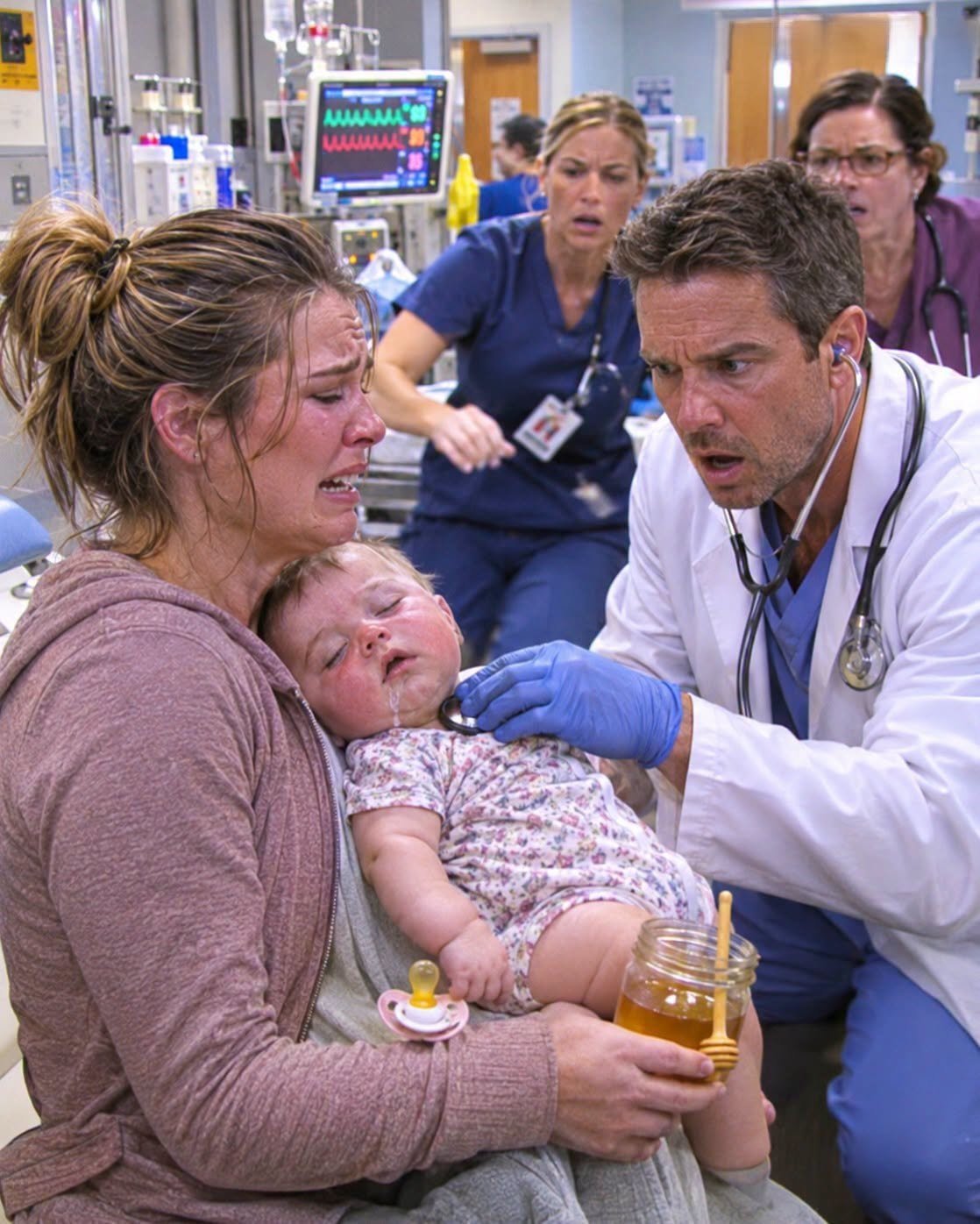
I looked around the kitchen. There, on the counter, next to the sink, was Poppy’s pacifier.
I picked it up.
It was sticky.
Next to it was a big glass jar. Raw, unfiltered honey from a farm stand. Half empty. There was a little bottle of whiskey next to it too.
“Bernadette. Did you give her honey?”
Bernadette crossed her arms.
“Just a little on her pacifier. For her gums. And a drop of whiskey on her gums at night so she’d sleep. That’s how we did it in my day. It’s natural.”
“I told you. I begged you. Babies can’t have honey.”
“Oh, please. That’s a myth. My kids all had honey, and they’re fine. You’re just looking for something to blame me for.”
I didn’t argue with her.
I didn’t have time.
I said, “Okay,” and I grabbed my keys and ran.
I drove to the children’s hospital with Poppy in her car seat, talking to her the whole way so she’d keep her eyes open.
The emergency room nurse took one look at her and called a doctor right away.
The doctor’s name was Dr. Whitfield. He examined her for five minutes. He checked her eyes. He checked her reflexes. He watched her try to suck on his finger and fail.
Then I told him about the honey.
His face changed.
He turned to the nurse and said something very fast that I didn’t understand. Then three more people came running into the room.
“Ma’am,” he said. “I think your daughter has infant botulism.”
“What does that mean?”
He looked at Poppy. Her chest was moving up and down slowly. Too slowly.
“It means the toxin is paralyzing her muscles,” he said. “Including the muscles she uses to breathe.”
Then an alarm on the monitor started beeping.
PART 2
The monitor was beeping because my daughter had stopped breathing well enough on her own.
Dr. Whitfield moved fast. The nurses moved faster. Someone slid a tiny mask over Poppy’s face and squeezed a bag to push air into her lungs, and her little chest rose in a rhythm that wasn’t hers.
A hand touched my elbow. “Mom, I need you to step back with me.”
It was a nurse with short gray hair and a badge that said Rosalind. She guided me to the wall, the way you’d guide someone on ice. I let her, because my legs had quit taking orders.
I watched them put a breathing tube down my five-month-old daughter’s throat.
I couldn’t scream. I couldn’t move. I stood there with both hands pressed over my mouth, and the only sound in my head was my own voice from three days earlier, saying no honey, please, promise me.
Then they were wheeling her out, and I was half-running beside the bed, and the elevator doors closed on a hallway full of strangers in scrubs.
The pediatric intensive care unit was on the fourth floor. It was quieter than the emergency room, but not in a peaceful way. It was the quiet of a place where everyone is listening to machines.
They put Poppy in a room with a wall of glass. A ventilator stood beside her bed, sighing in and out. Wires ran from her chest to a monitor. An IV was taped to the back of her tiny hand, and a strip of white tape held the tube to her cheek.
She looked so small. She looked like a doll somebody had left in the wrong place.
I sat in the chair next to the bed and didn’t move.
An hour later, Dr. Whitfield came to find me. He pulled a stool close and sat so we were eye to eye. I would later learn this is a thing good doctors do when the news is serious.
“I want to explain what’s happening,” he said. “Infant botulism happens when a baby swallows spores of a bacteria called Clostridium botulinum. Spores are everywhere, in soil and dust. Honey can carry them. An adult’s gut handles them without a problem. A baby’s gut isn’t developed enough, so the spores can grow and make toxin inside it.”
“And the toxin stops her muscles,” I said.
“It blocks the signal between the nerves and the muscles. That’s why she went floppy. Why she couldn’t suck. Why she couldn’t cry. And why the constipation, because the muscles in her intestines slowed down too.”
I thought about the three days without a diaper change and wanted to throw up.
“Is there a treatment?”
“There is. It’s called BabyBIG. It’s an antibody medicine made specifically for infant botulism, and it’s produced by a program in California. We’ve already called them. It’s being flown here tonight on a medical flight.”
“Will she be okay?”
He took a breath. He didn’t give me a fast answer, and I respected him for it.
“I’m going to be honest with you. The toxin that’s already in her system will take time to clear. Her body has to grow new nerve endings to replace the ones that were blocked. That takes weeks. She’ll need the ventilator while that happens. But babies who get treatment tend to recover fully, and the single most important thing in her favor is that you brought her in early.”
He leaned forward.
“If you’d waited until morning, I’m not sure we’d be having this conversation. You did the right thing. Remember that, even on the bad days.”
The medicine arrived at three in the morning.
A courier in a gray jacket carried it through the unit doors in an insulated case, and a pharmacist met him at the nurses’ station. I watched through the glass as they checked the label twice. I know how those checks go, because I do them for a living. It was the strangest feeling, standing on the other side of a process I’d done a thousand times, wanting to scream, faster, please, faster.
They hung the bag at 3:20. Rosalind adjusted the drip rate, wrote something on the whiteboard, and squeezed my shoulder.
“Now we wait,” she said.
I’ve never hated two words so much.
My husband, Wade, landed at six. He’d taken the first flight out of Denver after my frantic call, and he came through the PICU doors still wearing his work lanyard. He saw our daughter through the glass, the tubes, the tape, the wires, and he stopped walking.
His knees went. He caught the edge of a chair and folded into it.
“What happened?” His voice cracked in the middle. “Marnie, what happened?”
I told him. The honey. The pacifier. The whiskey. The way Poppy’s head had fallen back in my hand.
He listened without a sound. When I finished, he stared at the floor for a long time, and I could see him running the same math I’d been running all night. Three days. A promise. A laugh.
Then he pulled out his phone and called his mother.
He put it on speaker. I don’t think he meant to. I think his hands had stopped taking instructions too.
It rang five times.
“Wade?” Bernadette’s voice was thick with sleep and irritation. “Honey, it’s the middle of the night. Is something wrong?”
“Mom. Poppy is in the ICU. She’s on a ventilator. She can’t breathe on her own.”
A pause.
“Well, that’s terrible. Poor thing must have caught a bug. I told Marnie she needs to stop taking that baby out in public.”
“It’s botulism, Mom.”
“Botulism?” She actually laughed, a short brittle sound. “From what? Marnie’s cooking?”
“From the honey.”
The silence stretched.
“Now, Wade, I’m sure it wasn’t the honey. I gave her a little on the pacifier. Hardly a drop. All five of you boys and girls had honey, and look at you. Marnie probably gave her something. You know how she is with all those pharmacy chemicals.”
I watched my husband’s face. I had never seen it do what it did then. It went very still and very old.
“Mom,” he said. “The hospital tested the jar. I brought it in myself last night.” He hadn’t, of course. I had, tucked in my bag with the pacifier, because some animal part of my brain had known they’d want it. But he said it the way you say a thing you intend to make true. “They’re testing it right now. And the doctor told us what’s happening. Don’t tell me it wasn’t the honey.”
“Wade.”
“Don’t come to the hospital. Don’t call Marnie. Don’t text her. I’ll call you when I’m ready.”
“You can’t talk to me like—”
He hung up.
He sat holding the phone against his knee. Then he turned to me and said the words I’d been waiting to hear without knowing it.
“I should have listened to you. All those years. Every time she said something and I said, ‘Oh, that’s just Mom.’ I should have listened.”
I took his hand. I didn’t say it was okay, because it wasn’t. But I held on.
The next days blurred.
Poppy stayed on the ventilator. The hospital kept a thick folder on her, and every morning a team stood at the foot of her bed and discussed her like a puzzle. Her heart rate. Her oxygen. Her feeding tube, which snaked through her nose to her stomach because she couldn’t swallow. Her intestines slowly waking up.
I learned what everything meant. The pharmacy tech in me couldn’t help it. I asked about dosages and drip rates, and Rosalind started answering me in clipped, professional shorthand, like a colleague. It made me feel a little less helpless.
On the third day, a woman from the county health department came to the unit. Her name was Ms. Alvarado, and she was kind but thorough. She asked about the honey, where it came from, how much, when it was opened. She wrote everything down. She took the jar and the pacifier with her in sealed bags.
“We investigate every infant case,” she said. “It helps us track the source. I’ll let you know what we find.”
A week later she called. The honey had tested positive for botulinum spores.
Wade took that call. He listened, thanked her, and put the phone face-down on the table. Then he went into the family bathroom and shut the door. I heard the water running for a long time.
Nobody had ever needed proof. We both knew. But it made something real, and it settled into the room like a third person.
Bernadette called nineteen times that week. Wade let every one go to voicemail. His sisters called too, and his brother, wanting to know what had happened and why Mom was crying so hard they couldn’t understand her. Wade told them the truth in a flat voice, over and over, until his throat was raw.
I was surprised to find I didn’t want to scream at her. Not yet. I was too tired. All my anger was folded away somewhere, like a coat for later.
What I wanted was Poppy’s eyes open.
On the ninth day, Dr. Whitfield said the words I had been living for.
“She’s starting to show movement.”
I pressed my face to the glass. Her right hand, the one with the tape, curled. Just a little. The fingers closed on the edge of the blanket and opened again.
I cried so hard Rosalind had to bring me a chair.
After that, it came back in pieces, the way he’d promised. Her fingers. Then her toes. On the eleventh day she turned her head an inch toward my voice. On the twelfth day she opened her eyes all the way, those big blue eyes, and looked straight at me.
I said, “Hi, sweet girl.”
She blinked.
On the fourteenth day, the team decided she was strong enough to try breathing on her own. They gave me the choice to stay or step out. I stayed, standing in the corner, one hand over my mouth for the second time that month.
A respiratory therapist slid the tube out in one smooth motion.
Poppy coughed. She sputtered.
Then she opened her mouth and let out the loudest, angriest scream I have ever heard.
It filled the whole unit. A nurse down the hall clapped. Wade, behind me, made a sound halfway between a laugh and a sob. I laughed too, tears streaming down my face, because I had never in my life been so happy to hear a baby cry.
She was angry because everything felt strange. She was angry because her throat hurt. She was angry because she was five months old and had been asleep for two weeks. I would have let her scream for a year.
The recovery took longer than the crisis. Poppy had to relearn how to suck, how to swallow, how to hold up her head. A therapist came every day. She had a little foam wedge to practice tummy time, and for the first week she hated it so much that she screamed through every session, and I celebrated every single scream.
She came home after three weeks.
I’d cleaned the house top to bottom, the way you do when you’re afraid of everything. Wade had put the stuffed giraffe in her crib. We stood in the nursery doorway, watching her sleep, and for the first time in a month I felt my shoulders come down from around my ears.
“The doctors say she’ll make a full recovery,” I whispered.
“Say it again,” Wade said.
“A full recovery.”
He put his forehead against mine.
Bernadette did not come to the house.
She hadn’t been told she could. Wade had kept his word and stayed silent, and for four weeks she sat alone in her kitchen in Shelbyville with her phone in her lap. His sister told us later that she had stopped going to church. She’d stopped answering the door. She’d lost weight.
I’m not telling you this so you’ll feel sorry for her. I’m telling you because it’s true, and because I’ve learned that a person can be responsible for a terrible thing and still be a person.
A month after Poppy came home, on a gray Saturday in late November, the doorbell rang.
Wade looked at me. I nodded.
He opened the door.
Bernadette stood on the porch in her good wool coat, holding a paper grocery bag against her chest with both arms. She looked ten years older. Her hair, always set in perfect curls, hung limp around her face.
“I won’t come in,” she said. “Not unless you tell me to.”
“What’s in the bag?” Wade asked.
She held it out and he took it. He looked inside, then tilted it toward me.
Jars of honey. Four of them. A tall bottle of amber liquid I recognized as the same whiskey. A small tin of something labeled teething powder, which I’d never heard of and now knew to be afraid of. A jar of the camphor rub she used to put on children’s chests.
“That’s everything from my pantry,” she said. Her voice shook. “Everything I ever used on a baby that I shouldn’t have. I’m throwing it out. I wanted you to see me do it.”
She started to cry, not the loud kind, but the silent, helpless kind that only comes when you’ve held it back for weeks.
“I was wrong,” she said. “I was so proud. I raised five children and I thought it meant I knew everything. I didn’t listen to you, Marnie. I looked you in the eye and I lied to you because I thought you were being dramatic. And I almost killed my granddaughter.”
I had practiced what I would say to her. For weeks, in the shower, in the car, in the middle of the night. I’d had speeches that were cutting and speeches that were cold.
None of them came.
“Come in,” I said.
She stepped over the threshold like she was crossing something holy. Wade took her coat. She stood in the living room with her hands twisting in front of her, and Poppy, in her bouncer by the window, turned her head and looked at the new person.
“Can I?” Bernadette asked.
“Wash your hands first,” I said. “And sit down on the couch. Wade will bring her to you.”
She nodded, nothing like the woman who used to roll her eyes at me. She washed her hands for a full minute, the way I’d shown her, and sat with her arms out stiffly.
Wade laid our daughter in them.
Bernadette held her as if she were made of glass. She stared down at that round face and those enormous eyes, and her chin crumpled.
“I’m sorry, little one,” she whispered. “Grandma is so, so sorry.”
Poppy looked at her for a long moment, her brow furrowed in serious baby thought. Then one fat hand shot up and grabbed Bernadette’s nose, and she let out the squeal. The squeal that makes everyone in the grocery store turn around.
Bernadette burst out laughing and sobbing at the same time.
“Oh,” she said. “Oh, there she is.”
I sat down next to them, and for a while none of us said anything.
I’m not going to tell you I forgave her all at once. Forgiveness doesn’t work like a light switch. It was more like a long, slow thaw. For the first few months, Bernadette only saw Poppy at our house, with me or Wade in the room. I didn’t let her be alone with her. She never asked me to. She understood.
She came to every follow-up appointment. She sat in the waiting room with a book she never read, and when Dr. Whitfield’s clinic gave us the all-clear, she cried in the parking lot.
She asked questions, real ones, and listened to the answers. She asked me about safe sleep. About car seats. About why we don’t give water to babies under six months. She wrote it all down in a little spiral notebook.
One afternoon in spring, I found her in our kitchen, reading the labels on a jar of baby food as carefully as a chemist.
“I’m learning,” she said, not looking up. “It turns out a lot has changed since 1985.”
“A lot has,” I said.
“And some of it was never a myth in the first place.” She set the jar down. “Honey. Fine. I know now. I know.”
Poppy’s first birthday was in May.
We kept it small. A cake with one candle, a pink balloon, a smash of frosting that ended up mostly in her hair. Dr. Whitfield sent a card. Rosalind sent a stuffed owl. Ms. Alvarado sent a note, saying she hoped the little girl was thriving.
Bernadette arrived with a gift bag and her notebook. She’d made a decision, she said, and she wanted to show me.
She had a printed page, the same page I’d written the night before the training course, with my instructions in neat bullet points. She’d laminated it. She’d put a magnet on the back.
“It’s on my refrigerator,” she said. “Right at eye level. I read it every morning.”
At the top, below my original heading, she had added a line in thick red marker, her own handwriting, big and shaky:
NO HONEY UNTIL ONE.
Poppy was one now.
I looked at the page, at the red letters, at the woman holding it.
Then I picked up a spoon, scooped a tiny dab of golden honey from a jar on the counter, and held it out to my daughter, who grabbed at it with a gummy grin.
“Happy birthday, baby girl,” I said.
Bernadette started crying again, but this time she was smiling.
She follows my rules now. Every single one.
THE END.