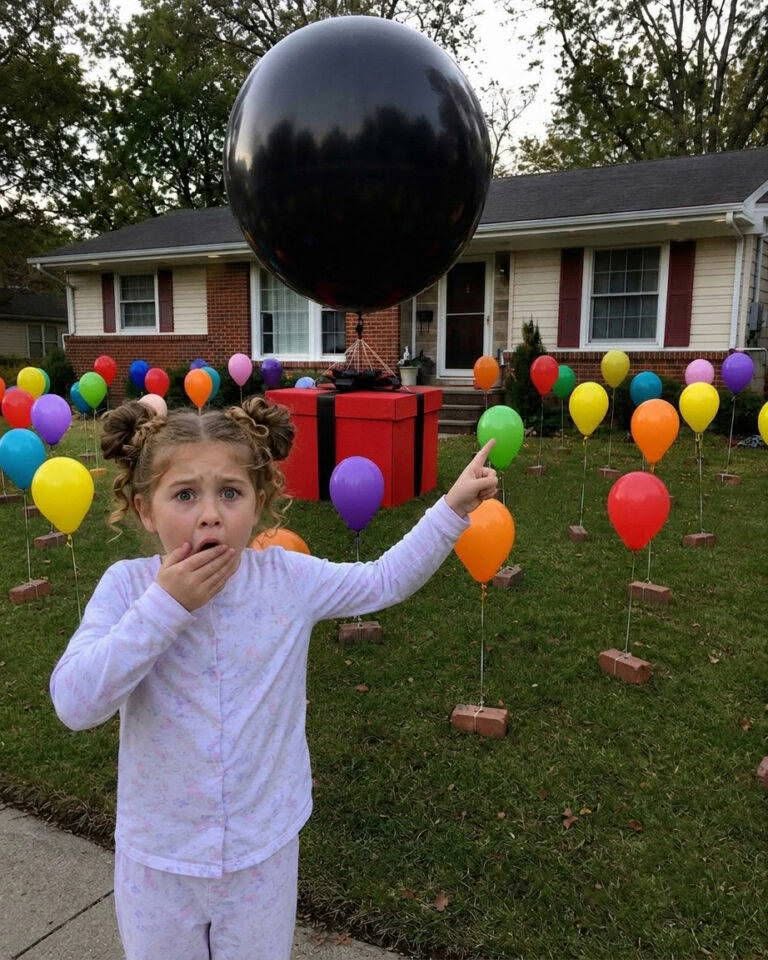
I became my little sister’s parent before I was old enough to become an adult myself. I believed that keeping food on the table and a roof over our heads was enough. Then she spent every dollar of her lunch money buying a birthday cake for a lonely boy in the hospital. The next morning, a black balloon and a red box appeared in our yard, and everything I thought I understood about love changed.
The morning after my little sister used every coin she owned to buy a birthday cake for a boy staying in the hospital, I opened our front door and discovered our front lawn filled with balloons.
Dozens of them had been tied to bricks and placed throughout the damp grass.
Right in the middle stood one huge black balloon. Beneath it rested a red box.
Della, my little sister, clutched the back of my shirt. “Syd, who is that from?”
I couldn’t answer. My stomach had already sunk.
A note had been taped to the lid.
“You came to my window every day. Nobody else did. And nobody knew anything about me. Please open it.”
—
I had been raising Della alone since I was nineteen.
Eight years earlier, our parents disappeared during a hiking trip and never returned. One week I was arguing with Mom about staying out too late. The following week I was signing school paperwork for Della with trembling hands.
By the time Della turned eight, our life had settled into a routine. She had the bedroom. I slept on a foldout couch while working breakfast shifts at a diner and evening hours in a pharmacy stockroom.
Della never complained.
That frightened me more than if she had.

One Thursday night, I was folding laundry while she sat cross-legged on the floor, rattling an old mint tin full of coins.
“You’re eating lunch at school, right?” I asked.
Della froze.
“I’m eating parts of lunch, Syd.”
“Parts?”
“The free parts.”
I set down the shirt I was holding.
“Della.”
She sighed like an exhausted grandmother trapped inside an eight-year-old body.
“Nobody dies from skipping canned peaches.”
“Why are you saving lunch money, monkey?”
She hugged the tin tightly.
“I have a project. A hospital boy.”
The hospital was two blocks from her school. Della walked with the Keene children and Mrs. Keene, who crossed them safely at the intersection.
Even so, my chest tightened.
“What hospital boy?”
“The one in the third-floor window. He watches us walk by.”
“You talked to him?”
“No. At first, I just waved.”
“At first?”
“Today, he was outside,” she said. “In the garden. In a wheelchair with a green blanket. Nurse Gloria was with him, so Mrs. Keene said I could say hi.”
I finally breathed again.
“What did you say?”
“I asked if he was the window boy.”
“And?”
“He asked if I was the waving girl.”
A shy smile appeared on her face.
“His name is Tobias. He turns 11 tomorrow. He likes dinosaurs and hates vanilla pudding.”
“You learned all that today?”
“He talks fast when someone listens.”
That sentence stayed with me.
I looked at the tin.

“And the lunch money?”
“He said nobody was coming for his birthday.”
“Honey, his parents may have reasons.”
“I know,” she said. “But he still looked sad.”
Then she opened her backpack and pulled out a small grocery-store cake and a cheap dinosaur toy with one crooked eye.
“I spent $11.40,” she said. “Every coin I had.”
My eyes stung.
“You gave away all your lunch money?”
“I didn’t give it away. I used it.”
“For a boy you barely know?”
Her chin lifted.
“I know him.”
“Waving at someone isn’t knowing them, Della.”
“Then how come I know he pretends not to cry when his mom leaves fast?”
I had no answer.
I wrapped my arms around her.
“You can’t skip lunch to be kind,” I whispered. “Next time, you tell me. We figure it out together.”
“You’re always figuring out bills,” she mumbled.
“We’ll do it properly,” I said. “We’ll go to the front desk. We’ll ask. If they say no, we listen.”
She leaned back.
“So yes?”
“So maybe.”
Her smile nearly broke me.
The following afternoon, I left the diner with aching feet, picked Della up, and we walked to the hospital together.
She carried the cake as if it were made of glass.
At the reception desk, I asked if we could see Tobias on the pediatric floor.
The woman typed something into her computer and shook her head.
“Only approved visitors can go up.”
“Could you call Nurse Gloria?” I asked. “Please?”
Ten minutes later, Nurse Gloria came downstairs.
“Hi, sweetie,” she said to Della. “And you must be Sydney.”
“Syd,” Della corrected softly. “People who love her call her Syd.”
Nurse Gloria smiled.
“We can’t allow a regular visit, but Tobias is in the family lounge. Della can hand him the gift there, with me present.” Family
“Thank you,” I said.
Tobias sat in his wheelchair with a green blanket across his lap. The moment he saw Della, his entire face brightened.
“You came inside,” he said.
Della held up the grocery bag.
“I brought birthday stuff.”
His eyes dropped to the bag.
“For me?”
“Yes, for you,” she said, smiling.
He laughed.
It was small, but real.
She handed him the stuffed dinosaur.
“It’s a dinosaur,” she said. “One eye is funny, so he might need glasses.”
Tobias touched the crooked face.
“I like him.”
“The cake got smushed,”
“That’s the best side,” he replied.
A security guard appeared near the doorway.
Nurse Gloria’s smile faded.
“I’m sorry. That’s all the time we have.”
Della looked up.
“Already?”
The guard kept his tone gentle.
“You’re not on the approved list.”
I stepped forward.
“She’s eight. She saved her lunch money for this.”
“I know,” he said. “But I have to follow policy.”
Tobias held the dinosaur tighter.
Della’s chin trembled.
“Can he still eat the cake?”
Nurse Gloria nodded.
“I’ll make sure he does.”
Inside the elevator, Della wiped her eyes with her sleeve.
“Why did it feel like we were in trouble?”
“We weren’t,” I said. “Hospital rules, baby girl. I’m sorry.”
The next day, Nurse Gloria brought Tobias to the garden window. Della stood outside with me and Mrs. Keene and sang “Happy Birthday” with both hands pressed against the glass.