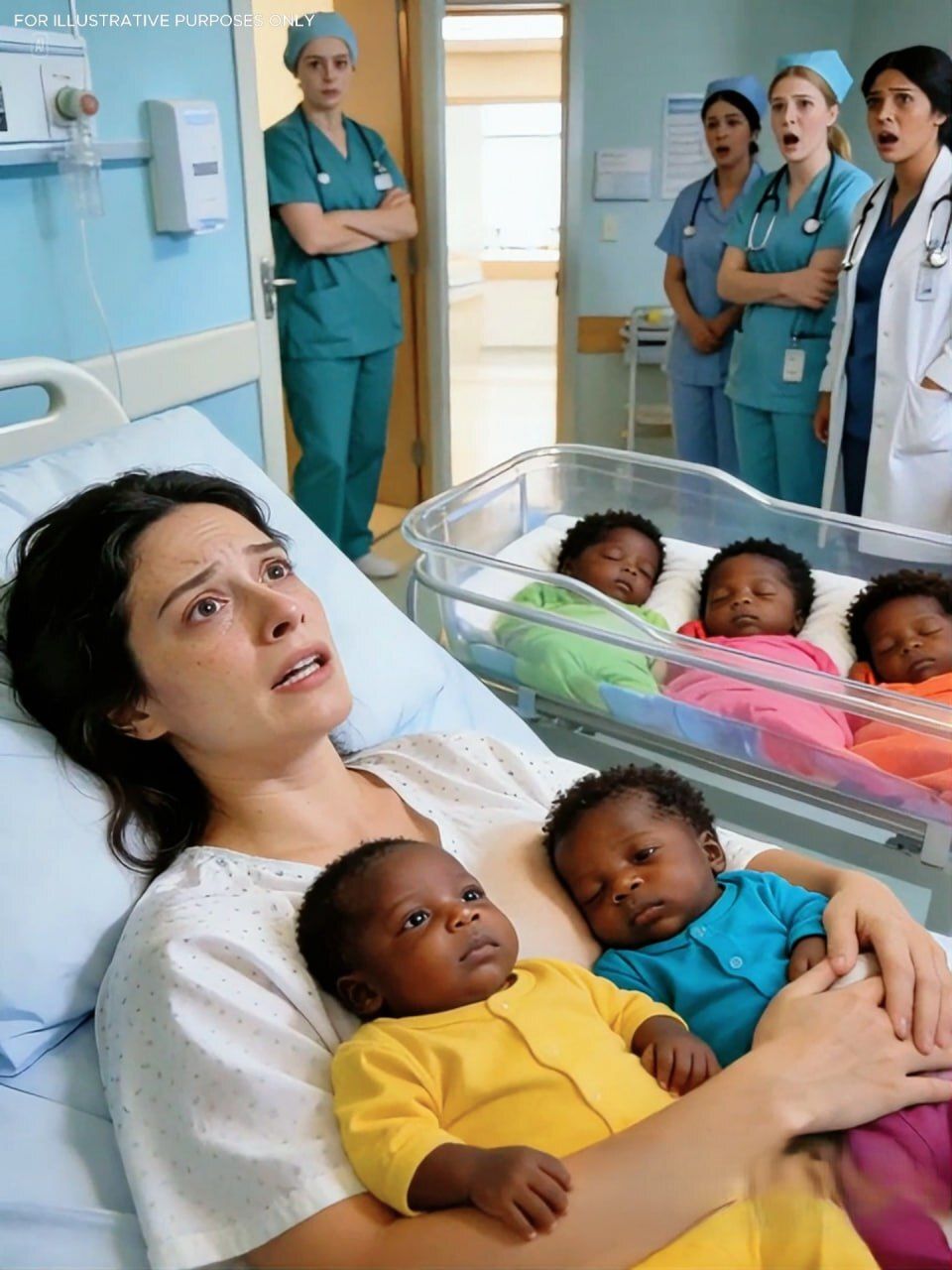
The first thing my husband said after our children were born was not what I expected.
It wasn’t concern for my health. It wasn’t relief that the delivery was over. It wasn’t wonder at the sight of five tiny lives breathing for the first time.
It was accusation.
The nurse had just placed two of the babies into my arms while the other three slept in the bassinets beside my bed. I was exhausted beyond words, my body still trembling from the strain of labor, my mind barely able to keep up with the reality that I was now a mother to five newborns at once.
Five heartbeats. Five tiny chests rising and falling. Five lives that already owned every part of my heart.
My husband stood at the foot of the hospital bed, completely still.
“All five babies are Black,” he said loudly, his voice breaking through the quiet of the maternity ward.
The room froze.
I remember the smell of antiseptic, the dull ache pulsing through my body, and the way the babies felt impossibly warm against my skin. I remember nurses exchanging uneasy glances and a doctor clearing his throat, as if trying to decide whether to intervene.
I looked at my husband, confused and stunned.
“What are you saying?” I whispered.
He took a step backward, his face pale, his eyes wide with something that looked like fear mixed with anger.
“They’re not mine,” he said. “You cheated on me.”
The words landed like ice.
I tried to sit up, pain shooting through my abdomen. “That doesn’t make sense,” I said weakly. “You know it doesn’t.”
But he wasn’t listening.
He didn’t ask questions. He didn’t wait for explanations or medical answers. He didn’t give me time to speak at all. He turned away, walked out of the room, and vanished from my life as completely as if he had never existed.
I did not see him again for fifteen years.
The judgment started almost immediately.
Even before I left the hospital, whispers followed me down the hallways. Visitors stared a little too long. One nurse asked gently if I had “support arranged.” Another quietly asked if I needed help contacting “the fathers.”
Plural.
I signed the discharge papers alone. I wheeled five infant car seats out to the parking lot with hands that still shook from blood loss and shock. There were no flowers. No congratulations. No partner waiting to drive us home.
Just me, and five babies the world had already decided to judge.
The early years were relentless.
Strangers felt entitled to ask questions at the grocery store, at the pharmacy, anywhere we went.
“Are they adopted?”
“Do they have different dads?”
“That must have been… complicated.”
Some asked with smiles that didn’t quite reach their eyes. Others didn’t bother hiding their curiosity or judgment.
I worked multiple jobs. I learned how to stretch every dollar until it begged for mercy. I learned how to soothe one baby while feeding another and breaking up toddler squabbles all at once. I learned how to braid hair while stirring pots on the stove. I learned how to be calm when I felt like screaming.
At night, when the house finally went quiet, I cried into my pillow so they wouldn’t hear me. I cried for the life I thought I’d have. For the partner who vanished. For the way people looked at my children before they ever knew them.
But I never let my kids feel unwanted.
When they asked about their father, I told them the truth in a way they could carry.
“He was confused,” I said. “But I stayed. And that’s what matters.”
They accepted that answer, because children believe in the people who show up.
And I always showed up.
They grew into strong, kind, fiercely loyal kids. They protected one another like a small army, standing shoulder to shoulder against the world. Slowly, as people got to know them, the whispers faded. Respect replaced suspicion. Familiarity softened judgment.
Life wasn’t easy, but it was ours.
Fifteen years passed.
Then one afternoon, there was a knock at the door.
I almost didn’t answer.
Something in my chest tightened as I reached for the handle, as if my body recognized the moment before my mind did. When I opened the door, the man standing on my porch looked like a stranger wearing a familiar face.
He was older. Thinner. His posture sagged with exhaustion. Deep lines carved his face in places I didn’t remember.
It was my husband.
“I need to talk to you,” he said quietly. “I was wrong.”
I stared at him, silent.
“I found something,” he continued, his voice shaking. “Something that made me realize I made the worst mistake of my life.”
I laughed, sharp and humorless. “Fifteen years too late.”
He begged. He said he had lived with guilt every day. That he never remarried. That regret had followed him everywhere. Against my better judgment, I let him inside.
The children were in the living room. Five teenagers now, tall and confident, laughing together over something on a laptop. They looked up when he entered.
He stopped in his tracks.
“They look like you,” he murmured. “But still…”
I crossed my arms. “Still not yours?”
“I need proof,” he said.
I nodded. I had expected that.
“I already have it,” I replied.
I went to a drawer and brought back a thick envelope, worn from time and handling. I placed it on the table between us.
“These are medical records,” I said. “From before the birth. From the hospital. From years ago.”
His hands trembled as he opened the envelope.
The truth inside wasn’t dramatic or scandalous.
It was medical.
Years before my pregnancy, I had been diagnosed with a rare genetic condition. One I had told him about, though he hadn’t paid much attention at the time. A condition that could cause dormant genetic traits to express themselves strongly in children.
It wasn’t common.
But it was documented.
The final page stopped him cold.
A paternity test ordered by the hospital, completed after he fled, and never delivered because he was gone.
Probability of paternity: 99.99 percent.
The papers slipped from his hands.
“No,” he whispered. “That can’t be true.”
But it was.
All five children were his.
He collapsed into a chair, covering his face as sobs shook his body.
“I destroyed everything,” he cried. “I believed my own fear instead of the woman I married.”
One of my sons stood up.
“Mom,” he asked quietly, “is this him?”
I nodded.
The room went silent.
Then my eldest spoke, her voice steady and calm.
“You left,” she said. “She didn’t.”
There was no anger in her tone. No raised voice. Just truth.
The man who had walked away looked up at his children through tears.
“I don’t deserve forgiveness,” he said.
They didn’t rush to comfort him.
They didn’t need to.
Because the truth had already done what no punishment could. It stripped away his excuses and left him face-to-face with the cost of his choices.
When he left that day, he didn’t ask to stay.
He knew better now.
He writes sometimes. Letters filled with regret and apologies that can’t change the past. I don’t know what the future holds, and I don’t pretend this kind of wound disappears overnight.
But I do know this.
I raised five children alone not because I was abandoned, but because I was strong enough to stay.
And the truth, no matter how long it takes, always finds its way home.