Kurt looked down at the frost for a long moment. Then he took one slow step toward Dale.
I’d known Kurt Ostrowski for eleven years. He’d stood at my wedding with a carnation pinned crooked on his lapel. He’d eaten my chili at a dozen Packers games. He’d hunted my grandfather’s ridge every November since Brad first brought him out there in a borrowed truck.
I’d never once seen him look the way he looked that morning, standing at the edge of Grandpa’s cornfield in the gray light with frost on his boots.
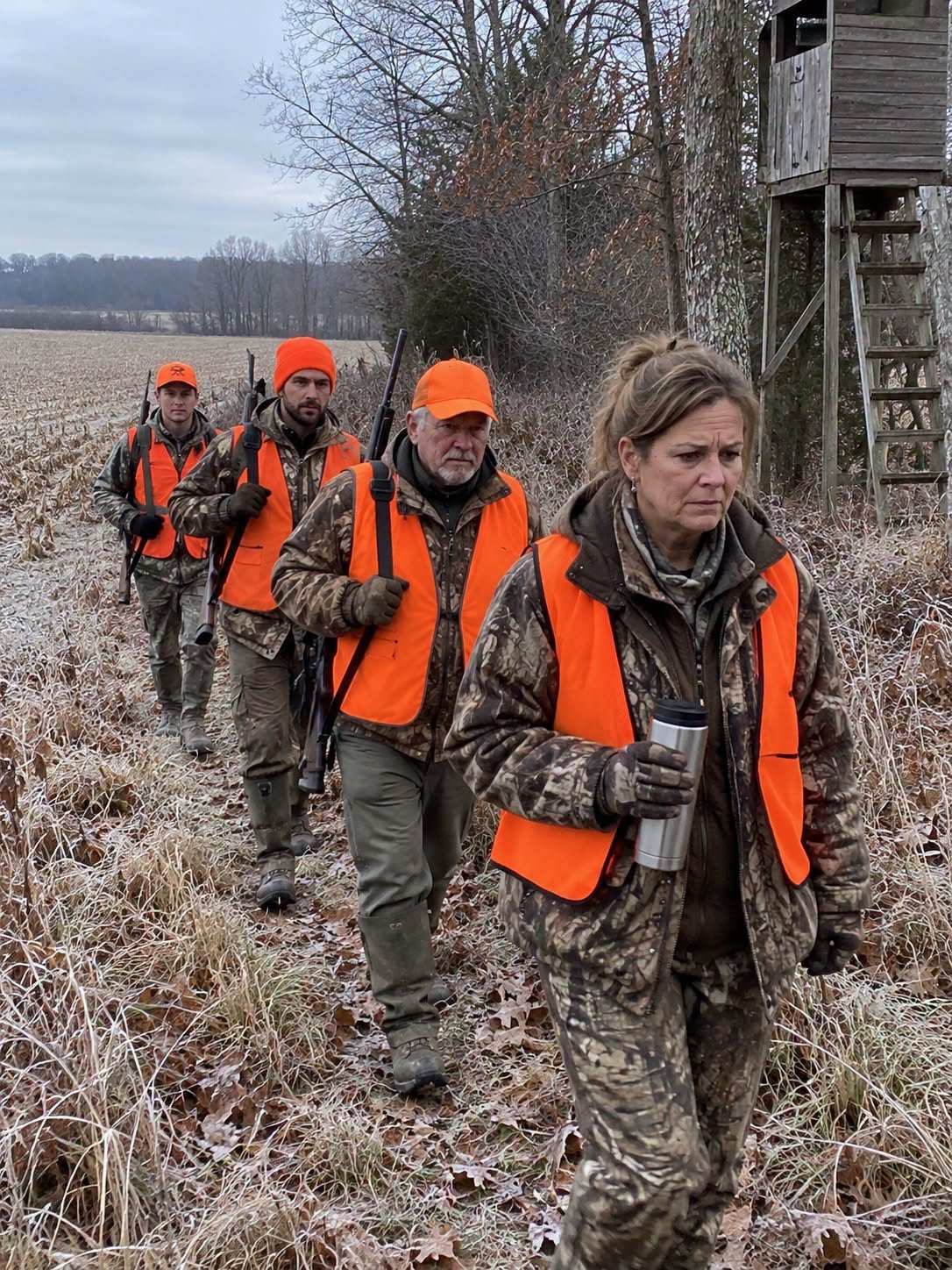
Behind him, Mike Pruett and Russ Lindahl stood with their rifles slung, breath smoking in the cold,
their eyes moving from me to the three blaze-orange hats in the trees and back again.
Dale didn’t move. He stood next to me at the foot of the old wooden ladder stand with his empty hands at his sides and his gray beard frosted white at the chin. He was fifty-eight years old
and stood about six-two, and he had the stillness of a man who’d been in rooms far worse than a cornfield.
Kurt stopped about three feet from him. He studied Dale’s face, then the faded patch sewn on the
left shoulder of Dale’s canvas hunting coat: a black horse head on a yellow shield, a diagonal stripe across it.
“First Cav,” Kurt said quietly.
Dale’s eyebrows went up a fraction. “That’s right.”
“Desert Storm?”
“Desert Storm. Then Iraq twice.”
Kurt stood there for a long time, breathing white clouds into the cold. Then he pulled off his right glove, finger by finger, and held out his bare hand.
“Twenty-fourth Infantry,” he said. “Ninety-one. I was nineteen.”
Dale looked at the hand. Then he took off his own glove and shook it.
Nobody said anything. A mile off, a second shot cracked across the hills, and then a third.
Kurt let go of Dale’s hand and turned to me. His face had gone red, and not from the cold.
“Amy,” he said. “What do you mean you didn’t cool off? Brad told us you were fine with it. He said you agreed to it.”
“Agreed to what?”
Kurt reached inside his blaze-orange vest, pulled out a folded piece of paper, and handed it to me. It was soft at the creases, like it had been in and out of that pocket a lot.
I unfolded it in the gray light. At the top, in bold letters somebody had typed on a computer, it said HUNTING LEASE AGREEMENT.
Below that was a legal description of my eighty acres, copied word for word off the deed: the
Southwest Quarter of the Northeast Quarter and the Northwest Quarter of the Southeast Quarter of Section 14, Township 27 North, Range 4 West. Then: Lessor, Amy L. Halvorsen. Lessee, Kurt Ostrowski, on behalf of hunting party. Term, November 2026 gun season. Consideration, $4,000,
paid in cash.
At the bottom were two signatures.
One was Kurt’s.
The other said “Amy L. Halvorsen,” in a loopy, slanted hand that looked nothing like mine.
I’ve signed my name the same way since I was twelve, when Grandpa Arvid taught me to write it on the back of a savings bond. I didn’t sign that paper. I’d never seen it in my life.
“Brad gave us that in August,” Kurt said. “He said you signed it at his place when you came to pick up the rest of your boxes. He said you were glad for the money, with property taxes and all.”
My hands were shaking so hard the paper rattled.
“I didn’t sign this, Kurt,” I said. “I haven’t been to Brad’s place since the divorce. I haven’t spoken to him except on the phone in August, when he told me I don’t even hunt and hung up on me.”
Kurt stared at me. Behind him, Mike swore under his breath.
“Then where’d our four grand go?” Russ asked.
Nobody had to answer that.
To understand how I ended up standing on that ridge at dawn with three Army veterans and a
forged lease, you need to know about my grandfather.
Arvid Halvorsen was born in 1932 in the farmhouse that still stands at the bottom of that land, a mile and a half outside Elk Mound, Wisconsin. He served in Korea with the Second Infantry Division
and came home in 1953 with a Purple Heart and a limp in his left leg that never went away. He married my grandmother, Ingrid, in 1955 and farmed that land for fifty years. They grew corn and soybeans, kept a few beef cattle, and raised three kids on what the eighty acres would give.
But what he loved most was the ridge.
The north forty is mostly hardwoods: big white oaks, a few red, and a creek bottom thick with cedar. Every fall the deer came down off that ridge to feed in the picked corn. Grandpa said it
was the best deer ground in Dunn County, and nobody ever argued with him, mostly because nobody else had a ridge like it.
He never charged anyone a dime to hunt it.
Every opening morning, from 1961 until the year before he died, he walked his hunters in himself. Most of them were veterans: Korea, Vietnam, the Gulf, then the younger ones from Iraq and
Afghanistan. He kept a little green ledger in the kitchen drawer with every name in it, the year they hunted, and whether they got a deer. Sometimes there was a line or two more. “Jim Haugen, Vietnam, 1969. First hunt since he came home. Didn’t shoot. Sat all day. Said it was the first time he
slept since Khe Sanh.”
When I was little, he let me walk behind him on those mornings. I’d carry his steel thermos, nearly as big as I was, and he’d tell me to step where he stepped so I wouldn’t crunch the leaves.
“Why don’t you charge them, Grandpa?” I asked him once. I was maybe nine. “The Larsons charge people to hunt their land. Uncle Gary says they make a lot of money.”

He stopped on the field edge in the dark and looked down at me.
“Some things you don’t sell, Amy,” he said. “These men already paid.”
Grandpa died three years ago in March. He was eighty-nine. His will had been drawn up by an old
lawyer in Menomonie named Harold Brekke, who’d handled the Halvorsen family’s affairs since the sixties. It left the farmhouse and the eighty acres to me, his only granddaughter, in my name alone.
At the time I was married to Brad Kessler.
We’d been married nine years. Brad was a sales manager at the John Deere dealership in Menomonie. He was charming and easygoing, and the kind of man who could sell a combine to a dairy farmer who didn’t need one. Everybody liked Brad. I liked Brad, for a long time.
When Grandpa’s will went through probate in Dunn County, Brad sat beside me in Harold Brekke’s office while Harold read it out loud. When Harold got to the part about the land, Brad squeezed my knee.
Afterward, in the parking lot, he said, “That’s our land now, babe.”
“It’s my land,” I said, half joking. “Grandpa left it to me.”
He laughed. “Same thing, right? We’re married.”
It wasn’t the same thing. I found that out a year later, when the marriage came apart.
I’m not going to tell you all of it. There’s no use. There was no affair, no screaming, nothing you’d put in a country song. We just woke up one day and realized we’d been living like roommates for
three years. Brad wanted to move to Madison and sell the farmhouse. I wanted to stay. Brad wanted to cash out the land. I couldn’t even picture it.
“It’s just dirt, Amy,” he said once. “It’s eighty acres of dirt and some old trees.”
“It’s Grandpa’s,” I said.
“Your grandpa’s dead.”
That was the night I knew it was over.
We filed in the spring. Brad hired a lawyer from Eau Claire named Darren Fiske, who wore cowboy boots with his suits and billed $325 an hour. In our first mediation session, Fiske argued that the land should be treated as marital property, or at least that Brad was entitled to a share of its
increased value.
“My client contributed substantially to the improvement of that property,” Fiske said. “He built four deer stands on it. He maintained the trails. He paid half the property taxes in 2024.”
My lawyer was a calm, gray-haired woman named Patricia Haugen. I found out later she was the granddaughter of Jim Haugen, the Vietnam vet in Grandpa’s ledger. She didn’t even look up from her file.
“Mr. Fiske,” she said, “in Wisconsin, property acquired by inheritance is individual property. It stays individual property unless it’s mixed with marital assets in a way that makes it impossible to trace. Mrs. Halvorsen inherited this land by will. The deed is in her name alone. It was never retitled, and it
was never refinanced. The tax bill came in her name. Your client wrote one check for half of one year’s property taxes. That’s $930. We’ll be happy to reimburse it.”
Fiske tried for two more sessions. He argued that the stands Brad built added value. Patricia
brought in a local appraiser named Gordon Lund, who testified that four homemade wooden deer stands added, in his professional opinion, “approximately nothing” to the value of eighty acres of farmland.
The divorce was final in October, two years ago. Under the judgment, I kept the farmhouse and the eighty acres as my individual property. Brad kept his truck, his bass boat, his half of our joint savings, about $23,000, and his own 401(k). I reimbursed his $930 in property taxes with a check
from my credit union account at Royal Credit Union, and in the memo line I wrote: “Paid in full.”
Brad moved to an apartment in Menomonie. I stayed in Grandpa’s farmhouse.
I thought that was the end of it.
I didn’t know he’d kept something. Not a key. Something worse than a key.
He kept the idea that the ridge was his.
Kurt told me in August like he was telling me the weather.
I was at the Cenex in Elk Mound filling my truck. Kurt pulled in at the next pump in his black Silverado and waved.
“Amy! How you doing?”
“Good, Kurt. You?”
“Good, good.” He pulled the nozzle out and leaned against his truck bed. “Hey, just so you know,
we’re paid up with Brad through this season. Four grand, cash. Me, Mike, and Russ. Same as last
year.”
I stood there with the gas nozzle in my hand. The pump kept clicking.

“Same as last year?” I said.
“Yeah. Brad said you were okay with it, with him still running the hunting out there. He said you didn’t care about it since you don’t hunt.” Kurt shrugged. “Figured you knew.”
I didn’t know.
I’d had no idea that for the last two seasons, after the divorce, after the judgment, after I wrote “Paid in full” on a check, Brad had been collecting four thousand dollars a year in cash from his
buddies to hunt land that wasn’t his.
And I’d been at home in the farmhouse every November weekend, hearing shots on the ridge and thinking they were coming from the neighbors.
I called Brad that night.
He answered on the fourth ring. I could hear a TV in the background and a woman laughing.
“Amy. What’s up?”
“Kurt told me you’ve been leasing the hunting on my land. Four thousand dollars a season. For two years.”
There was a pause. Then he chuckled, that easy, warm chuckle that used to make me forgive him
for anything.
“Come on, Amy. You don’t even hunt. It’s wasted on you. Those guys love it out there. They’ve been hunting that ridge for years.”
“With my grandfather’s permission,” I said. “And then with mine, when we were married. Not with yours, Brad. You don’t own anything out there.”
“I built those stands.”
“You built four plywood boxes on my land.”
“Amy.” His voice stayed calm, almost amused. “Don’t make this into a thing. It’s a few weeks in November. Nobody’s hurting anybody.”
Then he hung up.
He never raised his voice. He never had to. That was Brad’s gift: making you feel like the unreasonable one, just by staying calm while you got upset.
I sat at Grandpa’s kitchen table for a long time with the phone in my hand. The green ledger was in the drawer in front of me. I took it out and turned the pages: all those names, all those years. Fifty-nine years of men walking up that ridge with my grandfather because he told them they’d
already paid.
And Brad was selling it for cash.
The next morning, I drove to Menomonie and sat across a desk from Patricia Haugen.
“I don’t want to sue anybody,” I told her. “I just want it to stop.”
“Then we stop it,” she said. “You don’t need a sheriff or a judge to keep people off your own land, Amy. The deed has one name on it. That’s yours.”
She explained it plainly. Wisconsin law lets a landowner post her land against trespass. If I put up signs at the right intervals along the boundaries and at the gates, anybody who entered without my permission would be trespassing, no matter who told them it was okay. And if I sent Brad a
certified letter revoking any permission he thought he had, he couldn’t claim later that he didn’t know.
“There’s one more thing you need to know,” Patricia said. She folded her hands on the desk.
“Something about liability.”
“Wisconsin has a recreational use law,” Patricia said. “Most states do. It protects landowners who let people hunt, fish, hike, or whatever on their land for free. If somebody gets hurt hunting on
your property, falls out of a tree stand, say, the law mostly protects you from being sued. It encourages people to open their land.”
“Grandpa always said nobody could ever sue him for letting somebody hunt.”
“Your grandfather was right, because he never charged.” Patricia leaned forward. “But Amy, a lot of that protection can go away if the landowner gets paid. Brad has been collecting four thousand dollars a season to let people hunt your land. If one of those men falls out of one of Brad’s
homemade stands and breaks his back, his lawyer is going to argue that this was a paid hunting arrangement on your property. Then you’re the one in the courtroom, not Brad.”
I felt cold all the way through.
“He’s not just taking money for something that isn’t his,” I said slowly. “He’s putting the farm at risk.”
“Call your insurance agent,” Patricia said. “Today.”
I called Lyle Swenson at the Farm Bureau office that afternoon. Lyle had written Grandpa’s farm policy for thirty years. When I told him about the cash lease, there was a long silence on the line.
“Amy, your farm liability policy covers incidental recreational use. Neighbors, family, friends hunting
for free. It does not cover commercial hunting leases. If somebody’s paying to hunt that ground, I’d need to know about it and write a separate rider. And I’d want a written lease, proof the lessee has their own insurance, and stand inspections.” He sighed. “Without any of that, if there’s an
accident, you could be in a real mess. We’re talking about the farm.”
The farm. Eighty acres worth about $640,000 at the going rate in Dunn County, plus the farmhouse. Everything Grandpa built.
That night I went to the Fleet Farm in Menomonie and bought eighty orange PRIVATE PROPERTY – NO TRESPASSING – NO HUNTING signs, a box of aluminum nails, and a staple gun. I spent two weekends walking every fence line of those eighty acres, posting signs exactly the way Patricia

told me: at the corners, along the boundaries, and on both sides of the field gate.
My neighbor, Earl Nygaard, who has farmed the ground to the south for forty years and cash-rents my tillable sixty acres for corn at $185 an acre, saw me posting signs along the line fence
and pulled his tractor over.
“Brad’s crew?” he asked.
“Brad’s crew,” I said.
Earl nodded slowly. “I wondered about that last November. Saw his buddies’ trucks parked at your gate every Saturday, and you weren’t with ’em. Didn’t seem right.” He climbed down off the tractor. “Want help with the north line? That fence is a mess along the creek.”
We posted the north line together. Earl didn’t say much. He didn’t need to.
Then I sat down at Grandpa’s kitchen table and wrote one letter. Patricia looked it over before I sent it.
“Mr. Kessler: This letter is formal notice that any permission you may believe you have to enter, use, hunt, or grant hunting rights on my property in Section 14, Town of Elk Mound, Dunn County, Wisconsin, is revoked, effective immediately. This revocation applies to you and to any person to
whom you have granted, sold, or represented any right to enter or hunt this property. The property is posted. Any entry without my express written permission will be treated as trespass. — Amy L. Halvorsen, Owner.”
I mailed it from the Elk Mound post office, certified, return receipt requested. It cost $8.85.
Four days later, the green card came back in my mailbox, signed in Brad’s loopy handwriting.
Nobody called me, and nobody argued.
I thought he’d gotten the message. I thought he’d tell his buddies.
I was wrong about the second part.
In September, I sat across from Dale Moody at the potluck after church.
Our Savior’s Lutheran in Elk Mound holds a harvest potluck the third Sunday of every September in the basement fellowship hall. There are long folding tables, paper tablecloths, and about forty kinds of hot dish. I brought Grandma Ingrid’s scalloped potatoes, which is the only thing I make
that people ask for.
Dale sat down across from me with a plate full of tater tot casserole and three different Jell-O salads. I’d seen him at church for years but never really talked to him. He was a big man with a
short gray beard and a quiet way of looking at people, like he was making sure they were okay before he said anything.
“These your scalloped potatoes?” he asked.
“My grandmother’s recipe.”
“Ingrid Halvorsen’s?” He smiled. “I remember these. She brought them to my dad’s funeral in ’99.”
That got us talking. Dale had grown up in Colfax, joined the Army at eighteen, and served twenty-
four years, including Desert Storm with the First Cavalry Division and two tours in Iraq. He retired as a first sergeant and came home to Dunn County to drive a delivery truck for the Menomonie co-op.
“You hunt?” I asked.
He shook his head. “Used to. Hunted public land for thirty years. The state forest up by Bruce, the county land near Downsville.” He pushed a tater tot around his plate. “Quit about five years ago.”
“Why?”
He was quiet a moment.
“Too many guys walking in on me in the dark,” he said. “Public land on opening morning is a circus. You get to your spot at four-thirty, and somebody’s already there. Or somebody walks right
under your stand at dawn with a flashlight, talking on his phone.” He shrugged. “After Iraq, I don’t do so well with people coming up behind me in the dark. I’d sit there with my heart going like a jackhammer, and that’s no way to hunt. That’s no way to do anything.”
A younger man sitting beside him looked up from his plate. He was in his thirties, thin, with a careful way of holding himself.
“This is Tim Seger,” Dale said. “He works with me at the co-op.”
Tim nodded at me. “Ma’am.”
“You hunt, Tim?”
“Not since I was a kid.” He set his fork down. “My uncle used to take me, up near Chippewa Falls.
Then I joined up at nineteen and did two tours in Afghanistan. Kandahar. When I came home, my uncle had passed and his land was sold. I never found anywhere to go after that.” He gave a short, embarrassed laugh. “I’ve got a rifle in my closet I haven’t fired in fifteen years. Dad’s old .30-
06.”
On Dale’s other side, another man shook his head. He was maybe forty, broad-shouldered, with a buzz cut and a Wisconsin Badgers sweatshirt.
“Wes Hanna,” Dale said. “Army National Guard. Iraq, 2007.”
“Nobody’s got land anymore,” Wes said. “Everything’s leased up. The big outfitters lease it, or out-of-staters come in and pay a fortune. Guy I know pays six grand a year to hunt a hundred and twenty acres over by Durand. Six grand. I’ve got two kids and a mortgage on a house in
Boyceville. I can’t pay six grand to sit in a tree.”
I looked at the three of them, sitting in the basement of my grandfather’s church eating Jell-O salad off paper plates.
I thought about the green ledger in the kitchen drawer. I thought about Grandpa standing on the field edge in the dark, looking down at a nine-year-old girl.
“These men already paid,” I said out loud.

Dale looked up. “Sorry?”
“I have eighty acres,” I said. “My grandfather’s farm, out on County Road H. There’s a hardwood ridge with a creek bottom. Best deer ground in Dunn County, according to him.” I took a breath.
“It’s posted now, but not against you. If you three want to hunt it this fall, it’s yours. All season.”
The table went quiet. Even Wes stopped chewing.
“What’s it cost?” Dale asked carefully.
“Nothing.”
“Ma’am, we can’t hunt your land for nothing.” Dale reached for his wallet right there at the potluck table. “Let me at least give you something. A thousand. That’s fair for opening weekend alone.”
I put my hand over his wallet.
“Dale,” I said, “my grandfather walked veterans up that ridge for free from 1961 until the year before he died. If I took a dime from you, Grandpa Arvid would haunt us both.”
Dale looked at me for a long moment. Then he slowly put his wallet away.
“Arvid Halvorsen,” he said quietly. “My dad hunted with him. In the seventies. After Vietnam.”
I went home that night, opened the green ledger, and found it in Grandpa’s slanted handwriting:
“Roger Moody, Vietnam, 1974. Big 10-pointer, north ridge. Cried when he shot it. Said it was the first good thing since he got back.”
We spent two October Saturdays fixing Grandpa’s old stands.
Brad’s four plywood boxes I tore down myself with a pry bar and a cordless drill. Patricia said I didn’t have to, but I didn’t want anybody climbing into something Brad built. Some of the plywood was rotting, and one of the ladders had a cracked rung he’d patched with duct tape.
Duct tape, twelve feet up a tree.
Grandpa’s stands were different. He built them himself in the early eighties out of white oak he cut and milled on the farm. There were three of them, simple wooden ladder stands with a little bench
seat and a shooting rail, set in the best spots on the ridge: one at the corner of the woods where the deer came down to the corn, one halfway up the ridge at the creek crossing, and one at the top overlooking the cedar bottom.
They’d weathered silver-gray over forty years, but the oak was still hard as iron. They just needed new straps, some new lag bolts, and a couple of rungs replaced.
Dale knew carpentry. Wes had a truck full of tools and opinions. Tim mostly carried lumber and
didn’t say much, but he worked harder than both of them, and at the end of the second Saturday, he stood at the bottom of the creek-crossing stand looking up at it for a long time.
“My uncle’s stand looked just like this,” he said.
I bought new ratchet straps and safety harnesses at Fleet Farm, $340 worth, because Lyle at Farm Bureau told me to and because Grandpa would’ve wanted it. Wes inspected every bolt twice. Dale climbed each stand and bounced on it to test it, and at fifty-eight and two hundred thirty
pounds, that was a pretty good test.
The second Saturday, while we were finishing up, a black Silverado slowed on County Road H, rolled past my gate, and kept going.
Kurt’s truck.
I didn’t think anything of it at the time.
Opening morning of the Wisconsin gun deer season was the Saturday before Thanksgiving.
I set my alarm for 3:45 and didn’t need it. I’d been awake since three, lying in Grandpa’s old bed in the farmhouse and listening to the wind in the oaks.
At 4:30, I filled Grandpa’s steel thermos with coffee. It’s an old green Stanley with a dent on one
side from when he dropped it off the tailgate in 1987. I tucked my auburn hair into a low ponytail and pulled on a blaze-orange knit hat. Then I took Grandpa’s tan canvas hunting coat off the hook by the back door, where it had hung for three years.
It still smelled like him: pipe tobacco and wood smoke and cold November air.
I put it on. It was too big in the shoulders, and the sleeves came down past my fingertips. I rolled them up twice.
Dale, Tim, and Wes pulled into the yard at 4:45 in Dale’s pickup. They got out in blaze-orange vests and hats, rifles cased, breath fogging in the yard light.
“Morning,” Dale said.

“Morning,” I said.
Grandpa always walked his hunters in the first morning, so I did too.
I went first along the field edge in Grandpa’s coat, with the thermos under one arm and a small
flashlight with a red lens pointed at the ground. There was frost on the picked cornstalk stubble, and gray light was just starting to come up behind the oaks on the ridge. The stars were going out one at a time.
Behind me came three men in blaze orange with their rifles slung, none of them loaded. That was Grandpa’s rule. Nobody loads until they’re in the stand and the harness is clipped.
Nobody said a word. The only sounds were frozen cornstalks crunching under our boots and,
somewhere down in the creek bottom, a barred owl asking who cooks for you, who cooks for you all.
I took Wes to the top stand first, the one overlooking the cedars. He climbed up, clipped his
harness, and gave me a thumbs-up in the dark.
Then Tim, to the creek crossing.
Tim stood at the bottom of his stand for a long minute without moving. I waited. I’d learned
from Grandpa that you never rush a man at the bottom of a ladder on opening morning.
“My uncle used to walk me in like this,” he whispered. His voice was thick. “In the dark. He’d go first, and I’d step where he stepped.” He swallowed. “I forgot that till right now.”
“You can remember it every year now, if you want,” I whispered back.
He nodded without looking at me, then climbed up into the old oak stand and clipped in.
Dale’s stand was the last, the wooden ladder stand at the corner of the woods, where the ridge
comes down to the corn. It was the best stand on the farm. It was Grandpa’s own.
I unscrewed the thermos cap, poured coffee into it, and handed it to him. Steam rose up into the cold.
“Your dad sat right here,” I said. “In 1974. He shot a ten-pointer from this stand.”
Dale held the cup in both hands and didn’t drink it. He just looked up at the stand in the gray light.
He had one boot on the bottom rung when we heard it.
There were voices at the gate, then footsteps coming up the field edge, heavy boots on frozen stubble, and flashlights bobbing white instead of red.
Kurt, Mike, and Russ, Brad’s buddies, were walking onto posted land.
Dale stepped off the ladder and stood beside me. He handed me back the thermos cap without spilling a drop.
The three of them came up the field edge and stopped about thirty feet away. Kurt shone his flashlight on me, then lowered it.
“Amy,” Kurt said. “Brad said you’d cool off.”
“I didn’t,” I said.
Kurt looked up at the blaze-orange hats in the trees, then at Dale’s gray beard.
“Who are these guys?”
“Army,” I said. “All three. They hunt here now.”
Nobody moved.
A mile off, the first shot of the season cracked across the hills.
Kurt looked down at the frost. Then he took one slow step toward Dale, and everything that happened next happened the way I already told you: the patch, the handshake, the folded paper
with my name forged at the bottom, and Russ asking where their four thousand dollars went.
We stood there in the cold while the light came up. I read that fake lease three times. The signature was close enough to fool someone who’d never seen mine, but it was nothing like the
way I actually write my name.
“Kurt,” I said. “Didn’t Brad tell you about the letter?”
“What letter?”
“I sent him a certified letter in August. It revoked any permission for him or anybody he’d told. He signed for it.” I pulled out my phone and showed him the photo of the green return receipt card with Brad’s signature on it. “And I posted every fence line on this property. Didn’t you see the
signs at the gate?”
Kurt looked at Mike. Mike looked at the ground.
“We saw the signs,” Mike admitted. “Last week, when we drove by. Brad said they were for other
people. For trespassers. He said you put them up because some guys from Eau Claire were poaching out here, and that we were covered because we had the lease.”
“He said that?”
“He said, ‘You’ve got paper. Paper beats signs,’” Russ said bitterly. “And we believed him. We paid him four grand in July. Cash, in an envelope, at the Legion Hall. Same as last year, and the year before. Twelve thousand dollars over three seasons.”
“Three seasons?” I said. “The divorce wasn’t final until two years ago.”
Kurt’s face changed again.
“The year before the divorce,” he said slowly, “Brad told us you two were splitting up and he
needed money for his lawyer. He asked if we’d pay him for the hunting that year, since you were going to be difficult about the land. We felt sorry for him.” He shook his head. “We paid for three years, Amy. Four thousand a year. Brad said you were in on it the last two. That you’d agreed.”
Twelve thousand dollars, for hunting rights Brad never had, on land that was never his. And he’d been doing it since before the ink was dry on the divorce.
I thought about what Patricia had told me about the recreational use law, and about Lyle Swenson
on the phone saying, “We’re talking about the farm.” For three years, men had been climbing Brad’s duct-taped stands on my land with a cash lease in their pockets, and if any of them had fallen, I’d have been the one sued.

Dale had been quiet through all of it. Now he spoke, low and even.
“Sounds to me like you three got robbed,” he said.
Kurt looked at him.
“Your buddy sold you something he didn’t own,” Dale said. “That’s not on her, and it’s not on you. That’s on him.”
Kurt pulled his hat off and rubbed his hand over his head. In the growing light, he looked older
than forty-nine. He looked tired.
“Amy, I’m sorry,” he said. “We’re leaving. Right now. I swear we didn’t know.” He looked up at the stands, at Tim and Wes watching silently from the trees. “And I’m sorry we came up here in the
dark, making noise on opening morning.” He looked at Dale. “I know better than that. I really do.”
“It’s all right,” Dale said. “You didn’t know.”
“We’ll talk to Brad,” Russ said. His voice was hard. “Today.”
They turned and walked back down the field edge toward the gate, flashlights off now, stepping carefully on the frozen stubble like men leaving a church service.
Halfway to the gate, Kurt stopped and turned around.
“Amy,” he called softly. “Your grandpa walked me in once. Nineteen ninety-two. The year after I got home. Brad never knew that. I was too embarrassed to tell him.” His voice wavered. “He told me I’d already paid.”
Then he turned and kept walking.
I walked back to the farmhouse alone while the three of them sat in their stands. It was full light by then, a clear, cold November morning. The frost was going silver on the cornstalks, and shots
were echoing all over the township.
I sat at Grandpa’s kitchen table with my coffee and the green ledger and that forged lease spread out in front of me. Then I called Patricia Haugen at home, on a Saturday at 7:15 in the
morning. She answered on the second ring.
“He forged my name, Patricia,” I said. “On a hunting lease. And he’s been taking cash for three years.”
Patricia was quiet for a moment. “Do you have the document?”
“I’m holding it.”
“Don’t fold it again. Put it in a plastic sleeve. Don’t let anyone else handle it.” Her voice was calm,
but I could hear the edge in it. “What you’re describing is serious, Amy. Signing someone else’s name to a document to get money is forgery under Wisconsin law. It’s a felony. Taking money by pretending to have rights you don’t have can be theft by fraud. That’s a matter for the district
attorney if you want to report it.”
“I don’t know if I want to send Brad to prison,” I said. “I just want this to stop.”
“That’s your decision,” Patricia said. “Nobody gets to make it for you. But you should know that
Kurt and his friends have their own claims. They’re the ones he took the money from. They can sue him in small claims court to get their twelve thousand back. In Wisconsin, small claims handles cases up to ten thousand dollars per claim, so they’d each file separately, or split it. Or they can
go to the DA themselves.”
“What about the trespassing? This morning?”
“Kurt and his friends didn’t know. They thought they had permission. Did they leave when you told
them to?”
“Immediately.”
“Then I’d let that go. They were victims too.” She paused. “Brad’s a different story. If Brad sets one foot on that property after receiving your certified letter, that’s trespass, and he knew it. Call the
sheriff or the conservation warden. Don’t confront him yourself.”
“Do you think he’ll come?”
“I think a man who forges his ex-wife’s signature on a lease doesn’t like being caught,” Patricia
said. “Keep your phone on you.”
She was right.
At 2:40 that afternoon, Brad’s red Ram pickup came down County Road H too fast, skidded on
the gravel, and stopped at my gate. He got out and stood there with the engine running and the door open.
I was on the porch. I watched him read the orange sign on the gate post: PRIVATE PROPERTY –
NO TRESPASSING – NO HUNTING.
He put his hand on the gate latch.
Then a green Department of Natural Resources truck came around the bend from the other
direction and pulled in behind him.
The conservation warden was a lanky man in his fifties named Ray Lindqvist. He’d been the warden in Dunn County for twenty-two years, and he’d known my grandfather well. Earl Nygaard had called
him that morning after he heard about the dawn visitors from his hired man, who’d been out checking fence and seen the flashlights.
Ray got out of his truck slowly, adjusting his hat.
“Afternoon, Brad,” he said.
Brad turned. His hand came off the gate latch.
“Ray. Hey. Just stopping by to see Amy.”
“Uh-huh.” Ray walked up and looked at the orange sign on the gate post, then at me on the porch, then back at Brad. “Amy tells me she sent you a certified letter in August revoking any permission you had to be on this property.”
Brad’s easy smile flickered. “That’s a misunderstanding. Amy and I have an arrangement about the hunting.”
“Do you?” Ray reached into his jacket pocket and took out a folded piece of paper in a clear
plastic sleeve. Patricia had told me to give it to the warden, so I had, that morning. “This the arrangement?”
Brad saw the lease and went white.

“Where’d you get that?”
“Kurt Ostrowski gave it to Amy at five-thirty this morning, standing out there in the cornfield,” Ray said. “Kurt also called me this afternoon. So did Mike Pruett. They both gave me statements.” He
folded his arms. “Brad, I’ve known Amy since she was carrying her granddad’s thermos up that ridge, and I’ve seen her signature on a dozen landowner forms. That’s not it.”
Brad looked at me on the porch. For the first time in all the years I’d known him, his calm cracked.
His face went red and twisted.
“Amy, come on. You’re going to do this? Over some deer?”
“It was never about the deer, Brad,” I said. “It was always about the ridge.”
“I built those stands! I put work into that land!”
“I tore your stands down in October,” I said. “One of them had duct tape holding a rung. Twelve feet up. You let Kurt climb that.”
Brad opened his mouth, then closed it.
Ray took out a citation book.
“Brad, I’m writing you a citation for trespass, because you’re standing at this gate with your hand
on the latch after written notice. The county attorney will decide about the rest. I’m forwarding this lease and the statements to the district attorney’s office on Monday.” He tore off the ticket. “And I’m giving you a friendly piece of advice: get back in your truck, and don’t come back to this
property. Next time, I won’t be the one who shows up. It’ll be a deputy.”
Brad took the ticket. He looked at it, then at me, and for a second I thought he was going to say something. Maybe something cruel, or maybe, God help me, something like sorry.
He didn’t say anything. He got into his truck, backed out onto County Road H, and drove away.
Ray watched him go. Then he walked up the porch steps and took off his hat.
“Your granddad would’ve had me out here at six this morning,” he said. “Arvid didn’t wait on
anything.”
“I know,” I said. “He’d have walked down to that gate himself.”
Ray smiled. “In that coat.”
I looked down. I was still wearing Grandpa’s tan canvas coat with the sleeves rolled up twice.
Tim Seger shot his first deer in fifteen years at 3:52 that afternoon.
It was a fat six-pointer that came up out of the cedar bottom along the creek crossing, right
under Tim’s stand, walking slow in the late light. We heard the shot from the farmhouse, one clean crack from his dad’s old .30-06, and then nothing.
Fifteen minutes later, my phone buzzed with a text from Wes up in the top stand.
“Tim got one. He’s sitting next to it. I think he’s crying. Should I go down?”
I texted back, “Give him a few minutes.”
When we got there, Tim was sitting in the leaves with his back against the oak, one hand resting
on the deer’s neck. His eyes were red. He didn’t try to hide it.
“My uncle would’ve liked this,” he said.
Dale knelt down next to him and put a big hand on his shoulder. He didn’t say anything. He didn’t
have to.
Wes pulled out his phone and took a picture of Tim with the buck in front of Grandpa’s old oak stand. Later, Tim had it printed and framed and gave me a copy. It’s on the wall in the farmhouse kitchen now, next to a photo of Grandpa in 1974 with Roger Moody and his ten-pointer.
Dale didn’t shoot that day. He sat in Grandpa’s corner stand from dawn to dark and watched eleven deer, does and young bucks, come down off the ridge into the corn. He didn’t raise his rifle once.
“I didn’t need to,” he told me that evening at the kitchen table, over a bowl of venison chili Wes’s wife had sent along in a Crock-Pot. “I just sat there. Nobody came up behind me. Nobody walked in on me in the dark. For the first time in about twenty years, I just sat there and watched the
world wake up.” He shook his head slowly. “I’d forgotten what that felt like.”
That night after they left, I opened the green ledger, took out Grandpa’s old fountain pen, and wrote three new lines under his last entry.
“Dale Moody, Army, Desert Storm and Iraq. 2026. Didn’t shoot. Sat all day. Said nobody came up behind him.”
“Tim Seger, Army, Afghanistan. 2026. Six-pointer, creek crossing. First hunt since he was a boy.
Remembered his uncle.”
“Wes Hanna, Army National Guard, Iraq. 2026. Saw a big one, couldn’t get a shot. Says he’ll get him next year.”
Then I sat back and looked at the page for a long time. Grandpa’s handwriting ended on one line, and mine started on the next. It was the same ledger and the same ridge.
Things moved slowly after that, the way legal things do.

In December, Kurt, Mike, and Russ filed small claims cases against Brad in Dunn County Circuit Court. Each of them sued for his share of the twelve thousand dollars, $4,000 apiece, plus filing fees. They brought the forged lease, the envelope receipts from the Legion Hall, and their
statements to Ray Lindqvist.
Brad didn’t even contest it. His lawyer, Darren Fiske, the one with the cowboy boots, called Patricia the week before the hearing and asked whether “Ms. Halvorsen would be willing to not pursue the
forgery matter with the district attorney if Mr. Kessler pays full restitution to all parties.”
Patricia called me that night.
“It’s your decision, Amy,” she said. “The DA hasn’t filed charges yet. They’re still reviewing Ray’s
report. I can tell you that a lot of prosecutors, in a first offense like this where the money gets paid back, will consider that when deciding what to do. But it’s not up to you whether they charge him. You can tell them what you want. They’ll decide.”
I thought about it for three days.
I thought about the forged signature. I thought about the duct tape on the ladder rung, and about Brad saying, “Your grandpa’s dead.” And I thought about how he’d laughed in the parking
lot after the will was read and said, “That’s our land now, babe.”
But I also thought about the man I married at twenty-six, who carried me over the threshold of the farmhouse and promised Grandpa he’d take care of me. And I thought about how those
three hunting buddies were about the only friends Brad had left after the divorce, and now they were suing him.
“Tell the DA what happened,” I finally said to Patricia. “All of it. The truth. Then let them decide. I’m
not going to beg them to charge him, and I’m not going to beg them not to. I’m done carrying Brad’s choices.”
In January, Brad paid back all twelve thousand dollars to Kurt, Mike, and Russ in full. He sold his
bass boat to do it.
The district attorney’s office charged him with a misdemeanor and offered him a deferred prosecution agreement. If he stayed out of trouble for a year, paid court costs, and stayed off
my property, the charge would be dismissed. He signed it in February.
The trespass citation was a $263 forfeiture. He paid that too.
I got one more letter that winter. It came in March, addressed to me in Brad’s loopy handwriting
with no return address.
Inside was a single sheet of notebook paper.
“Amy, I’m not good at this. I know I messed up. I told myself the ridge was half mine because I
spent nine years out there. But it was never mine. It was Arvid’s, and then it was yours. I think I knew that, and it made me angry. I’m sorry about the paper. I’m sorry about the stands. I’m sorry I said your grandpa was dead like it didn’t matter. Brad.”
I read it twice. Then I folded it and put it in the back of the green ledger.
I didn’t answer it. Maybe someday.
Kurt called me in October, a year after all of it.
“Amy,” he said. “I know I don’t have any right to ask. But Mike and Russ and I have been talking.” He hesitated. “We’d like to pay you. For the hunting. Whatever you think is fair. We’ll sign whatever paperwork Lyle at Farm Bureau needs. Real paperwork, with your real signature.”
“No,” I said.
“Okay,” he said quickly. “I understand. I get it.”
“Kurt,” I said. “I’m not saying no to the hunting. I’m saying no to the money.”
The line went quiet.
“Grandpa walked you in once,” I said. “Nineteen ninety-two. You told me so in the cornfield. You’d already paid. You just forgot.”
I heard him breathe out slowly.
“The ridge has room for six,” I said. “Dale, Tim, Wes, and you. If Mike and Russ want to come, they can sit the creek bottom on the second weekend. But opening morning is for the veterans.
You’re one of them, Kurt. You just let Brad make you forget it.”
He didn’t say anything for a while. When he did, his voice was rough.
“Thank you, Amy.”
This year, opening morning was the Saturday before Thanksgiving again.
I set my alarm for 3:45 and didn’t need it. At 4:30, I filled Grandpa’s dented green thermos with coffee, tucked my auburn hair up under the blaze-orange hat, and took the tan canvas coat off
the hook by the back door.
Four trucks pulled into the farmhouse yard at 4:45: Dale’s, Wes’s, Tim’s, and Kurt’s black Silverado.
I walked out onto the porch, and there they were, four men in blaze orange standing in the yard
light with their breath smoking in the cold. Kurt stood a little apart from the others with his hat in his hands, like a man at the door of a church he hadn’t been to in a long time.
Dale walked over and put a hand on his shoulder.
“First Cav and Twenty-Fourth,” Dale said. “Good to have you.”
Kurt nodded and couldn’t seem to say anything.
I went first along the field edge in Grandpa’s coat, with the thermos under my arm. There was
frost on the cornstalk stubble, and gray light coming up behind the oaks. Four men walked behind me with their rifles slung, none of them loaded. Nobody said a word.
Down in the creek bottom, the barred owl asked its question.

I took Wes to the top stand, Tim to the creek crossing, and Kurt to a new stand Dale and I had built that summer out of white oak, just like Grandpa’s, halfway up the ridge where the old logging trail crosses.
Kurt stood at the bottom of it for a long minute.
“Step where I step,” I whispered. “That’s what Grandpa always said.”
“I remember,” he whispered back. “I remember now.”
Then I took Dale to the corner of the woods, to Grandpa’s own stand, where his father shot a ten-pointer in 1974.
I unscrewed the thermos cap, poured coffee, and handed it to him.
He held it in both hands, steam rising in the cold, and looked up at the old silver-gray oak stand.
“Your grandpa,” Dale said quietly. “He’d be proud of you.”
“He’d tell me I rolled the coat sleeves wrong,” I said.
Dale laughed, softly, so he wouldn’t scare the deer. Then he handed me back the cup, clipped on his harness, and climbed into the stand.
I walked back down the field edge alone as the sun came up over the ridge and lit the frost gold.
Somewhere far off, the first shot of the season cracked across the hills.
I didn’t flinch. I just kept walking, stepping where Grandpa stepped, in his coat, on his land.
My land.
Back at the farmhouse, I took out the green ledger and uncapped Grandpa’s fountain pen. On a fresh line under last year’s entries, I wrote:
“Kurt Ostrowski, Army, Desert Storm. 2027. Walked in by Arvid’s granddaughter. He’d already
paid.”