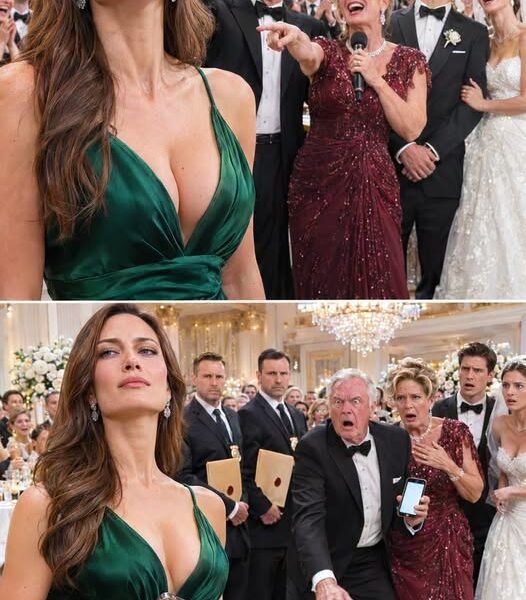
MY DIRECTOR WALKED INTO MY EMERGENCY
WING, SAW ALL FIFTY-SEVEN CRASH VICTIMS ALIVE, AND DEMANDED, “WHO SAVED THEM?” THEN MY YOUNGEST NURSE POINTED AT THE EXIT DOORS AND ANSWERED, “THE NURSE YOU SUSPENDED THIS MORNING…”
MY DIRECTOR WALKED INTO MY EMERGENCY WING, SAW ALL FIFTY-SEVEN CRASH VICTIMS ALIVE, AND
DEMANDED, “WHO SAVED THEM?” THEN MY YOUNGEST NURSE POINTED AT THE EXIT DOORS AND ANSWERED, “THE NURSE YOU SUSPENDED THIS MORNING…”
Dr. Ivor Falco suspended me in front of two nurses and a resident, on the main floor of the emergency department.
“You bypassed my order.”
“You went over my head to rapid response.”
“A system only works when people stay inside their roles.”
“It does not matter that the outcome was good.”
I stood there in my scrubs at the regional hospital in Toledo where I had worked for eleven years, and
I did not argue. The man in bay four was alive because I had gone over his head. His scans had shown nothing, his numbers had sat in a range the chart called acceptable, and Dr. Falco had written that we would reassess in forty minutes.
I had read that chart, then looked at the man. His color was leaving him slowly, almost politely, the
way I had seen it leave men in field tents overseas. His pulse had a small, wrong catch no monitor had flagged. I told Dr. Falco he was bleeding inside, and forty minutes would kill him.
“The scans show no bleeding.”
“The protocol exists for exactly this.”
“The decision is made.”
So I made mine. I called the rapid response team myself and had the man moved toward the operating room. The surgeons found active bleeding that would have taken him inside the hour. He lived. Dr. Falco was told while I was still outside those doors, and he did not come to find me
privately. He came where people could hear him, because the point was never the patient. The point was that a nurse had been right in a way that made his order look like what it was.
I handed over my badge before he asked for it. A security officer walked me through the lobby, and I carried a small cardboard box into the morning light. A coffee mug. A spare pen. One photograph, taped inside my locker for years, of my old unit overseas, all of us squinting into a desert noon.
Most of my colleagues never knew I had spent four years as a combat medic before I ever worked a civilian shift. I never offered it. Say it, and people stop hearing what you know and start hearing where you have been. I wanted to be judged on the work in front of me.
I set the box on the hood of my car and stood in the parking lot, not crying, not shaking, waiting for the noise in my head to quiet down. Then the sirens started. One, far off. Then many. A first
ambulance cut across the lot, then a second, then a third, then a military transport. On the drive in I had heard about a cargo plane down near the city. Watching them pour in, I did the math the way you learn to do it in a war.
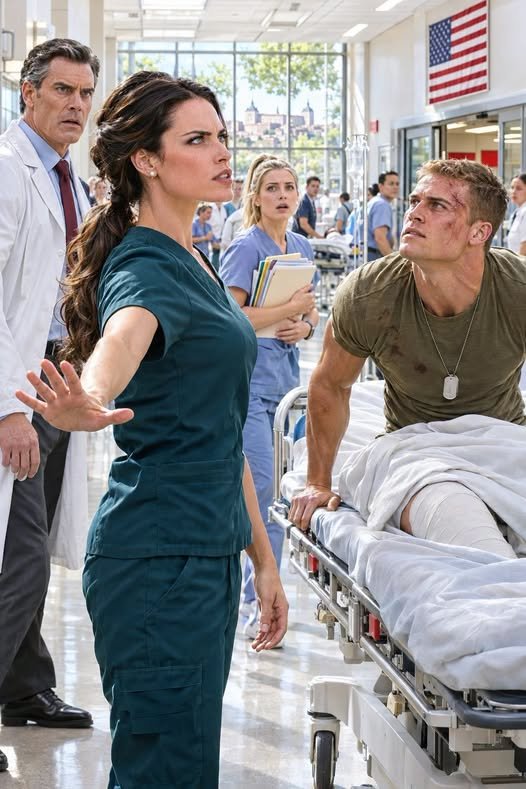
A young soldier burst out of the bay doors, blood soaked through one sleeve, scanning the lot. He saw my scrubs and ran at me.
“We need everyone.”
“It is bad in there.”
“People are going to die without more hands.”
He did not know I had been suspended an hour earlier. He only saw someone who looked like she knew what she was doing. I thought about what any face in that photograph would have done
standing where I stood. The people coming off those ambulances had done nothing to me.
I set the box beside my rear tire and walked back toward the entrance, not quite running. The security officer who had walked me out was working the ambulance bay now. He saw me coming and stepped aside without a word.
Inside, the department was already drowning. Gurneys lined both walls at bad angles. The floor by
the bay doors was wet. Monitors beeped from three directions, and under all of it I could hear the sound I track first in any crisis, the patients making no sound at all. A resident was taking patients in arrival order, the right instinct on a normal morning and the fastest way to lose people on this one. Against the far wall lay a man with gray skin and a chest that barely moved, unreached.
I went to him first, checked his pulse, pulled his jacket open, and found what was killing him. I turned to Cora Jessop, a young nurse from the morning shift, and gave her one clear order.
“He needs blood, and he needs it now.”
“He is in hemorrhagic shock.”
“The quieter he gets, the worse he is.”
She moved without questioning me. From that moment I stopped waiting for permission. I called the room low and exact. One patient straight to the operating room. One could hold fifteen minutes. The woman in bay two needed a needle for the air trapped around her lung first. The teenage boy by the
window was bleeding out slowly on a trend nobody had caught. A few staff hesitated, because word
had spread that I had no badge. I did not argue. I kept being right where everyone could see it, and after the third or fourth call, the hesitation dissolved.
Thirty minutes after I walked back in, Dr. Falco appeared at the entrance. He took in the gurneys, the wet floor, and me, standing in the center of it all, directing patients and staff. Something crossed his
face, then hardened. He started toward me.
He never reached me. Halfway down the hall, a young soldier on a gurney, helped along by two orderlies, a soaked bandage around his left leg, looked up and saw my face. His name was Phineas Tiller, twenty-two. Despite the two men holding his weight, he pulled himself as straight as his body allowed, and said my old rank and my name the way soldiers say the names of people who pulled
them back from somewhere they were never supposed to return from.
“Sergeant Bentley.”
The quiet moved down that hallway in a wave. Falco stopped.
Dr. Falco stood in that silence, and I watched him understand the room had shifted around him in a way his title could not fix. He did not come at me again. He did not leave, either. He moved to the side
of the hallway and started working the supply requests and the surgical suites upstairs, quietly, without announcing it. It was the smallest version of doing the right thing. The staff noticed. I did not look at him. I had a next patient.
The next hour was the hardest of the day. The first wave we survived because I had caught the department before it folded. The second wave found the weak points. A surgical suite running three
cases at once hit a bottleneck when two of them turned worse than expected. Supplies that should have been restocked an hour earlier were not there. A nurse lost critical minutes hunting a second defibrillator after the first one’s battery died.
Cora broke, and I saw it coming before she did. She had been holding herself together on will alone, standing beside a patient who needed a line restarted, a crash cart checked, and a family member
moved out of the room all at the same time. She started crying the sudden way people cry when the
body simply overrules the decision to keep going. I crossed to her in four steps. I did not touch her shoulder. I did not tell her it would be okay. I put myself in her line of sight and spoke in a tone that was not unkind and left no room at all.
“Bay six needs that line held.”
“You can fall apart when this is over.”
“I will sit with you while you do it.”
“Right now, bay six cannot wait.”
She took one ragged breath, nodded, and went to bay six. What I was doing in that room was bigger than any single patient. I was running a system past the limits it was built for, finding the failure
points before they turned catastrophic, spending hands and minutes and blood where they would keep the most people alive. None of that was in my job description. None of it came from a nursing program. Four years overseas had built it into me, and it was the only reason the department was still standing.
The last group came in late in the afternoon, five patients from the far end of the crash site, where
crews had taken longer to reach. Two of them narrowed everything down to one choice. The first was a young soldier with a chest injury so severe he could not breathe on his own. The second was a man in his late forties with a brain injury, losing consciousness in stages, each one harder to come back from than the last. There was one ventilator.
I stood between them with ninety seconds to decide. Protocols give you language. They do not make the call. I read both men the way the field had taught me to read, fast and honest, what each one needed and what each one could survive. I gave the ventilator to the soldier. I put the second man’s team on an alternative protocol that gave him a lower chance, but a real one. Nobody questioned me.
By then they had watched me make calls all day and be right, and that adds up to something no
badge can hand you. I would not know until later whether this call was right too. I moved to the next patient, because standing still was the one thing that room could not afford.
The last patient was stabilized at 6:47 that evening. I knew the exact time because I had been
watching the clock over bay three for the final twenty minutes. When the young soldier’s monitor held a steady rhythm for four full minutes, I stopped moving for the first time in nearly nine hours. I found a stretch of wall by the supply corridor and put my back against it. My scrubs were stiff where things had dried. A bruise I had never felt happening was blooming on my left forearm where a cart had caught me during the second wave. Around me the department settled into the quiet that
follows a sustained crisis. Cora sat on the floor near bay six with her knees pulled up, staring at nothing. Two residents sat with their elbows on their knees, not talking. All fifty-seven patients were alive.
Director Abram Norton arrived at 7:15. He had driven straight across town. He walked past the overflow rooms, past the family waiting room and its particular anguish, and through the double
doors into the hallway where it had all happened. He stopped just inside and looked at the dried floor, the gurneys, the staff who looked like people who had run much farther than they had trained for. Then he turned to the room and asked who had managed all of this. He was not asking for a report. He already knew something significant had happened. He needed the human answer first.
Nobody spoke for several seconds. The answer was simple, and saying it out loud meant naming everything that came with it. Cora lifted her head from the floor, looked straight at him, and said it in the flat tone of someone too exhausted for anything but the truth.
“It was Marla Bentley.”
“The nurse you suspended this morning.”
Director Norton crossed the department to my wall. He looked at the dried blood on my scrubs, the bruise on my arm, and my face, which was not triumphant and not bitter. Then he asked me the one question I had not expected.
“Why did you come back?”
I thought about the box by my tire, and the photograph, and the morning. Then I told him the truth, plain.
“The people in those ambulances did nothing to me.”
“What happened this morning was between me and this hospital.”
“It had nothing to do with them.”
“So I came back.”
“The rest of it can wait.”
He was quiet a moment. He looked at the floor between us, and then his expression shifted the way
it does in a man who has just heard something simple clarify something complicated. He had run a hospital for twenty years. He knew exactly what it costs when authority and competence live in different people, and he knew what it had nearly cost that day. He turned and looked down the hallway at Dr. Falco, standing by the nurses’ station in the stillness of a man with nothing prepared
left to say. Director Norton did not speak. The silence did the work. Dr. Falco looked down first. Every staff member who had watched him walk me out that morning saw it. Nobody said a word. Nobody needed to.
Later that night, after the transfers were managed and the families notified, Director Norton found
me by the locker room. He told me the suspension was lifted, effective immediately. He told me a formal review was being opened, not into my conduct, but into how this department weighed the judgment of its most experienced nurses, and what that morning said about where that process had failed. He said it plainly, without dressing it up. I thanked him, and I told him the lifted suspension
was not the part that mattered to me. I had known that morning I was right, and being right had never needed this building to confirm it. What mattered was what changed from here.
The review that followed was not comfortable for anyone. Dr. Falco kept his position, but he lost something harder to recover, the automatic deference of the people around him. The review found a
pattern of experienced nurses raising concerns and being waved off without real engagement, and the administration could not treat it as a string of isolated moments. New protocols were written. They were imperfect, the way all protocols are, and better than what had stood before.
Dr. Falco did not apologize in those first weeks. Months later, in a short hallway conversation neither
of us had planned, he told me he had gone back and reviewed the bay four case from that morning, and that he understood now what I had seen and why I had acted. He did not call it an apology. He called it a statement of fact, which was probably the most honest accountability he had in him. I accepted it for exactly what it was. I had stopped needing it to be more a long time before he offered
it.
The morning after the crash, before any review or protocol had a name, I walked out to the parking lot and found my cardboard box still sitting beside my rear tire, undisturbed, the photograph of my old unit on top. I carried it back through the lobby and down the hall to the locker room, where Cora was waiting with my badge. She held it out in both hands and said nothing at all. I took it the same
way. No ceremony. No speech. I clipped it to my scrubs and walked back out into the department, where the morning shift was arriving, the night staff was giving handoff at the nurses’ station, and somewhere down the hall a family was hearing news that would change the rest of their lives. The department was running the way it always ran, imperfectly and necessarily, and I was in it. Not as a
symbol. Not as a lesson. Just as a nurse who had shown up, the same way I had shown up every morning for eleven years, ready to do the work for whoever needed it done.