“We need your lake house for the 4th of July weekend, Margaret. All four bedrooms. My parents are flying in from Scottsdale.”
Tiffany said it to her phone, not to me. She stood at my kitchen island in white linen pants, holding an iced latte she’d picked up in town. The coffee I’d brewed for her at 8 that morning apparently hadn’t made the cut.
My son Brian was studying the walleye Dennis had mounted over the pantry door as if it might swim down off the wall and rescue him. I kept wiping the same 8 inches of counter.
“I’m sorry?”
“There will be 18 of us counting the kids.” She finally looked up. “Mom says you can just book a hotel in town for the weekend. It’s the Fourth, Margaret. It’s not like you’ve got anywhere to be.”
I looked at Brian. He suddenly found the cup hooks by the window fascinating, the ones his father screwed into the beam in 1997. That was my son’s whole personality when things got uncomfortable:
present in body, elsewhere in spirit.
“Tiffany,” I said, “you and Brian have a four-bedroom house in Grand Rapids. Why not have your parents there?”
“Because it’s not the lake.” She said it slowly, the way you explain something to a toddler. “They want the lake. Rooms on the water run $400 a night over the Fourth, which is exactly why she said we’re using yours.”
I let that sit in the air between us for a moment. Then I said, very evenly, “I won’t be here that weekend.”
Tiffany smiled. It wasn’t a warm smile. It was the smile of a woman who has just been told the table by the window is available.
“Perfect,” she said. “Even easier.”
She didn’t ask where I’d be. She didn’t ask whether I minded strangers sleeping in my bed, using my
towels, and cooking in the kitchen where I’d made my children’s birthday cakes.
I was 67 years old, a widow with a lot of square footage, and she had decided I came with no backbone to match.
So, I didn’t argue.
Five years of Tiffany had taught me that arguing with her was like bailing a rowboat with a teacup. You worked hard, you got tired, and the water stayed exactly where it was.
I nodded and poured myself the last of the coffee.
They gathered their jackets and headed out to lunch at the place on the bay, and the house went quiet, the way a lake does when the wind drops.
I stood in the kitchen for a long time. Then I wanted my mother’s coffee cake recipe. No particular reason. I just wanted something that was mine in my hands.
I reached for the blue Danish cookie tin where my recipe cards have lived since 1983. And I noticed the
lid was on crooked.
I lifted it. Between pot roast Sundays and pumpkin bread, Mom’s, there was a gap.
Dennis had written an index card in his careful engineer’s block letters the winter after we put the new
keypad on the garage.
It had the code. It had the code for the mudroom door. It had the Wi-Fi password because he never trusted me to remember it.
I’d tucked it in the tin years ago for safekeeping, where no burglar would think to look, because who goes through someone’s mother’s recipes?
Someone who had spent 20 minutes alone in my kitchen that morning while I carried recycling out to the garage and Brian was in the driveway on a phone call.
I didn’t cry. I didn’t shout.
What I felt was a cold, clean clarity, like stepping into Lake Michigan in October. It hurts for a second,
and then everything is very, very sharp.
Tiffany hadn’t only demanded my house.
She had taken my way in quietly, betting I wouldn’t notice. And if I did, she was betting I wouldn’t dare mention it.
Why wouldn’t she bet that? I’d given her every reason.
I paid for half of their rehearsal dinner. I let her repaint my guest room a color she called coastal gray because she said white was dated. I drove two and a half hours to feed her cat for a week when they
went to Cancun.
Somewhere along the way, I had become the staff at my own house. And Tiffany had simply promoted
herself to management.
But a card out of a recipe tin isn’t rudeness. That’s entry.
What Tiffany and Brian didn’t know was that I wasn’t going away for a weekend.
I was going away for good.
For nearly a year, I had been doing sums at this same kitchen table. People hear “lake house” and picture a fortune.
What I had was a pension from 38 years of nursing at Mson Medical Center, my Social Security, and a roof estimate for $31,000 that had been stuck to my refrigerator since March.
My property taxes had crept toward $12,000 a year. The dock needed to be rebuilt. The furnace ate
money like a teenage boy.
I loved that house.
Dennis and I built it on Pineel Bluff Road in 1996 out of one nurse’s salary, one carpenter’s wages, and more pancake dinners than I care to count.
But it had become a beautiful, expensive anchor, and I was too tired to keep dragging it.
I couldn’t bring myself to sell it. Not yet.
So, on the 8th of May, I had signed a 12-month lease with a young emergency room physician named Anna Delgado, her husband Marcus, and their two children.
Anna was starting at Mson on July 1st.
Dr. Delgado had walked through my sunroom in April, stood very still, and said, “Oh, this is where I’m
going to drink my coffee for the rest of my life.”
And I knew right then.
The rent would cover my taxes, my insurance, and most of a two-bedroom condo I’d found in Traverse City with a balcony facing the bay.
I’d close on it on the 12th of June. I planned to move out in the last days of the month.
I had meant to tell Brian after the holiday, once things calmed down at his work. I’d wanted to spare him.
Sparing people was a habit I was about to break.
That night, I called Anna.
I told her everything: the demand, the card, the whole ugly business. I wanted her to hear it from me
before it could ever land on her doorstep.
She was quiet for a few seconds. Then she said, “Margaret, I work nights in an emergency room. A crowd showing up unannounced is a Tuesday.”
I laughed so hard I had to sit down.
And then she asked, “What do you want to do?”
I told her what I was thinking.
I told her I wouldn’t do it unless she and Marcus were completely comfortable, unless the kids were safe,
unless every step was documented and legal.
She asked me to run it by my lawyer first. I told her that had been my plan.
The Monday after that Sunday, I sat in the office of my attorney, Dolores Penn, who has handled my affairs since Dennis died, and who has never once raised her voice or lowered her standards.
I told her about the card.
She asked what I wanted.
I said I wanted it documented before anything else.
She wrote a letter that afternoon. It was two paragraphs long, and it was a masterpiece of calm.
It stated that a card containing access codes to my property had been removed from my home without my consent, that Tiffany Hollis had no permission to enter the property, and that any entry would be treated as trespass.
She sent it by certified mail to Brian and Tiffany’s address.
It was delivered on the 22nd of May, and the little green return card came back signed with a loopy “T. Hollis” that I’d know anywhere.
I also called the non-emergency line at the Lelina County Sheriff’s Office and filed a simple report.
A deputy named Hanley took it down, patient as a fence post.
Nobody was arrested. And that wasn’t the point.
The point was that there was now a file number written at the top of a page in my handwriting, and a record that I’d said no in every way a person can say it.
And I said it more gently, too.
Two days after the letter, I texted Tiffany.
I told her the house would be occupied by tenants that weekend and asked her to make other arrangements.
She read it at 9:12 that evening. I know because the little word “Read” showed up under my message.
She wrote back, “We’ll figure it out. Mom already bought flights.”
On the 14th of June, she texted again as if the letter and my earlier message had never happened.
“Need the house clear by noon on Thursday the 2nd. Did you book your hotel yet?”
I wrote, “I’m not booking a hotel. The house is rented. Please read my letter.”
She didn’t answer.
I took two screenshots of that exchange. I did not yet know what I’d do with them.
Now, my friends, I’ll tell you something I’m not entirely proud of.
I did not have the keypad code changed.
I could have. A locksmith would have done it in 20 minutes.
Instead, I left it exactly as it was, and I asked Anna’s permission to do so.
Dolores had listened to my reasoning, taken off her glasses, and said, “Margaret, you’ve given her a letter, a text, and a phone call’s worth of off-ramps. What she does next is her own decision.”
I wanted to see whether Tiffany would walk past three stop signs.
I wanted to know who she was when she believed nobody was keeping score.
The deputy agreed to have a cruiser on M22 that afternoon, just in case.
Anna and Marcus agreed to keep the kids at the kitchen table and the lights on.
If one single person in that crowd raised a voice in anger, I told them the plan was over and the deputy
would handle it.
I have been a nurse a very long time. I know what a bad situation looks like.
This was not going to be one.
It was going to be a lesson.
Over the next several evenings, I made a series of phone calls, 11 of them, to every inn, motel, and bed
and breakfast within 40 miles of my house.
I sat at the kitchen table with a legal pad and wrote down every answer.
Nine were full for the Fourth. One had two rooms left at $512 a night.
And the Pinehore Motorcourt, 12 miles up M22, had exactly two rooms on the backside near the ice machine, for $98 a night.
I booked both of them for Thursday through Sunday.
I paid in full, and I put the reservation in the name Voss so the clerk would be expecting Tiffany’s parents.
Tiffany’s mother and father had done nothing wrong.
They were 68 and 70. They’d bought plane tickets in good faith, and I wasn’t about to let that be wasted.
If their daughter had put them in a bad spot, they would at least have a clean bed and a door that locked.
Then I went to Mayor and bought a laminator.
The woman at the register, who was about my age, looked at the box and then at me.
“Big project?”
“Three weeks,” I said. “I have three weeks, a laminator, and a very strong opinion.”
She laughed and said she wished she had one of those.
I also bought a three-inch binder in bright yellow, a pack of tab dividers, a ream of heavy paper, and a fat
black marker.
I lined it all up on my kitchen island next to my mother’s recipe tin and got to work.
I’m not going to tell you what was in the binder yet. You’ll see it the way Tiffany did.
Brian called twice in those weeks. Both times to complain about his work schedule. Both times I listened.
Neither time did he ask what I was planning for the holiday. And neither time did he mention the letter that had arrived at his door.
I kept my answers brief and pleasant because I was busy.
I had a house to empty.
The movers came on the 26th of June.
A big white truck backed up my driveway. And for two days, I watched 41 years of my life get wrapped in
gray blankets and carried out the door.
The sofa, the cherry dining table Dennis refinished himself, my mother’s cedar chest, the bed, the books, the lamps, the little mallard decoys from the mantel.
Each piece went out the front door and onto the truck, and a part of me went with it.
And then, on the evening of the 29th, I was alone in the house.
Nothing in the rooms but the echoes and the late light slanting across the bare floors.
I walked through it one last time with a cup of tea, touching doorframes.
In the pantry, I stopped.
On the inside of the doorframe, in faded pencil, were the height marks.
Dennis made them every August 1st for Brian, starting when Brian was three.
There was a tall one at the top.
The summer he turned 17 and stood taller than his father for the first time.
Dennis had written beside it in that careful block print, “Too tall. Stop growing.”
Underneath the last mark was the date, three years before the heart attack.
I stood there until the tea went cold.
I photographed every line. I wasn’t leaving him behind in that house.
I told myself I was taking him with me, one picture at a time.
And I had asked Anna when we signed whether she’d mind leaving the pantry frame unpainted.
She hadn’t minded at all.
“Of course,” she’d said. “That’s family.”
It was strange.
The woman I’d hardly known understood the weight of a pencil mark better than the daughter-in-law I’d
known for five years.
I left the heat running. I put a fresh roll of toilet paper in every bathroom because I’m not a monster.
I set the big yellow binder on the kitchen island, squared up to the edge, and I wrote on its cover in block capitals, “Welcome Tiffany’s guests.”
Anna had said she’d leave it right there until Thursday.
Then I locked the door behind me and drove 30 miles to my new life.
The morning of July 2nd, I was sitting on my balcony in Traverse City with a cup of Earl Grey and a
blanket on my knees, though it was 78 degrees.
I’d always wanted a balcony.
The bay lay flat and blue beyond the rooftops, and somewhere below, a kid was practicing a trumpet
badly.
I felt strangely calm.
I felt like a woman waiting for a pot to boil, knowing it would and knowing she had nothing left to do but listen.
At 3:07 in the afternoon, my phone buzzed.
A FaceTime request from Anna.
I answered.
All I could see at first was a wedge of ceiling and the top of a refrigerator.
Then Anna’s face slid into view upside down, and she whispered, “They’re here. Four vehicles and a
pickup hauling a boat.”
She was grinning.
“I’m propping you against the fruit bowl. I can see everything from here, and you’ll hear everything. Don’t say anything. Just enjoy it.”
“I’m not sure I’m going to enjoy it,” I said.
“Margaret,” she said, “you’re going to enjoy it a little.”
She set the phone against the fruit bowl.
Over the speaker, I heard a sound I knew in my bones.
The rumble of the garage door rolling up.
Dennis installed that door in 1998. I’d know its groan anywhere.
The old code had worked.
Of course it had. I’d left it that way.
Through the phone, I watched Anna move to the stove, where something with garlic and cumin was already sizzling.
Marcus was slicing limes at the counter.
Their nine-year-old daughter, Sophia, and six-year-old son, Mateo, sat at the kitchen table, bent over a
jigsaw puzzle of a lighthouse.
It was the most peaceful domestic scene you could imagine.
And then the mudroom door banged open.
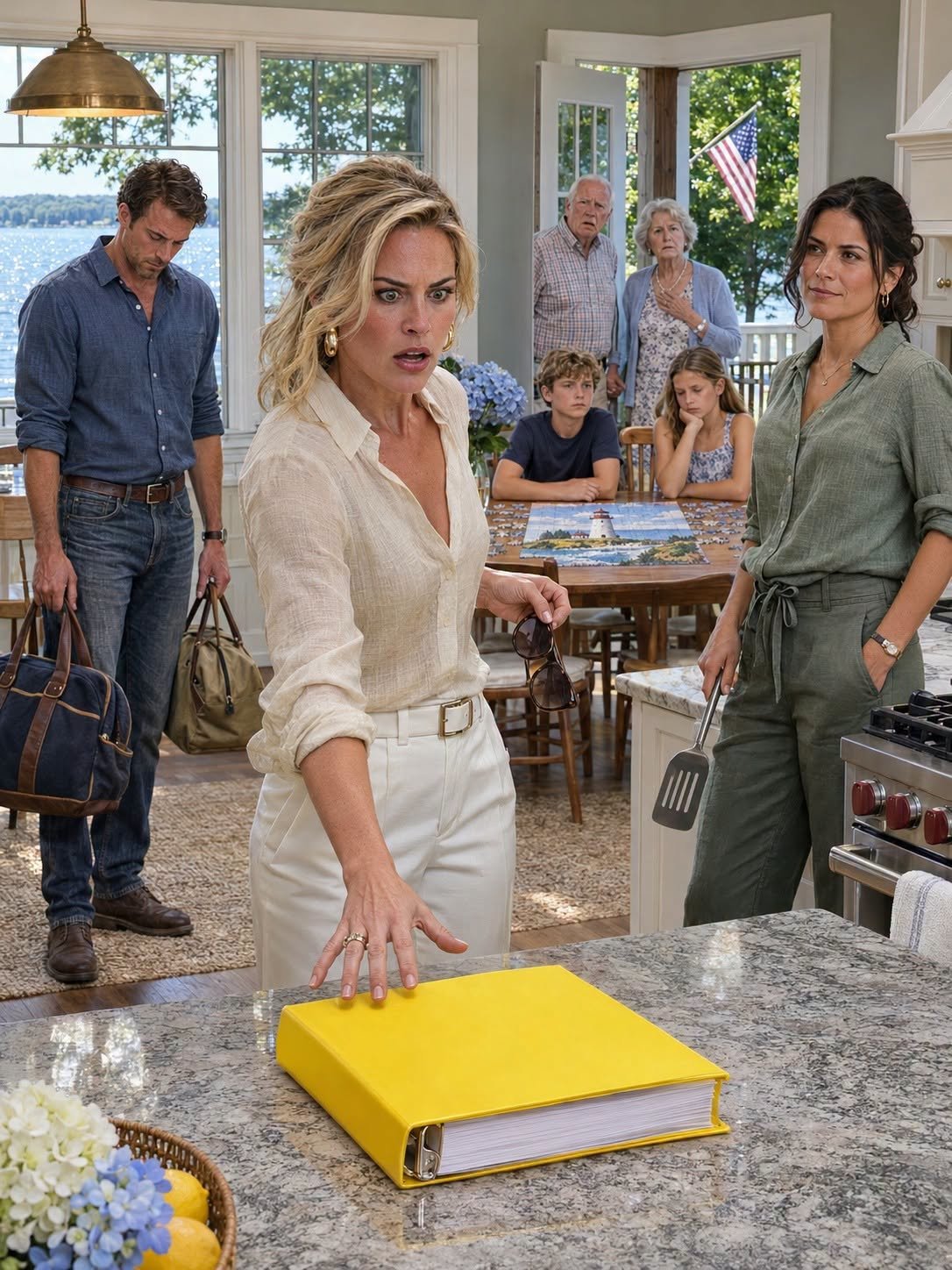
Tiffany came through it like a woman arriving at her own surprise party, in white linen and big sunglasses, with a tote bag over one shoulder.
“Okay, everybody, shoes off, but don’t worry about the floors. I’ll show you.”
She stopped.
The room smelled of garlic.
A little boy looked up from a puzzle.
“Mama,” Mateo said perfectly clearly. “There’s a lady in our kitchen.”
Tiffany took her sunglasses off.
“Who are you?”
Anna turned from the stove, spatula in hand, and said in the pleasant voice I imagine she uses on
frightened patients, “Hi there, I’m Anna. Can I help you with something?”
“This is my husband’s family’s house.” Tiffany’s voice climbed. “Where is Margaret? Where’s her furniture? Whose couch is that?”
“That’s ours,” Anna said. “The navy one.”
Behind Tiffany, the others began to crowd into the mudroom.
Her father, Gary, tall and stooped, a retired insurance adjuster who has read the fine print on every
document of his life.
Her mother Linda in a floppy straw hat.
Tiffany’s sister Courtney with two kids by the hand.
Uncle Ray in a fishing cap.
A string of cousins I’d never met.
And at the back, Brian carrying two duffel bags and looking like a man walking into his own surgery.
“I’m Dr. Anna Delgado,” Anna said. “My family and I signed a 12-month lease on this house on the 8th of
May. We moved in the 1st of July. I’m happy to show you the paperwork.”
“That’s not possible,” said Tiffany. “Margaret would have told us.”
“She did,” said Anna, and gestured with the spatula toward the island. “She also left something for you. It
has your name on it.”
Every head turned.
There it sat, bright yellow, three inches thick, squared to the edge of my old granite.
“Welcome Tiffany’s guests.”
I watched Tiffany stare at it.
Then she gave a short, sharp laugh and flipped the cover open.
And the whole room leaned in.
The first page was laminated.
It said in my block capitals:
“Welcome. This is a private residence. The people who live here are the Delgado family. They are making
dinner. Please do not touch it.”
A cousin snorted.
Tiffany didn’t.
She turned the page.
The second was a copy of the first page of the lease. Names, dates, the signatures, the notary stamp, the words “Term: July 1st through June 30th.”
Her thumb came down hard on the corner.
The third tab, I’d put a copy of Dolores’s letter on the left and, on the right, a photocopy of the little
green return card with the signature in her loopy hand and the date, May 22.
Gary leaned over her shoulder and read the letter’s two paragraphs in silence.
His lips moved on the word “trespass.”
Then he turned his head slowly and looked at his daughter.
“Tiff,” he said. “Did you sign this?”
“Dad, it’s just paperwork. It’s a misunderstanding.”
“Did you sign this?”
She didn’t answer.
In the whole kitchen, nobody breathed.
Gary took the binder out of her hands.
And that, my friends, is when the show truly began.
Because the man read the rest aloud, one page at a time, in that dry, careful voice of his.
“Tab four. Lodging within 40 miles of Sutton’s Bay, July 2nd through 5th. Called June 17th through 20th.”
He turned the page.
“There are 11 places listed. Nine are marked full. One has two rooms at $512 a night.”
His eyebrows climbed.
“And one, the Pinehore Motorcourt, has two rooms at $98.”
“Dad!”
“Reservation confirmed,” he read. “Rooms six and seven, Thursday through Sunday, under the name
Voss, paid in full.”
He lowered the binder an inch.
He looked at his wife.
Linda, under the floppy hat, had gone pink around the eyes.
“The last page,” Gary said, “is a note.”
He cleared his throat.
“Tiffany, you said I could just book a hotel. I did. I booked two rooms for your mother and father because they did nothing wrong and their trip shouldn’t be wasted. Everyone else, I’m told the state park campground sometimes has openings. I wouldn’t count on it. Happy Fourth, Margaret.”
Somebody at the back started to laugh and quickly turned it into a cough.
Ray, I think.
Courtney’s two children stared up at their mother and asked in clear, small voices whether they were
going to a campground.
And Tiffany stood there, her face going a slow, ugly red from the collar of her expensive linen blouse up to her roots.
Then she noticed the phone leaning against the fruit bowl and the face in it.
“Is that her?” she said.
“She’s been on the line since you pulled in,” said Anna calmly. “She’s watching.”
Tiffany crossed the kitchen in three strides and snatched the phone up in both hands.
Her face filled my entire screen, close enough that I could see the mascara starting to run.
“Margaret!”
The whole kitchen rang with it.
“What is this? Where are your things? Who are these people?”
“They’re the Delgado family,” I said. “They live there.”
“You leased the house out from under us?”
“Out from under no one, Tiffany. It was mine to lease.”
“We have 18 people here! My parents flew in from Arizona! Where are we supposed to sleep?”
“I booked a room for your parents. You heard your father read it. It’s 12 miles away, and it’s a motel with an ice machine.”
“It’s a very clean motel,” I said. “I called ahead and asked.”
“You told us we could use the house!”
“No,” I said, as gently as I’ve ever said anything. “You told me you were using the house. I told you I
wouldn’t be here. Then you took a card out of my mother’s recipe tin.”
Her face did something complicated.
“I don’t know what you’re talking about.”
And then my son spoke.
“Tiff.”
Brian had set down both duffel bags.
He was standing very still in the doorway of the mudroom, and his voice was not loud, but it carried
across that kitchen like a dropped plate.
“I saw you, Brian. I saw you take it. I was in the driveway, and I looked back through the window. I saw
you slide it into your purse.”
He swallowed.
“I told myself it was nothing.”
Nobody moved.
Tiffany’s mouth opened and closed.
“Mom,” he said to the phone.
And Tiffany, who had gone suddenly limp, let him take it.
His face came into the frame.
My boy, 38 years old, with Dennis’s jaw and Dennis’s stubbornness buried somewhere under all that learned silence.
“I’m so sorry. I’ll call you tonight. I’m going to get everybody out of Dr. Delgado’s kitchen first.”
“Thank you,” I said. “And Brian, please thank Anna for me, too.”
“Mom.”
“Yes, sweetheart?”
“I’m going to fix this.”
His voice cracked.
“Not the way I’ve been fixing things. The real way.”
I told him I’d be here.
Anna told me later what happened next.
She’d put down the spatula and said to the whole crowd of 18 strangers in her new kitchen, “I’m going to ask you all to step outside now. I’m not angry. I’m hungry. My kids want to eat dinner.”
And they did.
They shuffled out one by one, still blinking, past the bass boat and the SUVs and the Delgado family’s
two bicycles on the lawn.
And Anna closed the door behind them and made the sign of the cross at the stove, which I’m told she doesn’t ordinarily do.
I set my phone down on the balcony table.
A gull landed on the railing and looked at me with great skepticism.
I drank my tea.
Not 10 minutes later, my phone began buzzing against the glass.
The family group chat, the one called “Voss Hollis Fourth of July,” which Tiffany had added me to in April with a little firework emoji, had lit up like a Christmas tree.
Courtney had written an angry paragraph about elder cruelty, though I could not figure out which elder
she meant.
A cousin I’d never met called me unbelievably petty.
Someone else wrote in all capital letters that I’d ruined the holiday.
I did not argue.
I opened my photos and picked the two screenshots.
The first was Tiffany’s text from the 14th of June.
“Need the house clear by noon on Thursday the 2nd. Did you book your hotel yet?”
The second was my answer.
“I’m not booking a hotel. The house is rented. Please read my letter.”
I posted them side by side with one sentence.
“I told Tiffany three separate times in writing that this house was occupied. I’ve arranged lodging for her
parents. The rest is her responsibility.”
The chat went silent for a full five minutes.
Then Uncle Ray, who I later learned drove a school bus for 31 years and had never much cared for being
told what to do by anyone’s daughter-in-law, typed:
“Margaret, I think you’ve been more than fair. Eighteen people, and not one of us confirmed a bed. That’s on us, Tiff.”
Tiffany left the group a minute later.
I put my phone on silent, poured a small glass of Leela Riesling, and sat on that balcony as the bay turned gold and then pink and then the deep blue of evening.
For the first time in years, I felt no weight of anyone else’s demands on my chest.
The air was very light.
A trumpet somewhere down the block played a few wobbly notes of taps, which I decided to take as an
omen of something.
But my friends, that wasn’t the end.
There’s a part that happened away from the cameras, and a few of you will want to know what became
of the card and the woman who took it.
That same night at 10:09, my phone rang.
A number I didn’t know, an Arizona area code.
I almost let it go.
“Margaret, it’s Gary Voss.”
I said nothing.
“I wanted to apologize.”
His voice was low and tired, and I could hear a television somewhere behind him, a motel TV with that thin, flat sound.
“Tiffany told Linda and me that you’d invited us. She said you were thrilled to have the family. She said the lake house was practically hers and Brian’s, that you were just keeping an eye on it for them. We flew out on that understanding.”
“I’m sorry your trip went this way, Gary.”
“We should have called you ourselves. That’s on us, too.”
He paused.
“I read that letter at the island, Margaret. The date on it was more than a month before our flight. She sat on it the whole time, and she let her mother and me get on an airplane.”
I said I was sorry for his disappointment, and I meant it.
“The others have scattered,” he said. “Courtney’s crew drove back to Grand Rapids around nine. Ray is
sleeping in the cab of his truck. Eleven of them split four rooms at a place in Cadillac, 45 minutes south, and I’m told the bill was something to see.”
“I’m going to see to it that my daughter pays every cent of what those rooms cost.”
“You don’t need to do that.”
“I do.”
He cleared his throat.
“Margaret, Linda is sitting right here. She says to tell you the bed at the Pinehore is the best one she slept in all year. Quiet, clean, no 18 people over the line.”
I heard a woman’s voice, muffled, say something that made him almost laugh.
“She’d also like me to tell you thank you, but she’d rather Tiffany not know she said so.”
I laughed.
It was a real laugh, the first one that week.
“Tell her she’s welcome.”
“And the room money,” he said. “I’m sending you a check for both rooms.”
“There’s no need.”
“There is every need,” said Gary Voss.
And I understood where Tiffany’s stubbornness came from, though not where she’d lost her honesty.
Saturday morning, the 4th of July, at 9:00, there was a knock at my door.
I looked through the peephole.
Brian, alone, with a bag from Mater in one hand and a flat pink box in the other.
How had he found me?
A fair question.
After Anna’s FaceTime, after the chat, I’d sat on the balcony for an hour wondering whether I wanted my
son in my life.
I decided I did.
Just not through his wife’s phone and not on her terms.
So, I texted him my address with one line.
“If you want to talk, come by yourself.”
I opened the door.
“Hi, Mom.”
“Hello, sweetheart.”
He stood in my entryway, a little stooped, as if the doorframe had grown lower.
“I brought strawberries and a cherry pie. It’s from the place on Front Street.”
He held out the pink box like a peace offering and then looked embarrassed that he’d said it that way.
“I didn’t know what else to bring.”
“Come in.”
He set the bag on my counter and looked around at the room.
The bright walls, the little balcony, the bay beyond.
“This is nice,” he said, and he sounded honestly surprised.
“Thank you. Coffee?”
“Yes, please.”
He sat down at the little table and didn’t take his jacket off.
I poured two cups.
The air between us felt like the air in a hospital waiting room, hushed and heavy and full of things unsaid.
“I saw her take the card,” he said finally, to the table. “It’s not a thing I can put a pretty ribbon on, Mom. I stood in your driveway, and I looked back through the kitchen window, and I saw my wife slide your recipe card into her purse.”
“I knew exactly what it was, and I told myself it was nothing because telling myself it was something
would have meant I had to do something about it.”
I put my cup down.
“That is the hardest sentence anyone said to me in five years.”
“It’s true, though.”
He rubbed his face with both hands.
“I stand there. I’ve always stood there. Dad used to say I had the gift of being furniture.”
He tried to smile and didn’t quite manage it.
“You said at the end of the call yesterday that you’d be here. I thought about that all night. You’ve always been here. I’m the one who wasn’t.”
“You were hiding, Brian. And I let you because it was easier than being angry.”
“I know what happens now.”
He took a breath.
“Tiffany and I are going to talk to someone. A counselor. I already called this morning, and the woman said she could see us on the 16th.”
He looked up.
“And I’m paying Gary and Linda back, and the people in Cadillac. All of it. It’s going to take a while, but I’ll do it.”
“And Mom, I told Tiffany last night in the motel parking lot that I’m not going to cover for her anymore.
Not with you. Not with anyone.”
I sat there with my coffee going cold.
My son has his father’s hands, strong and square, and they were shaking just a little.
“I’m not asking you to forgive her,” he said. “I’m not even asking you to forgive me yet. I just wanted you to know I’m not hiding anymore.”
I reached across the table and covered his hand with mine.
“I love you,” I said. “You’re my son, but I’m not your safety net, and I’m not a free hotel, and I’m not something to be used and put back in the drawer.”
“I know.”
“Stay and eat some pie.”
He stayed.
We ate cherry pie at 9:30 in the morning, which Dennis would have called a crime, and then asked for seconds.
And when Brian left around noon, he went down the hall with his shoulders a little squarer than when he
came.
I locked the door behind him, and I felt no guilt.
None of that old clammy worry that used to follow every disagreement.
I simply felt light.
What happened with Tiffany surprised even me.
Dolores called me at the start of the following week.
Gary had contacted her office and asked very formally whether a meeting could be arranged where his daughter might return the property she’d taken and say what she had to say.
Dolores asked whether I’d be willing.
I said yes on one condition.
It would be held in Dolores’s conference room, on neutral ground, with a lawyer present.
I wasn’t going to receive anybody in my home.
It was the 20th of July.
I wore my good navy blazer.
The conference room smelled like lemon polish and old coffee.
And the long walnut table had a box of tissues in the center, the way every lawyer’s table does.
Gary and Linda sat on one side in matching gray cardigans.
Brian sat beside them, hands folded.
Tiffany sat at the very end in a plain black dress.
No linen, no latte, no sunglasses.
She looked like a woman who hadn’t slept properly in three weeks.
Dolores sat at the head of the table with a legal pad and an expression of perfect neutrality.
Gary cleared his throat.
“Tiff.”
She didn’t look up.
“Tiffany,” Gary said again.
And it was only her name, said the way a father says it when the whole sentence is in the tone.
She reached into her handbag and took out a small rectangular card, slightly bent at one corner.
She slid it across the walnut.
I picked it up.
Dennis’s handwriting, his careful block capitals, and under them, in blue ink, a faint ring from someone’s coffee cup.
“This is yours,” she said to the table.
“Thank you for returning it.”
I kept my voice steady.
“The Delgado family changed the code the morning after the Fourth. It doesn’t open anything anymore.”
“Margaret,” said Linda very quietly.
Tiffany swallowed.
“I shouldn’t have taken it.”
She was gripping her own wrist with the other hand.
“I shouldn’t have told my parents you’d offered the house. And I shouldn’t have…”
She stopped, and I watched her reach for the old excuse.
The way a drowning person reaches for the nearest thing that floats.
“I just thought with the place being so big and you being alone…”
“Tiffany,” Gary said.
Only that.
She closed her mouth.
Silence stretched over the walnut.
Then something in her face gave way, and I could see it happen.
The long, slow collapse of someone who has been holding up a wall for a very long time.
“Brian’s hours got cut in March,” she said in a different voice.
Much smaller.
“We’re two months behind on the mortgage. I didn’t tell you, Mom. I didn’t tell anybody. I’d already told everyone about the Fourth, and I couldn’t stand for it to look small. I’ve spent three years making it look like we’re doing better than we are.”
Her eyes filled.
“I told you it was ours because I wanted it to be. I wanted something that looked like having made it. And I knew if I asked, you’d say no. So, I stopped asking.”
Nobody in the room said anything.
I want to be honest with you, my friends, about what I felt.
I did not feel triumph.
I’d spent three weeks imagining that moment.
The look on her face, the apology, the satisfaction of it all.
What I actually felt was an old, tired sorrow.
The kind I used to feel at bedsides when a patient finally told the truth after weeks of insisting they were fine.
“Tiffany,” I said, “I understand shame. I’ve had my own, and I understand how easy it is to fall in love with
a story about yourself, a story where you’re doing better than you are.”
“But a hard place is not an excuse to walk into someone else’s home.”
“If you’d come to me and said, ‘Margaret, we’re in trouble. I’m embarrassed. I don’t know what to do,’ I
would have sat down with you at my kitchen table.”
“I’d have given you my coffee and my time. I might even have helped. I’d have asked first, and I’d have listened.”
She wiped her face.
“I know.”
“But you won’t be coming to my home,” I said. “And you won’t be calling me. Not for a while.”
“If Brian wants to see me, he knows where I live. And if you ever want to ask me for something, you’ll ask out loud to my face, and you’ll be ready to hear no.”
Her gaze flicked to Brian, hoping he’d object.
He sat there with his hands folded and said in a steady voice, “I think that’s fair.”
Gary slid a check across the table to Dolores, who passed it to me.
It was for the full amount of both rooms at the Pinehore, with a few extra dollars for interest, written in his careful handwriting.
“And the others?” Linda asked quietly.
“Tiffany’s taking care of those,” said Gary. “Out of the money we’d planned to give them for their anniversary. They’ll have to wait on the anniversary trip.”
He looked at his daughter.
“We’ll see you at Thanksgiving, honey, once you’ve had time to learn what asking looks like.”
Linda touched my sleeve as we stood.
“That bed at the Pinehore was lovely, dear,” she murmured.
And I almost cried because it was the kindest thing anyone had said to me in weeks.
They filed out.
Brian lingered at the door, looking at me with an expression I hadn’t seen on his face since he was 12.
“Sunday,” he said. “I’ll call you Sunday.”
Sunday that week, I deposited Gary’s check and wrote a check for the same amount to the nursing scholarship fund at the community college.
I attached a note.
I’d always thought a girl who wants to be a nurse should get a little help getting started.
Brian calls every Sunday now, right after church, the way he did before he got married.
Some Saturdays, he drives up alone, and we walk the path along the bay, past the sailboats and the ice cream stands and the old lighthouse.
And we talk about things we never talked about before: his father, his marriage, whether he’s brave enough to be honest with the people he loves.
He and Tiffany have seen the counselor 11 times so far.
I’m told they’ve sold her car and that Brian took a second job on weekends.
I’m told Tiffany has been the first to apologize to relatives, sometimes in writing, sometimes in person.
I don’t know if it’ll hold.
I’m not the one who has to know.
Tiffany and I haven’t spoken since that conference room.
I don’t miss it.
I’m told she booked a cabin of her own over Labor Day. A modest little one with two bedrooms, and paid for it herself.
Her parents came.
Linda sent me a postcard of the cabin.
On the back, in a careful hand, she’d written, “Quiet, clean. Thank you.”
The house on Pineluff Road belongs, for now, to a young doctor and her family.
Anna sent me a photo last month of Sophia and Mateo on the dock in their life jackets, grinning, and
one more photo of the pantry doorframe with a new pencil mark beside Brian’s tall one.
“Mateo,” it said. “Age six.”
I printed it and stuck it to my refrigerator right where the roof estimate used to be.
I’ve joined a book club in Traverse City.
I’ve painted my little kitchen a soft, warm yellow.
And on a hook inside my own front door, I’ve hung a brand-new key.
Here’s what I’ve learned, my friends.
At 67 years old, after a lifetime of saying yes, generosity without a door is just a hallway, and everyone
gets to walk through.
A kind heart isn’t the same as an open house.
You can love people and still say no to them.
You can let them stand in the driveway and learn what a no sounds like.
And then, if they truly change, you can open the door.
But it has to be opened by you, at the time you choose, for the person who earned it.
I poured another cup of tea tonight and sat out on the balcony as the last light slid down into the bay.
At last, I was home.