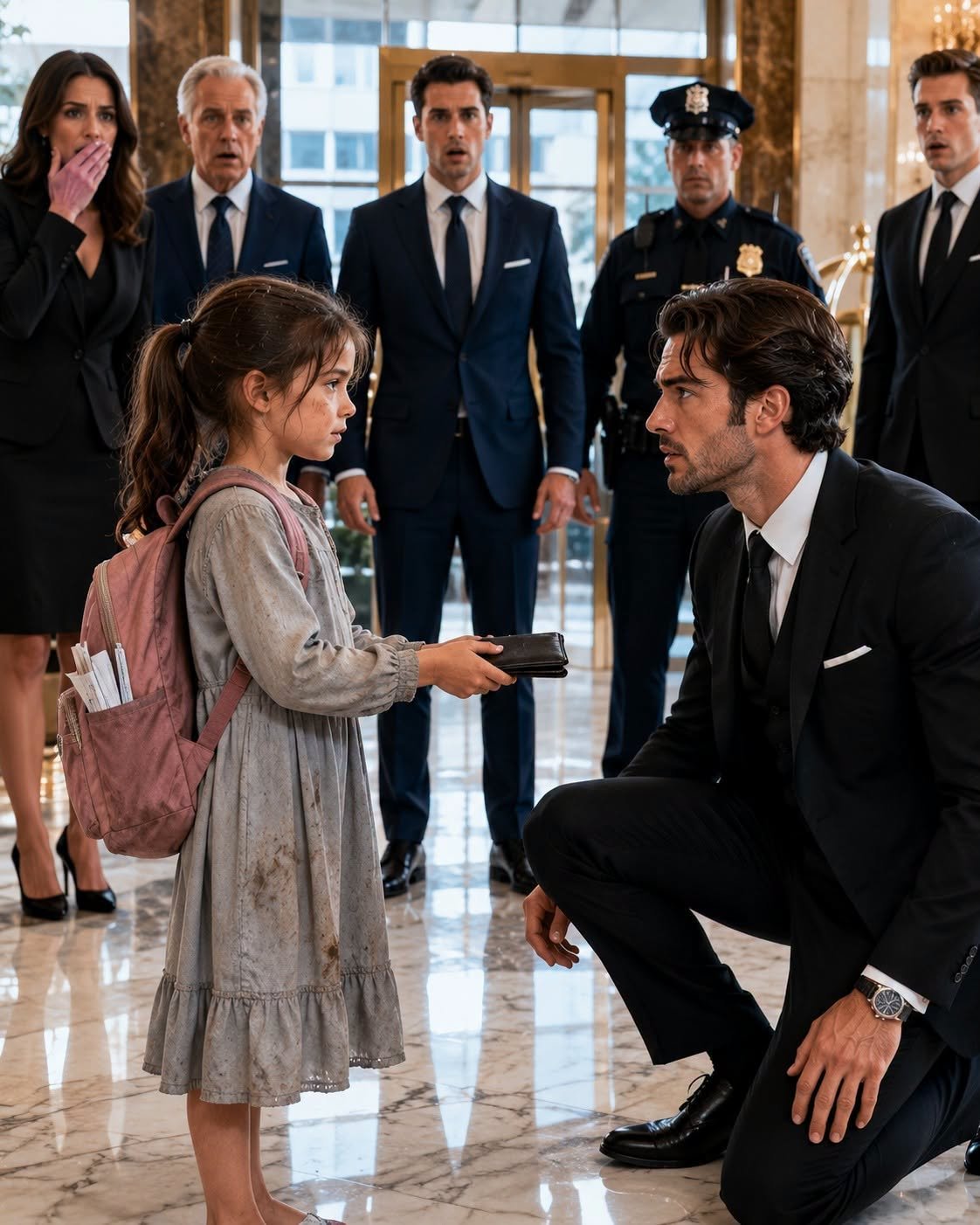
For several seconds, nobody moved.
The great glass doors of Graves Tower remained visible behind me, sunlight pouring through them, but the heavy locks slid into place with a mechanical click that seemed to echo all the way through my bones.
The security guards exchanged uncertain glances.
The receptionist stared at Nathaniel Graves as if she had never seen him before.
And I stood in the middle of the marble lobby, holding his wallet against my chest and
wondering whether returning something that did not belong to me had somehow become the worst mistake of my life.
Mr. Graves looked at the pink notice again.
Not at me.
Not at the wallet.
Only at the folded paper sticking from my backpack.
“Sir?” one of the guards asked carefully. “Is there a security concern?”
Mr. Graves did not answer him. He stepped closer to me, then stopped a few feet away, as though he was afraid that moving too quickly might make me disappear.
“What is your name?” he asked.
“Ruby.”
His jaw tightened.
“Ruby what?”
“Ruby Hart.”
A sound escaped him, almost like a breath catching in his throat.
Behind him, the receptionist slowly lowered the phone she had been holding.
Mr. Graves glanced toward the elevators. “Marianne, clear the conference room on the second floor.”
The receptionist blinked. “The executive conference room?”
“Yes.”
“There’s a board meeting in ten minutes.”
“Cancel it.”
A murmur spread through the lobby.
Mr. Graves turned sharply toward the employees who had gathered nearby.
“Everyone may return to work. The doors will reopen after security confirms what I need confirmed.”
He did not raise his voice this time, but people moved immediately.
The guards began guiding everyone away. Shoes clicked across the marble. Elevator bells chimed. Conversations started again in low, nervous whispers.
I remained where I was.
Mr. Graves looked down at me.
“You are not in trouble,” he said.
His words should have made me feel better.
They did not.
“Then why did you lock the doors?”
He glanced toward the notice.
“Because I needed to be certain no one left before I understood how that paper came into this building.”
I twisted around and pulled it from my backpack.
The pink sheet was wrinkled along the edges from being shoved between my spelling book and a folder of math worksheets. Across the top, in thick black letters, were the words FINAL NOTICE OF EVICTION.
My mother had told me not to worry about it.
She had said adults sometimes received frightening papers that did not mean what children thought they meant.
But I knew enough to understand the date written at the bottom.
We had five days.
I held the notice out.
Mr. Graves did not take it at first.
His eyes moved across the page, growing more troubled with every line.
Then he reached for it with a hand that was not entirely steady.
“This address,” he said. “Fourteen Willow Lane.”
“Yes, sir.”
“How long have you lived there?”
“My whole life.”
“And your mother?”
“My whole life too, I think.”
His gaze lifted to mine.
“What is her name?”
“Lena Hart.”

He closed his eyes.
The lobby seemed to disappear around us.
When he opened them again, there was sadness in them. Not the sort of sadness I saw in my
mother when she counted bills at the kitchen table. This was older. Heavier. It seemed to belong to something that had never stopped hurting.
“Please come upstairs,” he said.
I took one step backward.
“My mom says I’m not supposed to go anywhere with strangers.”
Something changed in his expression. For the first time, he seemed to remember that I was only
eight years old.
“She is right,” he said softly. “You should not.”
He reached into his jacket, then hesitated when he remembered that his wallet was still in my hands.
I looked down at it.
“Oh.”
I held it out.
He accepted it carefully, but instead of opening it to count the money, he slipped it into his pocket.
“You should check it,” I said. “There was nine hundred dollars.”
His eyebrows lifted.
“You counted it?”
“Twice.”
“Was it all there?”
“Yes, sir.”
“I believe you.”
“You shouldn’t just believe people about money.”
A faint smile touched his face, though it did not reach his eyes.
“That is usually true.”
He removed his phone from his coat and handed it to me.
“Call your mother. Tell her exactly where you are. Ask her to come here, if she can.”
I stared at the smooth black screen.
“We don’t have a phone right now.”
He seemed surprised.
“Our service got turned off last week,” I explained. “My mom uses the phone at the diner when
she needs to call someone.”
“What diner?”
“Millie’s, on Kingston Road.”
He immediately turned to Marianne.
“Call Millie’s Diner. Ask for Lena Hart. Tell her that her daughter is safe and that Nathaniel Graves would like to speak with her.”
Marianne nodded and hurried behind the reception desk.
Mr. Graves looked at the eviction notice once more.
“Ruby, would you sit with me while we wait?”
“Where?”
“In the lobby, if you prefer.”
I studied him.
Adults often acted like children could not tell when they were hiding something. But I had learned that grown-ups gave away secrets in small ways. They stopped looking directly at you. They answered questions with other questions. They became very interested in things like wiping
counters or folding laundry.
Mr. Graves was hiding something.
But he did not seem angry.
He seemed afraid.
I pointed toward a row of chairs beside a tall indoor tree.
“Over there.”
“Of course.”
We sat with one empty chair between us.
The leather seat was so soft I sank into it.
Mr. Graves placed the notice on his knee and folded his hands over it.
For nearly a minute, he said nothing.
I watched people move through the lobby. Some tried not to look at us. Others did not try very
hard.
Finally, I asked, “Do you know my mom?”
He looked at me.

“I knew someone named Lena Hart a long time ago.”
“My mom?”
“I don’t know yet.”
“That doesn’t make sense.”
“No,” he admitted. “It doesn’t.”
I thought about that.
“Did she work here?”
“Not in this building.”
“Did she work for you?”
His eyes drifted toward the tall windows.
“She worked for my family.”
Before I could ask another question, Marianne approached us.
“Mr. Graves?”
He stood.
“Did you reach her?”
“The diner manager says Lena didn’t report for her shift today.”
My stomach tightened.
“She always goes to work.”
Marianne glanced at me, then back at him.
“The manager said she called early this morning. She sounded unwell.”
“She wasn’t sick,” I said. “She made my breakfast.”
Mr. Graves crouched in front of me.
“Where did you see your mother last?”
“At home. She said she had to talk to the landlord before work.”
“Do you know the landlord’s name?”
“Mr. Bell.”
He stood so quickly that the notice slid from his knee.
Marianne picked it up.
“Sir?” she asked.
Mr. Graves looked toward one of the security guards.
“Daniel, find out who owns Fourteen Willow Lane.”
The guard nodded and stepped away.
I crossed my arms.
“You know Mr. Bell too?”
“I know the name.”
There was something in his voice that made me sit straighter.
“Is my mom in trouble?”
“I don’t know,” he said. “But I think we should go to your house.”
Marianne frowned. “Shouldn’t we contact the police?”
“Not without knowing there is a reason.”
“What about the doors?”
Mr. Graves looked around the lobby, as though remembering his own order.
“Open them.”
The locks released.
The sound was quiet this time, but everyone seemed to hear it.
He turned back to me.
“I can drive you home. Marianne will come with us.”
I looked at the receptionist. She appeared much less frightening than she had ten minutes earlier.
In fact, she looked embarrassed.
“I’m sorry I spoke to you harshly,” she said.
I was not ready to forgive her, but my mother said apologies should be answered honestly.
“You did speak pretty harshly.”
Marianne’s cheeks turned pink.
“Yes,” she said. “I did.”
Mr. Graves almost smiled again.
“Would you be comfortable coming with both of us?” he asked.
I considered the question.

“Can we stop at the diner first?”
“Why?”
“To see if my mom went there after talking to Mr. Bell.”
He nodded. “We’ll stop there first.”
Outside, a black car waited at the curb.
I had never been inside a car like it. The seats smelled like clean leather, and the windows were
darker than ordinary windows. There were tiny lights in the ceiling even though it was daytime.
Marianne sat in front beside the driver. Mr. Graves sat across from me in the back.
As the car moved into traffic, I kept one hand wrapped around the strap of my backpack.
Mr. Graves watched the city pass outside.
“Why did you return the wallet?” he asked.
“Because it was yours.”
“You could have kept the money.”
“I know.”
“Did you think about it?”
I looked down at my sneakers.
“Yes.”
He did not seem disappointed.
“What stopped you?”
“My mom.”
“Was she with you?”
“No. But I heard what she would have said.”
He studied me in silence.
“What would she have said?”
“That doing the right thing matters most when nobody’s watching.”
His face changed again.
This time, the sadness seemed to strike him so deeply that I wished I had not answered.
“That sounds like her,” he murmured.
I looked up.
“You do know my mom.”
“I knew a young woman with that same name. She once said something very similar to me.”
“When?”
“Twelve years ago.”
The same number from the secret I did not yet understand seemed to hang in the car.
Twelve years.
Longer than I had been alive.
“What happened twelve years ago?” I asked.
Mr. Graves looked at Marianne’s reflection in the front mirror. She was listening too.
“There was an accident,” he said at last.
“What kind?”
“A fire.”
The word made the car feel colder.
“My family owned an old research facility outside the city. It had been closed for renovations, but a small group of employees were still working there.”
“Was my mom one of them?”
“Yes.”
“Did she get hurt?”
He took a slow breath.
“Several people were injured. One person disappeared.”
“Who?”
He did not answer immediately.
“My younger brother.”
The car turned onto Kingston Road.
Millie’s Diner came into view, its blue sign flickering even in daylight.
The driver pulled to the curb.
Before anyone could open my door, I pushed it open myself and jumped out.
Inside, the diner smelled like coffee, fried onions, and warm bread. Red stools lined the counter. A

waitress carrying a tray stopped when she saw me.
“Ruby?”
“Is my mom here?”
Her face tightened.
“No, sweetheart.”
A broad woman with gray-streaked hair hurried from the kitchen, wiping her hands on an apron.
“Ruby, what are you doing downtown by yourself?”
“I’m not by myself.”
Mr. Graves entered behind me.
The woman stared.
“Mr. Graves?”
“My name is Nathaniel,” he said. “You must be Millie.”
“I am.”
“When did you last speak with Lena?”
Millie glanced at me.
“Ruby, why don’t you sit at the counter? I’ll get you a sandwich.”
“I’m not hungry.”
My stomach growled loudly enough for everyone to hear.
Millie raised one eyebrow.
“Your stomach disagrees.”
“I want to know where my mom is.”
“And we’re going to find out,” Mr. Graves said. “But you haven’t eaten.”
He turned to Millie.
“Please bring her whatever she usually has.”
“Grilled cheese,” Millie said. “With tomato soup.”
I climbed onto a stool because everyone had clearly decided I was eating whether I wanted to or
not.
Mr. Graves and Millie moved a few steps away, but not far enough.
I could still hear them.
“She called at six fifteen,” Millie said quietly. “Said she might be late. She sounded frightened.”
“Did she say why?”
“Only that someone had come to the house before sunrise.”
“Who?”
“She didn’t say. I asked whether I should call the police, but she told me not to. She said it was something from the past.”
Mr. Graves went still.
“Did she mention me?”
Millie’s eyes narrowed.
“She said if anything happened, I was supposed to contact Nathaniel Graves.”
The diner suddenly seemed too quiet.
Even the cook behind the kitchen window had stopped moving.
“Did she give you anything?” Mr. Graves asked.
Millie looked toward me again.
“Yes.”
She reached beneath the counter and took out a small white envelope.
My mother’s handwriting was on the front.
For Ruby.
I slid off the stool.
“That’s mine.”
Millie held the envelope against her apron.
“Your mother told me only to give it to you if she didn’t come to work by noon.”
The clock above the coffee machine read twelve twenty-three.
Mr. Graves took a step back.
“This belongs to Ruby,” he said.
Millie gave me the envelope.
It was sealed.
My name had been written carefully, but the R looked uneven, as if my mother’s hand had been shaking.
I opened it.
Inside was a single piece of paper and a small brass key.
The note was short.
My dearest Ruby,
I am sorry I did not tell you sooner. Some truths are difficult to explain until a child is old enough to understand that adults can make mistakes even when they are trying to protect someone they love.

If I am not with you, go with Nathaniel Graves. You can trust him, but do not let him open the blue box without you.
The key is for locker 214 at Central Station.
Whatever anyone tells you, remember this: you were never unwanted.
I love you more than every star.
Mom
I read it twice.
The words did not make sense.
Then they made too much sense.
I looked at Mr. Graves.
“What blue box?”
“I don’t know.”
“What does she mean, I was never unwanted?”
His face had turned pale again.
“Ruby—”
“Did my mom know she was going to disappear?”
“We don’t know that she has disappeared.”
“She left me a letter.”
Millie placed a plate in front of me, though nobody expected me to eat now.
Mr. Graves lowered himself onto the stool beside mine.
“I think your mother believed someone from her past had found her.”
“Who?”
“I don’t know.”
“You keep saying that.”
“Because I would rather tell you the truth than pretend I understand.”
I squeezed the brass key in my palm.
It was small enough to disappear inside my fist.
“Then take me to Central Station.”
Marianne stepped forward. “Mr. Graves, perhaps we should involve the authorities now.”
He nodded slowly.
“Yes.”
“No,” I said.
Three adults looked at me.
“My mom said to go with him. She didn’t say to go with the police.”
“Ruby,” Millie began.
“She said not to let him open the box without me.”
Mr. Graves studied the note.
“What else do you remember from this morning?” he asked.
I thought carefully.
My mother had been quieter than usual. She had burned one side of my toast. She had packed my school things even though school was closed for a teacher workday.
That was why the eviction notice was in my backpack. She had placed all our important papers
inside it and told me to keep the bag near me.
“There was a man outside,” I said.
Mr. Graves leaned closer.
“What man?”
“I saw him through the kitchen window. He was across the street beside a gray car.”
“What did he look like?”
“He had a brown coat. And glasses.”
“Did your mother see him?”
“I think so. She closed the curtains.”
Millie’s worry deepened.
“Why didn’t you tell me that when you came in earlier this week?”
“Because it happened today.”
Mr. Graves took out his phone and made a call.
“I need a security team at Fourteen Willow Lane,” he said. “Do not enter unless there is clear danger. Contact the police and request a welfare check for Lena Hart. Tell them her eight-year-old
daughter is safe with me.”
He ended the call.
I stared at him.
“What happens now?”
“We go to Central Station.”
The station stood in the oldest part of the city beneath a wide iron clock. Hundreds of people
crossed the main hall, pulling suitcases, hugging relatives, and studying departure boards.
Mr. Graves kept close beside me. Marianne followed with two security officers who had joined us outside.

Locker 214 was in a narrow corridor near the eastern platforms.
The blue paint on the locker door had chipped around the edges.
I held up the brass key.
Mr. Graves looked at me.
“Your mother was clear. You open it.”
My fingers trembled as I slid the key into the lock.
It turned with a soft click.
Inside was a square blue metal box, a folded coat, and an old photograph.
I reached for the photograph first.
It showed four people standing in front of a brick building.
One was my mother.
She looked younger, with shorter hair and a smile so wide I barely recognized her.
Beside her stood Nathaniel Graves.
He had dark hair then, but his eyes were the same.
A third person was a man in a white laboratory coat. He looked enough like Mr. Graves that I
knew he had to be his brother.
The fourth person was a young woman with curly black hair.
She was holding a baby.
On the back, someone had written:
The last good day. May 14.
No year.
No names.
“Who is she?” I asked, pointing to the woman.
Mr. Graves took the picture.
His face softened.
“Dr. Evelyn Shaw.”
“Was she your friend?”
“She was my brother’s wife.”
“And the baby?”
He turned the photograph over, though he had clearly seen the writing before.
“Their daughter.”
“What was her name?”
He did not answer.
I looked inside the locker again.
The blue metal box had a small keyhole, but the brass key did not fit.
Taped to the lid was another envelope.
This one had Mr. Graves’s name on it.
He reached toward it, then stopped.
“Your mother said not to open the box without you,” he said. “She did not say I couldn’t read the
letter.”
I handed it to him.
He broke the seal.
The message inside was longer than mine.
As he read, his expression shifted from worry to disbelief.
“What does it say?” I asked.
He lowered the paper.
“Lena says the official report about the fire was false.”
Marianne moved closer.
“False how?”
“The fire was blamed on an electrical failure. According to this, it began after someone removed confidential research files and damaged the alarm system.”
“Who removed them?” I asked.
“She does not say.”
“Why?”
“She believed the person responsible had connections inside my company.”
He read the next section silently.
“What else?” I asked.
Mr. Graves folded the letter.
“She says the blue box contains proof.”
“Proof of the fire?”
“And what happened afterward.”
He looked at the lock.
“There is no key.”

I reached into the locker and lifted the folded coat. Underneath was a small paper luggage tag.
On it, my mother had written three numbers.
4 – 12 – 8
“Is that a combination?” Marianne asked.
“There aren’t any dials,” I said.
Mr. Graves turned the box over.
On the bottom was a thin metal plate with three sliding pieces. Each had tiny engraved numbers.
He set the box on a bench.
I moved the first slider to four, the second to twelve, and the third to eight.
Nothing happened.
“Maybe it’s a date,” Marianne said.
“April twelfth, 2008?” one of the guards suggested.
Mr. Graves shook his head. “The facility fire happened twelve years ago, but not on that date.”
I stared at the numbers.
Four.
Twelve.
Eight.
Then I remembered something my mother often said when I asked why my name was Ruby.
“Four letters,” I whispered.
“What?” Mr. Graves asked.
“Ruby has four letters. Hart has four too, but Mom always says my name was chosen because of
four, twelve, and eight.”
Everyone looked at me.
“She says four letters for courage, twelve letters for remembrance, and eight for the day I came
home.”
Mr. Graves seemed unable to breathe.
“What day did you come home?”
“August eighth.”
“Do you know what the twelve letters are?”
I shook my head.
He looked at the three sliders.
“Four. Twelve. Eight.”
He moved the first to four, the second to twelve, and the last to eight again, then pressed his
thumb against a nearly invisible circle beside them.
The lid released.
Inside were neatly organized folders, a small digital recorder, three flash drives, a silver necklace,
and a sealed plastic pouch containing several official documents.
I reached for the necklace.
A tiny heart-shaped locket hung from the chain.
Inside were two miniature photographs.
One showed Evelyn Shaw.
The other showed the baby from the station photograph.
My hands grew cold.
I had seen that baby’s face before.
Not in a picture.
In the mirror.
The same rounded cheeks.
The same dark eyes.
Even the same small dip in the center of the chin.
I closed the locket.
“Why does she look like me?”
Mr. Graves did not answer.
I turned toward him.
“You know.”
His eyes glistened.
“Ruby, there may be an explanation.”
“Tell me.”
He reached into the box and removed the documents.
The top page was an old hospital record.
Most of the writing was too small for me to understand, but I could read one line.
Infant Female Shaw.
Below it was a date of birth.
August eighth.
Eight years earlier.
My birthday.
“No,” I whispered.

The station sounds faded into a distant blur.
Announcements floated above us. Trains arrived. Wheels rattled over tile.
But everything near the blue box became silent.
“My last name is Hart.”
Mr. Graves lowered himself to one knee.
“Yes.”
“My mother is Lena Hart.”
“Yes.”
“Then why is my birthday on this baby’s paper?”
He looked down at the hospital record.
“I don’t know the entire truth.”
“You know some of it.”
He nodded.
“After the fire, Evelyn was found unconscious near the east stairwell. She died two days later at the hospital.”
“And the baby?”
“The baby was missing.”
A deep ache spread through my chest.
“Your brother took her?”
“No. My brother disappeared the night of the fire. For years, I believed he had died.”
“But they never found him.”
“No.”
I looked at the photograph again.
My mother stood beside Evelyn, one hand resting on the baby’s blanket.
“She took me,” I said.
Mr. Graves’s eyes closed briefly.
“Perhaps.”
The word hurt worse than if he had said yes.
“She stole me?”
“We do not know that.”
“Why would she change my name?”
“Maybe to protect you.”
“From who?”
He opened the first folder.
Inside were copies of letters, employee records, photographs of damaged offices, and pages covered with technical diagrams.
He searched quickly until he found a document with my mother’s name.
LENA HART
Senior Research Assistant
Emergency Guardian Authorization
Below that were the names Evelyn Shaw and Adrian Graves.
“My brother and Evelyn signed this,” he said. “They named Lena as temporary guardian if
something happened to both of them.”
“So she was allowed to take me?”
“Temporarily.”
“What happened after?”
He turned the page.
The next section was blank.
“The official records said the infant died in the fire,” he said.
“But I didn’t.”
“If you are that child, then no.”
The blue box sat between us like something alive.
Marianne picked up the digital recorder.
“There may be answers here.”
Before she could press the button, one of the guards approached.
“Mr. Graves, the police are at Willow Lane.”
My heart jumped.
“Did they find my mom?”
The guard listened to the earpiece hidden beneath his collar.
“They entered the house. No one is inside.”
I gripped the edge of the bench.
“Was there blood?”
The adults looked startled.

I had seen enough television to know why people disappeared.
“No,” the guard said quickly. “No signs of violence.”
“What did they find?”
He listened again.
“The back door was unlocked. Several drawers were open. It looks like someone searched the house.”
“My mom?”
“They don’t know.”
Mr. Graves stood.
“Tell them not to remove anything until we arrive.”
The guard relayed the instruction.
I placed the locket around my neck.
Mr. Graves noticed but said nothing.
Then the digital recorder in Marianne’s hand suddenly lit up.
A red light blinked.
She nearly dropped it.
“I didn’t press anything.”
A voice crackled through the tiny speaker.
My mother’s voice.
“If you are hearing this, then Ruby found the box.”
I stopped breathing.
The recording was faint, but clear.
“Nathaniel, I know you have questions. So does she. I wish I could be there to answer them myself.”
Mr. Graves took the recorder.
“Lena,” he whispered.
My mother continued.
“The files in this box prove the fire was planned. They also prove Evelyn survived longer than the hospital reported. She told me to take the baby and leave the city. She believed someone wanted the child because of what Adrian had discovered.”
I looked at Mr. Graves.
“What did he discover?”
He shook his head, listening.
“The child’s name was changed,” my mother said. “Not to erase who she was, but to keep her hidden. Ruby deserves the truth now, though I prayed I would have more time to tell her gently.”
My eyes filled with tears.
My mother’s recorded voice softened.
“Ruby, being your mother has been the greatest gift of my life. Nothing you learn can change what you are to me.”
I pressed both hands against my mouth.
“Your birth name was Rose Evelyn Shaw.”
The station seemed to tilt.
Rose.
Not Ruby.
Evelyn’s daughter.
Adrian Graves’s daughter.
Nathaniel Graves’s niece.
Mr. Graves sat down beside me as if his legs could no longer hold him.
The recording continued.
“But there is something Nathaniel must understand. Adrian did not die in the fire.”
Mr. Graves gripped the recorder.
“He contacted me three months ago.”
A train thundered beneath the station floor.
I watched Mr. Graves’s face as shock moved through it.
“He said he had been searching for Ruby,” my mother continued. “He also said he could not trust anyone at Graves Energy. Not even you.”
The recording clicked off.
For a moment, none of us spoke.
Then the guard’s phone rang.
He answered, listened, and looked directly at Mr. Graves.
“Sir, the police found something at Willow Lane.”
“What?”
“A note on the kitchen table.”
“From Lena?”
“They don’t know.”
“What does it say?”
The guard swallowed.
“Bring Ruby to the old research facility before sunset. Come alone.”
Mr. Graves looked toward the station clock.
It was one fifteen.
I clutched the locket around my neck.
“My mom is there.”

“We don’t know that.”
“But somebody wants me there.”
He stared at the blue box, then at the letter in his hand.
“I am not taking you into danger.”
“What if not going puts her in danger?”
“Ruby—”
“She protected me for eight years.”
My voice shook, but I did not look away.
“If she’s there, I’m not leaving her alone.”
Something in his expression softened and broke at the same time.
Before he could answer, Marianne reached into the blue box and lifted the final folder.
“There’s another photograph,” she said.
It had been hidden beneath the documents.
Unlike the others, this picture looked recent.
It showed a man standing outside Fourteen Willow Lane.
He was older now, with lines around his eyes and gray at his temples.
But he was unmistakably the man from the laboratory coat.
Adrian Graves.
On the back, my mother had written a date.
Yesterday.
Below it were six words.
He says he came to save her.
Mr. Graves turned the photograph over again.
In the corner of the image, barely visible through the front window of our house, stood another
figure.
A man in a brown coat.
Wearing glasses.
The same man I had seen that morning.
And beneath the photograph, tucked into the folder, was a second eviction notice for Fourteen Willow Lane.
This one had never been delivered.
Across the bottom was a signature.
Not Mr. Bell’s.
Not my mother’s.
Nathaniel Graves’s.