I called Brendan from the superstore parking lot
on a Wednesday afternoon in early October, the back of my Honda loaded with enough food to feed eight people.
He didn’t answer. Jenna did.
“Patricia.”
Her voice was flat, the way it always was when she didn’t have a specific request.
“Brendan’s on a call.”
“No problem,” I said. “I’m just confirming. I was thinking I’d drive up Friday morning instead of Thursday evening. Beat the traffic on the 115.”
There was a pause. Not a long one. Just enough.
“Actually, that’s what I was going to talk to you about.”
She didn’t lower her voice or soften it.
“We’re doing Thanksgiving with my parents this year. My mom is flying in from Vancouver. It’s just going to be the four of us, us and her and my dad. It’s easier that way.”
I was standing between two rows of cars, a cold October wind cutting across the lot. The trunk of my car was open behind me. I could see the corner of the turkey through the reusable bags.
“I see,” I said.
“It’s nothing personal.”
She said it the way people say things they have already decided are true.
“We just need the space this year.”
“Okay,” I said. “Have a good holiday.”
I hung up first.
I stood there for a moment. A man in a red jacket walked past, pushing a cart, not looking at me. A toddler shrieked something happy from a passing minivan.
The parking lot continued its ordinary October logic without any awareness that I had just been
uninvited from my son’s home 4 days before Thanksgiving.
I was 66 years old. I had been a widow for 4 years.
Walter had died in November, which meant that every holiday since had carried a particular weight. Not unbearable, just heavier than it used to be.
For the past three Thanksgivings, I had made the 2-hour drive to Brendan and Jenna’s house in
Peterborough with food I had prepared the day before, gifts for the grandchildren I had wrapped myself, and a careful, practiced cheerfulness that I maintained even when Jenna reorganized my contribution to the meal without asking, and her mother, Viven, held court at the head of the table as though it were her own home.Track Pregnancy
I was not naive about what had been happening.
I had watched the dynamic shift slowly over years, like a house settling into softer ground.
Walter and I had owned a small cabin on Balsam Lake for 31 years.
Nothing grand. Two bedrooms, a screened porch, a dock that needed repairing every spring.
We had taken Brendan there every summer when he was a boy.
After Walter died, I had held on to the cabin longer than made practical sense, mostly because it still
smelled like him.
Last spring, I finally sold it.
The market in cottage country had not cooled the way people had been predicting, and I walked away with $165,000 after fees.
Brendan knew the number.
He had asked with what I think he believed was casualness a week after the sale closed. I had told him.
He had nodded slowly and said, “That’s great, Mom. That’s really great.”Track Pregnancy
Then, over the following months, he and Jenna had begun mentioning, in the way people mention things they have already decided, that they were looking at a property.
A semi-ural lot about 40 minutes outside the city, enough space for the kids, a garage for Brendan’s
tools.
They had to twice. Jenna had shown me photos.
No one had asked me directly for anything.
But the way they talked about the sale and then immediately talked about the property did not feel like coincidence.
Standing in that parking lot, I did not feel angry.
I felt something cooler than anger.
I felt clear.
I closed the trunk. I got in the car.
I did not drive back to my house.
Instead, I drove 20 minutes west to the Kortha Food Center on Landown.
The woman at the receiving dock, her name tag said Heather, looked surprised when I began unloading bags.
“I have enough here for a full Thanksgiving dinner,” I told her. “Turkey, vegetables, everything. Can you use it?”
“Can we ever?” she said.
It took four trips.
When the last bag was inside, I asked if I could speak with whoever was in charge of donations.
The director’s name was Phil.
He had reading glasses pushed up onto his forehead and the handshake of someone who meant it.

He made us each a cup of terrible coffee from a machine in the corner of his office, and we sat across from each other at a desk covered in stapled papers and sticky notes.
“I have money from the sale of a family property,” I told him. “I’d like to donate a portion of it. $40,000. I want it directed specifically toward emergency winter shelter support, rental deposits, utility reconnection, that sort of thing.”Plan Family Trips
Phil set his cup down.
“That’s an extraordinary amount.”
“It was an extraordinary amount of good years,” I said. “My husband built that dock himself. He would have liked knowing it went somewhere useful.”
Phil asked if I wanted the donation to remain anonymous.
I told him to use my full name and to post it publicly if it would help encourage others.
He said they would put it on their website and their Facebook page, and he asked if he could attribute it in Walter’s memory.
I said yes.
I wrote the check right there at his desk.
My hand was steady.
When I walked out into the October afternoon, the sky had gone that particular deep blue that only happens in autumn in Ontario, the kind that looks like something painted rather than something real.
I breathed in cold air and felt, with complete unexpectedness, entirely like myself.
The knocking started at quart 8 on Saturday morning.
Not a knock. A pounding. The kind that travels through walls.
I had been awake, sitting at the kitchen table with tea, reading.
I pulled my cardigan tighter and walked to the front door.
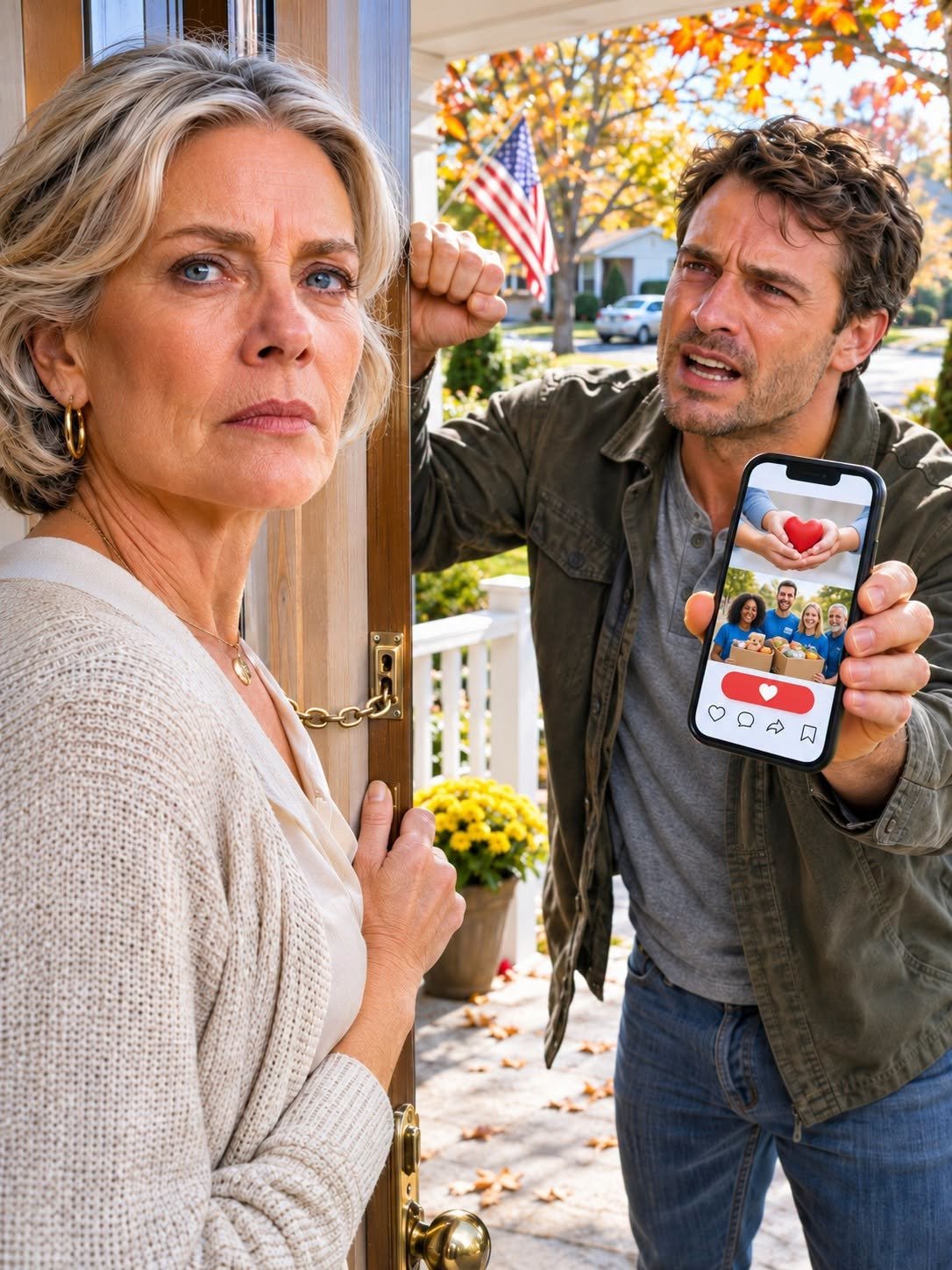
Through the narrow glass panel beside the frame, I could see Brendan on my porch.
He was not wearing a proper jacket. His—his hair was unc.
He looked the way he used to look when he had stayed up too late and then overslept something important.
I slid the chain across before I opened the door.
The gap let in cold air and his voice.
“Mom.”
He held his phone toward the narrow opening.
On the screen was the food cent’s Facebook post. My name was in the first sentence. Walters was in the
second.
The photo showed Phil accepting a ceremonial check in front of the cent’s entrance.
“You gave it away,” Brendan said.
His voice was not quiet.
“You gave away $40,000.”
“Good morning,” I said.
“We needed that, Mom, for the Ridge View property. We waved conditions because our realtor said we had to move fast. We were counting on having that cash available for closing.”Track Pregnancy
I looked at my son through the gap in the door.
He was 41 years old.
He had not called me in 2 weeks.
“What money?” I asked.
He blinked.
“The cabin money. You know what money.”
“Brendan,” I said. “Did you ever ask me for any of that money?”
His jaw moved.

“Did you?” I continued. “At any point in the past 8 months, sit down with me and say, ‘Mom, we are planning to purchase a property and we need financial help. Would you be willing to contribute?’ Did that conversation happen?”
“We talked about the cabin,” he said. “You knew we were looking at places.”
“I knew you were looking. I didn’t know I was the financing.”
He rubbed the back of his neck.
“Can you just… Can you open the door?”
I unhooked the chain and stepped back.
He came inside and went straight to the living room the way he had been doing since he was 17 and upset about something.
He stood in front of the window that looked out over the backyard, arms crossed, then turned to face me.
“We already made an offer,” he said. “Firm offer. No conditions. If we don’t close, we lose the deposit.”
“How much is the deposit?”
“12,000.”
I sat down in the armchair that had been Walters. I folded my hands.
“Brendan, you signed a binding contract on a property using money that was sitting in my bank account. Money you had never asked me for and that I had never offered.”
“You would have said yes.”
He said it not as an argument, but as a fact, the kind of fact that has been believed so long it no longer occurs to anyone to question it.
“You don’t know that,” I said.
He dropped onto the sofa, leaning forward with his elbows on his knees.
The entitlement was still there, but underneath it now was something else.
A real fear, the kind that comes when a plan built on assumptions suddenly has no ground under it.
“I thought you’d want to help us,” he said, quieter. “Dad always said he wanted us to have more space when the time came.”
“Your father is not here,” I said. “And I am not a bank that stays open because he would have wanted it to.”
He looked at the floor.
Then, in a voice I recognized as the shift to strategy, he said, “Jenna’s devastated. This has been a terrible week, and look, I know you’re upset about Thanksgiving, but this is about our family’s future. Clara and Theo deserve a real yard, real space to grow up in. Don’t you want that for them?”Plan Family Trips
The room was quiet.
Outside, a blue J landed on the fence post and then lifted off again.
I reached for my phone on the side table.
“What are you doing?” Brendan said.
“Calling Clara.”
His face changed entirely.
“Mom, don’t.”
I held up one hand.
He stopped.
Clara answered on the third ring, her voice still slightly soft with early morning.
“Grandma Pat.”
“Hi, sweetheart.”
I kept my voice warm and even.
“I hope I’m not calling too early.”
“No, I’m awake. Grandma Vivien made waffles.”
“That sounds lovely. I wanted to ask you something just between us. Did your dad say anything to you about why Grandma Pat wasn’t coming for Thanksgiving?”

Brendan leaned forward on the sofa.
His face had gone pale.
Clara was quiet for a moment.
Then he said, “You were too tired. He said you didn’t like the long drive anymore, and it was easier if you stayed home.”
A small pause.
“Are you okay, Grandma? Are you sick?”
I looked at Brendan.
He was looking at the carpet.
“I’m perfectly fine, Clarab Bear,” I said. “I’m not sick, and I’m not too tired. The grown-ups just had a mixup with the plans. But I want you to know that I love you and Theo very much, and I will see you both very soon. Okay?”
“Okay.”
She sounded relieved.
“Love you, Grandma.”
“Love you, too.”
I ended the call and set the phone down on the arm of the chair.
The silence in the room lasted a long time.
“You told your 8-year-old daughter that I didn’t want to make the drive,” I said. “You let her believe her grandmother had chosen not to come. And then you came here to ask me for $40,000.”
Brendan opened his mouth, closed it.
“You didn’t know how to tell Jenna the real reason,” I said. “So you invented a comfortable story and repeated it to your children. That’s not keeping the peace, Brendan. That’s cowardice dressed up as consideration.”
He sat very still.
We did not speak for almost a full minute.
Then the front door opened.
I had not heard a car pull up.
Jenna walked into the living room with the focused efficiency of someone who had been rehearsing what she planned to say.
She was still in her coat.
Through the front window, I could make out Viven’s silhouette in the passenger seat of the car, apparently having elected to wait outside.
Jenna looked at the phone on the chair arm, then at Brendan, then at me.
“Tell me you didn’t give that money to a charity just because I uninvited you from dinner,” she said.
“I gave it to the food center in Walter’s memory,” I said. “Before any of you came knocking.”
She shook her head.
“Patricia, we needed that money. You knew we were in the middle of a purchase.”
“I knew you were looking at properties,” I said. “That is different.”
“We are going to lose our deposit.”
She said it the way a person announces something that should end an argument.
“Then you’ll lose it,” I said. “You signed the contract, not me.”
Jenna looked at Brendan with the particular look of a person who expected their partner to intervene.
He didn’t.
She crossed her arms, and her voice shifted.
Softer, more reasonable.
“Look, I’ll admit the way I handled Thanksgiving could have been better. My mom was coming in from

Vancouver, and I wanted it to feel manageable. You know how it gets when there are too many people in the kitchen.”
“I do know,” I said. “And I acknowledge that I’ve overstepped in your home. I reorganized your pantry without asking once. I arrived early without calling. I apologize for that genuinely.”
She blinked.
She had not expected agreement, but I continued.
“There were ways to set that limit directly and respectfully. You chose to deliver a one-s sentence dismissal over the phone and let Brendan invent a story about me for your children. Those are two different problems.”
“We’re not here about Thanksgiving,” she said, recovering quickly. “We need 12,000 to save the deposit and at least 20 more at closing to make the numbers work.”
She said it the way someone says the time when you ask a fact, as something already decided.
“No,” I said.
Jenna’s posture shifted.
“What do you mean, no?”
“I mean no. I am not replacing the donation, and I am not financing a purchase you made without asking me first.”
“We stand to lose $12,000.”
“I know. That is a consequence of signing a firm offer without having your financing confirmed.”
Brendan stood up from the sofa.
His voice cracked slightly.
“Mom, please. 10,000. I will work overtime. I will pay you back every cent.”
“You planned a future with money that lived in my account,” I said. “I will not fund that plan retroactively. You are adults. You signed the contract. You will figure it out.”
Jenna grabbed Brendan’s arm.
Her face had gone entirely closed.
“Let’s go,” she said. “She’s made her mind up. She’ll come around by tonight.”
They left.
The door closed with a definitive click.
I sat in Walter’s chair and listened to the car back out of the driveway.
I did not come around by tonight.
Two days later, I called a locksmith.
The front and back doors were rekeyed by noon.
That afternoon, I logged into my Rogers account.
For three years, I had been carrying Brendan and Jenna’s two lines on my family plan. An old habit, a quiet way of being useful.Plan Family Trips
I removed both lines.
I cancelled the shared streaming subscription I had been paying for since the pandemic.
It was not done out of spite.
Spite is noisy.
What I felt was quieter than that.
Something closer to tidying.
Clearing surfaces that had been cluttered for too long.
Thanksgiving Monday, I drove to the food center at 9 in the morning and spent 6 hours on shift.
Heather put me on soup, a massive commercial pot of turkey vegetable that needed constant stirring

and real attention.
I worked alongside a retired high school teacher named Gordon who made consistently bad jokes and a young woman named Amara who was studying nursing and had strong opinions about broth ratios.
It was loud and unglamorous, and the kitchen smelled permanently of onions.
I have not felt more useful in years.
I drove home that evening with an ache in my feet and a lightness somewhere behind my sternum that I did not try to name.
My phone had messages from extended family. A cousin, two of Walter’s nieces, an old friend who had heard something through the network.Plan Family Trips
I gave them all the same answer.
“I donated my money to a community center. Brendan made a financial decision without consulting me. That is the complete story.”
Eventually, the calls stopped.
In November, a card arrived from Clara.
She had drawn a picture of us at the lake.
A figure with gray hair and a figure with a ponytail sitting together on a dock.
Inside, she had written in careful 8-year-old printing:
“I miss you, Grandma Pat. Can we go to the lake someday?”
I put it on the refrigerator.
I sent her a card back with a Tim Hortons gift card tucked inside and a note that said, “The lake is always waiting, Clara Bear. So am I.”
In December, a handwritten bill arrived from Brendan in the mail.
He had calculated 1 month of the new phone plan he’d had to sign up for after I removed him from mine and implied I owed him the difference since I hadn’t given formal notice.
I thought about this for a moment.
I wrote the number of a consumer advice line on a sticky note, put the sticky note in an envelope, and mailed it to his address.
I did not hear back.
January was cold in a way that had real weight to it.
February was worse.
I kept my twice weekly shifts at the food center.
I joined a Thursday morning walking group through the Rotary Club.
Six of us, bundled past recognition, covering the waterfront trail before the temperature peaked.
My savings, no longer quietly draining into their manufactured emergencies, began to reflect only what I actually earned and spent.
The number on the screen felt, for the first time in years, genuinely mine.
I thought about Clara and Theo constantly, but I had made a decision deliberately not to negotiate my dignity for access.
I had seen that trap close on other people.
The grandparent who swallows every grievance in exchange for supervised visits, who slowly trains the family that there is no floor to what they will accept.Plan Family Trips
I was not willing to become that person.
I trusted that reality would eventually do what I could not.
It was a Tuesday in late March.

I was in the back storage room of the food center sorting donated winter coats by size when the loading door opened behind me.
I turned around.
Brendan was standing in the doorway holding two large boxes.
He was wearing his older jacket, the one from before Jenna had bought him the new one for his birthday.
He looked tired.
Not the dramatic porch-standing tired of October, but a quieter, longer kind.
The kind that comes from months, not mornings.
He set the boxes down on the folding table without making eye contact.
“Phil said you’d be back here,” he said.
“I usually am on Tuesdays.”
He opened the first box.
Inside were canned goods, soup, beans, tinned salmon.
He began setting them out on the table with the careful movements of someone who had been shown where things go and had been paying attention.
“I’ve been coming Saturdays,” he said, not looking up, “for about a month. Sorting the food bank intake.”
I kept sorting the coats.
Medium, medium, large, extra large.
A child’s winter jacket that had somehow ended up in the adult pile.
“Phil mentioned,” I said.
Brendan lined up a row of soup cans.
He was quiet for a moment.
Genuinely quiet, not building towards something.
“I wanted to see where the money went,” he said finally. “I told myself I was just curious. But Phil showed me the records, the winter housing fund, the families who got into apartments because of it.”
He paused.
“There was a veteran, 63 years old. He’d been couch surfing since September. The deposit from your fund got him into a bachelor unit before Christmas.”
He stopped.
His hands rested on the edge of the box.
“I kept telling myself you did it to punish us,” he said. “That you knew we needed it and gave it away on purpose to make a point.”
He looked up then for the first time.
“But you did it before you even knew we’d come knocking. You did it because they actually needed it, and we just felt like we were entitled to it.”
I did not move toward him.
I let the room hold what he had said.
“I’ve been a coward,” he said. “I let Jenna make decisions I should have made myself. I told Clara you didn’t want to come. I told my 8-year-old daughter that her grandmother was tired of the drive.”
He pressed his palms flat on the table.
“I treated you like an account I could draw from whenever it was convenient, and I lied to my own kid so I didn’t have to have a hard conversation with my wife.”
He straightened up.
“I’m sorry, Mom,” he said. “I am genuinely, completely sorry. No qualifications.”Track Pregnancy
It was the first time in more than a decade that I had heard him apologize without a butt attached somewhere.
I looked at my son.
He was 41 years old, and he looked in this moment very much like the 12-year-old who had once broken
the garage window and spent 4 days trying to work out how to tell Walter.
“I accept your apology,” I said.
Something eased behind his eyes.
“So, Sunday dinner?” he said, tentative.
A small hopeful offering.
“No,” I said evenly. “Not yet. An apology is not a reset switch. Trust is rebuilt in months, not minutes.”
He nodded slowly.
His shoulders dropped a little, but he didn’t argue.
He didn’t look for a workaround.
“Then what do I do?” he asked.
I nodded at the second box.
“Right now, you unpack those cans, and next Saturday you come back and do it again.”
For the first time since he had walked through that door, the corner of his mouth moved.
“Okay,” he said. “Yeah, okay.”
Jenna took longer.
She texted in July asking if we could meet somewhere neutral.
I chose a coffee shop on George Street that I knew well.
She arrived first and was on her second cup when I got there, both hands wrapped around the mug.
She looked as though she had come with a prepared speech and then, somewhere on the drive over, had decided to leave it in the car.
“Brendan’s been different since he started going to the center,” she said before I had even taken off my
coat. “Quitter, but more present, more like himself.”
“He’s good at it,” I said. “Phil told me he’s one of their most reliable Saturday volunteers.”
She nodded, looked at the table.
“I owe you an apology. A real one.”
“All right,” I said, and sat down.
“I wanted my Thanksgiving to feel like mine,” she said. “I felt for years like there was always a right way it
was supposed to be done, and it wasn’t my way. Some of that was in my head, but some of it was real, and I should have told you directly instead of a cold phone call and then letting Brendan fill in the rest with a lie.”
She met my eyes properly for the first time.
“I used my kids as a reason not to invite you. I told myself it was about them. It wasn’t. That was cruel,

and I am sorry.”
I looked at her for a moment.
“I accept that,” I said. “And I mean the apology I offered you before. I did walk into your home as though it were an extension of mine. I should have asked before I touched your kitchen. I should have called before I came.”
She exhaled a long, slow breath.
“Going forward,” I said, “I will not show up without asking. I will not reorganize or take over in your home. In exchange, you will not use Clara or Theo in adult disagreements, and my finances are my own.”
“Agreed,” she said without hesitating.
We drank our coffee.
It was not warm exactly, but it was honest.
Honest was better.
The second Thanksgiving after that parking lot phone call, I drove up to Peterborough on the Saturday morning.
I brought one thing.
A dozen butter tarts from the bakery on Brock Street. The ones with the runny centers the way Brendan has always preferred.
He answered the door smiling.
Not the managed smile of someone handling a situation, but an actual one.
Clara and Theo came down the hall at a run, and I caught them both, one arm around each of them, and held on for a moment I knew I would keep.
In the kitchen, Jenna was managing a roasting pan that was clearly heavier than she’d anticipated and a
gravy that had reached a critical stage.
The old version of me would have been across the kitchen in four steps.
I would have taken the spoon.
I would have had opinions about the fond and the flower ratio, and I would have delivered them with the cheerful authority of someone who genuinely believed she was helping.
Instead, I set the butter tarts on the counter.
I poured myself a glass of water and leaned against the island.
“Need a hand?” I asked.
Jenna shook her head, not looking up from the pan, jaw set with concentration.
“I’ve got it.”
“It smells wonderful,” I said.
And I meant it.
The gravy came together.
The meal came together.
Viven arrived from the Holiday Inn.
She was staying there this trip rather than the guest room, an arrangement that everyone seemed to find
quietly comfortable, and she was pleasant in the way people are when nobody is competing for anything.
We ate together at the dining table with the good placemats.
Clara told me about her school project on the Great Lakes.
Theo, with complete seriousness, showed me a rock he had found in the driveway and explained that it

was very probably a meteorite.
I told him it was possibly the most interesting rock I had ever seen.
After dinner, Brendan and I washed up together while Jenna put Theo to bed.
He handed me plates to dry, and we talked about the food cent’s winter campaign.
They were trying to raise $80,000 by December, and Brendan had started helping with their social media.
His idea. No one had asked him to.
I thought about Walter.
I thought about how he used to say that the best thing you could do for the people you loved was to stop catching them before they fell, because falling was the only way they ever learned to find their own feet.
I had not believed him when he said it.
I thought he was being too hard.
Standing in Jenna’s kitchen with a dish towel in my hand, watching my son do something genuinely good for a reason that had nothing to do with me, I thought he was right.
He was completely right.
I drove home through the dark on the 115.
The highway quiet, the sky enormous and clear the way it gets in autumn in Ontario when there’s no cloud cover, and the stars press all the way down to the tree line.
I did not feel like a burden.
I did not feel like a safety net or an account or a problem to be carefully managed around.