The lock clicked once.
Then again.
Instead of panicking, I stepped backward, unlocked my phone, and opened the folder my attorney had
insisted I keep ready.
For one strange second, everything became painfully clear.
The hallway outside my apartment was no longer just a hallway. It was a threshold. Behind the door stood the family I had spent five years trying to please, apologize to, and survive. Behind me stood the first
morning of a life that belonged only to me.
Victoria’s key turned slowly in the lock.
I stared at the screen of my phone, my thumb hovering above the first name in the folder.
Elena Marquez.
My attorney.
My friend, though she would never admit it during office hours.
I pressed the call button.
She answered on the second ring, her voice rough with sleep but instantly alert.
“Sophia?”
“She’s here,” I said quietly.
A pause. Then her tone changed completely.
“Is she inside?”
“Not yet.”
“Do not touch the door. Do not argue through the door. Record everything. I’m calling building security and the precinct contact now. Stay visible on your cameras.”
The second lock gave.
My breath caught.
Not because I was afraid of Victoria exactly. I had learned years ago that fear could become boring if someone fed it to you often enough. What unsettled me was the intimacy of it—the obscene familiarity of
hearing my lock surrender to a person who had never respected a single closed door in my life.
The handle turned.
The door opened three inches.
The chain caught.
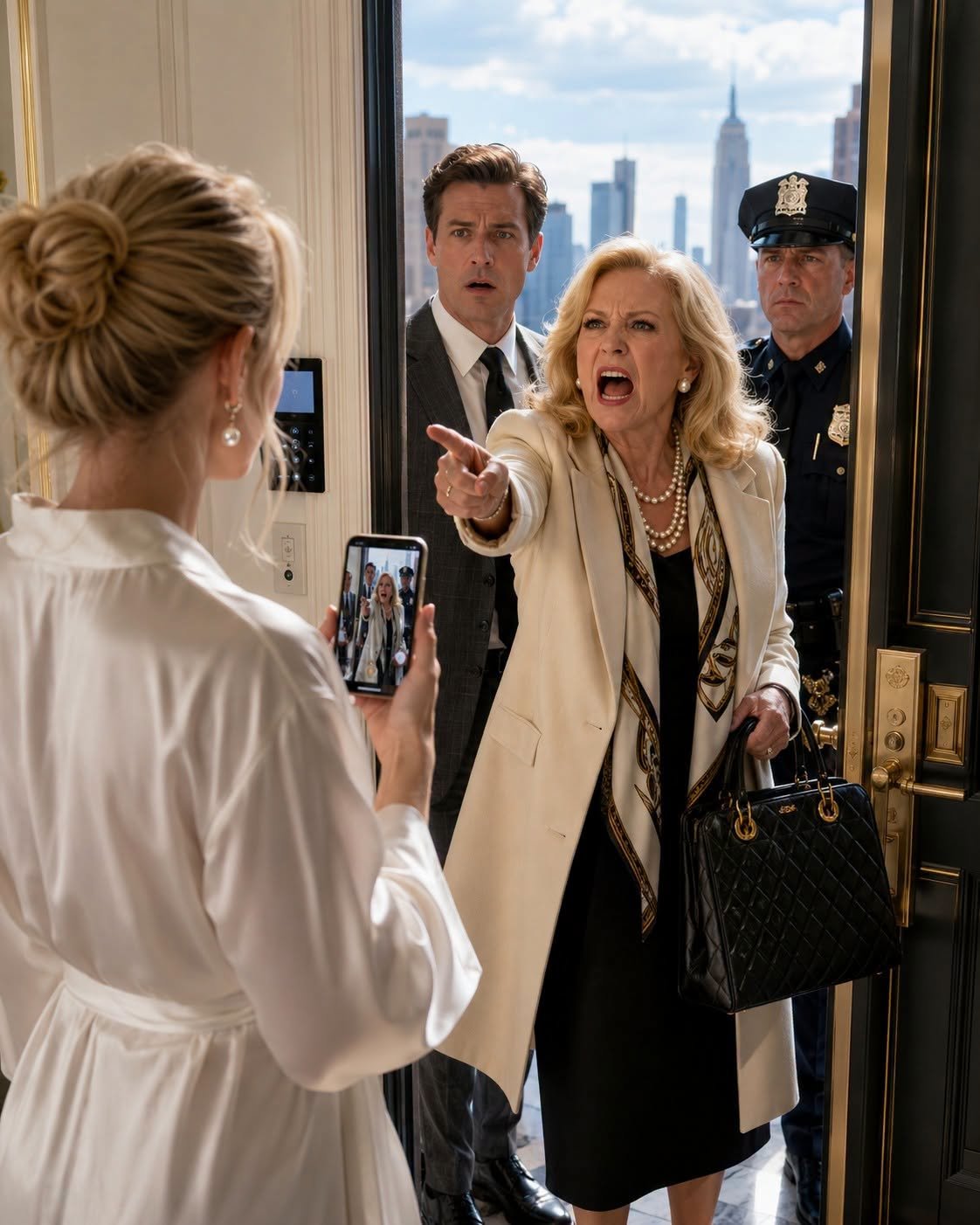
Victoria’s face appeared in the narrow gap, one eye sharpened with outrage.
“Sophia,” she snapped. “Take this ridiculous chain off.”
I lifted my phone so the camera captured her face, the key in her hand, Richard just behind her.
“Victoria, you do not have permission to enter my apartment.”
Her eyes flicked to the phone.
“Oh, don’t be dramatic.”
“You do not have permission,” I repeated.
Richard stepped closer, lowering his voice like that would somehow make the situation less illegal.
“Soph, just open up. Mom’s upset. You embarrassed her yesterday.”
“I canceled my own credit card,” I said. “That isn’t embarrassment. That’s accounting.”
Victoria’s mouth tightened.
“For five years, I treated you like family.”
A laugh escaped me then, soft and stunned, because of all the lies she had told, that was somehow the most insulting.
“You treated me like a receipt you didn’t have to read.”
Richard closed his eyes briefly. In another life, I might have mistaken that look for shame. I might have softened, opened the door, and let them enter the home I paid for, the home where I had cried quietly in
the shower after every holiday dinner, every icy comment, every performance review masquerading as family concern.
Not this time.
Victoria leaned in farther, her perfume drifting through the gap. Gardenia and something expensive, the scent of department-store counters and old money she had never actually possessed.
“Remove the chain,” she said.
“No.”
The security guard appeared behind them, visibly uncomfortable. His name was Malcolm. He had worked in my building for three years and had once helped me carry up six boxes of legal files when Richard had
forgotten to come home on moving day.
“Mrs. Bennett,” Malcolm said carefully, “you can’t enter a resident’s apartment without permission.”
Victoria turned on him with the kind of smile that cut before it warmed.
“This is a family matter.”
“It’s a security matter now,” I said from inside.
Richard looked at the camera, then at the phone in my hand.
“Are you recording us?”
“Yes.”
His face changed. Not much, but enough. His shoulders stiffened. His gaze moved toward his mother’s
hand, toward the key.
“Mom,” he murmured.
Victoria ignored him.
“You think a video will frighten me?” she asked. “You think your little attorney can fix what you’ve done?”
“My attorney told me exactly what to do if you used that key.”
For the first time since she arrived, something flickered across her face.

Not fear.
Recognition.
As though the word attorney had reminded her there were rooms where her voice didn’t automatically win.
Elena’s voice sounded faintly from my phone, still connected.
“Sophia, officers are being dispatched. Building management is on the line with me. Keep recording.”
Victoria heard it.
Her chin lifted.
“You called the police on your own family?”
“You stopped being family when you tried to unlock my door.”
Richard took a step back.
“Mom, close the door.”
She turned on him. “Don’t you dare start acting timid now.”
“I’m not acting timid,” he said, but he was. I heard the old note in his voice, the one I had heard at dinners
when Victoria corrected the way he held a wineglass, when she asked why he had chosen a modest firm instead of private equity, when she reminded him his father would have expected better. “This isn’t helping.”
“This would never have happened if you had handled your wife.”
The word landed between us like something spoiled.
Your wife.
Not ex-wife. Not Sophia. Never a person. Always a role someone else had failed to manage.
I looked at Richard through the narrow opening, and for one moment I saw him at twenty-eight, charming and eager, standing in my office doorway with a bouquet of tulips because I had once mentioned lilies
were too funereal. He had been attentive then. Funny. A little lost, maybe, but kind in the way people can seem kind when they are not being asked to choose.
I wondered when I had stopped waiting for him to choose me.
Maybe the first Thanksgiving at Victoria’s townhouse, when she had announced to the table that my “new money confidence” was refreshing, and Richard had squeezed my knee under the table as if silence were support.
Maybe our second anniversary, when his mother cried because we had traveled to Portugal instead of joining her at the lake house, and he had apologized to her before apologizing to me.
Maybe it had been yesterday, when the judge stamped the end of our marriage and Richard shook my
attorney’s hand before looking at me, as though even goodbye required permission.
“Richard,” I said, my voice quieter now. “Take your mother home.”
His eyes found mine.

For a second, there was a person there I used to know.
Then Victoria shoved the door hard against the chain.
The metal snapped taut with a violent clink.
I flinched despite myself.
Malcolm moved forward.
“Ma’am, stop.”
Victoria lowered her voice. “You think that chain protects you from me?”
“No,” I said, steadying my hand around the phone. “The law does.”
And then came the sound that changed the air completely.
The elevator chimed.
Two officers stepped into the hall, followed by Mrs. Alvarez from building management, wrapped in a gray
cardigan and wearing the expression of a woman who had already had enough before seven in the morning.
Victoria drew back at once. She smoothed the front of her coat, tucked the key into her palm, and became,
in the space of one breath, a respectable woman inconvenienced by other people’s hysteria.
“Officers,” she said, voice trembling delicately. “Thank goodness. My former daughter-in-law is having some sort of episode.”
I almost admired the speed of it.
Almost.
The older officer, a woman with silver-threaded hair pulled into a severe bun, looked from Victoria to the
partially opened door.
“Ma’am, step away from the door.”
Victoria blinked. “Excuse me?”
“Step away from the door.”
The younger officer turned to me. “Are you the resident?”
“Yes.”
“Do you want these individuals inside your apartment?”
“No.”
“Did you give either of them permission to use a key?”
“No.”
Richard’s face had gone pale.
Victoria tried to speak, but the older officer held up one hand.
“Ma’am, I need you to step back and place the key on the floor.”
The hallway went silent.
That was the thing about real authority. It didn’t need pearls. It didn’t need volume. It didn’t need to remind
anyone who it was.
Victoria looked genuinely confused by it.
“This key belongs to my son.”

“No,” I said. “It belongs to my apartment.”
Richard whispered, “Mom.”
For once, he sounded afraid of her answer.
Victoria’s fingers tightened.
The older officer noticed.
“Key on the floor.”
Slowly, with a look of wounded dignity so theatrical it belonged on a stage, Victoria dropped the key onto the carpet.
Malcolm picked it up and handed it to Mrs. Alvarez, who examined it, then looked at Richard with cool
disappointment.
“Mr. Bennett, management requested all copies returned when you vacated the premises.”
Richard swallowed.
“I thought they were.”
I knew then.
Not suspected. Knew.
He hadn’t given it to her.
She had taken it.
Or copied it.
And Richard had either looked away or never noticed, which in our marriage had often amounted to the same thing.
The officers asked questions. I answered through the chain. Elena stayed on the line, occasionally telling me
to pause or clarify. Victoria objected twice and was ignored both times. Richard said very little.
In the end, no one was dragged away. No dramatic arrest. No hallway scene for neighbors to whisper over. The world did not tilt in my favor with cinematic neatness.
Instead, the older officer explained in a firm, tired voice that Victoria could be cited for attempted unlawful entry if I wished to proceed, and that a report would be filed regardless. She warned both of them not to return without written invitation. Mrs. Alvarez added that the building would be changing my locks by noon
and reviewing how unauthorized access had happened.
Victoria looked at me then, and beneath her fury, I finally saw it.
Not regret.
Calculation.
“This isn’t finished,” she said.
The officer turned sharply. “Ma’am.”
Victoria smiled. “I meant emotionally, of course.”
“No,” I said from behind the door. “You meant exactly what you meant.”
Richard looked at me one last time before stepping toward the elevator.
“Sophia,” he said.
There were a hundred things he might have said after my name.
I’m sorry.

I didn’t know.
You deserved better.
Instead, he said nothing.
The elevator doors closed around them, and that silence became the truest thing he had ever given me.
Only after they were gone did my knees weaken.
I shut the door, slid the chain free, locked the deadbolt again, and leaned back against the wood. My
apartment was quiet except for my own breathing and Elena’s voice through the phone.
“Sophia?”
“I’m here.”
“You did well.”
“I don’t feel like I did anything.”
“You didn’t let them in. That was something.”
I sank to the floor, still holding the phone.
The kitchen lights were soft behind me. My coffee had gone cold. Outside, sunlight washed the tops of the buildings in gold, bright and indifferent.
“I thought I’d feel better,” I admitted.
Elena was quiet for a moment.
“Freedom isn’t always light at first,” she said. “Sometimes it’s just empty space where the noise used to be.”
That sentence stayed with me all morning.
By noon, the locksmith had changed both locks. By one, Mrs. Alvarez had personally delivered new keys in a sealed envelope and apologized three times with the restrained horror of someone whose building prided itself on discretion.
By two, Elena arrived in person carrying a leather tote, two coffees, and the expression she wore whenever she was about to turn sympathy into strategy.
She stepped into my apartment, glanced at the newly installed locks, and nodded.
“Good.”
“I’m fine,” I said automatically.
“No, you’re not. But you’re functioning, which is more useful.”
I managed a small smile.
Elena placed the coffees on the island and removed a folder from her tote.
“I need to show you something.”
My stomach tightened.
“That sounds ominous.”

“It is more complicated than ominous.”
“Lawyers should never say things like that before coffee.”
She handed me one of the cups. “Drink.”
I obeyed because Elena was five-foot-two and somehow more commanding than every Bennett I had ever met.
We sat at my dining table, the same walnut table Richard had once called “too modern” because his
mother preferred antiques with histories that could be exaggerated. Elena opened the folder and spread several documents in front of me.
Bank statements.
Credit summaries.
Copies of cardholder agreements.
A timeline.
My name appeared in neat black print across the top of every page.
“What am I looking at?” I asked.
“Evidence that Victoria’s spending was worse than we estimated.”
“I already knew that.”
“No.” Elena tapped the first page. “You knew about the authorized user card tied to your personal account. That was careless but legal while you allowed it. This is different.”
I leaned forward.
“There are charges here from accounts I don’t recognize.”
“Yes.”
A thin coldness moved down my spine.
“Elena.”
She met my eyes.
“Two retail cards were opened eighteen months ago using your information.”
The room seemed to narrow.
“That’s impossible.”
“I wish it were.”
“I never opened retail cards. I don’t use them.”
“I know. That’s why I ran the deeper check after Victoria tried to claim financial dependence during
settlement mediation.”
I looked at the documents again. The store names blurred, then sharpened. High-end department accounts. Luxury home goods. A private shopping service.
Balances paid intermittently.
Mailing address listed as Victoria’s townhouse.
My name.

My Social Security number.
My date of birth.
My signature, or something pretending to be it.
My hand trembled slightly as I reached for one page.
“Richard knew?”
Elena didn’t answer immediately, and that was answer enough to make my heart fold inward.
“I don’t know yet,” she said carefully. “But there is one payment from a joint account you shared with Richard before separation.”
I closed my eyes.
The joint account.
The one I had kept for household expenses long after common sense told me to separate everything. The one Richard had claimed made him feel less like a guest in his own marriage. The one I funded almost
entirely because his salary was respectable but inconsistent, and because I had never wanted him to feel small.
“How much?” I asked.
“Across all accounts? Just over eighty-seven thousand dollars.”
The number entered the room and sat down like a third person.
I stood.
Walked to the window.
Pressed my palm to the cool glass.
Below, Manhattan moved with its usual certainty. Yellow cabs. Delivery bikes. Tiny figures carrying coffee
and briefcases and private burdens nobody else could see. I had built my life in this city by trusting numbers because numbers did not smile at you over dinner and lie. Numbers were clean. Numbers either added up or they did not.
But these numbers had been wearing my name.
“How did she get my information?” I asked.
Elena’s voice softened.
“Sophia, during a marriage, documents are everywhere. Tax returns. insurance forms. mortgage applications. Medical paperwork. It would not have been difficult for someone with access to your home.”
Someone.
Not Richard.
Not Victoria.
Someone.
The kindness of that word nearly broke me.
I turned back.
“I want the truth.”
“Then we proceed carefully.”
“Carefully,” I repeated. “She tried to enter my apartment with a stolen key this morning.”
“And now there is a police report establishing pattern and escalation. That helps. But the financial issue is

separate and serious. We need documentation, credit freezes, disputes filed, and possibly a fraud report.”
I sat down again, suddenly exhausted.
“Why didn’t this come up during the divorce?”
“Because the accounts were not appearing on the initial reports we pulled. They may have been suppressed from paper billing, or the reporting changed recently. I found them after requesting expanded identity monitoring based on Victoria’s spending habits.”
“You suspected this?”
“I suspected she believed your money was still available to her somehow.”
That was such a precise description of Victoria that I almost laughed.
Instead, I stared at the forged signature.
It was strange seeing a stranger attempt to become you.
The loops were wrong. Too decorative. Whoever had signed had tried to make my name look wealthy, not
familiar.
“I don’t write my S like that,” I said.
“No,” Elena said. “You don’t.”
The quiet that followed was heavy but not empty. It held work. Decisions. The first shape of consequence.
For years, Victoria had made me feel petty for caring about money.
Money, to her, was something elegant people didn’t discuss while spending other people’s. If I questioned
a charge, I was insecure. If I set a boundary, I was cold. If I suggested Richard contribute more consistently, I was emasculating him. Somehow, in the Bennett family, financial responsibility was vulgar, but financial entitlement was tradition.
Now the paperwork lay in front of me.
Ugly.
Useful.
Real.
“What happens next?” I asked.
Elena closed the folder halfway.
“First, we secure you. Then we uncover who participated.”
“And Richard?”
“If he knew, that matters. If he didn’t know, that also matters.”

I looked down at my wedding ring finger. The pale indentation was almost gone.
“I don’t know which would hurt more.”
Elena said nothing because she respected grief too much to decorate it.
That evening, after she left, I did something I had avoided for months.
I opened the storage closet.
Inside were the remnants of my married life, boxed and labeled with the ruthless organization of a woman
trying not to feel anything. Wedding albums. Holiday cards. A silver frame from Victoria engraved with Bennett Family Christmas, though I had been placed at the edge of the photograph like a late addition. Richard’s old college sweatshirt. A porcelain bowl his mother had insisted was heirloom quality and I had never liked.
I pulled out the box marked OFFICE — RICHARD.
Most of his belongings had been returned through attorneys, but this box had remained behind because he
never asked for it. Old tax folders. Conference badges. A cracked leather notebook. Pens. A watch manual. Birthday cards from his mother, each written in the same elegant script that somehow managed to sound disappointed even in ink.
I carried the box to the table.
For a long time, I just sat with it.
Then I began sorting.
Most of it was harmless. Receipts. Expired business cards. A program from a charity gala where Victoria
had spent the entire evening introducing me as “Sophia, Richard’s wife, she works in finance,” as though my first name and occupation were unfortunate but necessary facts.
Near the bottom, tucked inside a blue folder, I found a stack of photocopies.
My passport.
My driver’s license.
A page from our tax return.
My signature page from a mortgage application we never completed.
I went very still.
The apartment hummed around me. Refrigerator. Distant traffic. Pipes ticking softly in the wall.
These copies could have been innocent. Marriage created paperwork. Paperwork created duplicates. But my body knew before my mind was willing to admit it.
I took pictures and sent them to Elena.
Her response came less than a minute later.
Do not touch anything else without gloves. Put the contents back exactly as found. I will arrange collection.
I stared at the text until the words blurred.
Then another message appeared.
Sophia, I’m sorry.
That was when I cried.
Not loudly. Not beautifully. There was no collapse, no dramatic sobbing against the window while rain traced the glass. The evening was clear. The city lights came on one by one. I sat at my dining table with

forged debts in my name and photocopies of my identity in my ex-husband’s forgotten box, and tears slid silently down my face.
I cried for the woman I had been at thirty-two, standing in a cream dress beneath hundreds of white
orchids while Victoria adjusted my veil and whispered, “Try not to look so nervous, dear. People can sense insecurity.”
I cried for every time Richard said, “She doesn’t mean it that way.”
I cried for the years I had spent translating cruelty into tradition, entitlement into family values, abandonment into loyalty.
But mostly, I cried because some part of me had still been protecting him.
Even after the divorce.
Even after the phone call.
Even after the key.
Some foolish, tender part of me had still been standing guard over the memory of the man who brought tulips to my office and remembered I hated lilies.
And now I had to ask whether that man had handed my life over to his mother, or simply left it unguarded
long enough for her to take.
Both answers hurt.
The next morning, Richard emailed me.
Not called. Not texted. Emailed.
Maybe because his number was blocked. Maybe because email felt civilized. Maybe because men like Richard often mistook distance for dignity.
The subject line read: Please.
I almost deleted it.
Instead, I forwarded it to Elena, waited for her permission, then opened it.
Sophia,
I know yesterday was awful. I’m sorry for how things happened. My mother was upset and I should have handled it differently. She has always had strong reactions when she feels disrespected, and I know that
doesn’t excuse anything.
I’d like to talk privately. Not through attorneys. Not about money. Just us.
There are things you don’t understand.
Richard
I read it three times.
There are things you don’t understand.
The sentence could have been a confession or a manipulation. With Richard, the two often wore the same
clothes.
Elena called twenty minutes later.
“Do not meet him privately.”
“I wasn’t planning to.”
“Good. But we may want him to talk.”
I leaned back in my chair. “You want me to answer?”
“I want you to give him a controlled opening. Written only.”
“Elena, he might be involved.”
“Yes. And guilty people sometimes explain themselves when they believe they are being misunderstood.”
I looked at the email again.
There are things you don’t understand.

My marriage had been built around that sentence. I didn’t understand his mother. I didn’t understand their traditions. I didn’t understand how hard it was for him to balance everyone’s feelings. I didn’t understand why peace required my silence but never Victoria’s restraint.
“What should I say?”
Elena dictated one sentence.
I typed it slowly.
Richard, any communication should remain in writing. What do you believe I don’t understand?
I sent it.
The reply came faster than I expected.
You don’t understand what she’s capable of when cornered.
I stared at the screen.
For the first time all day, I forgot to breathe.
Another email appeared.
And you don’t understand that cutting off the card may have exposed something much bigger than the shopping.
I called Elena immediately.
She answered with, “Forward it.”
“I already did.”
“I’m reading.”
Her silence lasted long enough for me to stand and pace.
“What does he mean?” I asked.
“I don’t know.”
But her voice had changed.
“Elena.”
“I said I don’t know. Not that I don’t have concerns.”
The next message from Richard arrived before she could continue.
Mom has been borrowing money from people. Not banks. People she knows socially. She told them funds
were tied up because of the divorce and implied you were withholding family assets.
I whispered, “Family assets?”
Elena exhaled sharply. “Keep reading.”
Another email.
One of them is threatening to sue. Another called me last night. They think you guaranteed repayment.
I sat down hard.
“That’s absurd,” I said.
Elena’s voice was clipped now. “Did you ever sign anything for Victoria? Charity pledge, club membership, investment subscription, private loan acknowledgment?”
“No.”
“Think carefully.”
“No. I was careful with documents.”
“Sophia.”
“I was careful with everything except the people.”
That stopped us both.
The emails kept coming.
I think she used old letterhead from your firm. Or something that looked like it. I don’t know how much is real. I found out because someone sent a copy to my office demanding payment.

My firm.
I felt the blood leave my face.
“Elena,” I said.
“I see it.”
“My career.”
“I know.”
“My licenses. My reputation.”
“I know.”
The words were steady, but underneath them I heard urgency.
Victoria had not simply spent too much.
She had performed wealth.
And when my credit card stopped working, the performance had cracked.
I thought of all those lunches at private clubs, the whispered introductions, the charity boards where women smiled with diamond-bright eyes and kept mental ledgers of who owed whom. Victoria had lived for those rooms. If she had borrowed against the illusion of my money, then canceling that card had done more than embarrass her.
It had announced to everyone watching that the Bennett fortune had no foundation.
Richard sent one final email.
I should have told you before. I didn’t know how. I found copies of documents in her desk months ago.
Some had your name on them. I wanted to ask her, but Dad’s anniversary was coming, and then the divorce got worse, and I thought if I kept things calm, maybe it would all settle.
I read that last line until it turned meaningless.
Maybe it would all settle.
That was Richard’s entire soul in five words.
“Elena,” I said quietly, “he knew enough.”
“Yes,” she said.
For the rest of the day, I moved through procedures like a woman underwater.
Freeze credit. File disputes. Preserve emails. Notify my firm’s general counsel. Prepare a statement in case fraudulent documents bearing my name surfaced. Every step felt both necessary and unreal.
My office responded faster than I expected.
At 4:15, I was on a secure video call with Marianne Cho, our general counsel, and Daniel Reeves, the managing partner who had hired me eight years earlier when I was still proving I deserved every room I entered.
Daniel looked older than he had the week before. Or maybe I had simply never noticed how worry aged powerful people.
“Sophia,” he said, “first, we are sorry this is happening.”
Marianne added, “Second, we are treating you as a potential victim of identity misuse unless evidence indicates otherwise.”
Unless.
There it was.
The thin professional line between support and self-protection.
“I understand,” I said.
And I did. That was the worst part. I understood the need to protect the firm. I understood reputation,
liability, risk. I had built my career around anticipating damage before it spread.
Now I was the damage.
Marianne shared her screen.
A scanned document appeared.
My firm’s logo sat at the top.
Beneath it, a letter addressed to a woman named Evelyn Hart.

To Whom It May Concern:
This letter confirms that Mrs. Victoria Bennett has access to secured family assets held under the advisory supervision of Sophia Bennett…
I stopped reading.
My eyes had gone directly to the bottom.
My signature.
Not quite right.
Too elegant again.
Too much flourish.
But close enough to trouble me.
“Where did you get this?” I asked.
“Evelyn Hart’s attorney forwarded it this afternoon,” Marianne said. “They claim Mrs. Hart loaned Victoria Bennett two hundred fifty thousand dollars based partly on this assurance.”
The room seemed to tilt.
“Two hundred fifty thousand dollars?”
Daniel’s jaw tightened.
“There may be others.”
I gripped the edge of my desk.
“I did not write that letter. I did not authorize that letter. I have never advised Victoria Bennett or any
member of her family in a professional capacity.”
“We believe you,” Daniel said.
Marianne’s expression remained unreadable.
“We believe the signature is inconsistent,” she said. “We also found metadata suggesting the PDF was created on a home device, not within our document system. However, the logo and formatting appear copied from a legitimate firm template.”
I knew exactly where that template could have come from.
My home office.
For years, I had worked late at the apartment while Richard drifted in and out of the room. He brought tea
sometimes. Asked if I was almost done. Kissed the top of my head. Once, in the early days, he had said he loved watching me work because I looked “untouchable.”
Untouchable.
The memory made me feel ill.
Daniel leaned closer to the camera.
“Sophia, we need full cooperation.”
“You have it.”
“There may be an internal review.”
“I understand.”
“And you need personal counsel separate from the firm.”
“I have her.”
Marianne nodded. “Good. Preserve everything. Do not contact Victoria Bennett directly.”
“I won’t.”
After the call ended, I sat alone in my home office, staring at the dark screen. My reflection stared back.
For five years, Victoria had tried to make me smaller.
Now, somehow, she had made herself large enough to threaten everything I had built.
A knock sounded at my door at six.
Not pounding this time.
Three soft taps.
My body reacted before my mind could calm it. I checked the monitor.
Richard stood in the hallway alone.

He looked terrible.
Unshaven. Tie loosened. Coat wrinkled. His eyes were red-rimmed, not theatrically but from the kind of sleeplessness that catches up with men who have avoided consequences too long.
I didn’t open the door.
I pressed the intercom.
“You can’t be here.”
“I know.”
“Then leave.”
“I found something.”
My hand froze over the button.
“Send it to Elena.”
“I can’t.”
“Then leave.”
“Sophia, please.”
I hated that word from him. Please had been his favorite tool. Soft enough to sound harmless. Heavy enough to make refusal feel cruel.
But this time his voice was different.
Stripped.
“I’m not asking you to let me in,” he said. “I know I lost that right. I just need to give you this before my
mother realizes I took it.”
He lifted a brown envelope toward the camera.
I called Elena.
She stayed on the line while I called Malcolm upstairs. Together, with security present, I opened the door only wide enough for Richard to place the envelope on the floor and step back.
He looked at me then.
Really looked.
No irritation. No practiced patience. No exhausted husband waiting for his wife to stop being difficult.
Just a man standing in the ruins of every compromise he had mistaken for love.
“I’m sorry,” he said.
The words were simple.
Too late.
But real enough to hurt.
I didn’t answer.
Malcolm picked up the envelope with gloved hands from the front desk kit Elena had insisted I keep after the morning incident. He brought it inside and waited while I closed and locked the door.
Only then did I open it.
Inside was a small black notebook.
Victoria’s handwriting filled the pages.
Columns. Names. Amounts. Dates.
Evelyn Hart — 250K — letter sent
Margaret Vale — 90K — promise bridge financing
Lydia S. — 140K — Richard unaware
Club account — past due
Card 2 — Sophia signature
My pulse thudded in my throat.
Page after page, Victoria had documented her own deceptions with the meticulous pride of a woman who considered herself organized, not dishonest.
Near the middle, one entry made my fingers turn cold.
S.B. account — keep active until transfer complete.
Transfer?

I turned the page.
There, tucked between two sheets, was a folded printout.
At first, I didn’t understand what I was seeing. It looked like a corporate formation document. An LLC
registered in Delaware.
Bennett Legacy Holdings.
Authorized manager: Victoria Bennett.
Secondary authorized signatory: Sophia Bennett.
My name again.
My signature again.
And beneath that, a bank confirmation for an account I had never opened.
Balance: $612,408.19.
For several seconds, I could not move.
Elena’s voice came through the phone.
“Sophia? What is it?”
I tried to speak, but the words had caught somewhere behind my ribs.
Because clipped to the back of the bank confirmation was a copy of a pending wire transfer request.
Amount: $600,000.
Recipient: an overseas account I did not recognize.
Scheduled date: tomorrow.
Authorization status: awaiting secondary confirmation.
And below it, in Victoria’s sharp handwriting, were six words that made the room go utterly still.
Richard must get Sophia to sign.