A Homeless Mom Inherited an Old Cabin — It Was Worth $265 Million, But…
When the letter arrived, it was addressed to a shelter.
Not to an apartment.
Not to a house.
Not to a forwarding address.
Rachel almost didn’t open it.
At thirty-nine, she had learned that most official envelopes carried bad news—overdue balances, denied applications, final notices. She was sitting on the edge of a narrow bunk bed while her seven-year-old daughter, Lily, colored quietly beside her.
“Is it important, Mommy?” Lily asked.
Rachel studied the thick cream paper. The return address bore the name of a law firm she didn’t recognize.
“It’s probably nothing,” she murmured.
But she opened it anyway.
The letter was brief.
It informed her that a distant relative—one Eleanor Whitmore—had passed away and named Rachel as sole beneficiary of her estate.
Rachel blinked.
She had no idea who Eleanor Whitmore was.
The letter instructed her to contact the firm regarding transfer of property located in northern Montana.
Property.
Rachel laughed softly.
The last property she had “owned” was a thrift-store lamp she’d left behind when eviction came two winters ago.
She folded the letter and slipped it into her worn backpack.
“Maybe we’re royalty,” Lily said brightly.
Rachel smiled despite herself.
“Maybe we inherited a castle.”
They both knew better.
Three weeks later, Rachel and Lily sat inside a polished conference room that smelled faintly of leather and expensive coffee.
The attorney, a gray-haired man named Mr. Carver, adjusted his glasses.
“Ms. Whitmore,” he began gently, “your great-aunt Eleanor lived a very private life. She never married. No children. Very few public records.”
Rachel nodded slowly.
“I didn’t even know she existed.”
“She purchased a large parcel of land in 1978,” he continued, sliding a folder across the table. “Approximately 42,000 acres.”

Rachel’s fingers froze.
“Forty-two thousand?”
“Yes.”
Her throat tightened.
“That’s… that’s a ranch?”
“It includes forest, freshwater access, and mineral rights,” he clarified.
Her heart thudded.
“And on this land,” he added, “is a cabin.”
Rachel let out a shaky breath.
A cabin.
Of course.
That sounded more realistic.
Old wood. Probably falling apart. Taxes overdue. Roof leaking.
“We’ll arrange transport for you to view it,” Mr. Carver said. “There is one matter, however.”
Here it comes, she thought.
“There are stipulations in the will.”
Rachel straightened.
“What kind of stipulations?”
He folded his hands.
“You must reside on the property for a minimum of one year before you may sell, lease, or transfer any portion of it.”
Rachel stared.
“I… have to live there?”
“Yes.”
She thought of the shelter bunk. The thin blanket. The nightly hum of twenty women breathing in the dark.
Live in a cabin in the woods?
It almost sounded peaceful.
“What if I can’t?” she asked carefully.
“Then the estate transfers to the state conservation trust.”
Rachel glanced at Lily, who was swinging her legs beneath the table.
“Mom, are we getting a castle?”
Rachel swallowed.
“No, baby. A cabin.”
The drive north took six hours.
Asphalt gave way to gravel, gravel to dirt. Mountains rose around them like ancient guardians. Pines thickened. Cell service vanished.
Rachel’s stomach fluttered—not with fear, but something unfamiliar.
Possibility.
Finally, the SUV turned onto a narrow path flanked by towering trees.
And then she saw it.
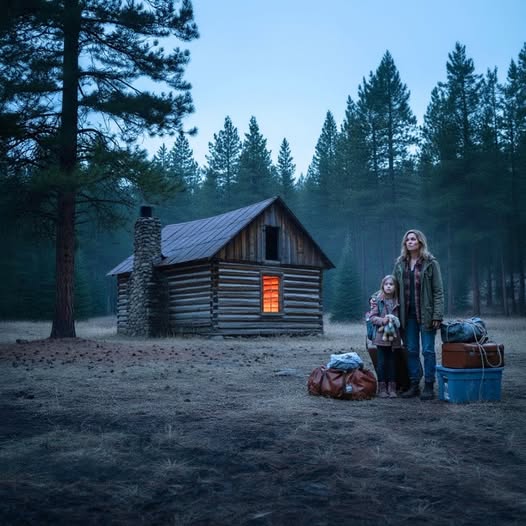
The cabin stood beside a crystal-clear lake, framed by mountains dusted with late-spring snow. It was rustic—hand-hewn logs, stone chimney, wide porch overlooking water that reflected the sky like glass.
It wasn’t falling apart.
It was breathtaking.
Lily gasped.
“Mom… it’s like a storybook.”
Rachel stepped out slowly.
The air smelled clean. Untouched.
For a moment, she couldn’t speak.
She had slept in cars. In bus stations. In a church basement during winter storms.
And now she stood in front of this.
Inside, the cabin was simple but well maintained. Wood-burning stove. Antique furniture. Shelves of books. Solar panels discreetly mounted near the treeline.
It felt less like a property.
More like a sanctuary.
Rachel walked onto the porch.
“Why me?” she whispered to the wind.
The first weeks were strange.
No city noise.
No sirens.
No fluorescent shelter lights humming overhead.
Just wind through pines and water lapping gently against the dock.
Rachel learned how to split wood. How to maintain the generator. How to fish with Lily off the small pier.
They planted a small vegetable garden near the south-facing wall.
At night, they sat under stars so bright it hurt to look at them.
For the first time in years, Rachel slept without fear.
But she couldn’t ignore the other part of the estate.
The mineral rights.
The acreage.
The numbers Mr. Carver had mentioned casually during paperwork.
After independent valuation, the land—due to rare earth deposits discovered nearby and increasing corporate interest in clean-energy materials—was estimated at $265 million.
Two hundred sixty-five million dollars.
Rachel had once cried over not having enough gas money to drive Lily to school.
Now she was sitting on land worth more than she could comprehend.
But the stipulation remained.
One year.
And she was beginning to understand why.
In Eleanor’s study, Rachel found journals—meticulously written entries spanning decades.
Eleanor had purchased the land to protect it.
She wrote about corporations attempting to buy surrounding acreage. About drilling proposals. About forest clear-cutting.
“If I do nothing,” one entry read, “this place will vanish beneath machines.”
Rachel traced the ink with her fingertip.
Another entry, dated just months before Eleanor’s death:
“If Rachel ever reads this, I hope she understands: wealth is not always freedom. Sometimes it is responsibility.”
Rachel’s chest tightened.
Eleanor had known about the minerals.
About the value.
She could have sold decades ago.
Instead, she held the land.