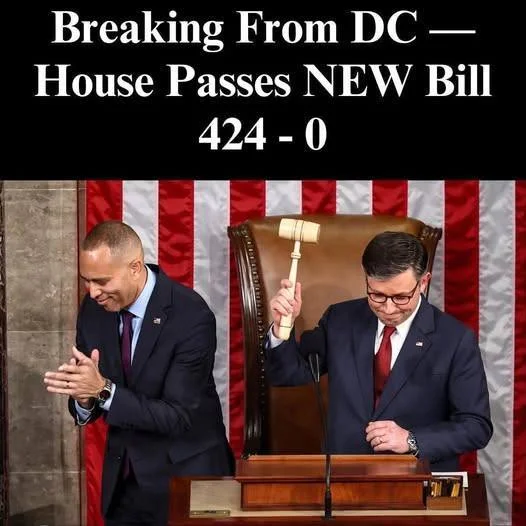
This week, the U.S. House of Representatives came together in a rare act of complete unity — a 424-0 vote that transcended partisanship and politics to reaffirm a simple truth: those who have risked everything for their country deserve more than gratitude; they deserve lasting support.
The bill, introduced with bipartisan sponsorship, seeks to raise the annual pensions of Medal of Honor recipients from $16,880 to $67,500 — a fourfold increase that would stand as the most significant boost to the benefit in modern history.
If the Senate approves the measure and the President signs it into law, the change will impact roughly 60 living recipients of the Medal of Honor — the nation’s highest and most sacred military decoration.
Why This Bill Matters Now
The push for higher pensions isn’t about luxury. It’s about dignity — and about ensuring that the heroes who once stood between freedom and tyranny can live their later years without financial strain.
Congressmen Troy Nehls of Texas and Chris Pappas of New Hampshire, who co-sponsored the bill, explained that many Medal of Honor recipients dedicate their retirement years to continuing service.
“They travel the country,” said Rep. Nehls, “visiting schools, speaking to veterans’ groups, attending ceremonies — reminding Americans what courage, sacrifice, and duty really mean. They do this not for fame or money, but out of love for the country they defended.”
However, those trips — airfare, lodging, meals — are often paid for from their own pockets.
“They’re not wealthy men,” Rep. Pappas added. “They’re soldiers, Marines, sailors, and airmen who did extraordinary things in extraordinary times. And they deserve our support, not our neglect.”
This legislation would help ensure that their devotion — both on the battlefield and beyond it — is recognized in a tangible, enduring way.
How the Funding Works
The increased pension will be funded through the Department of Veterans Affairs (VA) budget, primarily using existing disability compensation funds.
To offset the cost, the bill extends certain pension limitation provisions for veterans without dependents from 2031 to 2033. This adjustment, lawmakers say, will maintain the VA’s fiscal balance while honoring the promise made to America’s greatest heroes.
“Every dollar is accounted for,” said Nehls. “This isn’t about adding burden to taxpayers — it’s about reallocating priorities. These heroes are the reason we have a nation to budget for in the first place.”
A Legacy of Valor and Rising Recognition
The Medal of Honor, established in 1863 during the Civil War, remains the ultimate symbol of American valor. It’s awarded for acts of courage that go “above and beyond the call of duty,” often in moments when survival seems impossible.
Since its creation, fewer than 3,600 individuals have received it — a number that underscores both its prestige and the gravity of the actions it commemorates.
Over the years, the pension tied to the Medal of Honor has grown slowly, tracking the country’s changing understanding of what true recognition should look like:
1916: $10 per month
1961: $100 per month
2002: $1,000 per month
2024: $16,880 per year
This new bill — if passed by the Senate — would quadruple that amount, setting a precedent for future generations.
As Rep. Pappas noted during the floor debate, “This isn’t just about money. It’s about message. It’s about telling our heroes that their sacrifices are not relics of history — they’re living legacies that deserve our respect every single day.”
A Timely Moment: The Opening of the National Medal of Honor Museum
The bill’s passage coincides with another historic milestone — the opening of the National Medal of Honor Museum next month in Arlington, Texas.
This $300 million facility will be the first of its kind: a national home dedicated solely to preserving and sharing the stories of Medal of Honor recipients.
Built to educate, inspire, and honor, the museum will offer immersive exhibits detailing acts of courage across generations — from Civil War soldiers who charged into gunfire to modern-day heroes who risked everything in Afghanistan and Iraq.
“The museum isn’t just about the past,” said its CEO, Chris Cassidy, himself a retired Navy SEAL and former NASA astronaut. “It’s about teaching future generations what courage and integrity look like in real life.”
For many of the living recipients, the museum represents not only a commemoration of their sacrifice but also a bridge between their service and the public’s understanding of it.
The Man Behind the Medal: Maj. James Capers
Among those whose stories will feature prominently is Maj. James Capers Jr., a U.S. Marine Corps legend from the Vietnam War.
In 1967, then-Lieutenant Capers led Team Broadminded, a small reconnaissance unit tasked with gathering intelligence deep in enemy territory in Phú Lộc, Vietnam.
When his team was ambushed by a numerically superior force, Capers was severely injured — his leg shattered, shrapnel embedded in his abdomen. Yet he refused evacuation. Crawling through gunfire, he dragged wounded men to safety, coordinated airstrikes, and continued fighting until every one of his surviving men was extracted.
For his heroism, Capers received the Silver Star, Bronze Star, and Purple Heart — but those who served with him have long argued that his courage merited the Medal of Honor.
More than half a century later, the campaign to upgrade his decoration remains ongoing, supported by a bipartisan coalition in Congress and a groundswell of public support.
Capers, now in his late 80s, humbly resists the title of “hero.” “I was just doing my duty,” he said in a 2023 interview. “I wanted my men to make it home. That’s all.”
His story — like those of many others — encapsulates the enduring spirit behind the Medal of Honor: selflessness, loyalty, and love for one’s fellow soldiers.
Life After the Medal: The Burden of Being a Hero
For those who receive the Medal, life changes instantly — but not always in the ways people imagine.
They are celebrated in ceremonies, invited to speak at schools, honored at sporting events. But the weight of that medal — both literal and symbolic — can be heavy.
Retired Army Master Sgt. Leroy Petry, awarded the Medal of Honor in 2011 for saving fellow soldiers in Afghanistan despite losing his hand to a grenade, once said, “The Medal is not about me. It’s about them — the ones who didn’t make it back.”
That sense of duty never leaves them. Many recipients spend their later years as mentors, advocates, and educators, traveling across the nation to speak about courage, sacrifice, and the responsibilities of citizenship.
But as they age, those journeys become harder to afford.
That’s what inspired this bill: the recognition that service doesn’t end when the battlefield falls silent.
Stories of Modern Valor
The new pension increase would touch veterans from across generations.
Gary Beikirch, who saved countless lives as a medic under fire in Vietnam, lived modestly, often declining speaking fees. He passed away in 2021, but friends say he would have applauded this measure.
Florent Groberg, who tackled a suicide bomber in Afghanistan in 2012, now mentors young veterans adjusting to civilian life.
Clinton Romesha, who led a small unit to defend Combat Outpost Keating in Afghanistan, continues to advocate for fellow servicemembers struggling with PTSD.
These men — and the few dozen others still alive — form a living bridge between the history books and the present day.
Their courage spans continents and centuries, yet their humility remains the same.
Beyond the Battlefield
To understand why this bill carries such emotional weight, one must look beyond numbers.
Each Medal of Honor tells a story that can’t be captured in statistics — stories of soldiers who ran toward fire instead of away from it, who chose duty over safety, who placed the lives of others above their own.
Behind each medal lies trauma, loss, and sacrifice. Many recipients bear lifelong physical and emotional scars. For some, the honor is bittersweet — a reminder of friends lost rather than glory gained.
For decades, these men have asked for nothing. They didn’t lobby for this increase. Lawmakers and veterans’ advocates did — because, as one staffer put it, “Sometimes the people who deserve the most are the last to ask for anything.”
A Bipartisan Moment in a Divided Nation
In a political climate often defined by division, the 424-0 vote stood as a rare moment of unanimity — a reminder that gratitude for those who defend the nation transcends party lines.
Speaker after speaker on the House floor echoed that sentiment.
Rep. Nehls said: “We can disagree on policies, on taxes, on borders. But not on this. Not on honoring our heroes.”
Democrat Rep. Pappas added: “This vote isn’t blue or red — it’s red, white, and blue.”
The bill now moves to the Senate Veterans Affairs Committee, where early indications suggest it will pass swiftly with bipartisan support.
The Meaning of $67,500
For the roughly 60 living Medal of Honor recipients, $67,500 represents more than financial relief. It represents acknowledgment — a national gesture that says: We still see you.
The increase may allow recipients to travel more freely, attend commemorations, or simply live comfortably without financial worry.
But its symbolic value extends further — to the families of fallen heroes, to young service members just beginning their careers, and to the millions of Americans who draw inspiration from their courage.
As President John F. Kennedy once said while presenting the Medal of Honor to a World War II veteran, “A nation reveals itself not only by the men it produces but by the men it honors.”
Looking Ahead: Preserving Courage for Future Generations
The new pension bill and the opening of the museum arrive at a crucial moment — when the last generation of World War II veterans is passing into history, and younger Americans are increasingly disconnected from the realities of war.
The goal, lawmakers and historians say, is not merely to reward the past but to educate the future.
When the National Medal of Honor Museum opens its doors, it will feature interactive exhibits, personal letters, combat footage, and artifacts that bring to life the humanity behind the heroism. Schoolchildren will walk through galleries filled with stories of valor — learning not just about war, but about character, humility, and resilience.
As Maj. Gen. Patrick Brady, a Medal of Honor recipient from Vietnam, once said:
“The Medal doesn’t belong to me. It belongs to every soldier who ever served. I just wear it for them.”
Conclusion: Honoring the Few, Inspiring the Many
The legislation passed this week does more than raise a pension. It raises a standard — of gratitude, remembrance, and national unity.
In an age where headlines often divide, this vote united every voice in Congress around one enduring truth: that bravery deserves not only recognition but also care.
If the Senate follows through — as expected — America will soon give back, in small measure, to those who gave everything.
And perhaps, as future generations visit the new museum in Arlington, they’ll understand why these stories endure — not as relics of war, but as reminders of the very best of who we are.
Because in the end, courage never ages.