On the 3rd day of January, at 14 minutes
10:00 in the morning, my phone rang while I was scraping frost off my windshield.
“Mrs. Callahan, it’s Marcus from Mommy Valley Credit Union.”
I knew that voice. I had banked with Marcus for 11 years.
“Is everything all right, Marcus?”
He paused. And in that pause, I heard everything I needed to know.
“Your daughter-in-law is here,” he said quietly. “She has a power of attorney with your signature on it. It’s notorized. She’d like to open a home equity line of credit on your house.”
I set the ice scraper down on the hood of my Buick.
“And Mrs. Callahan,” he went on, lowering his voice even more, “I need to ask you about what’s written
above your name.”
I closed my eyes and I smiled. Not because I was happy. Because I had been waiting 10 days for that phone call.
Let me tell you how I got there.
Christmas Eve started the way Christmas Eve always started in my house. I was up at 6:00. I had the ham in
the oven by 9:00, brown sugar and cloves, pineapple rings pinned on with toothpicks, the way my mother taught me back in Lima, Ohio, when Eisenhower was president.
My name is Margaret Callahan, but everyone has called me Peggy since the first grade. I’m 71 years old. I live in Sylvania, just outside Toledo, in a brick ranch house my late husband Frank and I bought in 1981 for $42,000.
We paid it off the year our son Daniel graduated high school. Frank has been gone 3 years now. His recliner is still in the living room. I don’t sit in it, but I don’t move it either.
For 38 years, I was the bookkeeper at an auto parts supplier on Laski Road. I caught a lot of mistakes in that job. Most were honest. Some were not.
After a while, you develop a feeling in your stomach when a number doesn’t sit right, or when somebody
hands you a paper and says, “Just sign here, Peg. It’s routine.”
Routine was usually the word they used right before something wasn’t.
That afternoon, the house smelled of ham and cinnamon. I had set the dining room table for five: me, Daniel, his wife Brittney, and my two grandchildren, Lily, who is 10, and Owen, who is seven.
Lily had helped me set up the nativity set on the hutch, with the camel facing the baby Jesus so he doesn’t
feel left out.
At 4:40, I heard tires crunch on the snow in the driveway. I went to the door smiling.
It was only Brittany.
She came in fast with her keys in one hand and her phone in the other. Her coat was still zipped. Through the window, I could see the minivan running, the children in the back seat.
“Hi, Mom. Merry Christmas.”
She gave me one of those hugs where only the shoulders touch.
“Listen, I am so sorry. My mom moved dinner up, so we have to be in Parisburg by 5. And you know how she gets. We can’t stay.”
I looked past her at the dining room table. Five plates, five glasses, the good napkins.
“Oh,” I said. “Well, I made the ham.”
“I know, and it smells amazing. Can you wrap some up for Daniel?”
She was already reaching into her purse.
“But I need one tiny favor first.”
She pulled out a stack of Christmas cards with gold foil snowflakes.
“These are for the kids’ teachers and the bus driver and the coaches. I need you to sign ‘Love, Grandma Peggy’ on each one. Quickly, though. Okay, we’re late.”
I took the stack and sat down at the kitchen table. She stood over me, tapping on her phone.
I signed the first card, then the second, third, fourth, fifth.
“Love, Grandma Peggy. Love, Grandma Peggy.”
The last card felt different.
It was thicker, heavier. When I pressed my thumb against it, I felt the edges of folded paper inside. Not card stock. Paper, the legal-sized kind I had handled every working day for 38 years.
I didn’t look up.
I lifted the corner of the card, just a little.
Two words, bold in capital letters at the top of the page.
Power of attorney.
Below that, smaller, durable. Then my name typed. Then Daniel’s name typed as my agent and Britney’s name as the backup.
I saw the words real property. I saw banking transactions. I saw gifts.
There were little yellow sticky tabs on the pages.
Sign here. Sign here. Sign here.
My heart did something I hadn’t felt since the night the hospital called about Frank.
It didn’t race. It went very, very still.
I could have thrown it on the floor and asked her what in God’s name she was doing.
30 years ago, I would have.
But I am 71, and I have learned something about people who are in a hurry.
They are rushing so you won’t look. And if you look anyway, they just come back later with a better plan.
So I smiled.
“You know what, honey? These are lovely cards.”
“Thanks, Mom.”
She didn’t look up from her phone.
I picked up my pen, and on every page, before I signed my name, I wrote a few words above it, neat and
small, in the same block print I had used on 10,000 invoices.
Then I signed every page, every yellow tab.
I folded it back into the card and handed the bundle up to her.
“There you go, sweetheart. All done.”
“You’re the best.”
She tucked them into her purse without a glance, kissed the air near my cheek, and was halfway to the door.
“Love you, Mom. Merry Christmas.”
The door closed. The minivan backed out.
Lily waved at me through the back window, and I waved back until they turned the corner onto Monroe
Street.
Then I went back into the kitchen, turned off the oven, and sat down in front of five empty plates.
She never bothered to check what I wrote above my name.
But someone else would.
I sat at that table until the ham went cold.
I’d like to tell you I was shocked. That would make a better story. But the truth is, when I lifted the corner of that card, what I felt wasn’t surprise.
It was recognition.
Like finally finding the error in a ledger you’ve been rechecking for months.
Because the signs had been there. I just hadn’t wanted to add them up.
It started the spring after Frank passed.
Britney offered to help me set up online banking. She sat beside me at the same table with my laptop and said, “Mom, just tell me your passwords and I’ll write them down somewhere safe for you.”
I gave her two before something in my stomach told me to stop.
I changed them that night and never mentioned it.
Then came the comments. Small ones, always said with a smile.
“Mom, this house is so much for you to keep up.”
“Mom, what if you fall on those basement stairs and nobody finds you?”
“Mom, do you even know what this place is worth now? You should know for insurance reasons.”
In October, I found a glossy brochure on my kitchen counter for a senior living community out in Mommy.
Independent living with a lifestyle.
Britney said she’d picked it up for a friend’s mother and must have left it by mistake.
I put it in the recycling bin.
The next week, there was another one.
And Daniel. My Daniel.
He’d been looking tired for a year, gray under the eyes. Quiet in a way he never used to be.
In August, he showed up at my house in his old Ford Taurus instead of the new pickup truck he’d been so proud of.
When I asked about it, he said, “Traded it in. Mom, didn’t need all that truck.”
He didn’t look at me when he said it.
Then in November, Lily stayed with me overnight while her parents went to a work party.
We were making grilled cheese sandwiches when she said out of nowhere, “Grandma, mommy cries in the
car about the mortgage.”
I kept flipping the sandwich.
“Does she, sweetheart?”
“Uh-huh. And daddy says, ‘We’ll figure it out.’ He says that a lot.”
I didn’t ask her any more questions. You don’t put a 10-year-old in the middle of grown-up trouble.
But I lay awake that night listening to the furnace kick on and off, thinking.
Christmas morning, I woke up at 5, the way I always do.
The house was so quiet I could hear the kitchen clock ticking.
I made coffee and sat in the living room across from Frank’s recliner.
Near the end, when he was on oxygen and sleeping most of the day, Frank woke up one afternoon and
grabbed my hand.
“Peg,” he said, “put your affairs in order. Promise me. Or someday somebody else will put them in order for you.”
I promised.
And then I didn’t do it.
Every time I sat down to call a lawyer, it felt like admitting I was next. So I put it off.
One year became three.
Daniel called at 11:00. I could hear wrapping paper and the television in the background.
“Merry Christmas, Mom. Sorry about last night. Britney’s mother, you know.”
“I know, honey.”
“Kids say thanks for signing the cards.”
I held the phone a little tighter.
“Daniel, did Britney mention anything else she needed me to sign?”
There was a pause.
“No. Like what?”
“Never mind. Merry Christmas, son.”
After we hung up, I sat there for a long time.
That pause. It wasn’t the pause of a man hiding something. It was the pause of a man who had no idea.
And somehow, that frightened me more.
At about 4:00, someone knocked on the back door.
Only one person in Sylvania uses my back door.
Ruth Kowalsski has lived next to me for 26 years. She’s 74, 5′ nothing, and she spent 30 years as a clerk at the Lucas County Probate Court.
She came in stamping snow off her boots, holding a foil-covered dish.
“Perogi, potato and cheese. My sister made 200 of them, and I can’t look at another one.”
She set the dish down and looked at me.
“Peggy, what’s wrong?”
I hadn’t planned to tell anyone.
But Ruth has a way of looking at you over her reading glasses that makes lying feel like a waste of time.
So I told her everything.
The cards, the thick envelope, the yellow tabs, the words at the top of the page.
Ruth didn’t say anything for a moment.
She took off her glasses and cleaned them on her sweater.
“Durable power of attorney,” she said. “Real estate and banking powers. Gifting. Gifting.”
She let out a long breath.
“Peggy, I watched families tear each other apart over these for 30 years. A power of attorney is a loaded gun, honey. It doesn’t matter if your son is the one holding it. What matters is who’s standing behind him.”
“Tell me what it does plainly.”
“Plainly? With the right powers, your agent can act like he’s you. Sell this house, borrow against it, move your money, open accounts. And if gifting is written in, he can give your money away, including to himself, all without asking you.”
I felt cold, even with the furnace running.
“But here’s the thing,” Ruth said, tapping the table with one finger. “In Ohio, like most states, you sign that document in front of a notary. That’s what makes the bank and the county recorder take it seriously. A notary has to see you, check your ID, and watch you sign.”
I looked at her.
Then I looked at my kitchen, at the chair where I’d sat with my pen while Britney tapped on her phone.
“Ruth,” I said slowly, “there was no notary in my kitchen on Christmas Eve.”
She put her glasses back on.
“Then whatever they do next,” she said, “they’re going to have to lie to do it.”
Ruth stayed until almost 8 that night.
Before she left, she stood at my back door zipping her coat and said, “Peggy, don’t wait. People who do
this kind of thing don’t wait.”
So I didn’t.
On the morning of December 27th, I called St. Joseph’s, my parish for 40 years.
Our senior ministry keeps a list of local professionals who’ve helped members before.
Carol at the front desk didn’t ask me a single question. She just read me a name and a number.
“Denise Okafur, elder law. She helped my own mother. Peggy, she’s the real thing.”
I called.
I expected a voicemail during the holidays.
Instead, Denise answered herself.
“Mrs. Callahan, can you come in tomorrow morning at 9:00?”
Her office was on the second floor of a converted Victorian on Central Avenue, with creaky stairs and a
radiator that clanked like an old truck.
Denise was about 50, with reading glasses on a beaded chain and a legal pad already open on the desk.
She poured me coffee in a real mug, not a paper cup.
I noticed that. I noticed those things.
I told her everything the same way I had told Ruth.
She wrote while I talked, never interrupting.
When I finished, she set down her pen.
“Mrs. Callahan, a few things. First, you are not crazy, and you are not overreacting. What you’re describing has a name. It’s called elder financial exploitation, and it happens in nice families and nice neighborhoods
every single day.”
I nodded. My throat felt tight.
“Second, that document hasn’t been notorized yet. At least not legitimately. You never appeared in front of a notary. If someone stamps it saying you did, that’s not a family misunderstanding anymore. That’s fraud.”
“And third,” she leaned forward, “you said you wrote something above your name on every page. What did you write?”
I told her.
Denise looked at me for a long moment.
Then she laughed. Not a polite laugh. A real one from the belly.
“Mrs. Callahan, in 22 years of practice, I’ve never once had a client do that.”
She shook her head, still smiling.
“You may have just made that document a very dangerous thing for anyone to carry into a bank.”
Then she got serious again, and we went to work.
And I want to tell you exactly what we did because I wish someone had told me years ago.
First, I signed a written revocation, a simple, plain English document stating that any power of attorney I may have signed on or around December 24th was revoked, effective immediately, and that I did not
consent to it.
Her parillegal notorized it right there with my driver’s license on the desk.
Denise made three copies.
“A revocation only protects you if the people who need to know about it actually know,” she said. “So we tell them.”
Second, I signed a new durable power of attorney. My own.
Chosen by me, read by me, line by line, with coffee in a real mug and no one rushing me.
I named Ruth’s nephew, Greg Kowalsski, as my agent. Greg is a CPA in Parisburg who has done my taxes since Frank got sick.
No gifting powers. No authority to sell or borrow against my house unless a doctor certified that I couldn’t manage my own affairs.
“Should I be naming Daniel?” I asked. “He’s my son.”
Denise took off her glasses.
“Peggy, a power of attorney isn’t a measure of love. It’s a measure of trust and of circumstances. Right now, your son’s household is in financial crisis. Whether he knows it or not, you can change this later when things are different.”
Third, I wrote a short statement in my own words describing what had happened on Christmas Eve, dated and signed.
Denise kept the original.
That afternoon, I drove straight to Mommy Valley Credit Union on Monroe Street.
I asked for Marcus.
Marcus listened without saying a word.
When I handed him a copy of the revocation, he read it twice.
“Mrs. Callahan, I’m going to put an alert on all your accounts. If anyone presents a power of attorney with your name on it, nothing happens until I personally speak to you.”
He also helped me fill out a form naming a trusted contact person.
I put down Ruth.
If the credit union ever suspected I was being taken advantage of or couldn’t reach me, they’d call her.
“You’d be surprised,” Marcus said quietly, “how often we see this. Usually by the time we do, the money’s already gone and the family isn’t speaking. You came in first, Mrs. Callahan. That changes everything.”
That evening at my kitchen table, Ruth sat beside me while I called Equifax, Experian, and TransUnion, one after the other, and froze my credit.
It was free.
It took less than an hour.
Nobody could open a new loan or a credit card in my name now without me lifting that freeze myself.
When I finished, Ruth patted my hand and went home.
And I did something I hadn’t done since Frank’s funeral.
I went out to the garage, got into my Buick, closed the door, and cried.
Not because I was afraid.
I had done everything right. The paperwork was signed and the doors were locked.
I cried because of a little boy in a Cleveland Browns jacket who used to bring me dandelions from the backyard and say, “These are for you, mama, because you’re the prettiest.”
I cried because I wasn’t protecting my money that day.
I was protecting the last version of my son I still believed in.
I sat there until my hands got cold.
Then my phone buzzed on the passenger seat.
It was a text from Britney.
“Hey, Mom, Daniel and I want to take you to lunch Friday. Just us adults.”
And a little red heart at the end.
I read it three times.
Then I put the phone face down on the seat, wiped my eyes, and went inside to warm up some soup.
I never went to that lunch.
I texted Britney back the next morning.
“That’s sweet, honey, but I have plans Friday. Maybe another time.”
It was the first time in my life I’d ever lied to get out of a meal with family.
I didn’t feel good about it, but I didn’t feel bad enough to change my mind.
She didn’t answer.
No “Okay.” No heart. Nothing.
For a woman who texted me pictures of every school concert and every dentist visit, the silence said plenty.
New Year’s Day came and went.
I watched the Rose Parade alone and ate one of Ruth’s perogi for lunch.
Daniel sent a photo of the kids in paper hats blowing horns at midnight. Owen’s eyes were half closed.
I saved it to my phone and looked at it more times than I’d admit.
And then came the morning I told you about at the very beginning.
10:14.
Frost on the windshield.
Marcus on the phone, lowering his voice.
“Mrs. Callahan, I need to ask you about what’s written above your name.”
“Marcus,” I said, “is she still there?”
“She’s sitting in my office. I told her I needed to verify a few things with our compliance department.”
“Keep her there. I’m 15 minutes away.”
I don’t remember the drive down Monroe Street.
I remember my hands at 10 and 2, the way Frank taught me, and the radio off, and thinking very clearly, Peggy, whatever you see in there, do not raise your voice.
Raise.
Mommy Valley Credit Union is a small brick building with a drive-thru on one side and a Christmas wreath
still hanging over the door.
Inside, it smelled like coffee and carpet cleaner.
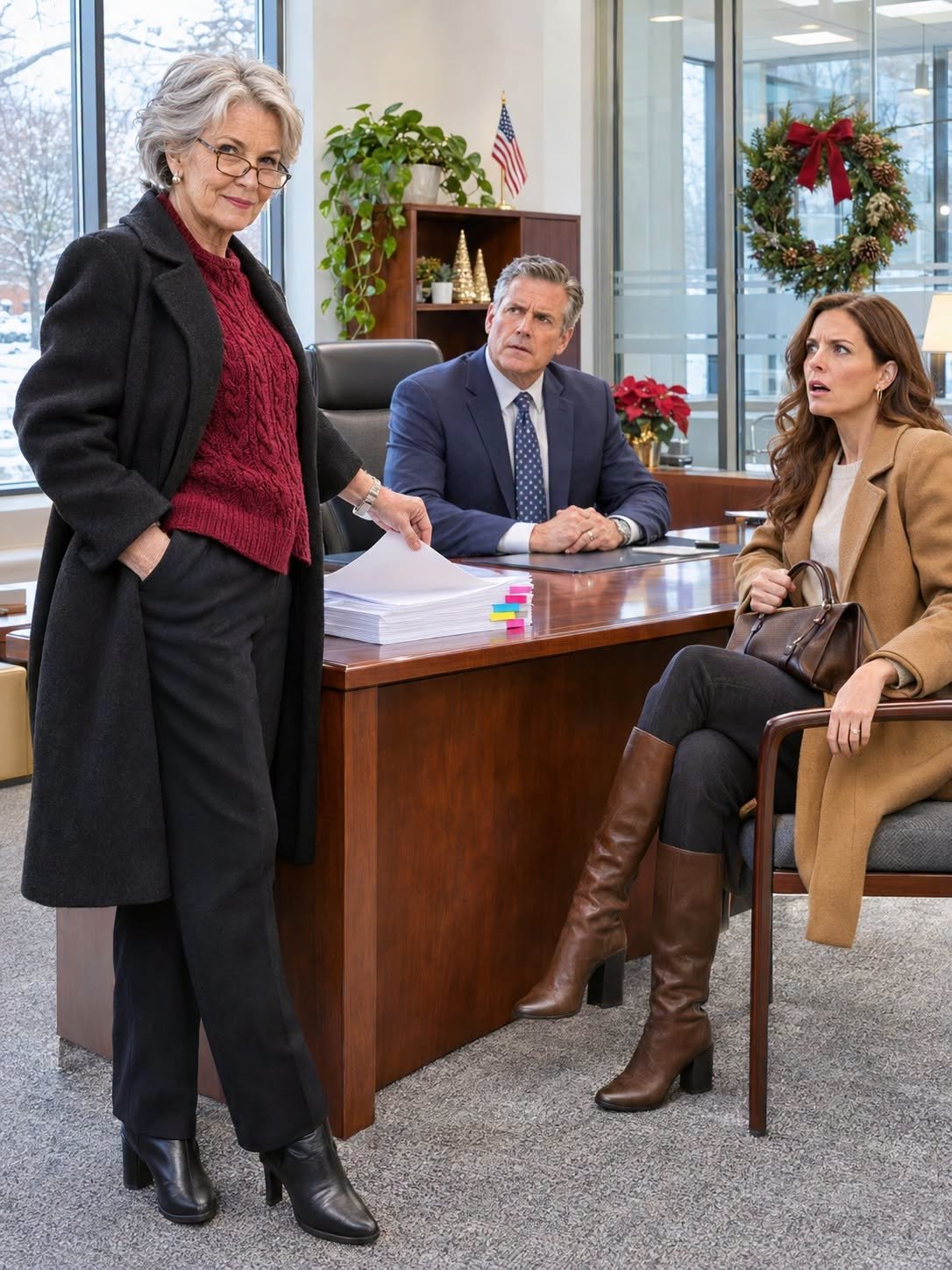
Marcus’s office has a glass wall facing the lobby, and through it, I saw her.
Britney was sitting in the visitor’s chair with her purse in her lap, scrolling on her phone. She was wearing
the camel coat Daniel bought her two Christmases ago and her good boots.
She’d dressed up for this.
She looked up when the door opened, and I watched the color leave her face all at once, like water going down a drain.
“Mom,” she said, “what are you doing here?”
“Marcus called me. Sweetheart, I bank here. I’ve banked here since 1979.”
Marcus stood and offered me his chair.
I sat down beside her.
On the desk between us lay the document. The real one, the one from the Christmas card, now unfolded and flattened, with a raised notary seal pressed into the last page.
“Mrs. Callahan,” Marcus said gently, “would you mind reading the line above your signature for the record?”
I didn’t need to read it. I’d written it.
But I picked it up anyway, put on my reading glasses, and read it aloud, slowly, in that quiet office, the way you read a verse in church.
“I did not read or agree to this, handed to me as Christmas cards. December 24th. I do not grant this
power. Peggy.”
The same words in my neat block print sat above every single signature line.
Page one, page two, page four, page six. Every yellow tab.
Britney stared at the paper as if she’d never seen it before.
And in a way, she hadn’t.
She had carried it in her purse for 10 days, through a notary’s office, and into a bank.
And not once had she looked at the lines she’d asked me to sign.
“That’s…” she started. “Mom, that’s just… You were joking. You were being funny.”
“Was I?”
Marcus cleared his throat.
He turned the last page toward me and pointed to the notary block.
“Mrs. Callahan, this certificate says you personally appeared before a notary public at a UPS store in
Sylvania on December 28th and signed this document in her presence.”
I looked at the stamp.
Kayla Brennan.
I knew that name.
Britney’s friend from her book club. She’d been to Lily’s birthday party.
“December 28th,” I said. “Marcus, where was I on December 28th?”
He didn’t hesitate.
“In the morning, you were at your attorney’s office on Central Avenue. In the afternoon, you were sitting in
that very chair, handing me a notorized revocation of any power of attorney dated around Christmas Eve.”
He tapped his computer.
“It’s timestamped in our system. 2:41 in the afternoon.”
Britney’s phone slid off her lap and onto the carpet.
She didn’t pick it up.
“There’s one more thing,” Marcus said.
He turned to the page near the back, where an agent signs to accept the responsibility.
Daniel’s name was signed there in blue ink.
“Mrs. Callahan, does this look like your son’s signature?”
I knew Daniel’s handwriting.
I’d signed his permission slips and read his letters from Boy Scout camp. I’d watched him sign his first car loan at this very credit union.
His capital D was always big and loopy, like a sale.
This one was small and careful.
“No,” I said quietly. “That isn’t my son’s.”
I turned and looked at my daughter-in-law.
She was crying now, mascara running, both hands pressed against her mouth.
“Brittany,” I said, “does Daniel know you’re here?”
She shook her head.
Then she grabbed her phone off the floor, stood up so fast the chair rolled back into the wall, and walked
out of the office through the glass.
I watched her push open the front door, already dialing, the wreath swinging behind her.
Marcus sat down slowly.
“Mrs. Callahan, I’m required to document this, and our policy requires me to report suspected elder
financial exploitation. I’m sorry.”
“Don’t be sorry,” I said. “Do your job. That’s why I came to you first.”
I drove home and sat in my kitchen with my coat still on until it got dark.
At 9:15 that night, my phone rang.
Daniel.
For a moment, he didn’t say anything at all.
I could hear him breathing and, somewhere behind him, a door closing.
Then, in a voice I hadn’t heard since he was a little boy, my son said, “Mom, what did Britney do?”
I didn’t answer Daniel’s question on the phone.
Some things shouldn’t be said into a phone.
“Come over tomorrow night, son. 7:00. Both of you.”
“Mom, she’s saying I signed something. I never signed anything. I swear to God, I never…”
“I know you didn’t, honey. I saw the signature. 7:00.”
The next evening, I made a pot of coffee I knew nobody would drink.
I set three mugs on the kitchen table, the same table where Britney had stood over me on Christmas Eve.
Then I laid out my papers the way I used to lay out month-end reports for the owners at the plant.
Neat stacks. Everything in order.
The copy of the revocation, Denise’s letter, the statement I’d written about Christmas Eve, and a photocopy Marcus had made for me of every page of that power of attorney with my words above every signature.
At a/4 to 7, Ruth called from next door.
“My porch light’s on and my phone’s in my hand. You holler, I’m there in 30 seconds.”
“I won’t need you, Ruth.”
“I know. Porch light’s on anyway.”
They came at 7 sharp.
Daniel came in first.
He looked like he hadn’t slept.
He hugged me hard, the way he used to when he came home from college, and held on a beat too long.
Britney came in behind him.
No makeup, in an old Ohio State sweatshirt.
She didn’t look at me. She looked at the papers on the table, and her shoulders dropped.
We sat.
Nobody touched the coffee.
I didn’t yell. I didn’t cry.
38 years of reading numbers to people who didn’t want to hear them taught me one thing.
Say it plain and say it once.
“On Christmas Eve,” I said, “Brittany handed me a power of attorney hidden inside a Christmas card and told me to sign quickly. On December 28th, someone had it notorized, saying I appeared in person, on a
day I was sitting in my lawyer’s office and then at my credit union. Daniel’s name was signed as my agent, and Daniel says he never signed it. On January 3rd, Britney took that paper to my credit union to borrow against this house.”
I slid each paper across the table as I spoke.
Then I folded my hands.
“I want to understand why.”
For a long moment, the only sound was the kitchen clock.
Then Britney started talking.
And when she started, she couldn’t stop.
It began 2 years earlier when her mother was diagnosed with breast cancer.
The insurance didn’t cover the specialist in Cleveland, and her parents didn’t have the money.
Britney didn’t want her mother choosing a worse doctor to save money, so she put the bills on a credit
card.
Then another.
She opened cards Daniel didn’t know about and had the statements sent to her email.
“I kept thinking I’d catch up,” she whispered. “Then the minimum payments were more than my paycheck, so I took a cash advance to pay the cards. Then another one.”
“How much?” Daniel asked.
His voice was very quiet.
She looked at the table.
“87,000.”
“And we’re 3 months behind on the second mortgage, the one I took out on the house last spring.”
Daniel stared at her.
“What second mortgage?”
She started to cry.
“You signed it. I told you it was a refinance to lower our rate. You didn’t read it. You never read anything I hand you. You just trust me.”
The kitchen went very still.
Daniel looked down at his hands, then at me.
I didn’t say a word.
I didn’t have to.
We were all thinking the same thing.
Sign this, honey. Quickly. It’s routine.
“I was going to pay it back,” Britney said. “That’s the truth, Mom. I’d take a line of credit on this house, pay
off the cards, catch up the mortgage, and pay you back a little every month. You’d never even know. You don’t use the equity. It’s just sitting there.”
“It’s not just sitting there,” I said quietly. “It’s 40 years of Frank’s overtime. It’s every Christmas we skipped a vacation. It’s what I live on if I ever get sick.”
She nodded.
She couldn’t speak.
Then Daniel spoke, and what he said surprised me.
“This isn’t all on her. Mom,” he rubbed his face with both hands, “I knew something was wrong. I knew it
when the truck got repossessed. I told everybody I traded it in. I knew it every time she cried in the car and I said, ‘We’ll figure it out.’ I let her handle everything because it was easier than knowing.”
His voice cracked.
“I didn’t ask because I didn’t want the answer.”
I reached across the table and put my hand on his.
He gripped it like he was drowning.
Then I told them the rest because they needed to hear it.
“My lawyer says this could be prosecuted. Forgery, falsifying a notorized document, elder financial exploitation. The credit union has already filed a report because they’re required to. And Kayla,” I said,
turning to Britney, “could lose her notary commission. She could face charges herself for a favor.”
Britney covered her face.
“She didn’t want to. I told her you were sick and couldn’t come in. I told her you’d already said yes.”
“So you lied to her, too.”
“Yes.”
I picked up the last page of the document, the one with the notary seal and my handwriting above my name, and I laid it in the middle of the table between the three of us.
“Do you know why I wrote those words?” I asked. “I could have torn this up on Christmas Eve. I could have called the police from the kitchen phone.”
Neither of them answered.
“I wrote those words above my name so that one day you would have to read them. Not the bank, not Marcus, not some lawyer.”
I looked at Britney and then at my son.
“You.”
Brittney picked up the page with trembling hands.
And for the first time since Christmas Eve, she read every word.
Britney read the page twice.
Then she sat it down, folded her hands the way I had folded mine, and said the words I had been waiting 10 days to hear.
“I’m sorry, Mom. Not sorry I got caught. Sorry I did it.”
I believed her.
I can’t fully explain why.
Maybe it was the sweatshirt or the bare face or the way she said it without looking at Daniel first.
After four decades of watching people apologize across a desk, you learn the difference between someone sorry for the consequences and someone sorry for the act.
But believing someone and trusting them are two different things.
Trust is rebuilt one honest month at a time.
So I told them my decision.
“I’m not going to ask anyone to press charges,” I said. “I’ll tell my lawyer that, and I’ll tell the case worker from adult protective services when she comes. But I have conditions, and they are not up for discussion.”
Daniel nodded.
Britney wiped her eyes and nodded too.
“First, you two go to a nonprofit credit counseling agency. A real one, not one of those outfits on late-night TV. You sit down together and put every card, every statement, and every loan on the table. Both of you. And you show me the paperwork.”
“Okay,” Daniel said.
“Second, you go to marriage counseling because this didn’t start with money. It started with two people who stopped telling each other the truth.”
“Okay,” Britney whispered.
“Third, Kayla calls the Ohio Secretary of State and tells them exactly what she did. I won’t lie for anyone, and I won’t ask her to. But it’s better coming from her than from my lawyer.”
Britney swallowed hard.
“I’ll go with her when she calls.”
“And last,” I said, “nobody in this family ever says, ‘Just sign this quickly,’ to anybody again. Not to me, not to each other, and not to those children when they’re grown. If it needs a signature, it needs to be read.”
That was the end of it.
Or rather, it was the beginning.
The months that followed weren’t easy.
Daniel and Britney sold their house in the spring and moved into a rented duplex near the kid’s school.
Britney took a second job doing billing for a dental office.
Kayla lost her notary commission, but the county prosecutor chose not to charge her once she came
forward on her own.
She and Britney still aren’t speaking much.
Some consequences don’t go away just because people are sorry.
Britney’s mother finished her treatment in March.
She’s in remission now.
When I heard, I sent her a card.
A real card. Nothing hidden inside.
I didn’t give them my house, and I didn’t give them a dime toward that debt.
That was theirs to carry.
But in June, I sat down with Greg and opened two college savings accounts.
One for Lily and one for Owen.
I put money in every month, straight from my account into theirs.
That way, my help goes exactly where I mean it to go.
And then it was Christmas Eve again.
At 3:00, an hour early, there was a knock at the door.
Britney stood on the porch with her coat already unzipped and the kids behind her stamping snow off their
boots.
She was holding a stack of Christmas cards.
“Before you say anything,” she said, smiling, “these are actually just cards for the teachers and the bus driver.”
She held them out.
“Read everyone, Mom. Take all the time you want.”
We both laughed.
And I did read them.
Every single one.
Owen leaned on my shoulder and helped me lick the envelopes.
Daniel came in last, carrying a manila folder.
He set it on the kitchen table in front of me without a word.
Inside were their credit counseling statements.
Every month since February, in order, to 59,000.
“Mom,” he said, grinning like a boy bringing home a good report card, “read every page.”
The last card in the stack wasn’t for a teacher.
It had my name on it.
In Britney’s handwriting inside, there were only eight words.
“Thank you for not giving up on me. Love, Britney.”
I put that card on the hutch next to the nativity set where the camel still faces the baby Jesus so he doesn’t
feel left out.
And that night, for the first time in four years, all five plates on my dining room table were full.
Now, before I go, I want to say something to you, the one listening.
If you’re my age, someone you love may one day hand you a paper and say, “Quickly, we’re late.”
Please hear me.
Love is not a blank signature.
Read everything, even from family, especially when someone is rushing you.
Put your affairs in order while you’re well enough to choose who speaks for you.
Talk to an elder law attorney.
Name a trusted contact at your bank.
Freeze your credit.
It’s free, and it takes an afternoon.
And if you ever suspect someone is taking advantage of you or someone you love, call your local adult
protective services.
You won’t be betraying your family.
You may be saving them from the worst moment of their lives.
Protecting yourself is not the opposite of loving your children.
Sometimes it’s the deepest way to love them.
They asked me to sign my name, so I did.
But first, I wrote the truth above it.
And the truth, it turns out, was the best gift I ever gave my family.
If my story touched your heart, I’d be grateful if you’d share it with a friend, a sister, or a neighbor who
might need to hear it this Christmas.
Tell me in the comments, has anyone ever asked you to sign something in a hurry?
And if you’d like to hear more stories like mine, please subscribe and stay a while.
Pour yourself a cup of coffee.