My stepfather never used the word “step.” Not once in the fifteen years he raised me did he treat me as anything less than his own child. To him, I was never an obligation or an extra responsibility. I was family—fully, completely, and without hesitation. He showed up for me in every quiet, meaningful way that truly matters.
He was the one running behind my bike, keeping me steady until I could ride on my own. He sat with me at the kitchen table after I failed a big math test, patiently helping me understand every problem until it finally clicked. When I graduated high school, he stood in the crowd with eyes full of pride, smiling like my achievement belonged to him too.
He never missed a parent meeting. Never forgot a birthday. Never once reminded me that we didn’t share DNA. His love didn’t come with footnotes or conditions.
So when he passed away, it felt as if the ground had opened beneath my feet. Losing him wasn’t just losing a parent—it was losing the person who had quietly held so many parts of my world together.
The funeral was formal, distant, filled with polite speeches about his work and accomplishments. Everything was true, yet it still felt incomplete. None of them spoke about the late-night talks we had, or the fishing trips where we never caught anything, or the way he always said, “You’re going to be okay. I’ve got you.” Those moments belonged only to us.
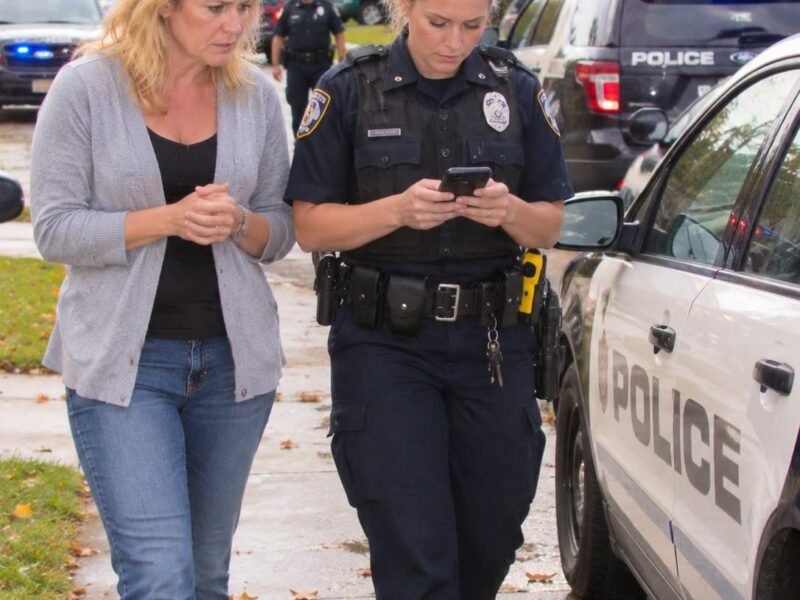
“The moment I was turned away from the will reading — not because of blood, but because of someone else’s definition of family.”
After the service, we were told that the will reading would take place later that week. I went simply because I wanted to be included—not for money, not for possessions, but because I believed I mattered to him the way he had always made me feel.
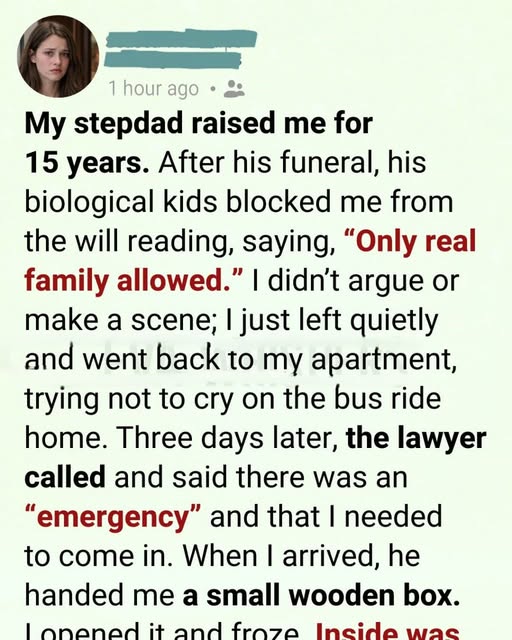
But when I arrived at the lawyer’s office, his biological children blocked the doorway. We had lived under the same roof, but we had never been close. One of them said without looking at me, “Only real family is allowed inside.”

The words hit harder than I expected. I could have fought back. I could have listed every moment he chose me. But I didn’t. I turned around and walked away, swallowing the hurt quietly.
On the bus ride home, I stared out the window trying not to cry. The pain wasn’t just grief—it was the feeling of being erased from a story I had lived fully. When I got home, I finally let myself cry in silence.
“Inside the wooden box were the memories he saved, the moments that proved I was loved long before any legal document could say so.”
Three days later, the phone rang. It was the lawyer, asking me to come in immediately. His voice sounded urgent, and my stomach tightened as I prepared for more disappointment.
When I arrived, the office was empty. The lawyer handed me a small wooden box, worn smooth from years of handling. “He left this for you,” he said gently. “His instructions were very clear.”
Inside the box were photographs—pictures of us at the river with crooked fishing poles, pictures of him laughing while I proudly held up a tiny fish. There were school awards I barely remembered bringing home, carefully saved and stacked.
And then I saw them: letters. One for every year he raised me.
His handwriting filled each page with memories, worries, hopes, and love. He wrote about how proud he was of me, how watching me grow changed him, and how being my father had been the greatest privilege of his life. Not duty. Not responsibility.
At the bottom of the box lay a copy of the will. Everything he owned had been divided equally—between his biological children and me.
The lawyer explained that my stepfather had made that decision years ago. He never doubted it. He never saw a need to explain it. To him, it was simple: I was his child, and family was defined by love, not blood.
I walked out of the office holding the box close to my chest, feeling a mixture of grief, peace, and overwhelming gratitude. For the first time since he passed, I felt anchored again.

That day, I finally understood something that took me much of my life to realize: love doesn’t need witnesses. It doesn’t argue at doorways or demand approval. It lives quietly in the everyday moments—showing up, protecting, choosing you over and over again.
“Walking out of the lawyer’s office with the box in my arms, I finally understood: love had written me into his life in a way nothing else could erase.”
I wasn’t his family because we shared genetics. I was his family because he loved me as his own. Day after day. Year after year. And that love, even after goodbye, outlasted everything else.