I married a blind man because I believed he would never have to see the parts of me the rest of the world had spent years staring at. I thought his darkness would finally be my safe place.
Then, on our wedding night, he gently traced my burn scars, called me beautiful, and whispered a truth that shattered every ounce of safety I thought I had finally found.
The
Word That Never Felt Right
On the morning of my wedding, my sister cried long before I did.
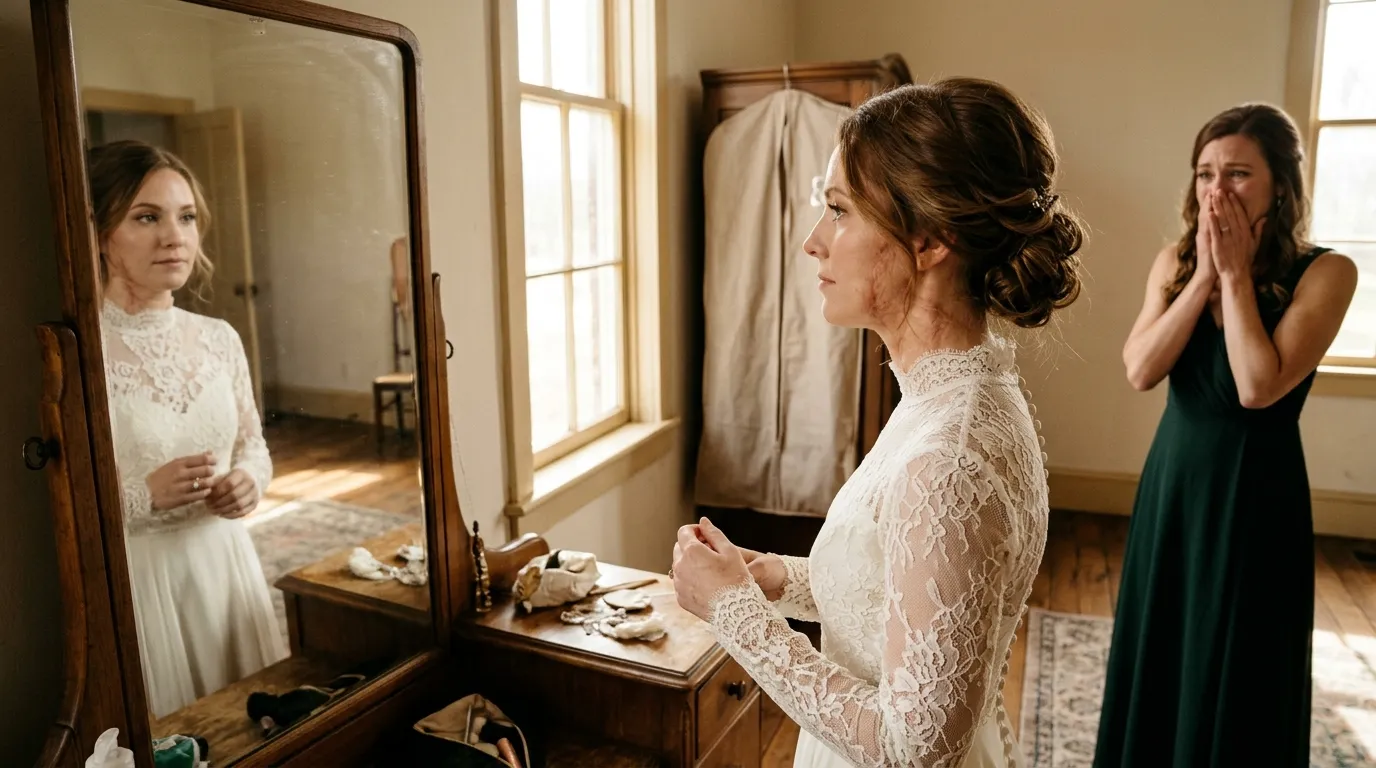
Lorie stood behind me in the quiet church dressing room, both hands pressed over her mouth. She stared at my reflection in the mirror as if she could still see the terrified thirteen-year-old girl I used to be, hiding somewhere beneath the ivory lace and careful makeup.
My gown had a high neckline and long sleeves. I had chosen it as much for coverage as for elegance, though Lorie had stubbornly called it gorgeous every single day until I finally stopped arguing with her.
“You look beautiful, Merry,” she whispered, tears spilling over her lashes.
Beautiful. Even at thirty years old, that word still caught in my throat. When I was thirteen, I had heard a very different word while lying in a sterile hospital bed, half my face throbbing with fire and every breath feeling borrowed.
“A neighbor must have mishandled the gas,” a police officer had told me after the explosion in our kitchen. “You’re lucky to have survived.”
Lucky. To everyone else, lucky meant breathing. To me, lucky meant waking up in a body I no longer recognized. It meant enduring the sharp whispers of kids in school hallways, the lingering stares of strangers in grocery stores, and the soft, crushing pity in the eyes of men who never looked past my skin.
Our parents were already gone by then. Our aunt took us in for a while, and when she passed away, eighteen-year-old Lorie stepped into a life she never asked for and became my entire world. She was the one who ran beside the ambulance that afternoon. She was the one who sat with me through every surgery, every bandage change, and every quiet humiliation of healing.
For the first time in seventeen years, I wasn’t the girl people tried not to stare at—I was the bride.
Standing in front of me on my wedding morning, Lorie gently squeezed my hands. “Are you ready?”
I wiped a stray tear from my cheek, took a steady breath, and nodded. I was ready to walk toward the man who had changed everything.
The Man Who Saw Without Looking
By the time I turned thirty, I had never been in a real relationship. The few men I had tried to date only ever saw my scars. After a while, I grew exhausted from watching their eyes dart away in polite discomfort. Nobody ever lingered long enough to find my heart. To them, I was just damaged goods.
Then I met Callahan in the basement of the very same church where we were getting married.
He taught piano three afternoons a week to neighborhood kids who couldn’t keep a beat and always sang much louder than they played. The very first time I heard him, I hadn’t even stepped into the room yet. I just paused in the hallway, captivated by the sheer patience in his voice as he corrected a little boy’s timing.
“Again,” Callahan said warmly. “Slower this time, pal. The song isn’t running away from you!”
I was already smiling before I even saw him. He sat at the worn upright piano wearing dark glasses, one hand resting lightly on the keys while the other reached down to scratch the ears of a golden retriever lying by his feet. The dog, Buddy, wore a leather harness and carried the calm, wise expression of an old soul.
Callahan lost his sight at sixteen, yet he saw more of me than anyone else ever had.
Callahan had lost his sight in a car accident when he was sixteen. With him, there was no flinching, no pity, and no awkward silences.
On our first date, sitting in a quiet diner booth, I stared down at my coffee cup and forced myself to say the words I always dreaded. “I should tell you something, Callie. I don’t look like other women.”
Without hesitation, he smiled and reached across the table until his fingers found mine. “Good,” he replied. “I’ve never been fond of ordinary things.”
I laughed so hard I nearly cried. In hindsight, maybe the way my heart surrendered so completely should have warned me.
We tied the knot on a chilly Sunday afternoon. Callahan waited at the altar with Buddy sitting proudly beside him, wearing a black bow tie one of his young students had insisted on picking out. Those same students played an old love song as I walked down the aisle. It was full of missed notes, uneven rhythms, and fierce effort—terrible in the sweetest possible way.
When the pastor asked if I took Callahan to be my husband, I said “I do” before he even finished the sentence.
The reception was filled with warm hugs, grocery-store cake, paper cups of punch, and children darting under folding tables. For one glorious afternoon, I wasn’t the scarred woman people politely ignored. I was simply the bride.
A Confession in the Dark
Lorie drove us back to Callahan’s cozy apartment after sunset. Buddy trotted in first, exhausted from a full day of belly rubs, and curled up by the bedroom doorway with a heavy, satisfied sigh.
“You deserve this, Merry,” Lorie whispered, hugging me tight at the front door. “I’m so happy for you.”
When she left, the quiet of our new life settled around us. I took Callahan’s hand and guided him into the bedroom. As we stopped by the edge of the bed, my heart hammered against my ribs. I was more nervous now than I had been walking down the aisle—not because he could see me, but because he couldn’t.
Deep down, a part of me had always believed his blindness was the only reason our love was possible. With Callahan, I would never have to watch recognition flicker across a man’s face and wonder if his affection could survive the full truth of my scars.
He lifted a trembling hand. “Merritt… may I?”
I nodded, forgetting for a second that he couldn’t see it, and softly whispered, “Yes.”
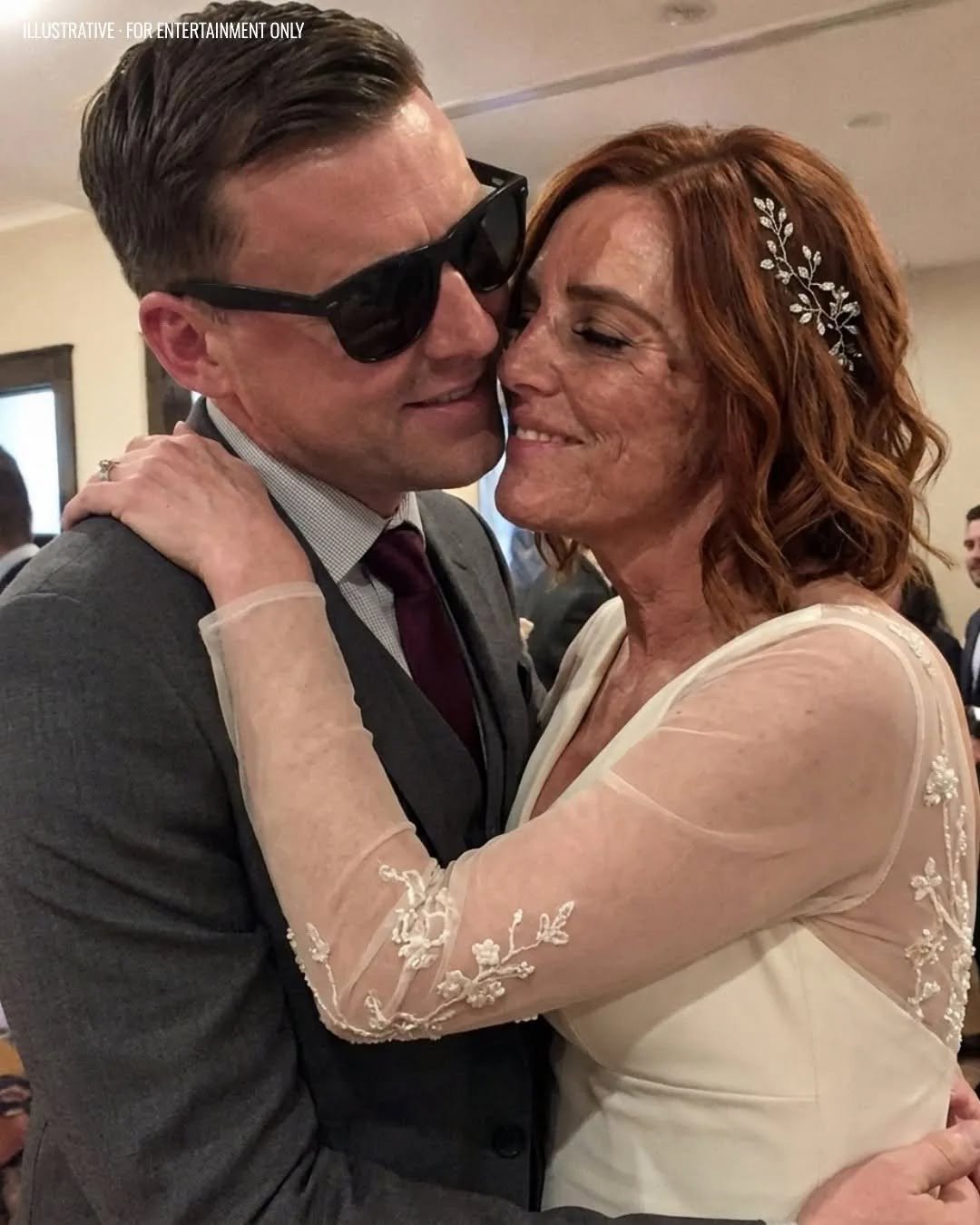
His fingertips brushed my cheek first. Slowly, reverently, he traced the scarred line of my jaw and the uneven ridges along my throat just above the lace. Instinct screamed at me to pull away—seventeen years of hiding don’t vanish overnight—but his touch was so gentle that I let him stay.
“You’re beautiful, Merritt,” he breathed.
That single sentence broke every wall I had left. I collapsed against his shoulder, sobbing so hard I could barely catch my breath. For the first time in my adult life, I felt completely seen without being looked at. I felt safe.
Then, Callahan’s shoulders stiffened.
“I can’t keep this from you any longer,” he said, his voice dropping to a strained whisper. “It’s going to change the way you see me. You need to know the truth I’ve been hiding for twenty years.”
I let out a wet laugh, wiping my eyes, thinking he was trying to lighten the mood. “What? Are you about to tell me you can actually see?”
Callahan didn’t smile. Instead, he took both of my hands in his.
“Do you remember the kitchen explosion?” he asked quietly. “The one you barely survived?”
Every muscle in my body froze. I had never told Callahan how I got my scars. I had only ever mentioned an “accident” when I was young, and even that had taken me weeks to admit. The explosion lived in a locked room in my mind that I had never opened for him.
I yanked my hands back. “How do you know about that?”
He reached up and slowly removed his dark glasses. For one terrifying second, I braced myself for him to lock eyes with me—to prove everything had been a cruel lie. Instead, he stared straight toward the sound of my voice and slightly past it, lost in his own darkness.
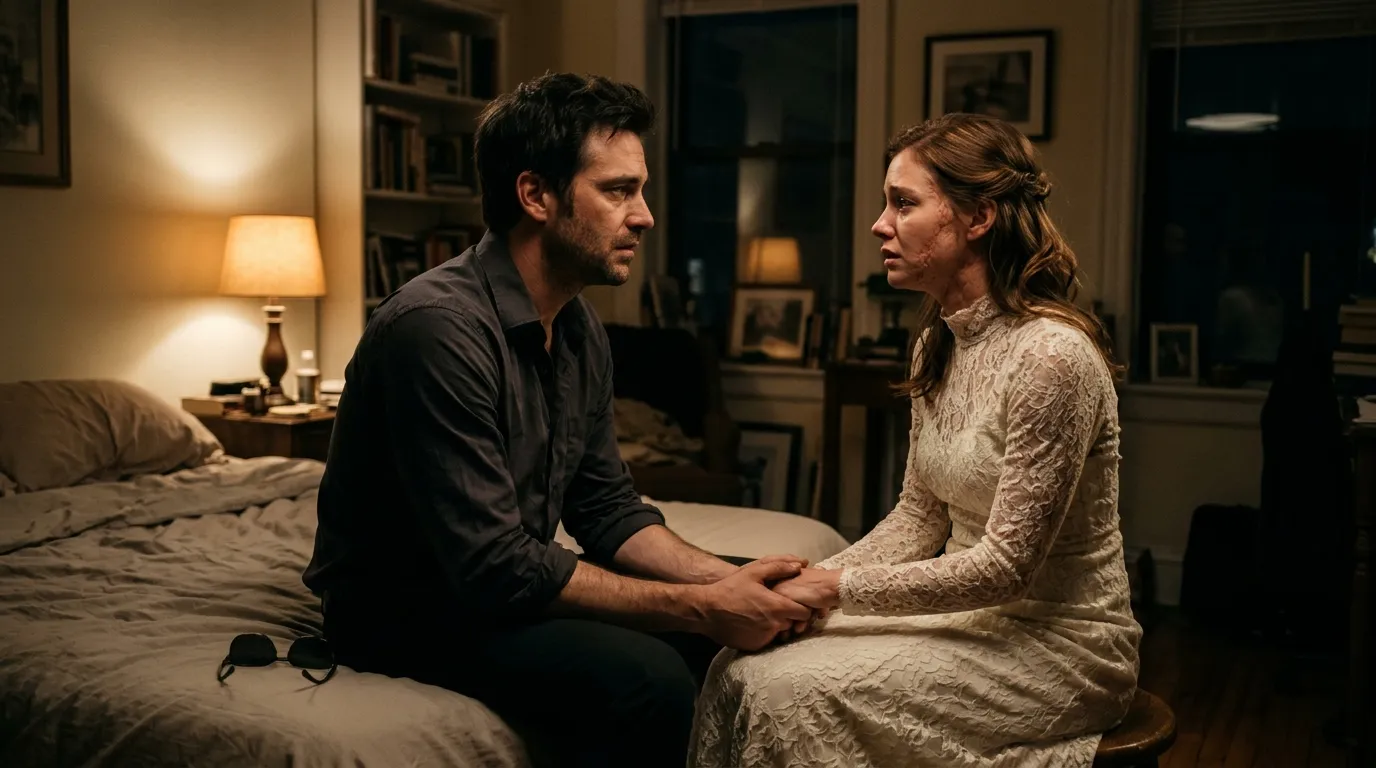
In a single heartbeat, our wedding night cracked open into a room full of ghosts.
“I was there that afternoon, Merry,” Callahan whispered.
My knees gave out, and I sank onto the mattress.
“I was sixteen,” he continued, his voice cracking. “My friends and I were visiting Mike. He lived two doors down from you.”
I remembered Mike immediately—the neighbor’s teenage son who played loud music through walls so thin we heard every bassline.
“We were reckless, stupid boys,” Callahan confessed, hanging his head. “We were messing around near the back of the building, siphoning gas, daring each other, showing off. One careless mistake led to a spark. A leak nobody took seriously suddenly became something too big to stop. And we panicked. All of us. We ran.”
Mike’s family packed up and moved away shortly after. Callahan stayed in town, and two days later, he saw my name in the local newspaper.
“A thirteen-year-old girl named Merritt survived, badly scarred,” he recited, as if the headline had been branded into his memory. “It tore me apart.”
Just a few months later, the car crash happened. It took Callahan’s parents, his brother, and his sight. For twenty years, he had carried that crushing guilt in complete silence.
Tears rolled silently down my face. “Why didn’t you tell me sooner?”
Callahan let out a bitter, hollow laugh. “At first, I wasn’t sure it was you. Then you told me your name, and I was terrified.” He had asked an old friend to confirm it. The woman he was falling in love with was the girl from the newspaper. “I tried to step back, Merry. I really did. I just kept thinking that if I told you too soon, you’d walk away before I ever got the chance to love you properly.”
“You took away my choice,” I whispered, anger finally slicing through the shock. “You let me stand at that altar and marry you without telling me what you did.”
“I know,” he said softly.
That was the most maddening part—he wasn’t making excuses. He knew exactly how deeply this truth would cut me. Part of me wanted to scream at him. Another part still wanted to reach for him, because he was still the same gentle man who had called me beautiful five minutes ago. That contradiction split me right down the middle.
“I need air,” I said, standing up.
Callahan quietly offered to sleep in the guest room, but I barely heard him. I grabbed my coat and fled into the freezing night—a bride walking alone down empty streets, my wedding hair still pinned up, my whole life unraveling beneath ivory lace.
Walking Back Toward the Truth
Without realizing where my feet were taking me, I ended up standing on the sidewalk outside my childhood home. It was still standing, dark and empty. I pulled out my phone and called Lorie, because on some nights, only the person who knew you before the scars can hold you together.
She arrived in ten minutes. One look at my face, and she pulled me straight into her car.
“Part of me wants to hate him,” I admitted after spilling the entire story in her living room. “But another part of me can’t forget how he made me feel seen.”
Lorie wrapped her arms around me and said nothing, knowing no words were big enough for a night like this.
I barely slept on her couch. As the pale morning light crept through the blinds, one clear thought settled in my mind: running from the past had already stolen seventeen years of my life. I refused to let it steal this decision, too.
I borrowed a pair of Lorie’s old jeans and an oversized knit sweater. She watched me lace up my sneakers. “Are you sure about this?”
“No,” I answered honestly. “But I’m going anyway.”
She smiled through wet eyes. “I’m proud of you, Merry.”
I walked all the way back to Callahan’s apartment, letting the crisp morning air clear my head. Before I even reached the top of the stairs, I heard Buddy’s paws skittering excitedly across the hardwood floor. The second I turned the doorknob, he nearly knocked me over with relief.
My husband was standing in the kitchen. He turned his head the moment I stepped inside.
“Merry,” he breathed. “You’re back.”
“How did you know it was me?” I asked softly.
A fragile, hopeful smile touched his lips. “Buddy told me first. My heart told me second.”
He took one careful step forward, then another, reaching out slightly. His toe caught the edge of the kitchen rug, and before I could even think, I stepped in and steadied him by the wrist. Callahan went completely still under my touch. Slowly, gently, he raised his hand and found my face again.
“You are the most beautiful woman I have ever known, Merry,” he whispered.
The raw honesty in his voice hit harder than any apology ever could have. It didn’t erase the past—nothing ever would—but it told me we had a future worth fighting for.
Then, a sharp, familiar smell drifted past his shoulder. I peered toward the stove.
“Callie,” I said, blinking. “Are you burning something?”
He frowned. “No, I don’t think so.”
A thin curl of smoke was rising from a frying pan where an omelet was rapidly turning pitch black. I burst out laughing so hard I had to lean against the counter to catch my breath. Buddy started barking happily, as if joy were a sound he recognized, and Callahan began to laugh too—the first real laugh since the night before.
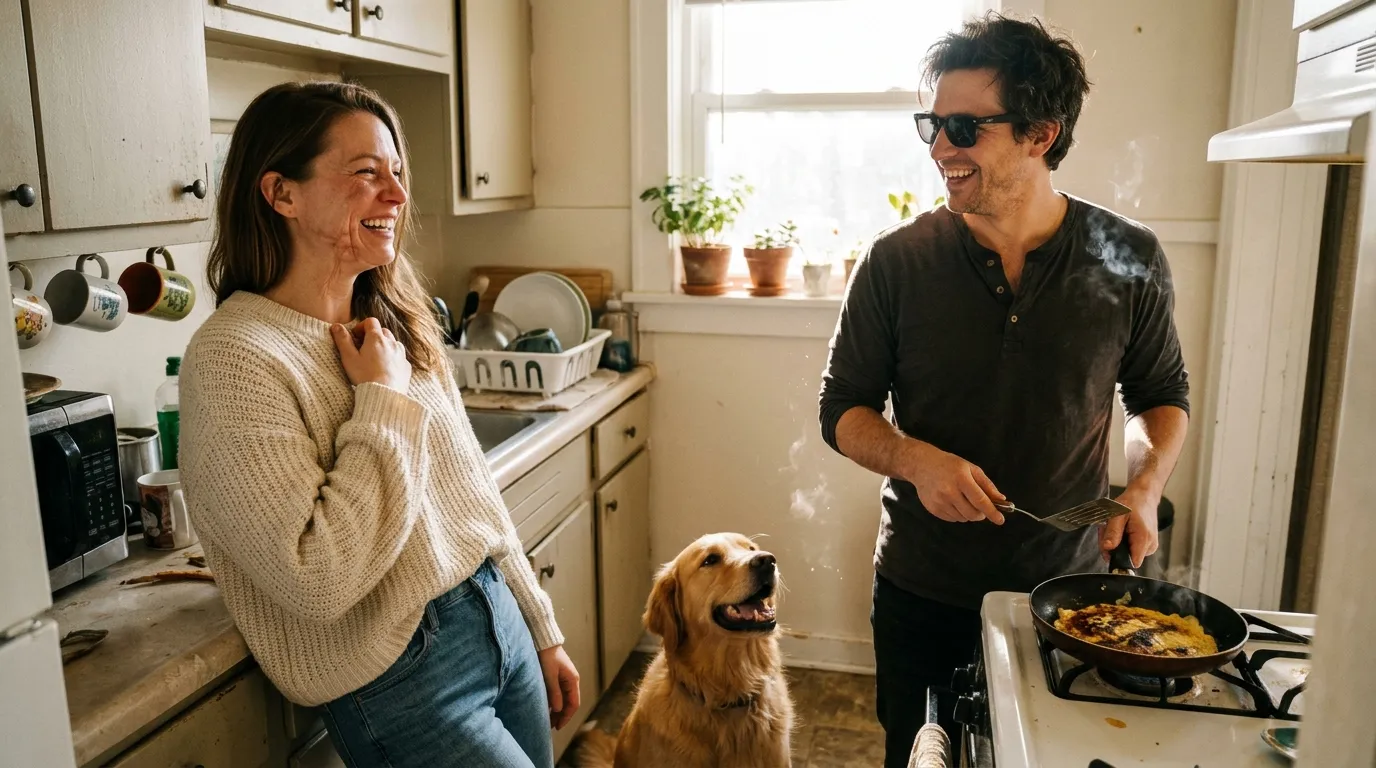
My first official decision as a married woman: the kitchen is officially mine.
“The kitchen,” I declared, laughing through fresh tears, “is mine now.”
That was my first official decision as a married woman. Buddy curled up under the dining table like a witness to a peace treaty, thumping his tail against the floor every time we laughed.
For the first time in seventeen years, I no longer feel ashamed of my scars. I finally understand that what happened to me was never my fault. And the one person who knew the ugliest truth attached to them still looked at me, through nothing but darkness, and found something worth loving.