Chapter 1: The Morning Call and the Vacant Row Fifty-four missed calls.
By the time the back-lit glow of my smartphone pierced the pale dawn filtering into our hotel suite, the glass screen had plunged into darkness and rekindled itself twice.
Outside, the slate-gray waters of Lake Michigan churned against the concrete barriers of Chicago, waking to the metallic hum of early-morning traffic on Lake Shore Drive.
Beside me, under the heavy linen duvet, my husband, Daniel, breathed in the measured cadence of deep exhaustion.
My phone shuddered once more against the mahogany nightstand, vibrating like an angry insect. I didn’t reach for it.
Twenty-four hours earlier, my family had deliberately chosen not to attend my wedding.
Now, their digital ghosts were battering at my perimeter because our quiet vows had somehow transformed into a syndicated national spectacle.
On live television, Daniel had spoken a single, unvarnished sentence that shattered the sanitized narrative they had spent decades cultivating.
I perched on the edge of the mattress, my bare feet sinking into the carpet, staring at the flashing screen.
To comprehend why those fifty-four notifications felt less like an olive branch and more like an ambush, you have to rewind to Saturday morning, precisely 8:12 AM.

I was sitting in a silk robe, my spine pulled taut, while Lena, my dearest friend and maid of honor, twisted sprigs of baby’s breath into my hair.
The mirror before me reflected a woman on the precipice of a new life—radiant, perhaps, but fragile around the eyes.
My sister, Rachel, had helped me pick the silk crepe gown six months prior, sending a voice note that still lived pinned to my favorites:
You look completely like yourself, Mara. That’s how you know it’s the one.
When the ringtone cut through the quiet room, I reached for it casually, assuming my father had simply taken a wrong exit on the interstate or needed the venue’s parking code.
“Mara,” my father’s voice arrived without greeting, flat and clinical, as if he were reading a dispatch from an insurance adjuster. In the background, tires hummed over asphalt, punctuated by the rhythmic swish of windshield wipers.
“Your brother’s graduation is more important than your wedding.”
The hairbrush paused in Lena’s hand. For an absurd second, my brain refused to parse the syntax. I thought he was executing some clumsy, ill-timed paternal joke.
“Dad? What are you talking about? Evan’s commencement isn’t until ten o’clock.”

“We can’t be in two places at once,” he cut in, his cadence brooking no rebuttal. “The traffic on I-94 is gridlocked. We made the call. We’re heading straight to Milwaukee.”
My brother, Evan, was graduating with his master’s degree from the University of Wisconsin-Milwaukee. My ceremony was scheduled for one o’clock in downtown Chicago, a ninety-minute drive away. The date had been carved in stone since January.
My parents had returned their stamped RSVP cards in March, marked with two firm checks beside Accepts with Pleasure. Rachel had confirmed their hotel reservation just four days ago.
“You promised you would drive down right after his convocation,” I said, my voice thinning as the air left my lungs. “We mapped it out. We delayed the photographs so you wouldn’t miss anything.”
“It isn’t practical, Mara,” he said, irritated that he was being forced to defend an administrative decree.
“A master’s in mechanical engineering happens once. A wedding can always be celebrated down the line.”
In the background, my mother’s muffled voice crackled through the receiver: Is she upset? Let me talk to her.
A rustle of fabric.
Then her breath against the microphone, brittle and defensive. “Mara, darling, please don’t make a scene out of this.
It’s Evan’s crowning achievement. You know how hard he worked after the academic probation. We thought we could split the difference, but the logistics simply collapsed.”
“You swore you’d be here,” I whispered. My reflection in the vanity mirror looked like a stranger playing dress-up in an ivory costume.

“We will take you and Daniel out for a lovely dinner next month,” she said, her voice adopting that practiced, soothing tone she used whenever an uncomfortable truth threatened her domestic equilibrium. “Have a beautiful ceremony, sweetheart. Truly. We love you.”
Before I could answer,
the line went dead.
Lena did not speak. She set down the silver hairpins, placed her warm palms on my trembling shoulders, and met my gaze in the glass.
“Do you want me to clear the room, or do you want me to finish pinning your hair?”
“Finish the hair,” I said.
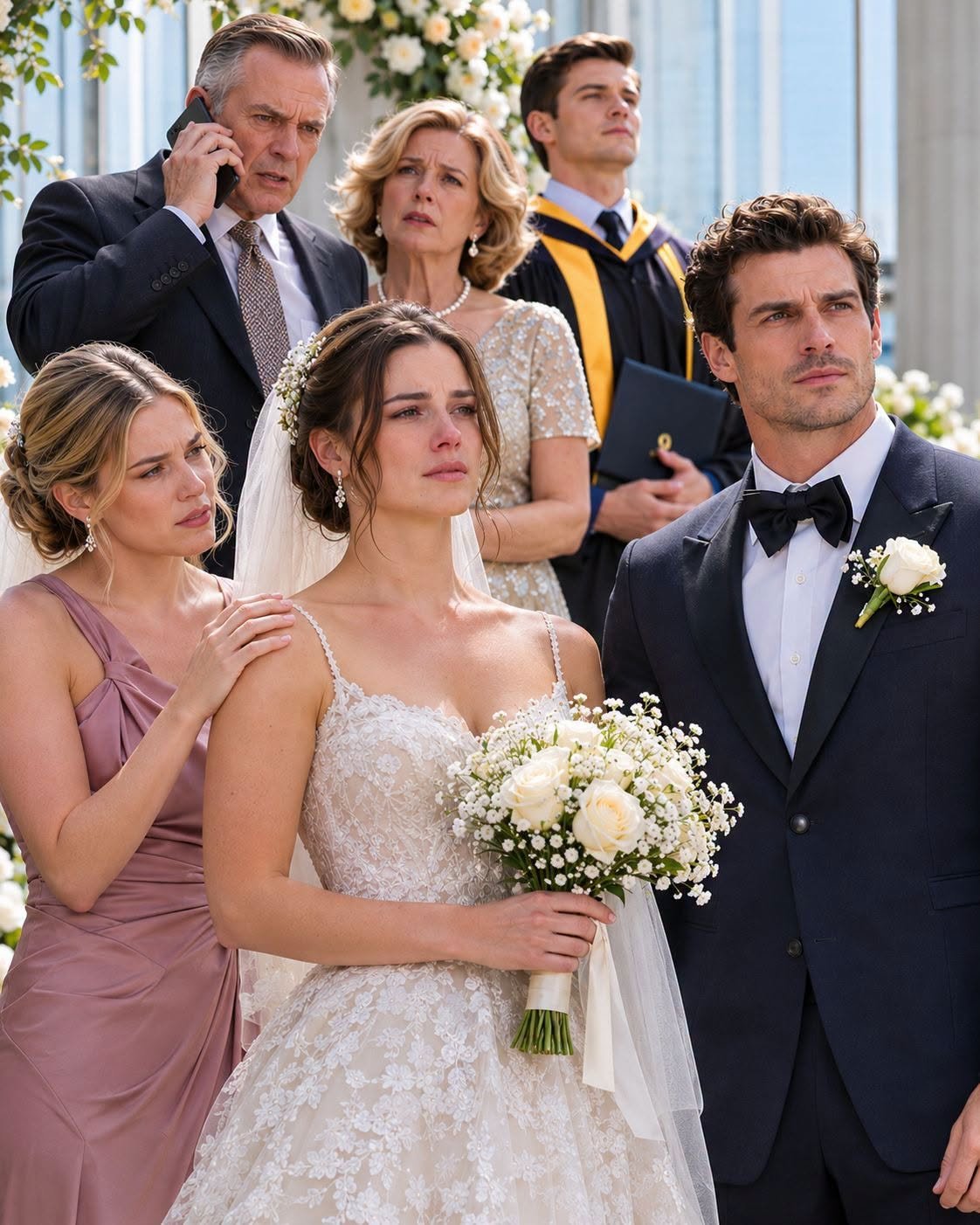
At one in the afternoon, I walked down an aisle framed by forty white chiavari chairs overlooking the water.
Ten of them, grouped together in the front row on the bride’s side, sat cavernously vacant.
Daniel stood beneath the arbor, his dark eyes steady, his warm fingers clasping mine with a strength that kept my knees from buckling.
We had kept the empty seats out of the official portraits, but during the family groupings, guests had instinctively shifted,
making room for parents who never arrived.
Chapter 2
That evening, I let my phone languish in my satin evening bag. Only one message had filtered through from Rachel: I am so sorry, Mara. I should have fought harder. I should have come.

I didn’t reply. We danced. We drank champagne that tasted like crisp pears. I convinced myself that my heart was bruised, not broken.
Then dawn broke, and the world discovered who Daniel really was.
Daniel was the majority shareholder and chief executive of Northline Media, an independent consortium
that owned dozens of regional newspapers and broadcast networks across the Midwest. To my parents, he had always been merely “Daniel in publishing,” an unassuming thirty-nine-year-old who wore faded denim and drove an eight-year-old station wagon.
I had never bothered to disabuse them of their assumptions; their disinterest in my professional life was an old, comfortable coat I had worn for years.
At seven that morning, Daniel had slipped out to attend a long-scheduled live broadcast on Chicago Business Weekly at the downtown studios to announce a major multi-million-dollar preservation grant for local journalism.
The host, a veteran anchor who had spotted the gold band on Daniel’s finger and our names on the society registry, leaned into the camera with an unscripted grin: “Before we delve into the Northline portfolio, Daniel, congratulations are in order. You married Mara Vance yesterday afternoon on the
lakefront. I imagine the entire family is still nursing a champagne hangover?”
Daniel had paused,
his gaze boring directly into the camera lens.
“My wife’s parents chose to attend her brother’s graduation instead of her wedding,” Daniel replied, his tone chillingly even, completely void of theatrical anger. “I won’t insult Mara by pretending that didn’t
cut her to the bone. But there is another fact the public ought to know. Mara Vance is the investigative consultant who conceptualized and built the regional reporting initiative we are funding today. She built it with her own blood and intellect long before she ever wore my ring. Her family didn’t just walk out on
a bride yesterday; they walked out on the most formidable woman in modern media.”
The anchor’s jaw slackened. The studio fell pin-drop silent.
By the time Daniel stepped back through the door of our hotel suite holding two paper cups of dark

roast, my phone was ringing for the fifty-fifth time.
Chapter 2: The Viral Firestorm “You shouldn’t have said it,” I murmured into the steam rising from my coffee cup.
Daniel leaned against the desk, still dressed in his charcoal suit, his tie loosened at the collar. “The host was trying to package our marriage into a fluffy human-interest segment to gloss over the hard questions about newsroom lay-offs. He wanted a domestic fairy tale. I wasn’t going to let him turn your
reality into a decorative prop.”
“It’s everywhere, Daniel.” I held up the phone.
The three-minute clip had been extracted,
watermarked, and posted to every social media platform imaginable. The algorithms were feasting on the contrast: a billionaire media executive publicly defending his self-made wife while calling out his own in-laws for provincial favoritism. Commentators were dissecting the phrase chose to attend her brother’s
graduation with forensic malice.
Strangers had already tracked down my father’s regional logistics firm on LinkedIn, leaving reviews that
questioned his character. My mother’s curated gardening page on Instagram was filling with hundreds of comments featuring single, digital icons of empty chairs.
The device rattled violently in my palm. Incoming Call: Rachel.
I took a stabilizing breath and pressed the screen.
“Rachel.”
“Mara, thank God,” Rachel gasped, her voice frayed and breathy. Behind her, I could hear the tinny, high-pitched squawk of a morning television anchor replaying Daniel’s clip at maximum volume. “You have to
tell Daniel to issue a retraction. Right now. Dad is pacing the kitchen like a caged animal. He looks like his blood pressure is through the roof.”
“A retraction of what, exactly?” I asked, keeping my voice utterly level. “Did Dad attend my wedding? Did
you sit in that front row while I said my vows?”
“That isn’t fair!” she cried out. “You know how Dad is when he gets an idea in his head! He decided on Friday night that driving between Milwaukee and Chicago was a recipe for disaster.

Mom tried to argue with him—”
“Mom did not argue with him, Rachel,” I interrupted, feeling the cold weight of certainty settle in my gut. “Mom looked at the two events, calculated which child required her validation the most, and decided
that Evan’s presence took precedence. Just like she did when I won the regional journalism fellowship the same weekend Evan made the junior varsity soccer roster.”
Silence stretched between us, thick and poisoned.
“Did you know?” I asked quietly. “On Friday night, when you texted me asking if the florist had delivered the peonies, did you know they were planning to abandon me?”
Chapter 3
Rachel’s breath caught. “Mom told me they might take two cars… she said she didn’t want to panic you before your big day…”
“You knew,” I whispered. “You live in the same house. You watched them pack their overnight bags for
Wisconsin, and you kept your mouth shut because it was easier to let me be blindsided than to endure Dad’s temper.”
“I am so sorry, Mara! I wanted to call you! But Dad swore he’d explain it to you gently—”
“He told me Evan’s ceremony was more important. That was his explanation, Rachel. Verbatim.”
“Well, now people are calling Dad’s personal office!” Rachel’s voice tipped into hysteria. “Local reporters are parked at the end of the driveway in Elm Grove! Evan is locked in his room refusing to come out
because his classmates are tagging him in memes about stealing his sister’s wedding day! Mara,
you have to fix this! Daniel has an army of public relations people. Just have them put out a statement saying it was a massive misunderstanding!”
“It wasn’t a misunderstanding,” I said, feeling my fingernails bite into the leather case of the phone. “It was a choice.”
“Mara, please—”
I disconnected the call.
Before I could set the phone down, the screen flashed with a newly transcribed voicemail. The automated
system read it aloud in a cold, synthesized voice:
“Mara. This is your father. This public circus ends today. Your mother is in tears, and your brother’s
reputation is being dragged through the gutter on the very weekend he entered the engineering sector. You call your new husband off this smear campaign immediately,
or you and I will have a conversation you will regret for the rest of your life.”

I stared at the screen, a low chill tracing the base of my neck.
Daniel took the phone from my hand, his thumb brushing against my knuckles. He glanced at the
transcript, his expression darkening into an iron mask. “I can have our legal team serve a formal cease-and-desist to anyone trying to harass them, Mara. But I won’t muzzle the truth to protect a man who
speaks to you like a subordinate.”
Just then, another ping sounded. A text message from an unknown number, followed by a campus ID screenshot:
Mara, it’s Evan. I swear on my life, Dad told me you had rescheduled the reception for next weekend so I could have my day.
I didn’t know until I saw the news. Please pick up.
Chapter 3: The Architecture of Neglect We checked out of the suite by noon, escaping the gathering
throng of paparazzi in the lobby via the service elevator. Daniel’s driver took us through the back alleys of the Loop, heading north toward our brownstone in Lincoln Park.
The media frenzy had mutated into a multi-headed hydra. A prominent national lifestyle magazine had published an op-ed titled: The Golden Boy Dilemma: When Family Loyalty Masks Emotional Desertion.
Pundits were debating whether Daniel’s public defense of my career was an act of gallantry or an overreach of institutional power.
Meanwhile, my corporate inbox was overflowing.
Former colleagues from my days at the investigative desk sent supportive notes, while producers from three separate morning shows begged for an exclusive sit-down.
“We issue one statement,” I told Daniel as we sat in the quiet of our study, surrounded by the towering
oak bookshelves that smelled of aged paper and leather. “We correct the factual record regarding my consulting tenure at Northline. We clarify that my strategy work preceded our personal relationship. But we say nothing about my parents. Not one word.”
“Are you certain?” Daniel asked, watching me with that careful, analytical focus that made him a titan in boardrooms. “Silence often sounds like acquiescence to people like your father.

”
“My father wants an audience, Daniel. He thrives on conflict because conflict allows him to play the beleaguered patriarch who sacrifices everything for his ungrateful children. If I step into the arena with
him publicly, I validate his premise.”
At three o’clock, my phone rang again. It was a local Evanston number.
I picked it up. “Evan?”
“Can you meet me?” His voice sounded cracked, stripped of the cocky assurance he usually carried. “I’m at that Scandinavian bakery on Central Street. Nobody knows me here. Please, Mara. Just twenty minutes.”
I looked at Daniel, who gave me a silent, supportive nod. “I’ll be there in half an hour.”
The bakery was nearly empty, smelling of crushed cardamom and dark chicory.
Evan sat in a corner booth, his long legs folded awkwardly beneath the laminate table, a gray hoodie
pulled low over his forehead. At twenty-seven, he still possessed the raw, lanky frame of an adolescent who had outgrown his clothes too quickly.
As I slid into the booth across from him, he looked up, his eyes ringed with crimson.
Chapter 4
“I didn’t know, Mara,” he said, his words tripping over each other in an urgent rush. “I swear to God, I
didn’t know. Dad called me three weeks ago and said you and Daniel were overwhelmed by the press attention, so you decided to do a private signing at city hall and push the family celebration to August. He said… he said you told him you didn’t want my graduation overshadowed by your wedding.”
I stared at him, feeling the room tilt slightly on its axis. “He lied to you.”
“He completely manufactured it,” Evan said, burying his face in his hands. “He told Mom that I had broken down in tears during finals week, saying that nobody cared about my master’s degree because
your wedding was sucking up all the oxygen in the family.
He played us against each other, Mara. He spent a month orchestrating this split.”
“Why?” The word came out like a breath of winter air. “Why would he go to such lengths?”
Evan lifted his head, his gaze raw with an ugly, bitter realization. “Because he couldn’t control it. Because Daniel didn’t ask his permission to propose. Because you didn’t hold the wedding at his country club in
Brookfield. Because you never asked him to write a check for the caterer. You built your life outside his jurisdiction, Mara. And Evan…” He pointed a trembling finger at his own chest. “Evan is the son who still
relies on him for his car insurance and his security deposit. Dad needed to be the king somewhere this weekend.
And he chose the kingdom where he still held the purse strings.”
I looked down at the pale wood grain of the table, feeling the phantom ache of twenty years of familial
dynamics suddenly crystallizing into sharp, crystalline focus.
“When did you find out the truth?” I asked.
“When Daniel looked into that camera and said my parents skipped your ceremony,” Evan whispered.
“My phone blew up while we were having brunch at the Pfister Hotel. Dad tried to smash his coffee cup on the floor. He called Daniel an arrogant interloper. But Mom… Mom just sat there, staring at the television, and whispered, ‘What have we done?’“
“And Rachel?”
“Rachel packed two suitcases this morning and moved into a sublet in Lakeview,
” Evan said. “She told Dad that if he ever spoke to her like an employee again, she would change her last
name.”
The family wasn’t just fractured; it was undergoing an internal detonation.
“The producer from Good Morning Daily called my personal cell an hour ago,” Evan added, his voice
trembling. “They offered me ten thousand dollars to come on the show tomorrow and tell ‘the brother’s side’ of the story. Dad wants me to take it. He drafted three pages of talking points claiming that Daniel is using his media empire to alienate you from your working-class roots.”
I froze, the blood drumming a frantic cadence in my temples. “What did you tell them, Evan?”
Evan reached across the table, his hand hovering near mine,

not quite daring to touch my fingers. “I told them to go to hell. And then I blocked Dad’s number.”
Chapter 4: The Booth on Ridge Avenue By Friday, the digital noise had begun to recede, displaced by the
relentless churn of the twenty-four-hour news cycle. But the silence in our home was heavier than the headlines had ever been.
My father had attempted six different avenues of contact, alternating between bombastic legal threats sent to Daniel’s corporate counsel and pleading voicemails left on my work phone. My mother had sent
an email every twelve hours, each one longer, more baroque, and more detached from reality than the last. She wrote about family heirlooms, about the cold winters when we were children,
about the necessity of Christian forgiveness—never once mentioning the words I am sorry.
On Friday evening, I sent a single text to both of them:
Saturday. 10:00 AM. The diner on Ridge Avenue. No lawyers. No public statements. If you bring a script, I
will walk out the door.
My father replied within four minutes: We will be there.
The diner on Ridge Avenue was a relic from my childhood—a long, stainless-steel dining car with

cracked red vinyl booths, the smell of burnt bacon fat, and an ancient jukebox that hummed in the corner. It was where my father had taken us after soccer matches and piano recitals, holding court from the head of the table while we waited for our orders of crinkle-cut fries.
I arrived twenty minutes early, accompanied by Lena, who waited in an idling sedan across the street, an uncompromising sentinel of my sanity. I sat in a booth near the frosted glass window, my fingers wrapped around a mug of lukewarm black coffee.