Every year my daughter-in-law and her family
told me I ruined Christmas, and every year I paid for it anyway. This year, I stayed home with my checkbook closed, and at 6 on Christmas Eve, my phone started to ring.
My name is Darlene Holmes. I’m 67 years old, a retired controller for a commercial builder outside Minneapolis, and a widow of 5 years.
38 years of reconciling accounts for Steven’s Construction taught me one thing above all: When a number doesn’t belong, somebody put it there.
I wasn’t looking for trouble. The Tuesday in mid-November when my phone buzzed on the kitchen counter, trouble had been looking for me.
Before I go any further, tell me the town you’re listening from. It means a lot to me.
I was standing at the sink, rinsing my coffee cup. Frost lay on the lawn, and the house was quiet in the way I’d grown used to since my husband Dale passed.
The text was from my bank’s fraud department.
Did I authorize a charge of $6,800 at Harborview Lodge and Events? Reply one for yes, two for no.
I dried my hands and read it twice.
The card in question was a backup I kept for emergencies. Two years ago, when my grandson Henry started playing travel hockey, I handed that card to his mother, my daughter-in-law Michelle.
I told her plainly that it was for Henry. Ice time, medical co-pays, a motel if a tournament ran late and she couldn’t drive home.
It had a $3,000 limit because I’d learned long ago that trust works better with a ceiling on it.
For 2 years, the statements were exactly what I’d expected. Gas, a mouthguard, pizza after games.
Harborview Lodge was none of those things, and $6,800 was more than double the limit.
That second fact is what stopped me.
The card had been raised. Somebody had called the bank posing as me and asked for a higher limit.
3 days earlier, Michelle had sat at this same counter drinking my tea. She sighed about how tired
Nathan was, how they just wanted a quiet, low-key Christmas this year.
Nothing fancy. Maybe just the three of us at their house.
She had even said, “Please, Darlene, no big spread. We don’t want you spending a dime.”
I should have heard the warning in that.
Michelle had never once turned down a dime.
I did not press one. I did not press two either.
Not yet.
I went down the hall to the little office where Dale’s pipe tobacco still hung faintly in the curtains, and I logged into the account.
The charge was posted that morning at 8:09, entered by hand.
I searched Harborview Lodge. It was a banquet venue on the lake with a ballroom, a bar, and a photo gallery of weddings.
Under holiday events, I found a package called the Winter Gala, a private Christmas Eve celebration
for up to 90 guests.
The deposit was exactly $6,800.
So, there would be no quiet Christmas for three.
There would be a party for 90, paid for with my card.
I sat back and took off my glasses. I’m not a woman who cries at her desk, and I didn’t.
Then what I felt was colder and more useful.
Years of audits had taught me that the first discrepancy is almost never the only one. People who lie
that smoothly have usually had practice.
I did two things before 10:00.
First, I called the bank, spoke to a real person, and told her the limit increase had not been authorized by me.
I asked her to freeze the card to any new charges and to open a dispute on the deposit.
She asked if I wanted Michelle notified.
I said, “No, the card would simply stop working, and nobody needed to be warned in advance.”
Second, I called Richard Nelson, the attorney who had handled Dale’s estate, and told his assistant I needed an hour that day.
I got 4:00.
If you’ve ever wondered whether you should phone a lawyer the first time something feels off, the answer is yes.
I’d rather be early and embarrassed than late and ruined.
Then I did a thing that surprised even me.
I baked.
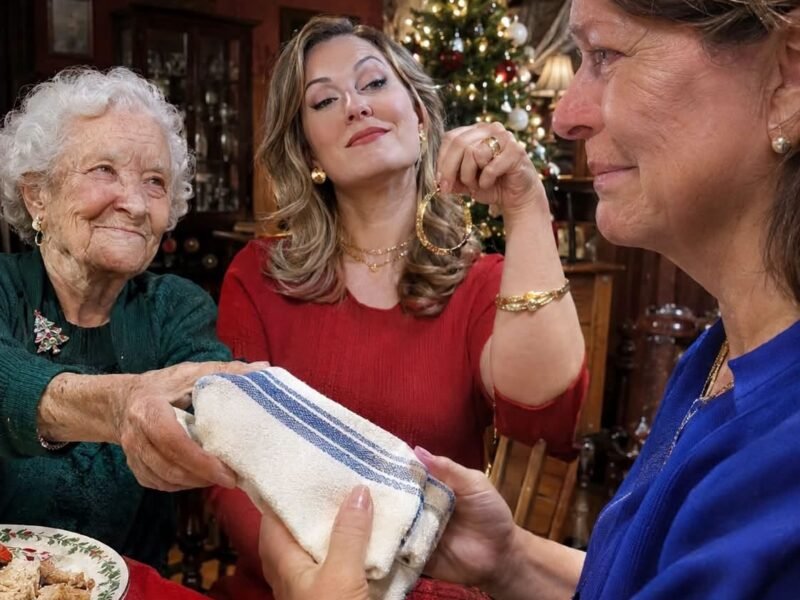
I made almond and cranberry scones, wrapped six of them in a dish towel, and drove over to Nathan and Michelle’s house like any grandmother with nothing on her mind.
Richard had told me once that you learn more from a person’s face when they believe they’ve gotten away with something.
I wanted to see Michelle’s face.
Their house sits on a cul-de-sac in Eden Prairie with a wreath already on the door. Dale and I had
given them the down payment for it.
I could hear Michelle’s voice through the glass before I even rang the bell, that bright, carrying voice she uses when she wants a room to belong to her.
Nathan answered. My son is 41 and looked 50. His shirt was wrinkled. His eyes were hollow. And he stood in the doorway like a man waiting for a bill to arrive.
“Mom, what are you doing here?”
“Scon,” I said, and held up the towel. “And I wanted to ask about Christmas.”
Michelle came around the corner in a cream sweater and gold hoops, with a smile that arrived half a second late.
“Darlene, what a surprise!”
We settled in the kitchen. She set out plates with a little extra force.
I let the silence sit because Michelle never could stand silence.
Within a minute, she was off.
“Honestly, we’re so stressed. Nathan’s got year-end numbers at Hicks Systems, and the holidays are just so much pressure.”
“I understand,” I said. “How are the plans? Still just the three of you, quiet and simple?”
I watched her.
There was no flicker, no pause, nothing.
“Oh, absolutely. Just us. Maybe a pot of chili on Christmas Eve. We want to keep it low-key.”
A pot of chili with a ballroom on order.
I’d interviewed bookkeepers who couldn’t have held that face.
I nodded and said, “Sounds lovely.”
And that was when Michelle decided to go on a fence.
Maybe it was the word simple. Maybe she sensed something.
Her smile dropped, and she put both hands flat on the counter.
“Darlene, since you brought it up, we need to talk about boundaries.”
“Boundaries?” I repeated.
“You monitor everything. Every dinner, every gift, every expense. You make the holidays feel like an audit. My mother and Courtney say the same thing. Nobody can relax when you’re in the room. Every year, you ruin Christmas with your questions.”
I had asked a single question about Chile.
I noticed what she hadn’t said.
She hadn’t offered to give the card back. She hadn’t suggested I stop helping.
She wanted the money to stay open while I stopped looking at it.
That is not a boundary. It’s a one-way door.
I turned to my son.
“Nathan, do you feel I’ve been suffocating you?”
He studied his coffee.
“Mom, Michelle’s just under a lot of stress. Maybe we all need to give each other some room.”
That was all.
Nathan has never in his life told a hard truth to someone who could get angry at him, and I had
spent 41 years calling it gentleness.
It wasn’t.
It was surrender with good manners, and it cost me something to finally see it.
I stood and smoothed my sweater.
“You’re right, Michelle. I’ll give you all the room you need.”
She blinked.
She’d been braced for a fight she could use against me, and I hadn’t given her one.
I picked up my purse and walked to the front hall for my coat.
On the stairs, I heard soft footsteps.
My grandson, Henry, 15, tall and quiet, with his father’s dark hair and none of his father’s habit of looking away.
He paused beside me and glanced toward the kitchen.
“Thanks for the scones, Grandma.”
He hugged me hard and a beat too long.
Something slid into my coat pocket, and then he let go.
He gave me a tiny nod, and I said, “I’ll see you soon, sweetheart,” and walked out into the cold like a
woman who had noticed nothing.
In the car, with the heater running, I unfolded a page torn from a spiral notebook.
The blue ink was rushed.
“Grandma, don’t sign anything Dad brings you on Sunday. Check what Aunt Courtney’s apartment says about you.”
Sunday.
Nathan had called the night before and asked if he could stop by on Sunday with a couple of school forms for Henry’s travel team.
I had said, “Of course.”
I sat there a good minute.
A 15-year-old had passed me a note under his parents’ noses.
Whatever he’d heard, he’d been afraid enough to risk it.
I drove home and did what I do.
I pulled my credit reports from all three bureaus, put on my glasses, and went line by line, past the summary pages and straight into the details.
The first two were clean.
On the third, under recent inquiries, was a rental application from Hunter Realy filed four weeks ago for a two-bedroom apartment in Adena.
Monthly rent: $3,150.
Tenant: Courtney Price, Michelle’s 33-year-old sister, a woman who’d had five jobs in six years and a
landlord dispute in each of them.
Under guarantor, in the neat type of an approved file, was my name.
Darlene Anne Holmes.
I had never met anyone at Hunter Realy. I had never seen that apartment.
The guarantor income statement listed my pension and my investment balance to the dollar, figures nobody could know without access to my mail.
A lease guarantee isn’t a favor.
It’s a legal promise that if the tenant stops paying, I pay for the full term of the lease plus fees.
12 months at $3,150 is $37,800 before late charges, and Courtney had never in her life paid anything on time.
I called Hunter Realy and told a polite young woman I wanted to verify a document attached to my name.
She emailed me a scan.
The phone number on the file was a cell I didn’t recognize.
The email on the guarantee was dolomes.guartor and a string of numbers at a free provider.
The signature at the bottom was an approximation.
The D leaned the right way, but the line closing the final letter hesitated as if it were being traced.
I’ve signed 10,000 documents, and I know how my own hand moves.
At 4:00, I was sitting across from Richard Nelson, and I laid it all out on his table in order: the bank alert, the raised limit, the ballroom deposit, the lease, the forged signature, the mismatched email and
number, Henry’s note.
I did not editorialize.
Richard read in silence, and when he looked up, he took his glasses off.
“Darlene, you did this right. Let’s keep doing it right.”
He explained things plainly.
“A forged guarantee on a lease is forgery and identity theft under Minnesota law. The credit card limit change was a separate false statement to the bank.”
I could report both, and I did not have to wait for Sunday.
We prepared a sworn affidavit that I had not signed or authorized anything at Hunter Realy.
Richard sent it with the documents to the Realy company’s compliance office and filed a report with the Eden Prairie Police fraud unit.
He also placed freezes on my credit with all three bureaus, which I should have done years ago.
A woman who spent four decades catching other people’s holes had left her own door unlocked because she was trying to be a nice grandmother.
I’ll own that.
Then came the harder part.
Richard asked what I wanted to do about my estate.
I’d been dreading that question.
Dale and I had built what we had on a quiet principle.
You work, you save, and what’s left goes to your child.
Nathan had been the center of every plan.
But the man who sat in that kitchen and let his wife call me an auditor in his own home was not who I’d drawn the plans for.
Nathan hadn’t forged anything, as far as I knew yet.
But I no longer trusted him to say no to the person who had.
We built a revocable trust to start, and then Richard explained that I’d want to move towards something firmer with an independent trustee.
For Henry’s college money, we set up a separate education account managed by a professional
fiduciary, out of reach of both his parents.
It was not a punishment.
It was a promise to a boy that no adults’ debts would ever touch his future.
I changed beneficiary designations on the accounts where I was allowed to, and I signed each page
only after reading it.
My hand shook once on the line that removed Nathan.
I made myself finish.
An inheritance is a gift, not a ransom note.
That left Sunday.
Nathan came at two with a folder and a worried smile. I made coffee and sat him in the living room.
The school forms were three pages, and the second was a durable power of attorney naming Michelle and Na Nathan as my agents for financial and medical decisions, with a notary line and a
blank for a witness.
“Mom, it’s just a formality in case of an emergency.”
“Who prepared it?” I asked.
“Michelle found it online.”
“I’ll have my lawyer look at it,” I said, and slid it back into the folder. “That’s what I do with any document that gives somebody control of my life.”
His face went a particular gray.
He had known.
I could tell by how quickly he stopped arguing.
A man who truly thinks something is a formality will tell you to take your time.
He left without finishing his coffee.
I didn’t say a word about the lease or the lodge.
Richard had asked me to wait, and I understood why.
The report was filed. The bank dispute was open, and a detective named Ellen Thompson had already called to confirm she would take the case from there.
All I had to do was be an old woman who had gone quiet.
Thanksgiving came anyway.
I almost didn’t go.
Richard said it was my choice, but he also said that if I was going to see them, I should say nothing about any of it, and I could document what they said.
I took a pecan pie and went.
Michelle opened the door in new cashmere, a diamond pendant at her throat.
Her mother, Joan, and her sister Courtney were already on the sectional, passing around a bottle of champagne.
Joan, who for years had called herself broke after her catering business went under, wore a tennis
bracelet that flashed in the firelight.
Courtney’s boots were the red sold kind, and her watch was easily $5,000.
“Darlene,” Joan said in the voice of someone who has never in her life been told no. “I hear you’ve been very busy.”
“Not too busy to see you looking so well,” I said, and took the armchair.
“We got a little windfall,” Joan said. “Everything’s turning around. You have to know how to use your resources.”
“I’d say that’s true,” I said. “As long as they’re yours.”
She smiled, hearing only the compliment.
Courtney laughed, tilted her glass, and announced that she was moving to Adena next month.
“A two-bedroom, doorman, a gym, and we’re doing Christmas Eve at Harborview Lodge, Darlene. 90
people. You wouldn’t believe the ballroom.”
“I thought it was chili for three,” I said mildly.
Michelle came in with a tray of cheeses.
“Plans changed. It got bigger.”
Nathan looked at the floor.
Henry watched me from the stairs, and when I smiled at him, his shoulders came down for the first time all day.
At dinner, they took turns.
Joan said I should learn to enjoy my money instead of hoarding it.
Courtney said I was obsessed with receipts.
Michelle said that if I couldn’t let go of control, maybe for Christmas, I should simply write a check and stay home so everyone could enjoy themselves.
The table went still.
Nathan stopped chewing.
Henry gripped the edge of his chair.
Michelle had finally said it out loud.
She wanted my money, and she wanted me gone so nobody at that party would have to wonder whose generosity was paying the bill.
I put my fork down.
I let 5 seconds pass because they matter.
“You know, Michelle, you’re right. I’ll stay home this year.”
Her eyebrows rose.
“Really?”
“I think it’s best for everyone.”
Joan lifted her glass.
“Very mature, Darlene.”
“Thank you, Joan.” I raised my coffee cup. “You all deserve exactly the Christmas you’ve planned.”
That night, I drove home and filed the date and time and what each of them had said in the folder Richard had given me.
December moved slowly, which is how I like it.
I put up a small tree and hung the glass ornaments Dale and I had collected over 43 years.
I baked sugar cookies and read by the fire.
The bank denied nothing because there was nothing to deny. The card had been dead since the day I
froze it.
Michelle simply hadn’t tried it yet because she was too busy planning.
I did watch the one thing I could.
The bank was holding the deposit dispute in review while the police finished their inquiry, and the
balance of the event, $14,300 for food, bar, and decorations, was due before service on Christmas Eve.
Richard’s investigator had learned that Michelle had told the lodge the card on file would cover it.
She’d also told Hunter Realy that her mother-in-law would confirm by phone if they ever called.
Nobody ever called because they’d put in the number Michelle gave them.
On the Tuesday before Christmas, I had a knock at my door.
It was Henry in a denim jacket and a hooded sweatshirt, no gloves, his nose red.
He had taken the bus to the end of my road and walked.
I took one look at his hands and swore under my breath.
“Inside now.”
I sat him down at the kitchen island, made hot chocolate the way he liked it, and wrapped a blanket around his shoulders.
I did not ask him anything until he’d had half the mug.
“Grandma,” he said finally, “I heard Mom and Grandma Joan last night. They were in the kitchen. Dad was at work.”
“Take your time.”
“They said you’re getting forgetful. Mom’s been writing down times you repeat yourself and like
things you said at Thanksgiving. She said after New Year’s she’s going to ask a judge to make her
your guardian. That way she’d control your accounts in your house.”
He swallowed.
“Grandma Joan said they could put you in a care facility and sell this place.”
The kitchen got very quiet.
I wasn’t shocked. Exactly.
That’s what is so odd about betrayal. After the first one, the rest only fit the pattern, but it still landed somewhere low and cold.
They had already taken my signature and my credit.
Now they meant to take my voice.
I reached across the counter and covered his hand with mine.
“Henry, look at me.”
He did.
“I need you to hear this. An accusation is not a diagnosis. A judge doesn’t hand over a person’s life because a daughter-in-law writes in a notebook. There would have to be medical evidence and a hearing, and I have a doctor who sees me every six months, and I have an attorney who already
knows about everything your mother has done.”
His eyes widened.
“You know?”
“Because of your note,” I said. “You may have saved me $100,000. Don’t ever doubt that.”
I told him gently and without detail that his college money was protected, that his parents couldn’t touch it, and that nothing the adults did was his to fix.
The tension in his jaw let go.
For the first time in a month, he looked 15.
“One more thing,” I said. “This house is yours anytime. You know the garage code. There’s a bed upstairs.”
While he drank his cocoa, he showed me screenshots of a text thread he’d found on his dad’s iPad.
And when he finished the mug, I put him in the car and drove him home myself.
I would not let a boy in subfreezing weather walk 2 miles to a bus stop twice in one day.
I dropped him two houses down so nobody saw me, and he waved once from the sidewalk.
Then came Christmas Eve.
I’d lit the fire by 5, poured a glass of red wine, and put on an old Ella Fitzgerald record.
Snow pressed soft against the windows.
The hall clock chimed the half hour, and at 6:30 exactly, my phone lit up on the side table.
Michelle.
I let it ring.
It went to voicemail, and then it rang again.
I learned the details later, mostly from Henry, who stayed through the first hour, and later from Detect Thompson.
At the lodge, the ballroom was dressed in white and gold.
Guests were coming in from the cold. Joan wore her bracelet, and Courtney had on a silver dress.
Michelle was working the room in green velvet, laughing like a hostess who’d never worried about a bill in her life.
At 6, the lodge’s events director asked to speak with her.
Payment for the balance was due before the kitchen released the food.
Michelle handed over my card with the kind of flourish she used on waiters.
The terminal declined it.
She asked for a second try, and it declined again.
She laughed and said, “It must be a glitch,” and produced her own debit card.
That one wouldn’t clear either because Nathan had been sitting on that account’s overdraft for two months and had said nothing.
The director was polite and firm.
No payment, no service.
The kitchen staff began pulling trays off the buffet.
By then, Michelle was on the phone to me and then to Nathan, who was standing behind her with
his hands shaking.
Joan tried a card of her own.
It was denied.
Courtney, who’d bragged about the party for weeks to everyone she knew, stood near the bar as a
waiter wheeled a warming cart away right past 90 well-dressed people holding empty glasses.
Henry told me it was the quiet that was the worst.
No one was shouting.
The lids were closing on the trays, and the wheels rolled over the carpet.
People checked their watches.
A few of Nathan’s colleagues made apologetic faces and moved toward the coat check.
At a quarter 7, the front doors opened and two uniformed officers walked in with Detective Ellen Thompson, a plain-spoken woman in a long navy coat.
The room went dead.
“Michelle Holmes,” she said.
Michelle’s maiden name was Price, the same as her sisters, and she’d used it as the contact name on the lease paperwork.
“I’m Detective Thompson with the Eden Prairie Police Department. We need to speak with you about a rental guarantee filed with Hunter Realy and a limit increase on a credit account belonging to Darlene Holmes.”
Michelle said, “This is a family misunderstanding.”
“Ma’am, there was a notorized affidavit from Mrs. Holmes saying she signed nothing. We also have the phone records tied to the number on the guarantee, and they placed the call on your cell. You can come with us quietly or not. That’s up to you.”
Joan said, “You can’t do this in front of all these people.”
“Ma’am, I’d advise you not to say anything further,” said the detective. “You are named on the lease as a secondary contact, and I’ll want to talk to you, too.”
Courtney started to cry.
Nobody comforted her.
In the middle of all of it, Nathan took out his phone and dialed me.
This time I answered.
“Mom…” He was breathing like he’d run a mile. “They’re arresting Michelle. You have to tell them it was a mistake. Tell them we had permission, please.”
I looked at the fire.
I listened to the noise behind him, the sobbing, the officer’s even voices, the muffled apology of a man from the lodge.
I waited until he was out of breath.
“Nathan, I read your text to Michelle. Henry showed me the thread. You wrote, ‘Do whatever you need
to. Don’t show me the paperwork. I can’t look at her if I know.’”
Silence.
“You didn’t forge anything,” I said. “I know that. But you knew, and you chose to protect your marriage from an argument by letting me be robbed. Then you brought me a power of attorney and
told me it was a school form.”
“Mom, I was scared. She said she’d leave. She said she’d take Henry. She said a lot of things.”
“You could have called me. You could have said no. A mother will forgive almost anything except being sold for the sake of peace.”
“Please.”
“I did not call the police on my daughter-in-law,” I said. “I reported a forgery. If that happens to be your wife, then that’s a matter for the court and not for the family. Merry Christmas, Nathan.”
I ended the call and set the phone face down.
I heard the rest of it from Henry, who stayed in the ballroom until the officers led her out.
He told me that his mother looked at him as the officers walked her toward the door, and her face changed all at once from fury to terror, and she said his name.
He said he didn’t answer.
He walked to the coat check, picked up his duffel, and went out to the lobby where Nathan caught him by the sleeve.
“Henry, wait. Where are you going?”
“To Grandma’s.”
Henry said, “She gave you a chance to protect her, Dad. You chose Mom.”
Nathan let go.
An hour later, my doorbell rang.
I opened the door, and Henry stood on the porch in the snow with his bag.
I pulled him in, locked the deadbolt, and held him until he stopped shaking.
He told me later he didn’t feel like he’d won anything.
He said he felt tired.
I told him that was an honest answer and that he never had to cheer for anyone’s downfall to keep
his place in my home.
The case didn’t close overnight.
Courts rarely work that way.
For 6 weeks, I refused every phone call from Nathan and let Richard handle the prosecutors.
I didn’t see any of them in person until the sentencing hearing on a gray morning in February.
Henry and I sat in the second row of the Henipin County courtroom with Richard beside us.
Across the aisle sat Joan and Courtney.
Gone were the cashmere and the red sold boots.
Joan’s wrist was bare where the diamond bracelet had been, and Courtney stared at her lap in a wrinkled coat.
When the side door opened and a baiff brought Michelle in wearing an orange county jumpsuit and steel handcuffs, Courtney let out a sharp, wet gasp.
Nathan sat on the far end of their bench, 10 lb lighter, his suit hanging off his shoulders.
He tried to catch my eye.
I looked straight ahead at the bench.
The judge reviewed the plea agreement allowed.
Identity theft and forgery for the Hunter Realy lease guarantee, and felony fraud for impersonating me to raise the credit limit.
Before handing down the sentence, the judge looked over her glasses at me.
“Mrs. Holmes, as the victim, you have the right to make a statement.”
I stood up and smoothed my coat.
Michelle turned her head toward me, her face pale and hollows dark under her eyes.
“Darlene, please,” Michelle whispered, her voice cracking across the quiet room. “Tell her it was a family misunderstanding. I was going to pay it back. Don’t let them put me in prison.”
“Wait your turn, Miss Holmes,” the judge said sharply.
I looked directly at Michelle.
“For 2 years, I gave you a card meant to buy my grandson pizza and hockey gear. You used my name to rent a luxury apartment for your sister. You booked a ballroom on my credit. And you kept a notebook
so you could tell a court I had lost my mind and lock me in a care facility. This was not a
misunderstanding. It was a plan.”
“Your Honor, I asked for the full sentence under the plea.”
Joan half stood from her bench.
“She’s 67. She has more money than she can spend in 10 lifetimes, and she’s ruining our lives over paperwork.”
“Sit down, Mrs. Price,” the judge said coldly. “Or you will join your daughter in custody before your
own probation hearing begins this afternoon.”
Joan sank back onto the wood, her face blotchy and trembling.
Courtney buried her face in her hands.
The judge didn’t hesitate.
She sentenced Michelle to 18 months in the Shakapei women’s facility, 5 years of supervised probation, and full restitution to the bank, the lodge, and Hunter Realy.
When the baiff stepped forward to take Michelle’s arm, she pulled back, her eyes wild as she looked at Nathan and then at Henry.
“Nathan, do something!” she cried out. “Henry, tell her I’m your mother.”
Henry didn’t flinch.
He kept his hand over mine on the bench and looked straight at her until the heavy door clicked shut behind her.
Outside in the hallway afterward, Joan and Courtney hurried past us toward the elevators without a
word.
Hunter Realy had voided Courtney’s lease the day my affidavit arrived, and Joan’s part in the scheme had already forced her to sell her jewelry to cover her legal fees and fines.
Nathan lingered by the courtroom doors, his hands jammed in his pockets.
Hicks Systems had let him go after the arrest became public, and the house in Eden Prairie had gone up for sale the week before to pay the legal bills.
“Mom,” Nathan said, his voice hollow as we walked past. “I’m losing the house. I have nowhere to go. Please just talk to me.”
I stopped and looked at him.
Somewhere inside that tired man was a boy who used to hold my hand crossing the street.
I let myself grieve that boy one last time.
“You watched your wife rob me, Nathan, and you brought me a power of attorney disguised as a
school form so you wouldn’t have to argue with her,” I said evenly. “My house is closed to you. Don’t contact me unless it is through Richard regarding custody paperwork for Henry.”
“Mom, I’m your son.”
“Yes,” I said, “and that’s why this hurts. Goodbye, Nathan.”
Henry didn’t look back as we walked out to the car.
I’d like to say it felt clean.
It didn’t.
A boundary can be necessary and still ache.
I knew how simple it would have been to pay one more bill and trade my piece for a few hours of his gratitude.
And I knew what that would have taught the boy walking beside me.
It’s June now.
The hydrangeas Dale and I planted have come in blue along the fence.
Henry lives with me full-time, and he’s at my kitchen island with his summer reading list spread out, a space cleared for the vase I’m filling.
He passes the scissors without being asked.
He looks up.
“You okay, Grandma?”
“Better than okay,” I tell him. “We’re going to be fine.”
For years, I confused giving with loving, and I mistook silence for peace.
Love isn’t an open line of credit.
It doesn’t fund the people who are plotting against you, and it doesn’t require you to be quiet while they do.
If you are the one in your family who keeps paying and keeps quiet, ask yourself who benefits from that arrangement.
Then check the statement.
It is a heartbreaking realization when you discover your years of quiet generosity have only created entitlement.