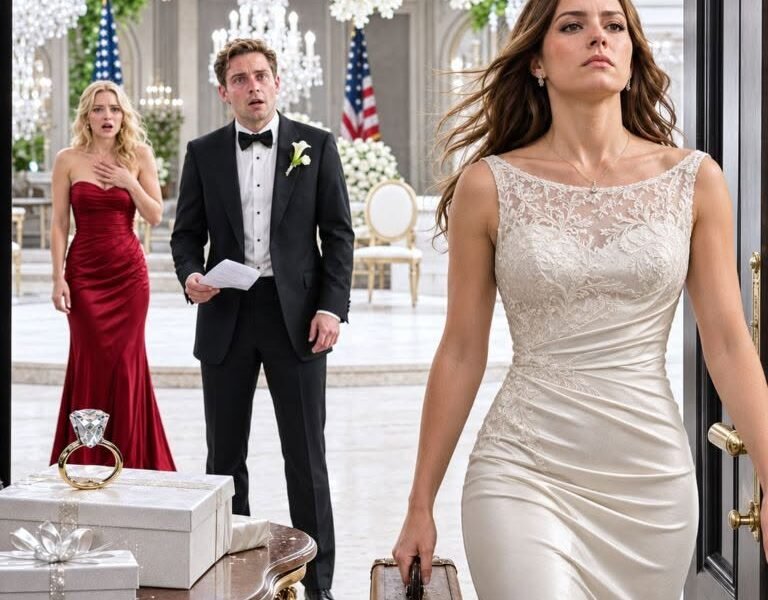
PART 1
My husband was fastening the back of his secretary’s red dress in our bedroom when I overheard him admit that our ten-year marriage was practically finished.
“Don’t worry about Wren,” he murmured as he slowly pulled the zipper up her back. “I’ve already prepared the divorce papers. She just hasn’t found out yet.”
His secretary giggled with delight.
“Then why are we still keeping this a secret, Grant?”
“Because she owns sixty-nine percent of the company, sweetheart. I need her to remain clueless for another two weeks.”
I stood frozen in the hallway, clutching the $38,000 watch I’d purchased for him in Paris.
My name is Wren Hollis. I was thirty-five years old, and until that Friday evening, I had considered my husband, Grant Aldous, the most important person in my world.
I’d arrived back in Minneapolis a full day earlier than planned after a business trip because I wanted to surprise him.
Instead, I walked straight into his plan to tear apart everything I’d spent years building.
Through the bedroom door, which had been left slightly open, I watched Grant straighten the shoulder strap of Tessa Marlow’s bright red dress.
Tessa was twenty-seven, attractive, and had worked as his executive secretary for nearly three years.
I was the person who had hired her.
She turned toward Grant, slipped both arms around his neck, and smiled up at him.
“What happens if she refuses to agree to the divorce?”
Grant leaned forward and placed a gentle kiss on her forehead.
“She won’t. Wren cares too much about appearances. She’ll put her signature on anything I give her.”
“What about the company?”
He let out a quiet chuckle.
“That’s the clever part. She believes that owning the majority of the shares makes her untouchable. But I’m the one running the operations. I manage the employees and the banking relationships. Once I shut her out and make her believe the business is collapsing, she’ll be practically begging me to take it off her hands.”
Tessa laughed excitedly.
“So I’ll finally get that promotion?”
“You’ll get a hell of a lot more than a promotion.”
My grip tightened around the watch box.
Ten years of marriage.
Our five-year-old daughter.
A technology business valued at more than sixty million dollars.
And there was my husband, casually plotting to take away everything I’d built while helping his mistress get dressed in the bedroom I’d designed myself.
Then Tessa brought up something that made the situation even more disturbing.
“Did you transfer the money out of the consulting account?”
Grant’s cheerful expression disappeared.
“Keep your voice down.”
“I’m asking because you promised the condo would be paid off before we went public.”
“It will be. I’ve already hidden the transfers among the vendor payments.”
For a moment, I felt as though I’d forgotten how to breathe.
Vendor payments.
For the past six months, our chief financial officer had been raising concerns about suspicious expenses involving a consulting firm that Grant had personally authorized.
Whenever I questioned him about those payments, he assured me there was nothing unusual and no reason to look into them.
Now I finally understood his reasons.
The watch box slipped out of my hand.
It struck the hardwood floor with a sharp crack.
Every sound coming from the bedroom stopped.
“Who’s out there?” Grant shouted.
I looked down at the broken glass scattered across the floor.
For one frightening second, I wanted to storm into the bedroom, grab Tessa by her expensive dress, and demand that both of them explain themselves.
But I forced myself to remain calm.
I bent down, gathered the damaged watch box, and picked it up.
Then I turned around and walked away.
“Wren?” Grant called again.
I gave him no answer.
I went downstairs, pulled open the front door, and walked out into the chilly Minnesota night.
I heard footsteps coming after me.
But by then, I was already inside my car, driving away.
I didn’t scream.
I didn’t cry.
Not yet.
One sentence kept echoing in my mind.
She owns sixty-nine percent of the company.
Grant believed my controlling stake was a weakness he could use against me.
But he’d overlooked one crucial detail.
Those shares had belonged to me long before our marriage.
And I had every legal right to sell them.
At exactly 11:47 p.m., I pulled into the parking lot of a twenty-four-hour diner near downtown Minneapolis and called Russell Penn, a longtime friend of my father’s.
Russell was a corporate attorney who had helped establish Hollis-Aldous Technologies twelve years earlier.
He answered after the fourth ring.
“Wren? What’s going on? Is everything all right?”
“I need to sell my shares in the company.”
He went quiet for a moment.
“How much of it?”
“All sixty-nine percent.”
This time, the silence lasted longer.
“Wren, that’s a controlling stake. Have you talked this over with Grant?”
“No.”
“Does he know you’re thinking about selling?”
“No.”
Russell let out a heavy sigh.
“What happened?”
I lowered my eyes to the wedding ring on my finger.
“I found him with his secretary. He’s been preparing to divorce me and secretly moving company money.”
My attorney didn’t say anything.
After several seconds, he asked me something I hadn’t expected.
“Do you remember the offer from Borealis Capital Partners?”
Of course I remembered.
Six months earlier, that private equity firm had approached us about purchasing a controlling interest in the company.
Grant had rejected the proposal.
He insisted that accepting the deal would mean surrendering everything we’d built together.
But I’d kept copies of the offer.
“I remember it.”
“Their managing partner has recently expressed interest again,” Russell explained. “Their investment team has already examined the company’s financial statements and major contracts. If the updated due diligence checks out, we could move forward with an offer fairly quickly.”
“How soon?”
“Possibly by Monday. The current shareholder agreement allows a transfer as long as we complete the required notices and obtain the necessary approvals. However, there’s something you need to be aware of.”
“What is it?”
“Once the sale is complete, you won’t have any control over what happens to Grant.”
I glanced at the broken watch box beside me.
“That’s exactly what I’m counting on.”
Russell took a moment to consider my answer.
Then he said, “I’ll contact the buyer’s legal team first thing tomorrow morning. Don’t sign anything until I’ve reviewed it.”
Before ending the call, I also asked him to arrange an independent forensic examination of the questionable vendor transactions.
I told him to prepare divorce documents for me as well.
Grant had already drawn up an agreement that he intended to put in front of me.
But the papers I was preparing would be nothing like the ones he’d imagined.
The following morning, Saturday, I went back home.
Grant was sitting at the kitchen island, wearing the navy silk robe I’d given him for Christmas.
The moment he saw me, he broke into a smile.
“Baby! When did you get back?”
“Late last night.”
His expression changed for just a second.
“Why didn’t you come upstairs?”
“I was exhausted, so I spent the night at a hotel.”
He studied my face carefully.
“Are you okay?”
“I’m just tired.”
He walked around the island and leaned toward me for a kiss.
I turned my face slightly, letting his lips land on my cheek instead.
His smile weakened.
“Listen,” he began, “I’ve been thinking about something. You’ve been putting in too many hours at the company lately. Maybe you should take a break and step away for a while.”
I almost laughed out loud.
We hadn’t even begun the divorce process.
Yet he was already looking for a way to push me out of the business.
“Maybe you’re right,” I replied.
He immediately looked relieved.
“Really?”
“Really.”
His face lit up with a broad smile.
“Good. I’ll take care of everything at the company. You’ve already done more than enough.”
I held his gaze.
“You have no idea how much.”
He didn’t recognize the meaning behind my words.
He was far too pleased with himself, convinced that everything was going according to plan.
After Grant left for work, I went upstairs.
Tessa’s perfume was still lingering in our bedroom.
There was even a single strand of blonde hair lying on my pillow.
I stared at it briefly before opening the bedside drawer and taking out the envelope containing the original incorporation documents for our company.
My name was listed first.
It had always been that way.
Long before Grant became CEO, before Tessa joined the company, and before we had the expensive house and luxury cars, Hollis-Aldous Technologies had begun with an idea of mine.
My parents had provided the initial $500,000 in funding.
Grant had contributed his engineering expertise.
But I was the one who secured our first clients, organized the financing, developed our sales strategy, and established the business relationships that kept the company running.
We married two years after the business was founded.
Before the wedding, we’d signed a prenuptial agreement stating that any shares either of us owned before the marriage would remain separate property.
As the company expanded, Grant gradually increased his ownership until he held twenty-one percent.
The remaining ten percent was divided between early investors and the employee equity pool.
He had convinced himself that I would never leave the company we’d built together.
He had badly misjudged me.
At 10:16 a.m., my phone rang.
Russell sounded more serious than usual.
“Wren, Borealis is ready to put a formal offer on the table.”
I closed the bedroom door behind me.
“How much are they offering?”
“Forty-five million dollars for your sixty-nine percent stake.”
I glanced toward the framed wedding photograph above our dresser.
In the picture, Grant was looking at me as if I were the only woman he had ever loved.
“Tell them I’m willing to proceed.”
Russell hesitated before adding something else.
“The managing partner would like to meet you in person before the deal closes.”
“What’s his name?”
“Everett Stone.”
The name meant nothing to me.
At least, not at that point.
I had no idea that the man preparing to purchase my controlling stake had been keeping a secret connected to my family for almost twenty years.
But before I could discover what that secret was, there was a wedding I needed to attend.
And my mother-in-law was about to receive the most humiliating gift of her life…
PART 2: The Wedding Gift
My mother-in-law called at exactly eight o’clock on Sunday morning.
“Wren, I’m calling to remind you not to embarrass this family at the reception today,” Joyce Aldous snapped, without even saying hello.
I stood in front of my closet, choosing between two dresses. “Good morning to you too, Joyce.”
For ten years, Joyce had praised her son’s “business genius” at every dinner and reminded me what an honor it was to carry his last name. She had never once asked who paid for her new kitchen. I had.
The wedding that afternoon was for Grant’s cousin Bridget. The whole family would be there, and so would half the people from our company. It was the perfect place to do what I had planned.
I picked the dark green dress. Then I took a small gift box from my dresser, wrapped in silver paper. Inside was a thick envelope that Russell had hand-delivered the night before.
The reception was at a lakeside hall in Wayzata. White flowers, string quartet, a hundred and twenty guests. Grant arrived with me, smiling and holding my hand like a husband in a magazine ad. Tessa wasn’t invited, but she wasn’t far from my mind. I had seen her car near the parking lot entrance. Of course.
Joyce found me at the gift table. She wore a pale blue suit and too much perfume.
“I hope you brought something generous,” she said. “The Aldous family has a reputation.”
“I did,” I said. “I brought something for you, too.”
“For me?” She sniffed. “I can’t imagine why.”
“Because you’ve been so kind to me. Open it after the toasts, Joyce. It’s better that way.”