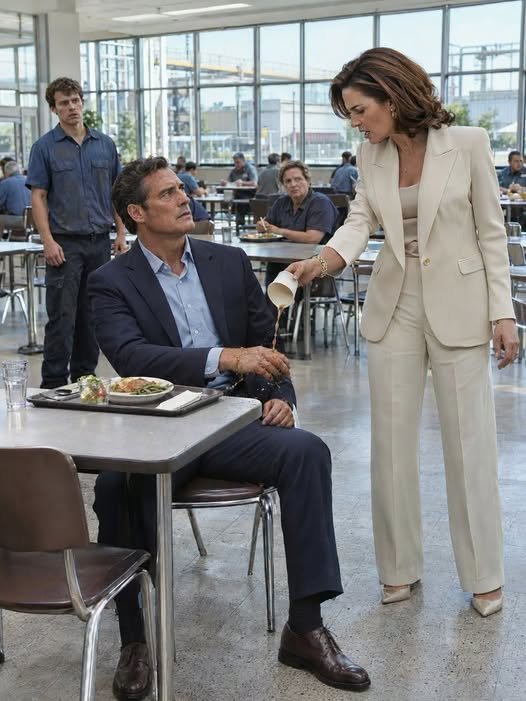
PART 2 — THE MAN WHO RECOGNIZED ME
Mr. Brooks?” he said.
Meredith stopped walking.
She turned toward her husband, clearly irritated by the interruption.
“Charles, what are you doing? I told you this man refused to move.”
Charles Whitaker didn’t answer her.
His eyes remained fixed on mine.
For a moment, I could almost see him searching for a way to undo the last thirty seconds. He glanced at my stained shirt cuff, the damp napkins beside my tray, and the redness across my right
hand.
Then he looked at his wife.
“Meredith,” he said quietly, “please stop talking.”
Her eyebrows rose.
“Excuse me?”
“Not another word.”
The cafeteria had become so quiet that I could hear the refrigeration unit behind the serving counter.
Meredith gave an incredulous laugh.
“Charles, are you seriously going to let some random employee—”
“He isn’t an employee.”
Charles swallowed.
“He’s Daniel Brooks. Our new chief executive officer.”
The words seemed to hang between them.
Meredith looked at me.
Then at Charles.
Then back at me.
Her expression changed slowly, as if her mind refused to accept what her husband had just said.
“That can’t be right.”
Charles closed his eyes briefly.
“It is.”
“But you said the new CEO was coming next week.”
“I said the board reception was next week. He started Monday.”
Meredith stared at my face.
I didn’t smile.
I didn’t stand.
I simply folded the damp napkin and placed it beside my sandwich.
“Good afternoon, Charles,” I said.
His mouth tightened.
“Mr. Brooks, I am terribly sorry. I had no idea my wife was speaking to you.”
That sentence interested me.
Not because he apologized.
Because of the way he apologized.
I had no idea my wife was speaking to you.
Not that she had poured coffee on someone.
Not that she had humiliated a person in front of an entire cafeteria.
Only that the person happened to be me.
“Would it have been different,” I asked, “if I were a machinist?”
Charles hesitated.
“Of course not.”
“Then why does it matter that I’m the CEO?”
He opened his mouth, but Meredith interrupted.
“This is ridiculous. It was a misunderstanding.”
I looked at her.
“Which part?”
She blinked.
“The seating arrangement.”
“Or the coffee?”
Her eyes flickered toward my hand.
“I didn’t mean to burn you.”
“Then what did you mean to do?”
She pressed her lips together.
Charles stepped closer.
“Mr. Brooks, perhaps we should discuss this upstairs.”
I looked around the cafeteria.
Nearly two hundred people had watched the incident unfold. Some were staring openly now. Others
pretended to concentrate on their lunches.
One man in a grease-stained uniform stood near the soda machine with his tray still in his hands.
He had been standing when Meredith first approached me.
He was still standing.
“No,” I said. “We can begin right here.”
Charles looked uncomfortable.
I gestured toward the empty chairs.
“Who authorized this table to be reserved for senior leadership?”
Charles glanced at Meredith.
Then at the table.
“It’s been an informal arrangement for years.”
“An arrangement approved by whom?”
“I suppose operations.”
“Your department?”
“Yes.”
“And does that arrangement appear in our employee handbook?”
“I don’t believe so.”
“Is there a sign?”
“No.”
“Then how are employees supposed to know?”
Charles rubbed the side of his jaw.
“It’s just something people understand.”
I heard Lucas Parker’s earlier words in my head.
Most people just do what she says. It’s easier.
I turned toward Meredith.
“Do you work for Westbridge Industrial Components?”
She stiffened.
“No, but my husband—”
“Do you hold a management position?”
“No.”
“Do you have authority to direct employees?”
“Not officially.”
There it was again.
Not officially.
I leaned back in my chair.
“Then you had no authority to order me away from this table.”
Meredith’s face reddened.
“I was trying to maintain standards.”
“By pouring hot coffee on someone?”
“It was an accident.”
I looked at Charles.
“Your wife says it was an accident. I think the company should establish exactly what happened.”
Charles nodded quickly.
“Absolutely. Whatever you think is appropriate.”
“Good. I’d like the cafeteria security footage preserved immediately. I’d also like the names of everyone responsible for managing visitor access.”
Meredith’s expression sharpened.
“Security footage?”
“Yes.”
“You’re making this into something much bigger than it needs to be.”
“I haven’t decided how big it is.”
I stood.
The movement made Charles straighten.
“I’ll have first aid examine my hand. After that, I’ll speak with Human Resources.”
Charles stepped aside.
“Of course.”
I picked up my tray.
Then I stopped.
“One more thing.”
Both Whitakers looked at me.
“Starting today, this table is available to everyone.”
Meredith’s mouth opened.
Charles didn’t let her speak.
“Understood.”
I carried my tray to the return counter.
Nobody applauded.
Nobody cheered.
That was fine with me.
I wasn’t interested in a cafeteria performance.
I was interested in what happened when the audience went back to work.
Because I had already noticed something far more troubling than an entitled visitor.
Every employee in that room had behaved as though Meredith’s conduct was normal.
And normal behavior is rarely created by a single incident.
The first-aid nurse examined my hand twenty minutes later.
Her name was Angela Foster. She had worked at Westbridge for eleven years.
She cleaned the irritated skin, applied a cooling dressing, and documented the injury.
“Superficial burn,” she said. “You should be fine.”
“Thank you.”
She hesitated before closing the medical record.
“May I ask something?”
“Of course.”
“Are you going to report what happened?”
“Yes.”
Angela nodded.
Then she said something I didn’t expect.
“Good.”
I studied her face.
“Has something similar happened before?”
She looked toward the closed door.
“Mr. Brooks, I don’t want to get involved in something that could cost me my job.”
“You shouldn’t have to choose between telling the truth and keeping your job.”
She gave a tired smile.
“That’s a nice sentence.”
I remembered Lucas saying almost the same thing about the employee handbook.
I left the medical office with a dressing on my hand and a growing sense that Westbridge’s problems were not limited to employee morale.
By two o’clock, I was sitting across from our Human Resources director, Patricia Sloan.
Patricia was in her early sixties, with silver-rimmed glasses and the careful manner of someone
accustomed to delivering unpleasant information politely.
I described the cafeteria incident without exaggeration.
She listened.
She took notes.
Then she said, “I’ll arrange for a formal investigation.”
“Who would normally investigate a complaint involving Charles Whitaker?”
Her pen stopped.
“Human Resources.”
“And who does Human Resources report to?”
“Administratively, the operations division.”
“Charles’s division?”
“Yes.”
I let the silence sit between us.
Patricia removed her glasses.
“I understand the concern.”
“Do you?”
She looked at the notebook.
“Mr. Brooks, Charles has been here for more than fifteen years. A great many reporting relationships were established before I took this position.”
“I’m not asking why the structure exists. I’m asking whether employees can reasonably expect an
independent investigation.”
She didn’t answer immediately.
Then she said, “Not always.”
It was the first unqualified answer I had received from a senior manager since arriving.
I appreciated it.
“Have there been complaints about Meredith Whitaker?”
Patricia’s expression became guarded.
“I would need to review the records.”
“Please do.”
“And complaints involving Charles?”
“Yes.”
She closed the notebook.
“How far back?”
“As far as our records permit.”
Patricia looked at me for a long moment.
Then she asked, “Are you prepared for what you might find?”
I thought about Lucas’s frightened expression.
About Angela’s hesitation.
About the employees who had watched someone get burned without believing they could intervene.
“I’d rather know what is happening inside this company,” I said, “than continue receiving reports that
everything is under control.”
Patricia nodded.
“I’ll start today.”
At 4:37 that afternoon, Charles Whitaker appeared outside my office.
My assistant, Rebecca, called to ask whether I would see him.
I said yes.
Charles entered carrying a leather portfolio.
He looked composed again.
The frightened man from the cafeteria had been replaced by the experienced executive I had met during my introductory meetings.
“Daniel,” he began, “I hope we can put this unfortunate misunderstanding behind us.”
I gestured toward the chair.
“Sit down, Charles.”
He did.
“Meredith feels terrible,” he said.
“Has she contacted Human Resources?”
“Not yet.”
“Has she apologized to the cafeteria employees who witnessed the incident?”
He frowned.
“Why would she apologize to them?”
“Because they were part of what happened.”
Charles shifted.
“Daniel, I think we’re getting distracted. My wife can be forceful. Sometimes she says things without considering how they sound.”
“She poured coffee on my hand.”
“She says the cup slipped.”
“That’s what the investigation will determine.”
He leaned forward.
“I’ve spent fifteen years building relationships here. I know how this plant operates. People respect
me.”
“Do they?”
His eyes narrowed slightly.
“Of course.”
“Then you should welcome an independent review.”
Charles looked at the dressing on my hand.
“I just don’t want a minor personal disagreement to damage the company.”
“Neither do I.”
I opened a folder.
“That’s why I’m concerned about the thirty-eight percent employee turnover rate.”
He sat back.
“Manufacturing is a difficult business.”
“Certainly.”
“People leave.”
“Yes.”
“We have competitors offering higher wages.”
“Some do.”
He relaxed slightly, apparently believing we were moving toward familiar territory.
Then I asked, “Why do forty-one exit interviews use almost identical language?”
His expression changed.
“What language?”
“Not a suitable fit.”
He looked away.
“That’s probably the standard form.”
“Who designed it?”
“Human Resources, I assume.”
“Under your division?”
Charles’s jaw tightened.
“Daniel, what exactly are you suggesting?”
“Nothing yet.”
I closed the folder.
“I’m asking questions.”
He stood a few minutes later.
We shook hands.
His grip was firm.
His smile was professional.
But as he reached the door, he turned.
“I’d be careful about taking everything employees say at face value.”
“Why?”
“People sometimes make accusations when they don’t get what they want.”
I nodded.
“That’s why we investigate.”
He left.
At 5:16, Patricia called me.
Her voice sounded different.
“Mr. Brooks, I think you need to see something.”
“What is it?”
“I’ve found a complaint file that was never included in your transition materials.”
“How many complaints?”
She hesitated.
“Fifty-eight.”
I looked toward the darkening windows.
“About Meredith?”
“Some.”
“And the others?”
Patricia took a breath.
“About Charles, his managers, and what happened to employees after they complained.”
I asked her to secure the original records, preserve the electronic audit history, and arrange an independent review.
Then I sat alone in my office, looking at the first-aid dressing on my hand.
That morning, I had thought a woman with a coffee cup had exposed a problem.
By evening, I was beginning to understand that she had exposed a system.
And someone inside that system had spent years making sure the complaints never reached the people who could act on them.
PART 3 — THE FIFTY-EIGHT COMPLAINTS
The next morning, Patricia arrived at my office carrying a gray binder.
It was thicker than I expected.
She placed it on the conference table without sitting down.
“Before you open this,” she said, “there’s something you should understand.”
I waited.
“Not all fifty-eight complaints are substantiated. Some concern the same incidents. Some were
submitted anonymously. A few were resolved.”
“Then we’ll distinguish them.”
She nodded.
“But many were closed without meaningful investigation.”
I opened the binder.
The first complaint was dated four years earlier.
A production supervisor had reported that Meredith Whitaker entered a restricted work area without proper protective equipment, criticized an employee’s appearance, and demanded that the
employee be removed from a customer-facing assignment.
The complaint had been marked resolved.
There was no explanation of the resolution.
The second concerned a machinist who had challenged a scheduling decision.
He claimed his overtime hours disappeared after he questioned Charles during a staff meeting.
The third came from a cafeteria worker.
She described Meredith demanding special meals, entering food-preparation areas, and threatening to have employees fired when they refused requests.
The fourth involved a maintenance technician who said he had been transferred to the least desirable
shift after reporting a safety concern.
I kept reading.
There were complaints about favoritism.
Complaints about retaliatory scheduling.
Complaints about supervisors discouraging written reports.
Complaints about employees being told they were not “leadership material” after questioning management decisions.
Some described ordinary workplace disagreements that might have been resolved through a fair process.
Others described conduct serious enough to require immediate attention.
What disturbed me most was the pattern in the closing notes.
Employee counseled regarding communication style.
Management expectations clarified.
No further action recommended.
The same phrases appeared repeatedly.
Sometimes the wording was identical.
“Who approved these closures?” I asked.
Patricia pointed to the signatures.
Charles Whitaker.
Two supervisors who reported directly to Charles.
And, on several older files, Patricia herself.
I looked up.
She didn’t avoid my eyes.
“I signed some of them,” she said.
“Why?”
“Because I was told the investigations had been completed.”
“Did you verify that?”
“No.”
The answer was quiet.
“I should have.”
I closed the binder.
“Patricia, I need you to understand something. This review cannot become an exercise in finding one person to blame while everyone else claims they were following instructions.”
“I understand.”
“Your decisions will be reviewed too.”
“I know.”
She sat down at last.
For the first time, she looked relieved.
Not because she was safe.
Because someone had finally said the process would apply to everyone.
By noon, I had contacted the chair of Westbridge’s board.
I explained the cafeteria incident, the injury, the complaint records, and the potential conflicts in our
reporting structure.
I recommended that an outside employment attorney and an independent workplace investigator review the matter.
The board approved.
Charles was placed on paid administrative leave while the review proceeded. His access to personnel
records and investigation files was temporarily restricted.
I also instructed our legal and IT teams to preserve relevant emails, access logs, scheduling records, and security footage.
No files were to be altered.
No witnesses were to be contacted by anyone seeking to influence their statements.
And no employee was to face retaliation for cooperating.
Those instructions were issued in writing.
I wanted them documented because I had already learned that verbal assurances meant very little at Westbridge.
The independent investigator, Elaine Porter, arrived the following Monday.
Elaine had spent twenty years examining workplace misconduct allegations.
She didn’t speak dramatically.
She didn’t make predictions.
She asked for documents.
Then she asked for people.
And she listened.
Lucas Parker was among the first employees she interviewed.
I didn’t attend.
That was deliberate.
I was the CEO, but I was also a witness to the cafeteria incident. I couldn’t pretend to be an impartial
investigator.
Two days later, Lucas asked to see me.
Rebecca scheduled fifteen minutes.
He arrived wearing the same faded blue work shirt.
He stood near my office door until I invited him to sit.
“Mr. Brooks, I wanted to ask you something.”
“Go ahead.”
“Am I going to lose my job?”
“No one should lose their job for giving an honest statement.”
He looked down.
“That’s not exactly what I asked.”
I understood.
He had heard promises before.
“I can’t guarantee the outcome of every employment decision,” I said. “But I can tell you that retaliation is prohibited, we’re monitoring for it, and any concern you raise will be reviewed outside Charles’s reporting chain.”
Lucas nodded slowly.
Then he reached into his pocket.
He unfolded a piece of paper.
It was a copy of an employee warning.
His name appeared at the top.
The date was six months earlier.
“What happened?” I asked.
“My supervisor told me to stay after my shift because Mrs. Whitaker was visiting with some people. They wanted the production floor cleaned up.”
“Was that part of your assigned work?”
“Not normally. I said I couldn’t stay because I had to pick up my little brother.”
“What happened?”
“I got written up for insubordination.”
I read the warning.
The explanation was vague.
“Did you appeal it?”
“I tried.”
“To whom?”
“Human Resources.”
“And?”
“They sent me back to my supervisor.”
“Who reported to Charles?”
Lucas nodded.
I handed the document back.
“Please give this to Elaine.”
“I already did.”
“Good.”
He remained seated.
“There’s something else.”
I waited.
“My dad worked here for twenty-six years. He always said Westbridge was a place where you could
build a life.”
His voice caught slightly.
“He retired two years ago. I haven’t told him how bad things got.”
“Why not?”
“Because he’d think I was weak for putting up with it.”
I looked at the young man across from me.
He couldn’t have been more than twenty-four.
He had approached a stranger with napkins because he thought someone needed help.
And he had been afraid to describe what he witnessed.
“Lucas,” I said, “staying employed while you take care of your family isn’t weakness.”
He nodded without looking up.
I didn’t ask him to be brave.
He had already done enough.
The investigation lasted six weeks.
During that time, I learned more about Westbridge than I had during the entire executive recruitment process.
Elaine and her team interviewed seventy-three current and former employees.
They reviewed scheduling records, disciplinary notices, promotion decisions, visitor logs, and internal correspondence.
Some complaints could not be verified.
Others involved misunderstandings or management decisions that were unpopular but legitimate.
But a substantial group revealed a consistent pattern.
Employees who challenged certain supervisors were more likely to receive unfavorable assignments.
Several disciplinary warnings lacked supporting documentation.
Promotions had been approved without following the company’s stated selection procedures.
And Meredith Whitaker had repeatedly been allowed to act as though her marriage gave her authority over employees.
One email stayed with me.
It had been sent by a production manager to Charles after Meredith complained about a cafeteria employee.
Meredith is upset again. Should we move the employee to another shift?
Charles had replied:
Handle it. I don’t want to hear about this twice.
That wasn’t proof of every allegation.
But it was evidence of a management culture in which one person’s displeasure could affect another person’s livelihood.
Another email concerned a machine operator who had reported a recurring equipment problem.
The operator had requested maintenance downtime.
His supervisor complained that the request would hurt the weekly production numbers.
Charles responded:
We need people who solve problems, not people who create paperwork.
Two weeks later, the operator was transferred to nights.
The investigation found no documented operational reason for the change.
I read that finding three times.
Westbridge manufactured hydraulic components.
If employees were discouraged from reporting equipment problems, the consequences could extend far beyond morale.
I ordered a separate technical safety review.
That review identified overdue preventive maintenance tasks and several documentation gaps requiring corrective action.
We did not find evidence that defective components had been knowingly shipped.
But we found enough to justify immediate changes.
I began to understand why the production reports had looked so reassuring.
Problems hadn’t disappeared.
They had been discouraged from becoming records.
Meredith’s interview took place during the fourth week.
Elaine later summarized her findings for the board.
Meredith acknowledged telling employees where to sit.
She acknowledged visiting the cafeteria regularly.
She acknowledged speaking to supervisors about workers she considered disrespectful.
But she denied deliberately pouring coffee on my hand.
The security footage showed her moving the cup toward my tray immediately after our exchange.
It did not establish every detail of her intent.
It did establish that the coffee spilled from her hand onto mine, and that she walked away without checking whether I was injured.
Elaine recommended that the company permanently revoke Meredith’s unrestricted visitor privileges.
The board agreed.
Meredith would no longer be permitted to enter nonpublic company areas without a legitimate business purpose, prior authorization, and an escort where required.
She would have no role in personnel matters.
That decision was straightforward.
Charles’s case was not.
He had been an important part of Westbridge for more than fifteen years.
He knew the customers.
He knew the equipment.
He knew which suppliers could deliver emergency parts and which maintenance problems required immediate attention.
Several managers defended him.
Some employees described him as generous during family emergencies.
One former supervisor recalled Charles personally helping raise money for a coworker’s medical bills.
Those accounts mattered.
They didn’t erase the complaints.
But they reminded me that leadership failures rarely arrive packaged in simple categories.
A person can do meaningful good for years and still create an environment where others are afraid to speak.
The board needed to judge the documented conduct, not the most flattering or least flattering story about the man.
On the forty-third day of the investigation, Charles requested a meeting with me.
Elaine advised that we wait until her final report was completed.
Charles agreed.
Three days later, the report arrived.
It was 186 pages long.
Its conclusions were measured and specific.
The investigation substantiated multiple instances of inconsistent discipline, failures to investigate employee complaints, improper influence by a nonemployee visitor, and management actions that created a reasonable fear of retaliation.
It did not substantiate every accusation.
And it did not conclude that Charles had personally ordered every unfavorable employment decision.
But it found that his decisions, his failure to supervise, and the structure he controlled had allowed the pattern to continue.
I read the report over a weekend.
By Sunday evening, I had reached one conclusion.
Westbridge couldn’t continue under the same operations leadership.
On Monday morning, I met with the board.
We discussed Charles’s employment, potential legal exposure, the need to correct affected personnel records, and the obligation to communicate honestly with employees.
There was disagreement about how to proceed.
One director wanted immediate termination.
Another worried that removing Charles without a transition plan would disrupt production.
I understood both concerns.
But I refused to treat operational convenience as a reason to preserve a failed management
structure.
We authorized counsel to present Charles with the findings and the available separation process.
He would have an opportunity to respond.
He would not be allowed to pressure witnesses or bargain away the company’s responsibility to address their complaints.
The board also approved a transition team to protect production continuity.
At 8:30 the following morning, Charles entered the boardroom.
He carried no portfolio.
For the first time since I had met him, he looked like a man who hadn’t slept.
On the table between us lay the gray binder.
Fifty-eight complaints.
Years of warnings.
And a decision that could no longer be postponed.
Charles sat down.
He looked at the binder.
Then he looked at me.
“Daniel,” he said, “how much of that are you going to make public?”
PART 4 — THE TABLE BELONGED TO EVERYONE
I didn’t answer immediately.
Charles sat across from me with his hands folded.
The board’s attorney, Margaret Ellis, occupied the chair to my right. Elaine Porter sat farther down the table with the final report.
Outside the windows, trucks moved slowly through the loading yard.
The plant was running.
People were working.
And the man who had controlled much of their working lives for fifteen years was waiting to learn what happened next.
“What do you mean by public?” I asked.
Charles looked at the gray binder.
“Are you going to read those complaints to the whole company?”
“No.”
His shoulders loosened slightly.
“Thank you.”
“Don’t thank me yet.”
He looked up.
“Those complaints contain private information about employees. Some involve medical circumstances, family responsibilities, disciplinary histories, and allegations that were never
substantiated. They aren’t mine to turn into a public spectacle.”
Charles nodded.
“But that doesn’t mean the findings disappear.”
Margaret slid a summary across the table.
Charles read it slowly.
The report described substantiated failures in complaint handling, improper influence over personnel decisions, inconsistent disciplinary practices, and inadequate protection against retaliation.
It also documented his responses during the investigation.
He had acknowledged that Meredith sometimes involved herself in company matters.
He had denied directing supervisors to punish employees for challenging her.
But he had admitted that he knew she made demands of staff and that he had failed to establish
boundaries.
When he finished reading, he placed the summary down.
“I never wanted people to be afraid of me.”
I believed he might be telling the truth.
That didn’t make the fear less real.
“Charles,” I said, “what did you think happened when an employee disagreed with you?”
“They could come talk to me.”
“And if the disagreement involved you?”
He hesitated.
“They could go to Human Resources.”
“Which reported through your division.”
His eyes lowered.
“I see the problem.”
“Do you?”
He looked at me again.
“I’m starting to.”
I leaned forward.
“The day your wife poured coffee on my hand, nearly two hundred people watched. Not one person challenged her. Lucas Parker brought me napkins, and he was afraid even to tell me who she was.”
Charles’s expression tightened at Lucas’s name.
“Lucas is a good kid.”
“He is.”
“I didn’t know he was having trouble.”
“He received a disciplinary warning after refusing to stay late for a task connected to your wife’s
visit.”
Charles looked toward Elaine.
“That wasn’t my decision.”
“No,” she said. “But it was made within the management structure you controlled, and the appeal was sent back into the same chain.”
He rubbed his forehead.
For several seconds, nobody spoke.
Then Charles said, “I’ve spent fifteen years keeping this place running.”
“I know.”
“Christmas shutdowns. Equipment failures. Customers calling at two in the morning. I’ve missed
anniversaries, birthdays, vacations. I gave everything I had to this company.”
“I believe you.”
He looked almost startled.
“But giving everything to a company doesn’t give you the right to take away someone else’s voice.”
Charles stared at the table.
I continued.
“Some employees respected you. Some appreciated what you did for them. Those accounts are in the report too. But the investigation also found that people learned to avoid disagreeing with your department because the consequences were unpredictable.”
He looked toward the windows.
“Meredith made things worse.”
“She did.”
“I should have stopped her.”
“Yes.”
His jaw moved.
“I kept telling myself it wasn’t worth fighting about. She’d complain, someone would handle it, and the day would go on.”
“And the employee?”
He didn’t answer.
“That’s the part you stopped seeing.”
Margaret explained the board’s decision.
Charles would not return to his role as operations director.
The company was prepared to proceed through a formal termination process, subject to its employment agreements and applicable law.
Alternatively, he could voluntarily resign under a separation agreement reviewed by counsel.
Any agreement would preserve the company’s obligations to investigate complaints, correct records,
cooperate with lawful inquiries, and protect employees.
It would not purchase silence from the complainants.
Charles listened without interrupting.
When Margaret finished, he asked for time to consider.
We gave him the room.
An hour later, he returned.
He carried a yellow legal pad.
“I’ve spoken with my attorney,” he said.
Margaret nodded.
“And?”
“I want to resign.”
She explained the next steps.
Charles picked up a pen and began drafting a short resignation letter.
His handwriting was careful.
Halfway through, he stopped.
“Daniel?”
“Yes?”
“Are you going to tell everyone I was fired?”
“You’re resigning. That’s what we’ll say.”
“And the investigation?”
“We’ll communicate the organizational findings and the corrective actions. We won’t expose confidential witness statements.”
He nodded.
“I appreciate that.”
“Charles, I’m not protecting your reputation.”
He stopped writing.
“I’m protecting the employees who trusted us with their experiences. Their complaints are not material for a public humiliation.”
He looked at the binder again.
Then he finished the letter.
When he pushed it across the table, I didn’t feel victorious.
I felt the weight of the work still waiting for us.
A resignation could remove one executive.
It couldn’t rebuild a culture.
The following week, I stood before employees in the same cafeteria where Meredith had poured coffee on my hand.
This time, there was no executive table.
Maintenance workers had helped rearrange the room.
The long rectangular table near the windows remained in place, but employees sat at it freely.
A forklift operator ate breakfast beside an accounting clerk.
Two supervisors shared a newspaper with a machinist.
Nobody appeared to consider the arrangement remarkable.
That was precisely the point.
I stepped to the microphone.
“Good morning. I want to talk about the independent workplace review we’ve completed.”
The room became quiet.
I explained that the review had identified serious failures in complaint handling, management accountability, and protection against retaliation.
I did not read individual complaints.
I did not name witnesses.
I did not ask anyone to applaud.
“Charles Whitaker has resigned as operations director,” I said. “We are establishing a new reporting
structure, and Human Resources will no longer report through operations.”
Several employees exchanged glances.
I continued.
“An outside reporting channel will be available for concerns involving management. Disciplinary
actions connected to the investigation will be reviewed. Employees whose records require correction will be contacted privately.”
I looked toward the back of the room.
Lucas stood beside two coworkers.
He wasn’t smiling.
He was listening.
“We are also changing how we evaluate managers. Production targets matter. Safety matters. Quality matters. But how people are treated matters too.”
Someone near the serving line raised a hand.
I recognized him as one of the machinists who had been standing during my first cafeteria lunch.
“Yes?”
“Sir, how do we know this won’t go back to the way it was after a few months?”
The question was direct.
I welcomed it.
“You don’t know yet.”
A few people shifted.
I continued.
“Trust isn’t something I can ask you to give me because I have a title. You’ll have to judge us by what
changes and whether those changes last.”
I described the new complaint process, the independent review schedule, and the quarterly employee meetings we would hold.
Then I made one promise.
“If you report a concern in good faith, you will not be expected to handle retaliation alone. There will be a documented process, independent review where appropriate, and accountability for anyone who violates it.”
I paused.
“And if those protections fail, I want to know.”
There was no thunderous applause.
Just a few nods.
Some skeptical expressions.
A handful of people taking notes.
It was the most encouraging response I’d seen since arriving.
They were thinking for themselves.
Not everything improved immediately.
Two supervisors resigned during the following month.
A third was reassigned after the review of disciplinary decisions.
Patricia Sloan remained with Westbridge, but her department underwent an independent compliance
review, and she accepted responsibility for the files she had signed without verifying.
We brought in a new head of employee relations who reported outside the operations division.
The maintenance team received additional funding to address overdue work.
Several employees had inaccurate disciplinary warnings removed from their records after individual
reviews.
Lucas Parker’s warning was among them.
I learned that when he came to my office one afternoon carrying a folded letter.
“Human Resources corrected it,” he said.
“Good.”
He sat down.
“There’s something else.”
I waited.
“I applied for the maintenance apprenticeship.”
“Congratulations.”
“They accepted me.”
I smiled.
“That’s excellent news.”
Lucas looked at the letter again.
“My supervisor said I should’ve applied last year.”
“Why didn’t you?”
He gave a small shrug.
“I figured it would be easier not to draw attention to myself.”
That answer stayed with me.
A company can lose talented people without ever seeing a resignation letter.
Sometimes they stay at their desks or machines, quietly deciding not to try.
I wondered how many opportunities Westbridge had lost that way.
Three months after the cafeteria incident, we conducted an anonymous employee survey.
Participation was higher than it had been in years.
The results weren’t perfect.
Some employees remained skeptical.
Others reported that certain supervisors still reacted defensively to criticism.
There were complaints about scheduling, equipment availability, and communication.
But the answers were more varied and specific than the old reports.
That mattered.
For the first time, people seemed willing to describe problems in their own words.
We also began tracking employee turnover monthly instead of discussing it only during annual reviews.
The rate didn’t collapse overnight.
No serious measure of workplace culture changes that quickly.
But the early numbers moved in the right direction.
More importantly, we were no longer treating departures as an unavoidable fact of manufacturing life.
We were asking why people left.
And listening when they answered.
I saw Meredith Whitaker once more.
It happened at a grocery store on a Saturday morning.
I was standing near the produce section, comparing two bags of apples, when I heard someone say
my name.
“Mr. Brooks.”
I turned.
Meredith stood a few feet away.
She wore a dark coat and carried a small shopping basket.
Without the cafeteria, the expensive handbag, and the people who had once stepped aside for her, she looked surprisingly ordinary.
“Mrs. Whitaker,” I said.
She hesitated.
“I’ve wanted to speak with you.”
I waited.
“Charles told me about the investigation.”
I nodded.
“He lost his job.”
“He resigned after the board reviewed the findings.”
She looked down at her basket.
“I never thought any of this would happen.”
“I believe that.”
Her eyes lifted.
“Do you?”
“Yes.”
She seemed confused by the answer.
“I don’t think you expected consequences because, for a long time, there weren’t any.”
Her face tightened.
“I made a mistake.”
“You did.”
“I was rude.”
“You were.”
She swallowed.
“And I spilled coffee on you.”
“Yes.”
She looked toward the produce display.
“I shouldn’t have done that.”
“No.”
For a moment, I thought she might apologize.
Instead, she said, “I wish you’d handled it privately.”
I studied her.
“Mrs. Whitaker, I did handle the investigation through proper channels. The employees’ private information was protected. Your husband’s decisions were reviewed by independent professionals.”
“But everyone knows.”
“People knew how they were being treated long before I arrived.”
She had no answer.
I picked up my apples.
“I hope you and Charles find a way forward.”
Then I left.
I didn’t need her to understand me.
And I didn’t need an apology to justify what had been done.
The purpose of the investigation had never been to make Meredith feel small.
It was to stop employees from being made to feel small by people who believed they were untouchable.
Six months after my first day at Westbridge, I ate lunch in the main cafeteria again.
It was a Thursday.
Rain tapped against the windows.
The serving line offered chicken soup, grilled cheese sandwiches, and a surprisingly good apple pie.
I carried my tray toward the long table overlooking the loading dock.
There were three empty chairs.
A woman in a welding jacket sat at one end, scrolling through photographs on her phone.
Two maintenance technicians were discussing a broken pump.
A young supervisor was eating soup while reviewing a training schedule.
I stopped beside the nearest chair.
“Mind if I sit here?”
The woman in the welding jacket glanced up.
“Go ahead.”
I sat.
Nobody moved.
Nobody lowered their voice.
Nobody looked worried.
A minute later, Lucas arrived carrying his own tray.
He wore a clean maintenance uniform with an apprentice badge clipped to the pocket.
He saw me and grinned.
“Mr. Brooks, you’re going to want to try the pie.”
“Is that an official recommendation?”
“Very official.”
He sat across from me.
We talked about his apprenticeship.
He described a hydraulic testing problem his instructor had assigned, then complained good-naturedly about how much mathematics the program required.
One of the technicians joined the conversation.
Soon the supervisor was asking questions too.
For twenty minutes, we discussed equipment, training, weekend plans, and whether the Browns had any chance of turning their season around.
Nobody asked who belonged at the table.
Nobody mentioned management seating.
Nobody seemed to remember that the chairs had once been treated as a privilege.
Then Lucas looked at my right hand.
“Does it still hurt?”
I flexed my fingers.
“No. It healed.”
He nodded.
“Good.”
I looked around the cafeteria.
There were still problems at Westbridge.
There would always be problems.
Machines would break.
Orders would arrive late.
Managers would make mistakes.
Employees would disagree.
But something essential had changed.
People were beginning to believe they could speak without first calculating the cost.
Lucas reached for the salt.
“Pass that over, Mr. Brooks?”
I handed it to him.
“Daniel is fine.”
He smiled.
“Thanks, Daniel.”
Outside, a truck backed toward the loading dock, its warning signal echoing faintly through the windows.
Inside, the cafeteria remained full of ordinary conversation.
I thought about the afternoon Meredith Whitaker had poured coffee on my hand.
She believed she was teaching a stranger where he belonged.
Instead, she had shown me what was wrong with the company I had been hired to lead.
The burn had healed in days.
The damage beneath it had taken months to begin repairing.
And the most important change wasn’t Charles Whitaker’s resignation, Meredith’s lost privileges, or
even the fifty-eight complaints that finally received proper attention.
It was the simple fact that a young maintenance apprentice could sit across from the CEO, ask him to pass the salt, and not worry about what would happen afterward.
I picked up my sandwich.
Around me, employees laughed, argued, complained, and talked over one another.
For the first time since arriving at Westbridge, I didn’t hear silence disguised as harmony.
I heard a company beginning to find its voice.