The phone on my patio table started buzzing at 2:15
in the afternoon on December 23rd. I was sitting on the screened lai of my little villa near Sarasota, Florida, with a glass of sweet tea and a crossword puzzle I wasn’t really doing. It was 74°.
A white egret was walking along the edge of the retention pond like it owned the place. Two days before Christmas, and I was barefoot.
The number on the screen belonged to Ruth Abernathy’s law office back in Dayton, Ohio.
“Mrs. Dawson?”
It was Janelle, Ruth’s paralegal. Her voice was careful, the way people sound when they’re carrying something heavy.
“I’m sorry to bother you. I just thought you should know. Your daughter has called our office 42 times since noon.”
I set my pencil down.
“42?” I said.
“Yes, ma’am. I’ve been keeping a tally on a sticky note. She’s very upset. She keeps asking if it’s true, if you really sold the house, if you really moved away. She wants your new number.”
I looked out at that egret for a long moment. My heart was beating so hard I could feel it in my ears.
“Janelle,” I said, “tell her yes. Tell her it’s true. And tell her everything she needs to know is in the letter.”
“And the phone number?”
“Not yet.”
I hung up. Then I sat there in the Florida sunshine and cried like I hadn’t cried since the day we buried my husband.
Now, I know what some of you are thinking. What kind of mother sells her house, moves a thousand miles away, changes her number, and lets her only child find out from a lawyer’s letter two days before Christmas?
I asked myself that same question many times.
So, let me tell you how I got there, and then you can decide.
My name is Margaret Dawson. Most folks call me Peggy. I’m 67 years old.
For 34 years, I was the school secretary at Fairview Elementary in Dayton. I knew every child’s name, every lost lunchbox, and every parent who was always late for pickup.
I was married to Ron Dawson for 41 years. Ron was a Navy man, and after that, a machinist at a tool
and die shop off Spring Pike. He was a quiet man with big hands and a soft heart.
Ron had a saying he repeated so often our daughter used to roll her eyes at it.
“Pay your debts, keep your word, and lock the back door.”
That was Ron’s whole philosophy of life right there.
Ron died six years ago this past March. Heart attack in his recliner, during the second period of a Blue Jackets game. I came in from the kitchen with two bowls of ice cream, and he was gone.
That first year was a fog.
Our daughter Lauren came by often in the beginning. She brought casseroles. She helped me sort
through the paperwork. She held my hand at the cemetery.
I was so grateful for her. I can’t even tell you.
That fall, I started thinking about Christmas.
Christmas had always been a big deal in our house. Ron used to string lights along the gutters every
year, cussing at the ladder the whole time. I baked for weeks.
After Lauren married Kyle and the grandbabies came along, Christmas morning at Grandma and Grandpa’s became a tradition.
Emma would come racing through the front door in her footie pajamas. Tyler, when he was little,
used to fall asleep under the tree.
So that year, the first Christmas without Ron, I did what I always did.
I bought a spiral ham from Kroger. I wrapped presents for the kids. I baked my pecan pie and Ron’s favorite apple pie, even though he wasn’t there to eat it.
I suppose I needed something to hold on to.
Lauren called me on December 20th.
“Mom,” she said, “Kyle and I have been talking. We’ve decided Christmas is just for our kids this year. We want it to be really magical for them. Just the four of us. You understand, right?”
I stood in my kitchen holding the phone and looking at that ham sitting on the counter.
“Of course, honey,” I said. “Of course, I understand.”
What else was I supposed to say?
I told myself they were young parents. I told myself they needed their own traditions. I told myself that grief makes everything feel bigger than it is.
That Christmas, I ate a Stouffer’s lasagna on a TV tray and watched It’s a Wonderful Life by myself.
When George Bailey ran down the street yelling, “Merry Christmas!” I turned it off.
I couldn’t take it.
The next year, Lauren called in early December.
Same as last year.
“Mom, Christmas is just for our kids.”
She asked me to drop the presents on their front porch on Christmas Eve after dark, so we don’t disrupt the morning.
So I did.
I drove over at 8:00 at night and set the bags by the door like a delivery driver.
I could hear music inside.
I didn’t knock.
The third year, I signed up to serve Christmas dinner at our church, St. Paul’s Lutheran, so the day
wouldn’t feel so empty.
It helped some.
Serving mashed potatoes to strangers is better than eating alone.
The fourth year, Lauren didn’t even call.
She texted in October.
“Hey, Mom, just a heads up. Christmas is still just for our kids this year. Love you.”
A little heart emoji at the end.
I stopped putting up a tree that year. There didn’t seem to be much point.
The box of ornaments sat in the basement, and Ron’s recliner sat empty in the living room.
And the house got very, very quiet in December.
For four years, I believed my daughter.
I believed that Christmas really was just for the kids, and that I was doing the loving thing by stepping
aside.
Then came year five.
That year, I drove over with two pies.
And that was the year I found out what “just for our kids” really meant.
Before I tell you about those pies, you need to understand something.
I wasn’t a stranger to my daughter’s family the rest of the year.
Far from it.
From January to November, I was the most useful woman in Montgomery County.
When Emma and Tyler got out of school, I was the one in the pickup line at 3:00, three days a week, in my old Buick LeSabre.
When Tyler had strep throat and Lauren couldn’t miss work at the dental office, I was the one sitting with him, making grilled cheese and watching cartoons.
When Emma needed braces, I wrote a check for the down payment because Lauren said their insurance barely covered anything.
And then there was the kitchen.
Three years ago, Lauren and Kyle decided they needed to remodel.
New cabinets, quartz countertops, a big farmhouse sink.
Kyle said it would add serious value to the house.
Kyle had his own HVAC business back then, and he always talked like a man who had money coming in next week.
One Sunday after church, Lauren sat at my kitchen table and cried.
They’d already torn out the old cabinets. The contractor wanted the next payment, and the bank was being difficult.
“Mom, I hate asking,” she said. “We just need a bridge. We’ll pay you back by spring. I promise.”
I took $38,000 out of the savings Ron and I had built over 40 years.
That was money from overtime shifts and canceled vacations, and Ron fixing our own furnace
instead of calling a repairman.
Lauren texted me that night.
“Thank you so much, Mom. We’ll pay you back by spring. Promise. Love you.”
I still have that text.
Hold on to that, because it matters later.
Spring came and went.
So did two more springs.
Not one dollar came back.
Whenever I gently brought it up, Lauren would sigh and say, “Things are tight right now, Mom. Kyle’s
business is in a slow season.”
And I’d let it go.
Because that’s what mothers do, isn’t it?
We let things go.
So by year five, I had become a kind of public utility, like the water company.
Always on, always there, and nobody thinks about you until the bill comes.
Now, about those pies.
That fifth Christmas Eve, I was sitting alone in my living room around 6:00.
The snow was coming down soft and steady outside the picture window, and I thought, “This is foolish, Peggy. That’s your daughter. Those are your grandbabies. You don’t have to stay for dinner.
Just drop off a couple of pies and give the kids a hug.”
So, I baked my pecan pie and Ron’s apple pie.
I put on my good red sweater.
I drove the 11 minutes across town to Lauren’s house in Centerville, a two-story colonial with a wreath on the door.
There were a lot of cars in the driveway.
More than four people’s worth.
I parked on the street.
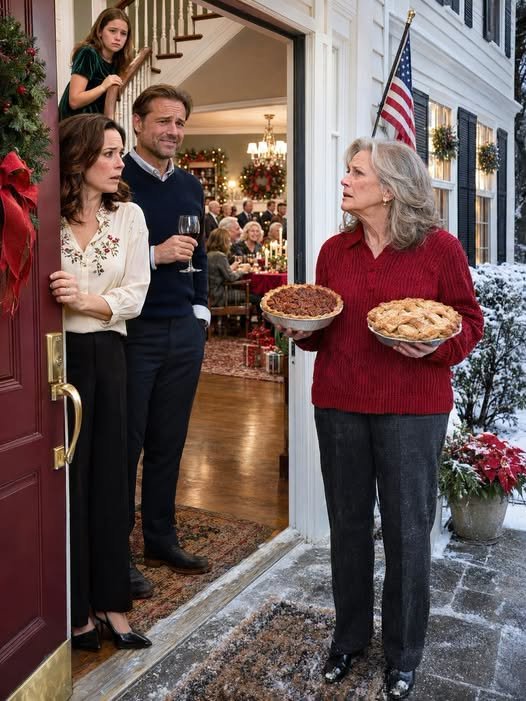
I walked up the path with a pie in each hand, and through the big front window, I saw the whole thing.
Saw.
The dining room was lit up like a magazine cover.
Candles, a centerpiece with pine cones and red berries, a long table covered in food.
And all around it sat people.
Kyle’s mother, Darlene, in a sparkly Christmas sweater. Kyle’s father, Gary. Kyle’s brother, Rick, and his wife and their two boys.
Kyle’s aunt from Kettering.
Even Kyle’s mother’s sister, who I’d met exactly once at the wedding.
Twelve people laughing, passing the rolls.
Christmas was just for their kids.
Except it wasn’t.
It was for everybody.
Everybody but me.
I stood on that front walk in the snow.
I don’t know how long.
My hands were going numb around those pie plates.
Then the front door opened because Kyle’s brother was letting the dog out.
And Lauren saw me.
Her face went white.
She came to the door quickly and pulled it halfway closed behind her.
“Mom,” she said, low and tight. “What are you doing here? We talked about this.”
“I just brought some pies,” I said. “For the kids.”
Kyle appeared behind her with a glass of wine in his hand.
He smiled that salesman smile of his.
“Peggy, Merry Christmas. Look, it’s just… well, it’s a lot for the kids. You know, too much commotion. We’re trying to keep it simple.”
Behind them, I could hear twelve people and a football game.
Then I saw Emma on the staircase in a green velvet dress.
She was eleven.
She looked at me, then at her mother, then back at me.
Her little face was so confused.
I held out the pies.
Lauren took them.
“Merry Christmas, honey,” I said.
My voice didn’t shake.
I’m still proud of that.
Then I walked back to my car.
And I cried the whole way home on I-75.
So hard I had to pull off at the Austin Boulevard exit and sit in a gas station parking lot until I could see
the road again.
I didn’t hear from Lauren for almost three weeks.
No apology.
No explanation.
Then, in the middle of January, she called.
Sweet as anything.
“Mom, Kyle and I want to come by Saturday. We have something we want to go over with you. It’s important.”
That Saturday, they sat at my kitchen table.
The same table where I’d written that $38,000 check.
Kyle opened a manila folder.
Inside were two documents.
One was a quitclaim deed transferring my house to Lauren and Kyle.
The other was a durable power of attorney naming Kyle as my agent.
“It’s just to avoid probate, Peg,” Kyle said, sliding a pen across the table. “Everybody does this now. If
something happens to you, God forbid, everything’s smooth. No lawyers, no courts. It’s for your protection.”
Lauren nodded along, not quite meeting my eyes.
I looked at that pen, and I heard Ron’s voice in my head.
Clear as a bell.
“Never sign anything at the kitchen table, Peg.”
“I’ll read it over,” I said, and closed the folder.
Kyle’s smile tightened just a little.
He told me it was for my protection.
Three weeks later, sitting in the bleachers at my grandson’s basketball game, I found out what it was really for.
It was a Saturday morning in early February.
Tyler’s fourth-grade basketball team, the Centerville Comets, was playing in a middle school gym
that smelled like floor wax and popcorn.
I had driven over in sleet because Tyler had asked me to come.
“You’re my lucky charm, Grandma,” he’d said.
You don’t say no to that.
I sat in the bleachers in my winter coat with a cup of bad coffee.
Lauren sat two rows down, scrolling on her phone.
Kyle came in late and stood by the doors talking on his cell.
At halftime, I went down the hallway to the ladies’ room.
On my way back, I passed the alcove by the trophy case where Kyle was standing with his back to me.
He had his phone pressed to his ear, and he was talking low, the way people do when they think nobody’s listening.
“No, I hear you, Dave. I hear you. Look, I just need another month. Once she signs the deed, we pull a home equity line on the place. One-fifty easy. That house is paid off. It’s sitting on a gold mine. That covers the supplier judgment and then some.”
I stopped.
I didn’t mean to.
My feet just stopped.
“She’ll sign,” Kyle said. “Lauren’s handling her, and honestly, she doesn’t need that big house anyway. Once it’s in our name, we’ll move her into one of those senior apartments over by the Dayton Mall.
She’ll be fine.”
He laughed.
Just a short little laugh.
I turned around and walked back to the bleachers before he could see me.
I sat down.
I cheered when Tyler made a free throw.
I clapped when the Comets won by four.
And the whole time, my hands were shaking so bad I had to hold my coffee cup with both of them.
Move her into one of those senior apartments.
Like I was a recliner they were getting rid of to make room.
I didn’t sleep that night.
I sat at my kitchen table with the manila folder in front of me and stared at the words “quitclaim deed” until they didn’t even look like English anymore.
The next morning, I knocked on Dolores Kowalski’s back door.
Dolores has lived next to me for 30 years.
She’s 74, Polish Catholic, sharp as a tack, and she makes the best pierogi in the state of Ohio.
She took one look at my face, poured me a cup of coffee, and said, “Sit.”
I told her everything.
The pies, the window, the folder, the phone call at the gym.
When I finished, Dolores was quiet for a long moment.
Then she said, “Peggy, did I ever tell you what happened with my Michael?”
She hadn’t.
Not all of it.
Back in 2019, her son Michael talked her into adding his name to the deed of her house to make things easier later.
“Ma, just sign.”
She signed.
Two years later, Michael’s marriage fell apart, and his ex-wife’s divorce lawyer went after everything with Michael’s name on it, including half of Dolores’s house.
“I spent $11,000 on lawyers to keep the roof over my own head,” Dolores said. “$11,000, and I almost lost anyway.”
She set her cup down and looked me straight in the eye.
“Honey, the minute your name isn’t the only name on that deed, it’s not your house anymore. It’s
theirs, and their creditors, and their ex-wives. Don’t you sign one thing until you see a real lawyer. Not Kyle’s lawyer. Yours.”
She gave me a name.
Ruth Abernathy, an elder law attorney with an office on Far Hills Avenue.
“She saved my bacon,” Dolores said. “She’s a tough cookie. But she’s honest.”
I called Monday morning.
Ruth Abernathy turned out to be a small woman in her late 50s with reading glasses on a beaded chain and a voice like a calm lake.
She listened to my whole story without interrupting once.
Then she opened Kyle’s folder and read every page.
“Mrs. Dawson,” she said, “I’m going to explain this in plain English because nobody explained it to you.”
And she did.
“A quitclaim deed,” she said, “isn’t a plan. It’s a gift. The moment you sign it and it’s recorded, the house belongs to someone else. You can’t change your mind next week. Once the house is in your children’s names, it’s exposed to their debts, their lawsuits, their divorces.”
Exactly what happened to Dolores.
“And there’s a tax problem nobody mentions,” Ruth said. “If your daughter inherits this house after you pass, she generally gets what’s called a step-up in basis. That can wipe out most of the capital gains tax. But if you give it to her now while you’re living, she may lose that. It could cost her tens of
thousands of dollars down the road.”
Then she tapped the second document.
“And this power of attorney, this gives Kyle the legal right to sign your name, your bank accounts, your property, your affairs. Choosing a power of attorney is like handing someone your checkbook and
your pen. You only hand that to someone you’d trust with your life.”
I swallowed hard.
“Kyle says it’s to avoid probate.”
Ruth nodded.
“There are good ways to avoid probate, Mrs. Dawson. A revocable living trust, for one. You keep full control of everything while you’re alive. You can change it whenever you want, and it passes outside of probate. Nobody has to take your house to save you from a courtroom.”
I sat there feeling like someone had finally turned on a light in a dark room.
Then Ruth asked one more question.
“That $38,000 you mentioned, do you have anything in writing?”
I pulled out my phone.
I scrolled back three years and showed her the text.
“We’ll pay you back by spring, Mom. Promise.”
Ruth read it twice.
Then she smiled.
Just a little.
“That helps,” she said.
I walked out of Ruth’s office into the cold February air, knowing two things for certain.
My daughter’s husband was planning to take my home.
And I was not going to scream, cry, or beg.
I was going to get quiet.
And I was going to get ready.
Getting quiet turned out to be the hardest thing I’ve ever done.
Every few days, Kyle would text me.
“Hey, Peg, had a chance to look over those papers?”
Then Lauren would call.
“Mom, Kyle’s just worried about you. We want everything taken care of.”
And every time, I’d answer the same way.
“Still reading it over, honey. You know how slow I am with legal things.”
They believed me.
Why wouldn’t they?
For five years, I’d been easy.
I’d been the woman who said, “Of course, I understand,” to everything.
Nobody expects the water company to stop running.
Meanwhile, I kept picking the kids up from school.
I kept making grilled cheese.
I kept my mouth shut.
But every other Tuesday, I drove to Far Hills Avenue and sat in Ruth Abernathy’s office with a yellow legal pad.
Ruth walked me through it one step at a time.
First, we created a revocable living trust.
With me as the trustee, I kept full control of everything I owned.
I could buy, sell, spend, or change my mind anytime.
But when I’m gone, it all passes on quietly without probate.
Second, we chose a new power of attorney.
Not Kyle.
Not even Lauren.
Not right now.
I named my cousin Linda, a retired nurse from Springfield who’s never asked me for a dime in her life, with Ruth’s firm as backup.
Same for my healthcare decisions.
“Pick the person who will tell you no when you need to hear it,” Ruth said. “That’s who you want
holding your pen.”
Third, the $38,000.
Ruth drafted a letter that would formally request repayment.
$300 a month.
No interest.
“$300 a month?” I said. “Ruth, that’ll take over ten years.”
“I know,” she said. “This isn’t about punishing them. It’s about teaching them that a promise to your mother is still a promise. Your husband would have understood that.”
Pay your debts.
Keep your word.
Lock the back door.
Yes, Ron would have understood.
Fourth, and this was the one that made me cry right there in her office.
We set up an education trust for Emma and Tyler, managed by an independent trustee.
When the time came, the money would go straight to their colleges or trade schools.
Not to their parents.
Not to Kyle’s suppliers.
To those two children, for their futures.
And then there was the house.
I’ll be honest with you.
That was the part that nearly broke me.
Ron and I bought that brick ranch on Maplewood Drive in 1984 for $61,000.
We had to scrape together the down payment from three different savings accounts.
Lauren took her first steps in that living room.
Her height marks were still penciled on the pantry door.
Ron’s workshop in the garage still smelled like machine oil and sawdust.
But Kyle had said it himself.
“That house is sitting on a gold mine.”
As long as I lived in it alone, with no one but Dolores keeping an eye on me, my house was a target.
And I was tired of being a target.
So in September, I called Barb Henley, a realtor from my church.
I told her I wanted to sell quietly.
No big sign in the yard.
No open houses on Facebook.
Barb found a buyer in nine days.
A young Navy family.
The husband was being stationed at Wright-Patterson Air Force Base.
They had a little girl about four and another baby on the way.
When I met them at the walkthrough, the young man shook my hand and said, “Ma’am, we’ll take
good care of it.”
I had to step out onto the back porch for a minute.
I swear I could almost hear Ron saying, “That’ll do, Peg. That’ll do.”
Now, where to go?
I’d always loved Florida.
Ron and I used to drive down to Siesta Key every few years when Lauren was small.
So, I flew down to Sarasota in October and found a little two-bedroom villa in a 55-plus community about 20 minutes inland.
Screened lanai, a community pool, a pickleball group that met every morning at eight, a Lutheran church two miles away.
Ruth helped me with the paperwork.
Florida has no state income tax, which helped my pension stretch further.
And once I became a Florida resident, I could file for the homestead exemption on my new place, which lowers the property taxes and protects your home in other ways, too.
I paid cash.
My name.
My trust.
My door.
I didn’t tell Lauren.
I didn’t tell anybody except Dolores, Linda, and Ruth.
In early November, Lauren texted me.
“Hey, Mom. We’re doing Thanksgiving at Kyle’s parents this year. You understand?”
I sat there and looked at that text for a long time.
Then I wrote back.
“I understand perfectly.”
I spent Thanksgiving at Dolores’s table, eating her pierogi and her famous sweet potato casserole.
We laughed until we cried.
Then we just cried.
On December 1st, I signed the closing papers at a title office on Wilmington Pike.
That afternoon, a moving truck loaded up Ron’s recliner, my good dishes, the box of Christmas ornaments from the basement, and 41 years of a marriage.
Before I left, I took a picture of the pantry door with Lauren’s height marks.
Then I went to the Verizon store and got a new phone number with a Florida area code.
I left two wrapped presents with Dolores.
One for Emma.
One for Tyler.
A card in each one.
“Grandma loves you always, no matter where she is.”
Dolores hugged me in her driveway in the cold.
She held on for a long time.
“Go live, Peggy,” she whispered. “You’ve earned it.”
I drove south on I-75 the next morning and didn’t look back until Kentucky.
Before I left Ohio, I gave Ruth one last instruction.
I asked her to mail the letter so it would arrive at Lauren’s door on December 23rd.
Not to ruin their Christmas.
I just wanted my daughter to know, for once, exactly how it feels to find out you’re not part of the plan.
I wasn’t there when the letter arrived.
But I know exactly how it went because later on, piece by piece, I heard it from Dolores, from Ruth, and eventually from Lauren herself.
December 23rd was a Wednesday.
The mail carrier came up the walk on Lauren’s street around 11:30 that morning.
Lauren was home, taking the day off from the dental office to wrap presents.
She signed for a certified envelope from the law office of Ruth Abernathy, attorney at law.
She opened it standing at her kitchen island.
The quartz countertops.
The farmhouse sink.
The kitchen my $38,000 built.
The letter was two pages long.
Ruth wrote it in plain, polite lawyer English.
It said, in short, that the property at Maplewood Drive had been sold and the sale had closed on December 1st.
That Margaret Dawson would not be signing any deed or power of attorney presented by Lauren or
Kyle, and that her affairs were now held in a revocable living trust with other parties named to act on her behalf.
That the $38,000 loan, documented by Lauren’s own written promise of repayment, was now
formally requested to be repaid at $300 a month without interest, beginning February 1st.
That funds had been placed in an education trust for Emma and Tyler, managed by an independent trustee, which their parents could not access.
And that, for the time being, all communication should go through Ruth’s office.
Clipped to the back of that letter was a single sheet from my own stationery, the kind with little
bluebirds in the corner.
I’d written it by hand at my kitchen table on Maplewood Drive the night before I left.
“Dear Lauren,
For five years, Christmas was just for your kids. This year, I decided my life was just for me.
I didn’t leave because I stopped loving you. I left because I finally started loving myself, too.
Your father always said, ‘Pay your debts, keep your word, and lock the back door.’
I’ve locked the back door, honey. When you’re ready to keep your word, you know how to find me.
Love always,
Mom.”
Lauren told me later she read that note four times before she understood it.
Then she grabbed her phone and called my old number.
“The number you have reached is no longer in service.”
She called again and again.
Then she put on her coat, drove to Maplewood Drive, and found a young Navy wife hanging a wreath
on my front door, with a toddler holding onto her leg.
My front door.
Lauren ran next door and pounded on Dolores’s back door.
Dolores told me she let her stand there in the cold for a moment.
Then she opened the door, handed Lauren the two wrapped presents for the kids, and said very gently, “It’s all in the letter, sweetheart.”
“Where is she?” Lauren cried. “Dolores, where’s my mother?”
“Somewhere she’s wanted,” Dolores said.
And she closed the door.
From the car, Lauren started calling Ruth’s office.
At noon.
At 12:05.
At 12:07.
Over and over, the whole afternoon.
Janelle, the paralegal, kept a tally on a yellow sticky note.
By 2:15, it said 42.
That’s when Janelle called me on the lanai.
But the worst of it, I learned later, happened that evening.
Kyle came home from a job around six.
Lauren was sitting at the kitchen island with the letter spread out in front of her and mascara all down her face.
She shoved it across the counter at him.
Kyle read it, and his face went gray.
Because what Lauren didn’t know, what nobody knew, was how deep he was.
The supplier judgment from his HVAC business was over $90,000.
He’d already promised his creditors he’d have the money by January from what he called the house
equity.
He’d even borrowed $8,000 from his buddy Dave against it.
My house.
A house that was never his to borrow against.
It all came out that night in that beautiful kitchen.
The judgment.
The second credit card Lauren didn’t know about.
The past-due notices he’d been hiding in his truck.
Emma told me much later that she and Tyler sat at the top of the stairs listening to their parents scream at each other on the night before Christmas Eve.
Tyler cried.
Emma held his hand.
When I heard that, it broke something in me.
Because those children didn’t do anything wrong.
Meanwhile, a thousand miles south, I was trying to have Christmas.
My neighbors in the villas, a retired fire captain named Walt and his wife Bonnie, invited me to a
Christmas Eve potluck at the clubhouse.
Forty people in Christmas shirts and flip-flops.
Somebody brought a karaoke machine.
A widower from Michigan named Frank sang “Blue Christmas” so badly it was wonderful.
Afterward, Bonnie took me to the candlelight service at the little Lutheran church.
When we sang “Silent Night” and everyone lifted their candles, I looked around that room full of strangers, and I realized something.
For the first time in five years, I wasn’t alone on Christmas Eve.
But when I got home that night, I sat on my lanai in the dark and looked at my phone.
Janelle had texted me the final count.
Lauren had called the office 42 times on the 23rd and 19 more on the 24th.
And I cried.
Not happy tears.
Not victory tears.
I’ll tell you something nobody tells you about revenge.
It doesn’t feel like winning.
It feels like grief with a better view.
The house was gone.
Kyle’s plan was gone.
For all of that, it was already too late.
But sitting there under the Florida stars, listening to the palm fronds rattle in the breeze, I didn’t know yet whether it was too late for my daughter and me.
Then, in late January, a letter came to Ruth’s office.
It wasn’t from Lauren.
It was written in purple gel pen, and it was from Emma.
Ruth forwarded Emma’s letter to me in Florida.
It came in a pink envelope with a unicorn sticker on the back, and the handwriting leaned uphill the way twelve-year-old handwriting does.
“Dear Grandma,
Mrs. Kowalski gave me the address of your lawyer. I hope that’s okay.
Was it because we didn’t invite you to Christmas? I always wanted you there. I asked Mom every
year. She said it was Dad’s rule.
Mom cries a lot now. Dad is staying at Uncle Rick’s for a while.
Tyler wears the sweater you gave him every single day, even though it’s too big.
I miss you. Please don’t be gone forever.
Love,
Emma.
P.S. I made the honor roll.”
I read it sitting on my lanai, and I cried so hard Bonnie came over from next door to check on me.
That night, I called Ruth and asked her to give Lauren my new number.
Then I called Emma.
“Grandma!”
Her voice cracked right down the middle.
“Grandma, is that really you?”
We talked for 40 minutes about honor roll and her friend Kaye and the dolphins I’d seen from the beach.
And then, very quietly, she said, “Mom wants to talk to you. Is that okay?”
Lauren came on the line.
For a long moment, she didn’t say anything at all.
I could just hear her breathing.
Then she broke.
She told me everything.
Kyle’s debts.
The judgment.
How “Christmas is just for our kids” started as Kyle’s idea because he didn’t want me in the house
where I might see the past-due notices or ask about the $38,000.
And how she went along with it year after year because it was easier than fighting him.
“I treated you like the bank and a babysitter, Mom,” she sobbed. “And you let me because you loved me.”
“I did,” I said. “I still do.”
“Can you ever forgive me?”
I took a breath.
This was the part I’d been praying about for weeks.
“I forgive you, Lauren. But forgiving isn’t the same as going back to how it was. So, here’s how it’s going to be. No talk about money, the trust, or what I might leave behind. Not now, not ever. The $300 a month continues. Not because I need it, honey, because you need to know you’re a woman
who keeps her word. Your father would want that for you.”
And I asked her to see a counselor for herself.
Whether Kyle went or not.
She said yes to all three.
The first check arrived February 1st, on time.
She’s never missed one since.
At Easter, Lauren flew down with Emma and Tyler.
Kyle stayed in Ohio.
We walked on Siesta Key at sunrise and collected shells.
Walt taught Tyler to play pickleball.
And Tyler beat him by the third game.
Emma and I painted our toenails on the lanai.
On their last evening, Lauren and I sat out there together and watched the sky turn orange over the pond.
She didn’t make a single excuse.
She just said, “I’m so sorry, Mom.”
And she held my hand like she did at the cemetery six years before.
Then she reached into her purse and pulled out a folded piece of paper.
It was a copy of the picture I’d taken of the pantry door.
Her height marks in Ron’s pencil from age two to age sixteen.
“Dolores sent it to me,” she said. “I keep it on the fridge now, so I remember who I come from.”
A week later, a letter came from Kyle.
One page.
No excuses either.
He’d sold his truck, taken a job with a big HVAC company, and was working with a nonprofit debt counselor.
He’d paid Dave back.
“I was drowning, Peggy, and I tried to use you as a life raft. That was wrong. I’m sorry.”
I accepted his apology.
I told him, “Trust comes slower than forgiveness.”
He said he understood.
I believe he’s trying.
That December, I put up a Christmas tree for the first time in three years.
On the 23rd, the doorbell rang.
Lauren was standing there with a spiral ham, the kids behind her.
Kyle was carrying the suitcases, looking nervous.
Lauren hugged me on the doorstep and whispered, “Christmas is for family, Mom. All of it. Especially you.”
That night, Emma hung her grandpa’s Old Navy ornament right at the front of the tree where
everyone could see it.
Walt and Bonnie came over for pie.
Tyler fell asleep under the tree just like he used to.
And for the first time since Ron died, his recliner had someone in it.
Because Lauren curled up in it with a mug of cocoa the way she used to when she was a little girl waiting for her daddy to come home.
Now, before I go, let me speak to you directly.
Friend to friend.
If anyone hands you a quitclaim deed or a power of attorney at the kitchen table, don’t sign it there.
Take it to an elder law attorney first.
Your own attorney.
Put family loans in writing.
Even a text message can matter.
A revocable living trust can protect you without giving away control.
Choose your power of attorney with your head, not just your heart.
And remember this.
A boundary isn’t revenge.
Walking away to save yourself isn’t cruelty.
Sometimes it’s the only thing that gives the people you love a chance to come back as better people.
For five years, I waited to be invited to Christmas.
Then I stopped waiting.
I made my own.
And in the end, my family found their way to my table.
If my story touched your heart, maybe there’s someone in your life who needs to hear it, too.
A sister, a friend, a neighbor who’s been quietly saying, “I understand,” for far too long.
Share it with them.
And if you’ve ever been the one left out at the holidays, tell me in the comments.
I’d truly love to hear your story.
Subscribe if you’d like to sit with me again for the next one