Part 1
My name is Gwen Delgado. I’m 38. I’m an insurance adjuster in Springfield, Missouri.
Every 4th of July, my family goes to my parents’ lake house on the Lake of the Ozarks. Fireworks. Barbecue. Too much beer.
My younger brother, Rhett, is 34. He’s my parents’ golden boy. He’s also been arrested twice for drunk driving. My parents call it “a rough patch.” It’s been a rough patch for twelve years.
My daughter, Winnie, is seven. She can swim, but not well. Not in open water.
So she wears a bright orange life jacket every time she’s near the lake. My mother thinks it’s “overkill.”
Before every trip, I teach Winnie the same rule.
“If you ever fall in deep water, don’t panic. Find something that floats. Hold on. Mommy will come.”
That afternoon, I went inside to get sunscreen. I was gone for maybe four minutes.
When I came back to the dock, Winnie was gone.
So was Rhett’s jet ski.
“Where’s Winnie?”
My mother waved her drink at the lake. “Relax. Rhett took her for a spin. She was begging.”
“He’s been drinking since noon!”
“He’s fine,” my father said. “He grew up on this lake.”
I shaded my eyes. Far out on the water, I could see the jet ski. Fast. Too fast. Weaving.
Then it hit a wake.
I saw a tiny shape in a pink swimsuit fly off the back.
The jet ski kept going.
I screamed. My father grabbed my shoulder.
“Don’t make a scene. He’ll go back for her.”
He didn’t.
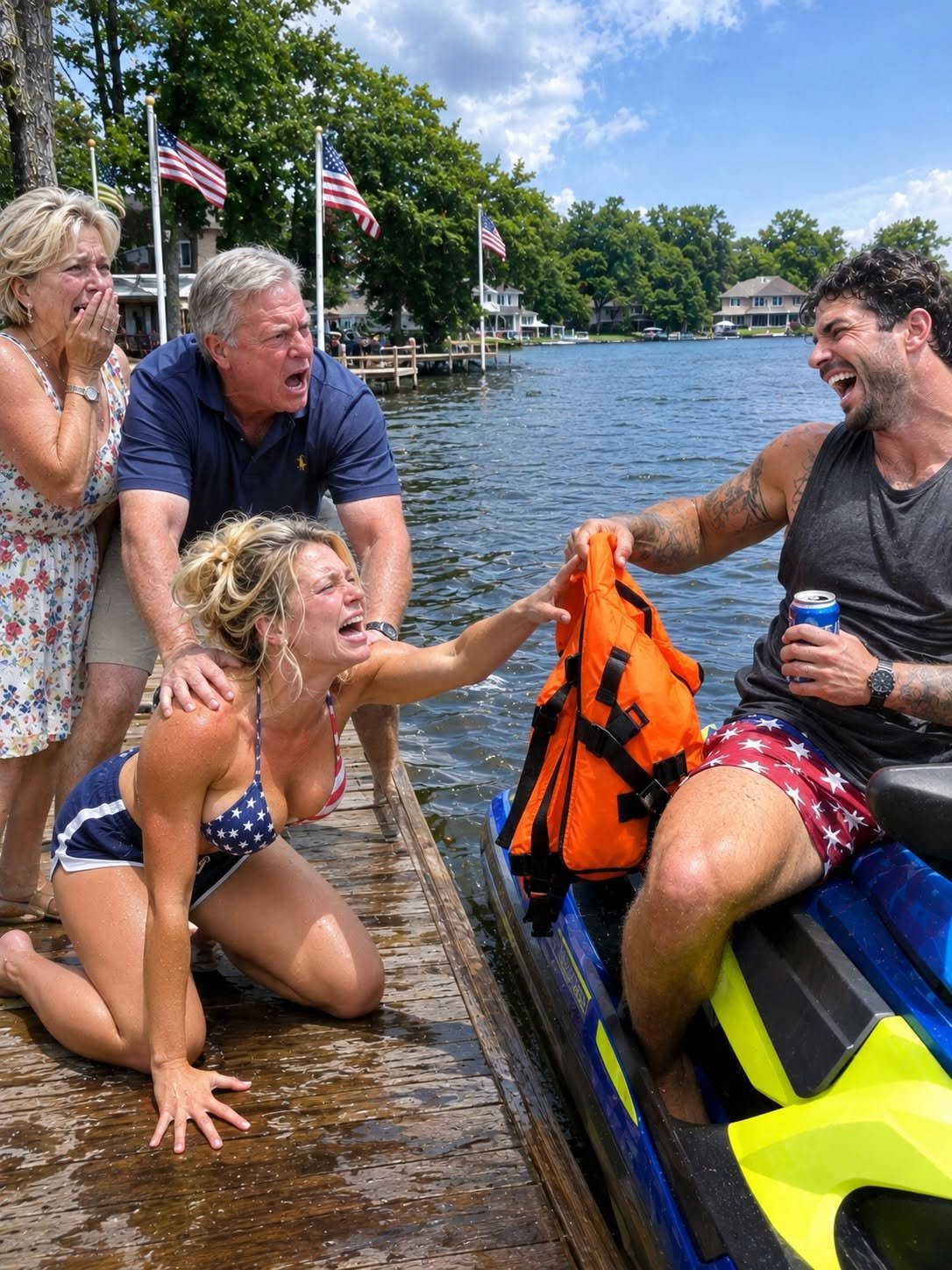
The jet ski curved around in a wide loop and came roaring back to the dock. Rhett cut the engine and climbed off, laughing.
He was holding Winnie’s orange life jacket in his hand.
“She didn’t want to wear it,” he said. “Said it was for babies. I told her she could hold on to me.”
My blood went cold.
“Rhett. She fell off. Without her vest. Where?”
He blinked, swaying. “She’s fine. She can swim.”
“WHERE?”
He pointed vaguely at the middle of the lake.
My father stepped between us.
“Gwen. Listen to me. Do not call the police on your brother. He’s already got two DUIs. A third one, he goes to prison.”
“My daughter is in the lake!”
“He’s had a hard year,” my mother said. “You always ruin everything.”
I didn’t argue with them.
There was no time to argue.
Here’s what my family always forgot.
Before I was a mother, before I was an insurance adjuster, I swam the 1,500 meters for the University of Missouri. I taught lifeguard classes for six summers.
I kicked off my sandals. I grabbed the orange vest out of Rhett’s hand.
And I handed my phone to my nephew, who’s sixteen.
“Call 911. Tell them a child is in the water off this dock without a life jacket. Tell them it was a jet ski. Tell them the driver is drunk. Use those words.”
My father shouted, “Gwen, don’t you dare…”
I dove off the end of the dock.
Three hundred yards is a long way when you’re terrified. I swam like I was nineteen again. Every stroke, I lifted my head and looked for orange. For a head. For anything.
Behind me, boats were starting to come out from the shore. People had heard me screaming.
I reached the spot where I’d seen her fall.
Nothing.
Just the wake of a passing boat rolling under me.
“Winnie! WINNIE!”
I spun in a circle in the water.
Then I saw it.
Floating a few feet away. Bobbing on the surface.
Her pink hair tie.
The one with the little plastic strawberry.
But no Winnie.
Part 2
I made myself stop.
Panic wastes air. I’d taught that for six summers, standing on a pool deck in a red swimsuit, telling sixteen-year-olds that the first thing a rescuer must do is look, not thrash.
So I trod water and looked.
The lake was choppy from the holiday boat traffic, glittering and loud. The hair tie had drifted with the current, so I turned the way it had come and did what I’d been trained to do: I followed the water. Wind out of the southwest. Wake rolling northeast. A small body without a vest would drift with both.
“Winnie, it’s Mommy! Say something! Holler as loud as you can!”
Nothing. Then, faintly, so faintly I thought I’d imagined it:
“…Mommy?”
It came from my left, maybe forty yards off, past a patch of chop.
I swam harder than I have ever swum in my life.
I saw her before I reached her, a small, dark head, a pair of thin arms hooked over something yellow. A floating cushion, the kind that comes loose from pontoon boats, drifted from somebody’s party earlier. She had both arms and one knee wrapped around it. Her lips were blue-white, and her teeth were chattering so hard she could barely talk.
“I found something that floats,” she gasped. “I held on. Like you said.”
I reached her and pulled her into my arms and cried, a great ugly cry, with lake water in my mouth.
“You did everything right,” I said. “Everything, baby. Everything.”
I got the orange vest over her head and cinched it tight. Her fingers were icy against my neck.
“I yelled for Uncle Rhett,” she whispered. “He didn’t come back.”
“I know. I’m here.”
“I thought you wouldn’t find me.”
“I will always find you,” I said. “Always.”
Behind us, a pontoon boat was cutting toward us, a stranger in a ball cap at the wheel, shouting, “Ma’am! We’ve got you! We’ve got you!”
Part 3
The stranger’s name was Dale Pruitt, a retired fireman from Jefferson City, and the woman beside him, his wife, wrapped Winnie in a beach towel and then in a fleece blanket and held her tight against her chest, humming under her breath.
“Her temperature’s low but she’s talking,” Dale said. “That’s good. I called it in. Sheriff’s marine patrol is two minutes out, and there’s an ambulance at the public dock.”
I sat on the deck of that pontoon with my arms around my daughter, shaking so hard my teeth hurt.
The marine patrol boat arrived a few minutes later, white and blue, lights flashing. A deputy, a woman in her forties with a braid, climbed aboard, checked Winnie’s pulse and pupils, and said the words I had been waiting to hear:
“She’s going to be fine, ma’am. She’s cold and scared, but she’s okay.”
I nodded, and kept nodding.
“Ma’am, I need to ask,” she said gently. “Your son called dispatch, and he said the driver of the jet ski was intoxicated?”
“My nephew. Yes. My brother.”
“Is he still at your parents’ dock?”
“He was.”
She spoke into her radio. Then she looked at me.
“We’ll take your daughter to the ambulance first. Then I’d like you to tell me exactly what happened.”
I told her all of it.
I told her about the four minutes. About my mother waving her drink. About my father grabbing my shoulder. About the life jacket in Rhett’s hand, and she didn’t want to wear it. I told her what my father said, and what my mother said.
The deputy didn’t write that down at first. She just listened. Then she wrote all of it.
Part 4
By the time the ambulance took Winnie to Lake Regional, a crowd had gathered on my parents’ dock.
My nephew, Sam, had done exactly what I’d asked. He’d called 911 and used every word. Then, according to a neighbor, he had stood on the dock holding my phone with both hands, tears running down his face, while my father yelled at him to hang up.
He hadn’t.
Sam found me in the hospital hallway an hour later, still in his swim trunks, a towel around his shoulders. He was sixteen and thin and looked ten.
“Aunt Gwen,” he said. “I’m sorry. I should’ve gone after Uncle Rhett sooner. I saw him drinking. I saw him take her.”
“Sam. Look at me.” I put my hands on his shoulders. “You did the one thing I needed. You called. You said the words. You did exactly right.”
“Grandpa said I was ruining everything.”
“Grandpa was wrong.”
He started to cry again. I held him in a hallway that smelled of antiseptic and floor wax, and I thought of how my father had grabbed my shoulder, and how I’d been taught to be quiet for thirty-eight years.
Winnie came through it fine. A cold, a little water in her lungs, a night of observation, and a nurse who let her pick out a sticker for each finger prick. She wore a hospital bracelet with a cartoon whale on it, and she wouldn’t let me out of her sight.
“Mommy,” she said, near midnight, her small hand curled in mine. “Is Uncle Rhett in trouble?”
“Yes.”
“Because of me?”
“No, sweetheart. Because of what he did.”
She considered this.
“I did what you said,” she whispered. “I found something that floats.”
“You did,” I said. “You saved yourself, Winnie. And I came.”
Part 5
Rhett was arrested at the dock that evening.
He’d had a blood alcohol level of 0.19 when the deputy tested him, nearly two and a half times the legal limit. He’d also, according to two neighbors and the marine patrol’s review, been operating the watercraft recklessly in a crowded no-wake zone for most of the afternoon.
He was charged with boating while intoxicated, child endangerment, and reckless operation of a vessel. Because of his two prior DUI convictions, the prosecutor, a calm, careful man named Mr. Holloway, told me the penalties could be severe.
“It’s going to be hard,” he said. “Your family will pressure you.”
“They already have.”
My mother called eleven times in the first day. The first message was furious. The second was hurt. By the sixth, she was weeping.
Gwen, please. He’s your brother. You’ve ruined his life over one mistake.
I did not call back.
My father called once, late on the second night. I answered, because I wanted to hear what he would say.
“Gwen.” His voice was gruff. “I’d like you to talk to the prosecutor. Ask him to go easy.”
“Dad. He threw my seven-year-old into the middle of a lake and left her.”
“She wasn’t hurt.”
“Because she was brave. Because she remembered a rule I taught her.”
“He’s your brother…”
“And she’s your granddaughter.”
Silence.
“You told me not to call the police,” I said. “With my child in the water.”
“I was thinking about Rhett.”
“I know,” I said. “That’s the problem.”
I hung up. My hands were steady. I hadn’t known they could be.
Part 6
The hearing was in September.
Rhett wore a gray suit that didn’t quite fit. He had lost weight. He looked, for the first time I could remember, like a man who understood the thing in front of him.
His lawyer argued that Rhett was a troubled man with an alcohol problem who deserved treatment, not prison. The judge listened, a heavyset man with a gravelly voice and a pair of reading glasses perched on his forehead.
I testified for forty minutes. I described the four minutes, the swim, the hair tie. I described my daughter’s blue lips.
The judge asked me one question.
“Ms. Delgado, what would you like this court to do?”
I’d thought about it for weeks.
“I’d like my brother to get treatment,” I said. “Real treatment, not a weekend program. And I’d like him never to be allowed near a child unsupervised again, or near a boat, or a car, while he’s drinking.” I paused. “I’d like him to understand what happened. And I’d like that to matter more than being punished.”
The judge looked at me for a long moment.
He sentenced Rhett to three years in state prison, followed by five years of probation, with mandatory inpatient treatment during the first year and a lifetime ban on operating any watercraft. As he read the sentence, my mother began to sob in the gallery.
My father didn’t look at me.
Afterward, in the corridor, Rhett’s attorney asked if his client could speak to me for a moment. I agreed, with a bailiff nearby.
Rhett stood in front of me in handcuffs, his eyes red.
“Gwen,” he said. His voice was hoarse. “I don’t remember it. I remember the jet ski, and I remember her laughing, and I remember the dock. I don’t remember her falling.”
“I know.”
“I would never…” He swallowed. “I would never hurt her.”
“You did, though.”
He closed his eyes.
“Is she okay?”
“She’s okay. She’s seven. She asks sometimes why you didn’t come back.”
His shoulders shook. I let him cry. I didn’t comfort him. That wasn’t my job anymore.
“I hope you get better,” I said finally. “I mean that. But I’m not going to be your safety net. Not ever again.”
He nodded, once, and the bailiff led him away.
Final Part
Winnie started swim lessons again in October, at the Y, in a heated indoor pool.
She hadn’t wanted to. For weeks, she’d cried at the sight of water, even the bathtub. A child therapist, Dr. Marsh, taught her slow breathing and let her draw the lake over and over until it stopped looking so big.
Then one afternoon in the fall, she looked up at me from the kitchen table and said, “I want to learn how to swim far.”
“Far?”
“So I can save somebody else.”
I put down my coffee. I didn’t trust my voice for a moment.
“Okay, baby. Let’s learn.”
By spring, she could swim a full length of the pool. By summer, she could tread water for five minutes and float on her back, her hair fanned out like a halo. She wore her orange vest every time we went near a lake, and when my mother said, at the one family dinner I attended that year, that it was “overkill,” Winnie looked straight at her.
“It’s not overkill,” she said. “It’s what keeps you alive.”
The table went silent. My mother’s face went pink. Then, to my surprise, she looked down at her plate.
“You’re right,” she said quietly. “I’m sorry.”
It was the first apology I had ever heard from her.
My father took longer. He came to the house in November, alone, holding his hat. He stood on my porch for a full minute before knocking.
“Gwen,” he said, when I opened the door. “I was wrong.”
I waited.
“I put your brother ahead of your daughter. I told you not to call.” His voice was rough. “I’ve thought about it every night since. I keep seeing you go off that dock.”
“Dad.”
“I’ve been telling myself for twelve years that Rhett’s trouble was a rough patch. It wasn’t. It was a disease, and we fed it.” His eyes filled. “I’d like to apologize to Winnie, if you’ll let me.”
I thought about it for a long time.
“Not yet,” I said. “But maybe someday. If you keep showing up.”
He nodded, as if I’d given him something precious.
“I will,” he said.
He did. Every Sunday for a year, he drove to my house with a pie from the bakery and sat on the porch swing. He didn’t ask for anything. Eventually, in a bright, cold March, Winnie came out in her mittens and sat down beside him.
“Hi, Grandpa,” she said.
His chin trembled.
“Hi, sweetheart.”
“Mom says you said sorry.”
“I did.”
She looked at him with the serious, searching gaze she has.
“Okay,” she said, and leaned her head against his arm.
On the second anniversary of that Fourth of July, Winnie and I went to a different lake, a smaller one, quiet, a few hours from home. We rented a rowboat. She wore her orange vest and her pink strawberry hair tie, which I’d fished out of the water that day and kept in a drawer, and which she had asked for after her third session with Dr. Marsh.
We drifted for a while, side by side, while the sun slid orange across the water.
“Mommy?”
“Yes?”
“Remember the rule?”
“Which one?”
“Find something that floats. Hold on. Mommy will come.”
“I remember.”
She trailed her hand in the water.
“You always came,” she said. “Even when it was far.”
I looked at my daughter, my brave, soaking, extraordinary girl, and thought of every stroke I had taken that afternoon, every breath. I thought about my parents’ dock, and the shoulder I’d shaken free.
“I’ll always come,” I said.
She smiled, small and certain, and the little boat rocked gently, and out on the water a loon called, long and low, and the evening went on.
THE END