PART 1: The Shattered Morning
The scent of lavender floor cleaner and scorching brakes was the last thing I remembered before my world folded in half on a wet Tuesday morning.
I had been driving home from the grocery store with bags of fresh fruit and Caleb’s favorite chocolate chip cookies resting on the passenger seat.
A distracted driver in a heavy pickup truck had run a red light at fifty miles an hour, slamming directly into the driver’s side door of my compact sedan.
When I finally opened my eyes beneath the blinding fluorescent lights of St. Luke’s Hospital, the lower half of my body felt as though it had vanished into thin air.
My husband, Richard, stood beside the window wearing his tailored gray suit, checking his watch with a tight, impatient frown etched between his eyebrows.
Dr. Aris Thorne stepped into the room holding a thick manila folder, his expression heavy with the practiced, sorrowful gravity of a physician delivering a life sentence.
“Sarah, the impact shattered your twelfth thoracic vertebra and severed the spinal cord,” Dr. Thorne said gently, pulling a chair beside my bed.
“You are going to survive, and your upper body is completely intact, but you will never walk again.”
The monitors beside my mattress seemed to scream in my ears as the air vanished from the room.
I looked down at the white hospital blanket covering my legs, willing my toes to move, praying with
every ounce of my soul for a single twitch of muscle.
Nothing moved; my legs lay like two heavy sandbags beneath the thin cotton sheet.
I turned my tear-filled eyes toward Richard, reaching out a trembling hand for the man I had loved and supported for fifteen years of marriage.
“Richard,” I choked out, my voice splintering into a panicked sob. “What are we going to do?”
Richard didn’t take my hand; he stared down at the floor, his jaw clenching until a muscle ticked violently beneath his cheekbone.
“I can’t do this, Sarah,” he whispered, stepping backward toward the door as if my paralysis were a
contagious disease.
“What are you talking about?” I gasped, horror freezing the tears on my cheeks.
“Look at you,” Richard said coldly, gesturing vaguely toward my bed before turning his gaze away. “You’re going to need round-the-clock care, ramps, medical equipment, and constant assistance.”
“This isn’t what I signed up for when I married you; I’m thirty-eight years old, and I want a better life.”
Before I could scream, before I could even form a single word of protest, he turned on his polished leather heels and walked out of the room.
The heavy wooden door clicked shut behind him, leaving the sterile room wrapped in a suffocating,
absolute silence.
Then a small, hesitant knock sounded at the glass panel of the door, and my twelve-year-old son, Caleb, slipped inside wearing his oversized school backpack.
His dark eyes were red-rimmed from crying in the waiting room, his pale face pinched with a terror far too heavy for a boy his age.
He didn’t look at the tubes, the monitors, or the limp blanket covering my legs.
He walked straight to my bed, climbed onto the edge of the mattress, and wrapped his thin arms
tightly around my neck.
“I’m right here, Mom,” Caleb whispered into my hair, his small voice trembling yet fiercely determined.
“We’re going to figure this out together, okay? I promise I’ll never leave you.”
I held my son against my chest, weeping silently into his cotton shirt, realizing that while a coward had
just walked out of my life, a hero had taken his place.
PART 2: Learning to Breathe Again
Three weeks after Richard vanished from our lives, I was discharged from the rehabilitation center into a two-story townhouse that had suddenly become a prison of stairs and narrow doorways.
Richard had cleaned out eighty percent of our joint savings account before disappearing to California, leaving behind only a stack of unpaid utility bills and a signed separation notice.
The first morning back in our own kitchen was the lowest, most humiliating moment of my adult life.
I sat in my heavy steel hospital wheelchair, staring up at the kitchen cabinets that towered impossibly
out of reach above my head.
When I tried to reach the coffee canister on the middle shelf, my chair tipped forward slightly, sending the glass jar crashing onto the linoleum floor in a shower of brown grounds and jagged shards.
I sat frozen amid the broken glass, my hands shaking uncontrollably on the rubber wheel rims as hot,
bitter tears blinded my vision.
I couldn’t even make a cup of coffee without endangering myself; how on earth was I supposed to raise a twelve-year-old boy?
Footsteps padded down the hallway, and Caleb appeared in the doorway wearing his faded pajama
pants, his dark hair sticking up in wild tufts.
He didn’t sigh, he didn’t look annoyed, and he didn’t treat me like a fragile invalid.
“Looks like the coffee lost that round, Mom,” he said softly, grabbing the broom and dustpan from the pantry closet without a word of complaint.
While he swept up the glass, I wiped my face with the sleeve of my sweater, swallowing down the self-pity that threatened to drown us both.
If I broke down, Caleb would spend his entire childhood carrying the weight of an adult’s despair.
That very afternoon, while Caleb was at middle school, I wheeled myself into the garage and found Richard’s old toolbox sitting on the workbench.
With a screwdriver, a wrench, and three hours of agonizing trial and error, I removed the wooden doors from the lower kitchen cabinets and moved every single plate, pot, and pantry staple down to
waist level.
I taped a long wooden yardstick to the side of my wheelchair so I could pull down towels and lightweight items from the upper racks.
Next, I opened my laptop on the dining table and spent six hours applying for every remote data-
entry, customer support, and medical transcription job I could find.
By five o’clock, my shoulders and arms burned like fire from pushing the heavy wheelchair across the carpets, and blisters had formed across my uncalloused palms.
When Caleb walked through the front door with his backpack, the smell of baked chicken and roasted
potatoes filled the house.
I had balanced the roasting pan on my lap with a thick folded towel to transfer it from the low oven rack to the counter without burning my legs.
Caleb stopped in the kitchen doorway, his eyes widening in genuine awe as he took in the reorganized
kitchen and the steaming dinner waiting on the table.
“Mom… how did you do all of this?” he asked quietly, setting his backpack down beside the door.
“I told you, sweetheart,” I smiled, wiping a streak of flour from my forehead. “We’re figuring it out together.”
That night, sitting across from my son at the dining table, I realized that paralysis had taken away my ability to walk, but it had not touched the steel in my spine.
PART 3: The Midnight Lights
Over the next four years, our lives settled into a grueling, disciplined rhythm built on sheer grit and mutual devotion.
I secured a full-time remote position as a medical billing auditor, working from six in the morning until three in the afternoon, and picking up freelance transcription shifts after Caleb went to bed.
Money was perpetually tight; every single dollar was carefully budgeted between mortgage payments, physical therapy supplies, groceries, and Caleb’s school expenses.
I traded our sedan for an older, modified minivan with a manual fold-out ramp, driving Caleb to every basketball practice, science fair, and parent-teacher conference in the district.
Whenever I rolled down the aisles of the high school gymnasium, I kept my head held high, dressed neatly in my favorite printed blouses, refusing to let anyone look at my son with pity.
Caleb, meanwhile, grew from a quiet, anxious twelve-year-old boy into a tall, broad-shouldered young man with a quiet, watchful intensity beyond his years.
He excelled in his honors classes, worked weekends bagging groceries at the corner market, and quietly slipped half his paycheck into the kitchen jar I used for utility bills.
“Keep your money for college, Caleb,” I would scold gently whenever I found the crisp twenty-dollar bills tucked beneath the sugar bowl.
“I’m saving plenty, Mom; consider it rent for the best cooking in town,” he would grin, kissing the top of my head before heading upstairs to study.
Yet during his senior year of high school, I began noticing subtle, mysterious changes in Caleb’s routine that stirred a quiet unease in my chest.
Often, when I wheeled past the bottom of the stairs at one or two in the morning after finishing a late billing audit, I saw a faint ribbon of light glowing beneath his bedroom door.
Whenever I asked him why he was awake so late, he always offered a quick, plausible excuse about advanced placement calculus homework or college scholarship essays.
One rainy Thursday in November, I needed an extra stapler from the hallway closet outside his room and rolled quietly onto the landing lift we had installed two years prior.
Through the partially open door of Caleb’s bedroom, I saw him hunched over his desk, illuminated by the blue glow of two computer monitors.
He wasn’t solving calculus equations; he was typing furiously into complex spreadsheet ledgers while whispering urgently into a headset microphone.
“Make sure the escrow transfer clears before the morning bell, and don’t let anyone trace the holding account back to my name,” Caleb muttered softly into the mic.
My breath caught in my throat, a cold chill creeping down my spine as I stared at the back of my seventeen-year-old son’s head.
Where had a high school senior working a minimum-wage grocery job learned terms like escrow transfer and holding account?
Before I could push the door open to confront him, Caleb clicked a button, blacked out both screens simultaneously, and turned around in his swivel chair.
He froze when he saw me sitting in my wheelchair in the doorway, a flicker of genuine, startled panic crossing his handsome face before he masked it with a warm smile.
“Mom? What are you doing up so late?” he asked quickly, stepping over to close the door slightly while shielding his desk from view.
“I came up for a stapler, Caleb,” I said, studying his guarded expression with a mother’s sharp, unerring intuition.
“Who were you talking to at two in the morning?”
“Just my study partner, Liam, from economics class; we’re doing a simulated stock market project for
our final grade,” he answered smoothly.
I nodded slowly, pretending to accept his explanation, though my heart beat with a heavy, troubling suspicion as I wheeled back toward the lift.
My son was hiding something massive, and for the first time since the accident, I felt terrified that I
wouldn’t be able to protect him from whatever storm he was walking into.
PART 4: Suspicious Envelopes
The following spring brought the whirlwind of senior year milestones, cap-and-gown fittings, and college acceptance letters arriving in our mailbox.
Caleb had been accepted into the state university’s prestigious business and finance program with a
partial academic merit scholarship, filling me with an overwhelming sense of pride.
Yet the strange anomalies surrounding my son’s secret life only continued to multiply as graduation approached.
On a sunny afternoon in April, while I was sorting through the afternoon mail at the kitchen table, I
noticed a heavy cream-colored envelope addressed to Caleb from a prominent downtown law firm.
Beside it lay a certified bank statement from an institutional wealth management group in Chicago, marked Private Client Division.
I didn’t open his mail—I had always respected his privacy—but my hands trembled slightly as I set the envelopes beside his dinner plate.
When Caleb came home from school at four o’clock, wearing his faded canvas jacket and carrying his worn backpack, he spotted the envelopes immediately.
For a fraction of a second, the color drained from his face, his dark eyes darting anxiously toward my wheelchair before he scooped the mail up and shoved it into his pocket.
“Everything okay, sweetheart?” I asked casually, continuing to chop carrots on the lowered cutting
board.
“Yeah, Mom, just some scholarship verification forms and campus housing paperwork,” he replied, kissing my cheek a little too quickly before heading toward the stairs.
Two days later, while Caleb was at his Saturday shift at the grocery store, I went to the market two
blocks away to pick up milk and fresh bread.
As I rolled down the frozen foods aisle, I bumped unexpectedly into Mr. Henderson, the elderly store manager who had hired Caleb two years ago.
“Sarah! How wonderful to see you out in this gorgeous weather,” Mr. Henderson beamed, tipping his
cap respectfully.
“Thank you, Mr. Henderson; I’m just grabbing a few things before Caleb finishes his shift at five.”
Mr. Henderson blinked in mild confusion, adjusting his glasses as he looked down at my wheelchair.
“Finishes his shift? Sarah, Caleb hasn’t worked here since October.”
My heart stopped dead in my chest, the plastic basket of groceries slipping slightly on my lap.
“What do you mean, since October?” I whispered, struggling to keep my voice steady. “He leaves the house every Saturday morning in his store apron and comes home at five with his paycheck.”
“Well, he certainly isn’t bagging groceries here,” Mr. Henderson chuckled warmly. “When he resigned in
the fall, he told me he had landed a remote internship with a tech firm downtown.”
“I figured he was making ten times what I could pay him! Tell that boy to stop by and say hello sometime.”
I smiled stiffly, thanked Mr. Henderson, and wheeled myself out of the store as fast as my trembling
arms could push the rims.
My mind raced wildly as I rolled down the sunlit sidewalk toward our townhouse.
For seven months, Caleb had been putting on his green grocery apron every Saturday morning, kissing me goodbye, and disappearing for eight hours.
He had been handing me crisp cash every two weeks, pretending it came from minimum-wage grocery bagging, while receiving certified mail from downtown law firms and private wealth banks.
What on earth was my seventeen-year-old son doing in downtown Chicago every weekend?
I reached our front porch, unlocked the door, and wheeled into the living room just as the front door
clicked open behind me.
Caleb walked in carrying a paper bag of takeout food, dressed in his green grocery apron, whistling cheerfully—until he saw the pale, terrified expression on my face.
PART 5: The Quiet Lie
“What happened? Are you feeling sick? Did you fall?”
“I went to the grocery store today, Caleb,” I said, my voice dangerously quiet as I rolled my chair to face him in the center of the living room.
“I spoke to Mr. Henderson.”
Silence fell over the room like a heavy winter blanket, broken only by the soft ticking of the wall clock above the fireplace.
Caleb didn’t make up another excuse, nor did he try to deflect with humor; he closed his eyes, let out a
long, defeated sigh, and walked over to sit on the edge of the coffee table directly in front of me.
“I didn’t want you to worry, Mom,” he said softly, reaching out to cover my trembling hands with his warm, steady palms.
“You’re seventeen years old, Caleb!” I cried, hot tears of fear and frustration spilling over my lashes.
“You’ve been lying to me for seven months! You’re getting letters from law firms and private banks—tell me you haven’t gotten yourself mixed up in something illegal to pay our bills!”
A soft, genuine laugh escaped Caleb’s throat, startling me completely through my tears.
“Illegal? Mom, look at me—do I look like a crime boss to you?”
“Then what are you doing every Saturday? Where is that money coming from?”
Caleb looked down at our joined hands, his expression turning deeply serious, mature, and remarkably calm.
“Three years ago, when I was fourteen, I started teaching myself algorithmic trading and software coding on that old laptop you bought me at the pawn shop,” he explained quietly.
“While you were asleep, I spent every night studying market patterns, reading financial filings, and
testing predictive models.”
“Last summer, a boutique investment firm in the Loop noticed one of my open-source financial algorithms online and offered me a paid weekend consulting contract.”
I stared at my son in utter, speechless disbelief, searching his dark eyes for any trace of deception.
“You… you’ve been working as a financial consultant?” I whispered.
“They couldn’t hire a minor directly on the executive payroll, so they set up a custodial trust through their corporate law firm until I turn eighteen next month,” Caleb smiled gently.
“I wore the grocery apron because I knew if you found out how much they were paying me, you’d force me to quit and tell me to focus only on high school.”
“And I knew you’d refuse to let me pay off the back taxes on this house.”
My breath caught in my throat, my chest tightening with a mixture of overwhelming pride and
profound, aching humility.
“You’ve been working seven days a week to protect me,” I wept softly, pulling his face down so I could press my forehead against his.
“I just wanted to take some of the weight off your shoulders, Mom,” he whispered, wrapping his
strong arms around me in my wheelchair.
“You’ve carried me for my whole life; it’s my turn to start carrying you.”
Little did I know that the consulting contract was only the tip of a monumental secret Caleb was preparing to unveil on the biggest day of his life.
PART 6: Ghosts of the Past
Two weeks before Caleb’s high school graduation, an unexpected shadow from our past arrived unannounced on our front porch.
It was a warm Friday afternoon in late May, and I was sitting on the front patio potting red geraniums while waiting for Caleb to return from senior rehearsal.
A sleek silver rental sedan pulled up to the curb outside our townhouse, its engine idling quietly in the afternoon sun.
The driver’s door opened, and a tall man in a light linen blazer stepped out onto the sidewalk, adjusting his sunglasses as he looked up toward my porch.
My hands froze in the potting soil, my breath catching in my throat as six years of buried pain slammed back into my ribs like a physical blow.
Richard.
He looked slightly older, with threads of gray at his temples and a deeper tan from California, yet he
still carried that identical, effortless air of self-satisfied entitlement.
He walked up the concrete path, his eyes sweeping over the wooden wheelchair ramp we had installed along the steps before landing on my face.
“Hello, Sarah,” Richard said smoothly, stopping at the bottom of the ramp with a practiced, hesitant
smile. “You look well.”
“What are you doing here, Richard?” I asked, wiping the dirt from my hands onto my gardening apron, my voice cold and steady.
“I heard through mutual acquaintances back east that Caleb is graduating next week with honors,”
Richard replied, leaning casually against the wooden railing.
“I flew in from San Diego because I realized how much time we’ve lost. A boy needs his father at a milestone like high school graduation.”
A bitter, humorless laugh escaped my lips, ringing clearly in the quiet afternoon air.
“He needed his father six years ago when his mother was lying in an intensive care unit learning how to breathe without feeling her legs,” I answered flatly.
“He needed his father when we were eating canned soup by candlelight because you drained our joint savings account before boarding a plane to California.”
Richard’s jaw tightened slightly, a flicker of irritation crossing his handsome face before he masked it with a sigh of theatrical regret.
“I made a terrible mistake, Sarah, I admit that; I panicked under the pressure of the accident,” he said smoothly.
“But I’ve rebuilt my career out west, and I’m ready to step back in—I want to help pay for Caleb’s college tuition and take him out to dinner tonight to reconnect.”
Before I could tell him to get off my property, footsteps crunched on the sidewalk behind him.
Caleb walked up the path wearing his graduation rehearsal t-shirt, carrying a cardboard box containing
his blue cap and gown.
He stopped five feet behind Richard, his posture stiffening instantly as he recognized the back of the man who had abandoned us without looking back.
Richard turned around, his face lighting up with a broad, expectant grin as he extended both arms toward the tall young man.
“Caleb! Look at you, son—you’re practically a grown man!”
Caleb didn’t move a muscle; he didn’t drop his box, he didn’t smile, and he didn’t take a single step toward his father’s outstretched arms.
“My name is Caleb,” my son said, his voice dropping into a low, terrifyingly calm register that made
Richard’s smile falter.
“And you lost the right to call me ‘son’ the afternoon you walked out of Room 412 at St. Luke’s Hospital.”
Richard blinked in shock, lowering his arms slowly as his eyes darted between Caleb’s stony face and
my wheelchair on the porch.
“Now look here, young man, your mother and I had adult issues you couldn’t understand at twelve—”
“I understood everything,” Caleb interrupted coldly, stepping past Richard and climbing the ramp to stand directly beside my wheelchair, placing a protective hand on my shoulder.
“I understood that when things got hard, you ran like a coward, and my mother stayed and fought through every single day to give me a life.”
“Get off our porch, Richard, and don’t show your face at my graduation next Friday.”
PART 7: The Whispered Secret
Richard stood frozen at the bottom of the ramp for several seconds, his face flushing dark red with humiliation as neighbors glanced out from behind their curtains.
“You’re making a mistake, Caleb,” Richard muttered, backing down the path toward his rental car.
“You’ll regret shutting out your own father when you realize how expensive the real world is.”
“We have everything we need right here,” Caleb replied without blinking, watching until the silver sedan sped away down the street.
Once the car turned the corner, the stern, protective armor melted from Caleb’s shoulders, and he
knelt beside my wheelchair, looking up at me with sudden, anxious concern.
“Are you okay, Mom? Did he upset you?”
“I’m completely fine, sweetheart,” I smiled, brushing a lock of dark hair away from his forehead. “In fact, I’ve never felt stronger.”
Yet over the next seven days leading up to graduation, I noticed that Caleb’s excitement had taken on an electric, almost breathless intensity.
He spent hours on the phone in the backyard speaking quietly with his investment firm’s senior partners, and twice I caught him hiding a large, sealed manila envelope inside his closet before I rolled
past.
On the morning of graduation Friday, the sun rose bright and warm over our quiet street, flooding our small living room with golden light.
I put on my favorite floral-printed silk blouse, brushed my hair until it shone, and carefully applied a
touch of lipstick—determined to look radiant for my son’s triumph.
When Caleb walked down the stairs wearing his crisp white dress shirt, dark tie, and flowing royal-blue graduation gown, my breath caught in my throat.
He looked so tall, so dignified, and so entirely worthy of every sleepless night, every blistered palm, and
every tear I had shed over the past six years.
“You look handsome enough to run the whole country, sweetheart,” I whispered, wiping a tear from the corner of my eye before it could ruin my makeup.
“And you look beautiful, Mom,” Caleb grinned, kneeling beside my chair to adjust the corsage of white
gardenias he had pinned to my lapel.
“Promise me something today, okay? No matter what happens during the ceremony, just trust me.”
I frowned slightly, tilting my head at the cryptic urgency in his voice. “Caleb, what are you planning? You aren’t going to pull a senior prank on the principal, are you?”
“No pranks, Mom, I promise,” he laughed softly, squeezing my hand before standing up to help load
my wheelchair into the modified minivan.
When we arrived at the sprawling high school auditorium an hour early, the hall was already buzzing with excited families, camera flashes, and festive music.
Caleb wheeled me directly to the front row, positioning my chair right beside the wide wooden steps leading up to the main stage, before hurrying off to join his graduating class in the staging corridor.
As the ceremony began and the graduates marched down the center aisle to Pomp and Circumstance, my chest swelled with an emotion so vast it felt as though my heart might burst.
I spotted Caleb near the middle of the line, leaning over to whisper earnestly with four of his closest friends from the varsity track team—Liam, Marcus, Devon, and Tyler.
All four boys nodded solemnly, glancing toward my wheelchair in the front row with expressions of fierce, unmistakable loyalty.
What on earth were those boys plotting?
PART 8: The Long Walk Up
For forty-five minutes, I sat in the front row applauding warmly as student after student walked across the stage to shake the principal’s hand and receive their diplomas.
I held my smartphone tightly in my lap, the camera app open and ready to capture every second of
Caleb’s moment in the spotlight.
Near the back of the auditorium, near the double exit doors, I caught a brief, unsettling glimpse of a man in a light gray blazer leaning against the wall.
Richard had ignored Caleb’s warning and slipped into the back of the hall to watch from the shadows.
I immediately turned my face back toward the stage, refusing to let his cowardly presence poison a single second of my son’s victory.
“Caleb Michael Vance,” Principal Miller announced clearly into the podium microphone, his voice echoing across the packed auditorium.
I hit the record button on my phone, beaming proudly through my tears as Caleb stepped out from the row of blue gowns.
He walked down the center aisle with his shoulders squared and his head held high, moving toward the wooden stairs on the left side of the stage.
Then, halfway to the steps, Caleb suddenly stopped dead in his tracks.
The entire auditorium went quiet as the eighteen-year-old boy turned sharply to his right and walked straight toward my wheelchair in the front row.
My heart skipped a beat, confusion instantly replacing my smile as he knelt on the carpeted floor
directly beside my knees.
“Caleb, sweetheart, what are you doing?” I whispered urgently, gesturing toward the principal waiting on the stage. “Go get your diploma!”
Caleb looked up at me, his dark eyes shining with unshed tears and an unshakeable, magnificent pride
that stopped my breath.
“Mom, I want you up there with me,” he said softly, loudly enough for the front rows to hear.
I stared at him, my cheeks flushing hot as a thousand pairs of eyes turned toward our corner of the auditorium.
“Oh, baby, this is your special day! There’s no ramp on that side of the stage—how am I supposed to get up there?”
Caleb smiled—the same fearless, determined smile he had worn at twelve years old beside my hospital
bed when he promised he would never leave me.
“Then let’s make it our day, Mom.”
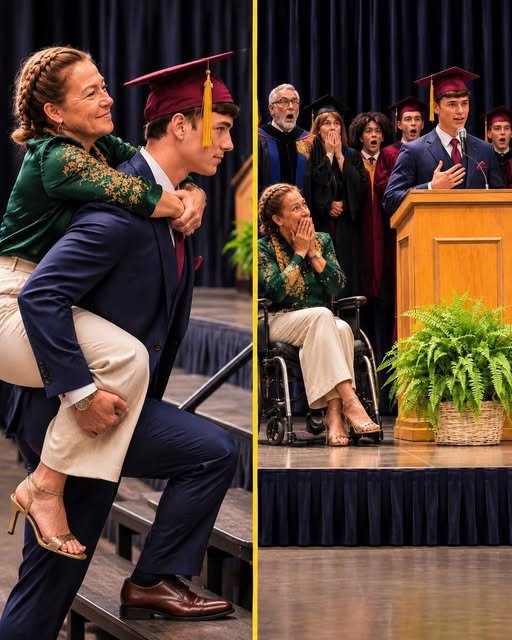
Before I could protest another word, Caleb stood up, slipped one strong arm gently beneath my thighs and the other securely around my back, and lifted me effortlessly out of my wheelchair.
A collective gasp rippled through the massive auditorium, followed immediately by a wave of stunned, reverent silence.
I wrapped my arms instinctively around my son’s broad shoulders, burying my face briefly against his blue graduation gown as hot tears spilled down my cheeks.
Caleb carried me up the six wooden steps onto the bright stage without faltering once, his posture straight, steady, and completely unashamed.
Right behind us, his four friends from the track team—Liam, Marcus, Devon, and Tyler—quietly stepped out of line, picked up my heavy steel wheelchair together, and carried it up onto the stage.
They set the chair down gently in the center of the platform, locking the wheel brakes securely before stepping back into line with solemn nods.
Caleb carefully lowered me back into my seat, smoothing down my floral blouse before turning to shake the stunned principal’s hand and accept his leather-bound diploma cover.
The auditorium erupted into thunderous, deafening applause—parents standing on their feet, teachers wiping away tears, and students cheering wildly.
I sat on the bright stage beneath the spotlights, smiling through my tears, thinking that this was the pinnacle of our journey.
Then Caleb turned away from the principal, walked directly up to the podium, and wrapped his hand around the silver microphone.
PART 9: Silence in the Hall
“Excuse me, everyone,” Caleb spoke into the microphone, his deep, steady voice reverberating through the auditorium’s speakers.
“Before the ceremony continues, there’s something important I need to say.”
The roaring applause died down instantly, replaced by a heavy, expectant stillness that seemed to hold every person in the room breathless.
Principal Miller stepped forward slightly with a hesitant frown, unsure whether to intervene, before
catching the quiet, commanding look in Caleb’s eyes and stepping back.
Caleb turned away from the audience, facing my wheelchair directly in the center of the bright wooden stage.
My heart began hammering wildly against my ribs, my hands gripping the rubber armrests of my chair as cold apprehension washed over me.
“Mom, I have something for you,” Caleb said, his voice trembling slightly with raw, unguarded emotion.
“For the last six years, everyone in this town has looked at me and told me how lucky you were to
have a son who stayed by your side after the accident.”
“They got it completely backward.”
Caleb’s eyes glistened beneath the harsh stage lights as he took a slow breath, his gaze locking onto
mine.
“When I was twelve years old, my father walked out of a hospital room because he decided that a paralyzed wife was too heavy a burden to carry.”
A sharp, audible intake of breath swept across the front rows of parents and faculty, and near the back
exit doors, I saw Richard flinch violently against the wall.
“You were left completely alone, in constant pain, with no money and a terrified kid depending on you for everything,” Caleb continued, his voice rising with fierce, unmistakable pride.
“You taught yourself how to cook from a chair so I would never go to school hungry.”
“You worked two remote jobs until three in the morning so I could have new shoes, school books, and
a roof over my head.”
“You never complained once, you never asked for pity, and you carried me through every single storm of my life.”
By now, half the women in the front three rows were openly weeping, clutching tissues to their faces as I sat paralyzed with emotion on the stage.
“There’s something I’ve done over the past year that I haven’t told you about yet, Mom,” Caleb said, reaching inside the front zipper of his royal-blue graduation gown.
“I can’t hide the truth anymore, and I want to admit it right here in front of everyone who ever doubted what we could survive.”
My pulse thundered in my ears as Caleb pulled out the thick, cream-colored envelope I had seen arriving from the downtown law firm two weeks ago.
“What is that, Caleb?” I whispered, forgetting that the sensitive stage microphone picked up every syllable and broadcast it across the silent hall.
Caleb walked over to my wheelchair, knelt down on one knee in front of me once again, and placed the sealed envelope squarely onto my lap.
“Open it, Mom,” he said softly. “It’s time you stopped carrying the weight alone.”
PART 10: The Deed on My Lap
With trembling, clumsy fingers, I broke the wax seal on the heavy cream envelope and pulled out three
crisp, embossed legal documents.
The auditorium was so quiet that the soft rustle of the paper sounded like wind blowing through dry leaves over the speakers.
My eyes scanned the formal legal heading at the top of the first page, blinking rapidly through my tears as the words swam into focus.
Warranty Deed and Satisfaction of Mortgage: 412 Oakridge Lane.
Below the title was the official county recorder’s stamp, confirming that the entire remaining balance of
our townhouse mortgage had been paid off in full, transferring sole, unencumbered ownership directly into my name.
“Caleb…” I gasped, my hand flying to my mouth as I stared at the zero-balance certificate. “How… how
much was this?”
“Every penny we owed,” Caleb smiled gently, his eyes shining with pure joy. “You will never have to worry about a bank taking our home again, Mom.”
Before I could recover from the shock, he reached into my lap and turned over the second document
inside the folder.
It was a certified medical billing authorization from the Midwest Neuro-Rehabilitation & Robotic Mobility Institute in Chicago—one of the premier spinal research facilities in the nation.
Attached to the cover page was an official acceptance letter signed by the chief of neurosurgery, confirming that my medical files had been reviewed and approved for their advanced epidural spinal stimulation and exoskeleton rehabilitation trial.
“The surgery and two years of intensive physical therapy are completely paid for in advance through
my custodial trust,” Caleb said softly, gripping my trembling hands.
“The doctors can’t guarantee you’ll run a marathon, Mom… but their preliminary review of your scans says there’s a seventy percent chance you’ll be able to stand on your own two feet again.”
A strangled, agonizing sob tore from my chest, shattering the last wall of composure I had held
together for six long years.
I dropped the papers onto my lap and threw my arms around my son’s neck, burying my face against his shoulder as the entire auditorium exploded into a standing ovation.
Students stamped their feet on the wooden bleachers, parents cheered until their voices cracked, and
even Principal Miller was wiping tears from behind his spectacles.
I held Caleb tightly, feeling the steady, powerful beat of his heart against my cheek—a heartbeat that had refused to surrender when everything in our world collapsed.
“You didn’t have to spend your future on me, Caleb,” I wept into his ear over the roaring applause.
“That money was supposed to be for your college!”
Caleb pulled back slightly, wiping the tears from my cheeks with his thumbs, grinning broadly as he turned the third page over on my lap.
It was an official letter from the dean of the University of Chicago’s business school, offering Caleb a
full-ride presidential fellowship and an immediate research position under their top quantitative finance professor.
“My college is already covered, Mom,” Caleb laughed softly, kissing my forehead. “Everything I built over the last three years was built for one reason—to give you back the life you gave up for me.”
PART 11: The Coward at the Exit
As the roaring applause finally began to subside, allowing the ceremony to proceed toward its conclusion, my eyes drifted involuntarily toward the back of the auditorium.
Standing near the double exit doors, illuminated by the harsh light from the lobby corridor, was
Richard.
His face was pale, gaunt, and completely stripped of the arrogant, self-satisfied smirk he had worn on our front porch just a week ago.
Every single person in the back rows was turning around in their folding chairs, staring at him with cold, unmistakable disgust—recognizing him instantly as the man Caleb had just exposed before the
entire community.
Richard looked toward the stage, his eyes locking onto mine across the sea of faces, seeing the legal deeds resting on my lap and the radiant, unbreakable bond between me and the son he had abandoned.
For one fleeting second, he raised a hesitant hand as if trying to signal me from the back of the hall, his mouth opening slightly in a silent, pathetic plea.
I didn’t flinch, I didn’t look away, and I didn’t feel a single drop of bitterness or hatred in my chest.
I simply looked directly into his eyes, placed my hand firmly over Caleb’s shoulder, and turned my chair smoothly back toward the center of the stage.
Richard stood frozen by the doors for three seconds before ducking his head, pushing open the exit bar, and disappearing permanently from our sight.
The rest of the graduation ceremony passed in a golden haze of joy, laughter, and camera flashes.
I remained seated right on the stage beside the faculty row until the final graduate crossed the platform and the class of eighteen-year-olds threw their blue caps into the air in a joyful explosion of
confetti and cheers.
When the ceremony ended, Caleb didn’t rush off to take selfies with friends or hurry toward the parking lot.
He unlocked my wheelchair brakes, rolled me smoothly to the edge of the stage steps, and once again lifted me gently onto his back while his four track teammates carried my chair down to the floor.
As we wheeled down the center aisle toward the sunny lobby, dozens of parents, teachers, and neighbors stopped us to shake Caleb’s hand, hug my shoulders, and offer words of profound
admiration.
Mrs. Gable, Caleb’s seventh-grade English teacher who had watched us struggle during that first brutal winter after the accident, knelt beside my chair with tears streaming down her cheeks.
“You raised a king, Sarah,” she whispered, squeezing my hands tightly. “The world doesn’t make many
young men like him anymore.”
We stepped out of the auditorium doors into the warm, brilliant May sunshine, breathing in the sweet scent of blooming lilacs and freshly cut grass.
Caleb stood behind my wheelchair, resting his hands gently on the push handles as we looked out
over the wide green campus lawn.
“Ready to go home, Mom?” he asked softly, leaning down to rest his chin lightly against the top of my head.
“Take me to Chicago first, sweetheart,” I smiled, clutching the medical authorization papers tightly against my chest. “We have an appointment with a neurosurgeon to schedule.”
PART 12: The Steel and the Nerve
Three months later, the sterile white corridors of the *Midwest Neuro-Rehabilitation Institute* in downtown Chicago felt entirely different from the cold, terrifying hospital ward where my life had shattered six years earlier.
Following a delicate, six-hour surgical procedure in July, neurosurgeons had implanted a miniature epidural pulse generator directly over the lumbar region of my spinal cord, designed to bridge the damaged nerve pathways with targeted electrical stimulation.
The physical rehabilitation that followed was the most grueling, exhausting battle I had ever fought in my life.
Five days a week, for four hours every morning, I strapped into heavy parallel bars, sweating through
my t-shirts as physical therapists calibrated the electrical frequencies while I forced my brain to send signals to muscles that had slept for six years.
At first, there was nothing—only the familiar, heavy deadweight of my legs hanging limp in the
support harness, triggering moments of dark, suffocating doubt when I sat alone in the recovery room.
Yet every single afternoon, right after his summer quantitative research classes ended at the university two miles away, Caleb walked through the clinic doors carrying my favorite iced tea and a fresh notebook.
He never missed a single therapy session, sitting on a wooden bench beside the parallel bars, cheering every tiny twitch of a muscle as if I had just won an Olympic gold medal.
On a crisp, sunny afternoon in mid-October, twelve weeks after my surgery, Dr. Elena Rostova adjusted the tablet connected to my spinal stimulator and nodded to my lead physical therapist.
“Alright, Sarah,” Dr. Rostova said, her voice steady and encouraging. “We’ve dialed in the exact frequency pattern for your left quadriceps; take a deep breath, grip the parallel bars, and focus on lifting your right heel.”
I closed my eyes, gripping the cold steel rails until my knuckles turned white, channeling every ounce of willpower, every memory of Caleb carrying me up those graduation stairs, into my legs.
“Push, Mom,” Caleb’s quiet, steady voice cut through the hum of the therapy gym from three feet away. “You’ve got this.”
I exhaled sharply, bearing down with my arms, and focused entirely on the floor beneath my sneakers.
Slowly, painfully, with a violent tremor that shook my entire frame, my right knee locked into place, lifting my weight off the support harness for three full seconds.
Then my left heel lifted two inches off the rubber mat, sliding forward in a clumsy, hesitant, miraculous
step.
The entire therapy gym erupted into gasps and cheers as the therapists rushed in to spot my waist while I stood upright on my own two feet for the first time in two thousand, two hundred days.
I looked down at my sneakers standing squarely on the floor, tears of pure, blinding disbelief pouring
down my face.
When I lifted my eyes, Caleb was standing right in front of me, weeping openly with a grin so wide and radiant it lit up the entire room.
“See?” he choked out, reaching out to steady my trembling elbows. “I told you we’d climb those stairs
together.”
PART 13: The Letter from California
By the time winter arrived in Chicago, my progress had astounded the entire neurological team at the institute.
With the stimulator active and a pair of lightweight carbon-fiber forearm crutches, I was able to walk short distances independently across level floors, climb low steps with a handrail, and stand upright without losing my balance.
We had sold the two-story townhouse back home and moved into a bright, ground-floor apartment
near the university campus so Caleb wouldn’t have to commute two hours a day between classes and the clinic.
One snowy evening in late December, just days before Christmas, I was standing at the kitchen counter using my crutches—cooking Caleb’s favorite beef stew from a standing position for the very
first time in six years.
The apartment smelled of simmering herbs, warm bread, and pine from the small Christmas tree twinkling in the corner of the living room.
The front door clicked open, and Caleb walked in brushing snow from his wool coat, carrying a stack of
university textbooks and a small bundle of mail from the lobby box.
He stopped dead in the kitchen doorway, dropping his textbooks onto the floor with a loud thud as he saw me standing upright at the stove without my wheelchair in sight.
“Mom…” he whispered, his voice catching in his throat as his eyes filled with tears. “You’re standing.”
“I’m cooking dinner, sweetheart,” I smiled warmly, turning carefully on my crutches to open my arms
to him. “Come give your mother a hug.”
Caleb crossed the kitchen in two strides, wrapping his arms gently around my waist and resting his chin on my shoulder, holding me carefully as if I were made of spun glass.
After dinner, while I sat resting my legs on the sofa with a warm blanket, Caleb noticed a battered,
postmarked envelope from San Diego sitting at the bottom of the mail pile.
He picked it up, recognizing Richard’s handwriting immediately, and looked over at me with a cold, protective frown.
“Do you want me to throw this in the trash, Mom?” Caleb asked, holding the envelope over the
wastebasket.
“No,” I said calmly, surprising both of us. “Open it and read it, Caleb; you’re an adult now, and you have the right to know what he has to say.”
Caleb slit the envelope open with a butter knife, unfolded the single sheet of lined paper inside, and
read it silently under the lamp light.
His expression didn’t soften, nor did it flare with anger; instead, a quiet, sobering stillness settled over his face as he handed the letter to me.
In shaky, hurried handwriting, Richard explained that his business venture in California had collapsed during a market downturn, leaving him bankrupt, alone, and living in a rented studio apartment.
He wrote that watching Caleb carry me onto that graduation stage had haunted him every single night since May, begging for a chance to meet for coffee and try to mend what he had broken.
I folded the letter neatly, slid it back into the envelope, and set it down on the coffee table without a flicker of hesitation.
“What do you want to do, Caleb?” I asked softly, watching my son’s face in the warm glow of the Christmas tree lights.
Caleb looked at the letter, then looked across the room at me sitting healthy, whole, and radiant on the sofa.
“I don’t hate him anymore, Mom,” Caleb said quietly, his voice filled with an extraordinary, mature
peace. “Hating him takes energy I’d rather spend on our future.”
“I’ll send him a brief note wishing him well, and telling him that our family is already complete.”
I smiled, reaching out to squeeze my son’s hand, realizing that the final shadow of our past had finally dissolved into nothing.
PART 14: The New Threshold
Four years after that unforgettable high school graduation, the warm June sun shone brilliantly over the sprawling Gothic quadrangles of the University of Chicago.
Thousands of families, professors, and graduates gathered on the main green beneath towering stone arches, celebrating the university’s annual commencement ceremony.
I sat in the third row of the reserved family section wearing a tailored cream linen dress, my carbon-fiber crutches resting neatly against the side of my folding chair.
I no longer needed the wheelchair for daily life; while long distances still required support, I could walk across rooms, climb stairs, and stand tall in any crowd without assistance.
When the dean of the business school stepped up to the podium to announce the valedictorian of the graduating class, a hush fell over the vast outdoor lawn.
“Ladies and gentlemen, it is my distinct honor to introduce this year’s class valedictorian, graduating summa cum laude with a dual degree in Quantitative Finance and Applied Mathematics—Caleb Michael Vance.”
Thunderous applause rolled across the green as Caleb walked up onto the grand outdoor stage
wearing his black doctoral-style honors hood over his graduation gown.
He looked magnificent—confident, poised, and radiating a quiet, grounded integrity that commanded the respect of every scholar and parent in the audience.
He adjusted the podium microphone, looking out over the sea of caps and gowns before his dark eyes searched the third row and locked directly onto mine.
“Four years ago, at my high school graduation, I carried my mother onto a stage because she couldn’t walk,” Caleb began, his voice ringing clear and strong across the warm summer air.
“At the time, everyone thought I was the one lifting her up.”
“What they didn’t see was that every single step I ever took—every late night studying, every
scholarship I earned, every obstacle I overcame—was built on the foundation of a woman who refused to let paralysis define our lives.”
Caleb smiled warmly toward my seat, his eyes shining with the exact same fierce devotion that had sustained us through twelve years of battles.
“Today, I don’t have to carry her onto this stage—because she taught herself how to walk again.”
The entire commencement audience turned toward the third row, erupting into spontaneous, roaring applause as I stood up from my chair without touching my crutches.
I stood tall in the golden summer sunshine, smiling through my tears, raising one hand to wave
proudly at my son standing at the podium.
In that moment, surrounded by thousands of strangers, there was no trace of the broken, terrified woman who had woken up alone in Room 412 ten years ago.
There was only a mother who had refused to quit, and a son who had turned love into a miracle.
PART 15: Every Step Forward
After the commencement ceremony concluded and the graduates tossed their caps into the clear blue Chicago sky, we walked slowly together down the shaded brick pathways of the campus quad.
I walked beside Caleb using my lightweight forearm crutches, enjoying the warm breeze, the sound of laughter echoing off the ivy-covered walls, and the unhurried rhythm of our steps.
Caleb carried his diploma folder tucked under one arm, walking at a gentle, matching pace beside me, never rushing ahead, never looking back.
He had already accepted a prestigious quantitative research fellowship in Boston starting in the autumn—a role that came with a generous research grant and a ground-floor brownstone apartment he had insisted on securing for both of us while I completed my master’s degree in patient advocacy.
“You sure you’re ready to trade Chicago winters for Boston snowstorms, Mom?” Caleb teased gently,
adjusting the strap of his honors hood over his shoulder.
“After surviving six years of stairs in a fifty-pound steel wheelchair, sweetheart, a little New England snow doesn’t scare me at all,” I laughed warmly.
We stopped beside a stone fountain in the center of the courtyard, where sunlight danced across the
water in sparkling ribbons of silver and gold.
I paused to catch my breath, resting my hand lightly on the cool stone rim of the fountain, looking up at my son’s tall, smiling face.
Ten years ago, when the doctors told me I would never walk again and my husband walked out of the
hospital room looking for a better life, I believed my story had ended in tragedy.
I thought that losing the use of my legs meant losing my strength, my dignity, and my ability to protect the child I loved.
I couldn’t have been more wrong.
Paralysis did not break us; it stripped away everything shallow, cowardly, and false in our lives, leaving behind an unbreakable bond forged in pure courage and unconditional love.
Richard had gone searching for a better life, blind to the truth that the greatest triumph on earth was standing right beside that hospital bed in an oversized school backpack.
“Ready to get some lunch, Mom?” Caleb asked softly, extending his elbow toward me with a gallant, playful bow.
I smiled, hooked my arm securely through his, and took a steady, confident step forward into the bright afternoon sun.
We didn’t need ramps, we didn’t need pity, and we didn’t need anyone else to carry us.
Together, step by step, we had already conquered the mountain.