When the man everyone called “the mob boss” found her in the kitchen trying to fix the sole again, I thought he’d fire me. But he knelt in front of her and asked a question that silenced the whole kitchen…
PART 1
My five-year-old daughter was sitting on the floor of our small apartment in Chicago, pressing the loose sole of one of her pink sneakers down with both hands.
“Look, Mama. I fixed them. Now you don’t have to spend money on new ones.”
I tried to smile, but something tightened in my chest.
“Sweetheart, I’m going to find a solution.”
She shook her head.
“But new shoes cost money. And you need money for our house.”
I had never told her we were three months behind on rent, that a prescription was still waiting at the pharmacy, or that I had barely $43 left until the next paycheck.
But children see more than we think.
I hugged her.
“Taking care of you is my job. You don’t have to worry about money.”
“I just wanted to help you.”
For almost two years I had worked as a housekeeper at an enormous estate in Lake Forest, owned by Victor Castellan, a fifty-three-year-old businessman many people in the city called “the mob boss.” I never knew how much truth there was to the rumors. I only knew that everyone feared him and that losing that job could leave us without a roof.
The house had strict rules. No visitors without authorization and, above all, no children.
At 5:47 that morning, I got a message from the daycare: a serious plumbing failure had forced it to close. I called two neighbors. Neither could watch my daughter.
Missing work again could cost me my position.
So I made a decision that could ruin us.
“Today you’re coming to work with me.”
“To the big house?”
“Yes. But you have to be very, very quiet.”
We arrived shortly before seven. My daughter wore a plain dress, a light blue sweater, and the sneakers she’d tried to glue. The sole was already coming apart again.
The head of household staff froze when she saw her.
“Don’t tell me you brought a child.”
“The daycare closed. I couldn’t find anyone. Please, she can stay in the kitchen with her notebook. She won’t bother anyone.”
The woman looked at my daughter.
“Good morning, ma’am,” she said politely.
The woman sighed.
“Just today. And under no circumstances let Mr. Castellan see her.”
We sat her on a stool near the pantry. For hours I cleaned, polished furniture, and prepared the salons for a meeting. Every time I came back, she was in the same spot, drawing.
On one page she had painted a yellow house.
“This is where we’re going to live someday. And it’ll have a yard for a puppy.”
“It’s beautiful.”
Near noon I saw that the sole of her sneaker had split even further.
When she noticed me looking, she stopped moving her feet and pressed one shoe against the other to hide it.
That broke something inside me.
My daughter was learning to make herself small so she wouldn’t give me another problem.
I promised myself that as soon as I got paid I’d buy her new shoes, even if I had to delay another bill.
Then the conversations in the kitchen cut off all at once.
The head of staff went rigid.
Victor Castellan was standing in the doorway.
Dark gray suit, gray at the temples, an expression impossible to read.
His eyes found my daughter, then dropped to her broken sneakers.
“Whose child is that?”
“Mr. Castellan, I can explain.”
Before I could answer, my daughter climbed down from the stool. Her sole slapped softly against the marble.
“My name is Lucy.”
Castellan walked toward her.
The shoe finally came all the way open. Lucy crouched quickly and tried to press the sole back together with her fingers, still stained with dried glue.
“Sorry,” she whispered.
“Is she your daughter?” he asked me.
“Yes. The daycare closed. I had no one to leave her with and I couldn’t miss work. I know it’s against the rules. I take full responsibility.”
Lucy squeezed the sole again.
“It broke again, Mama.”
I was certain I had just lost the only job keeping us afloat.
Then Victor Castellan did something no one in that kitchen expected.
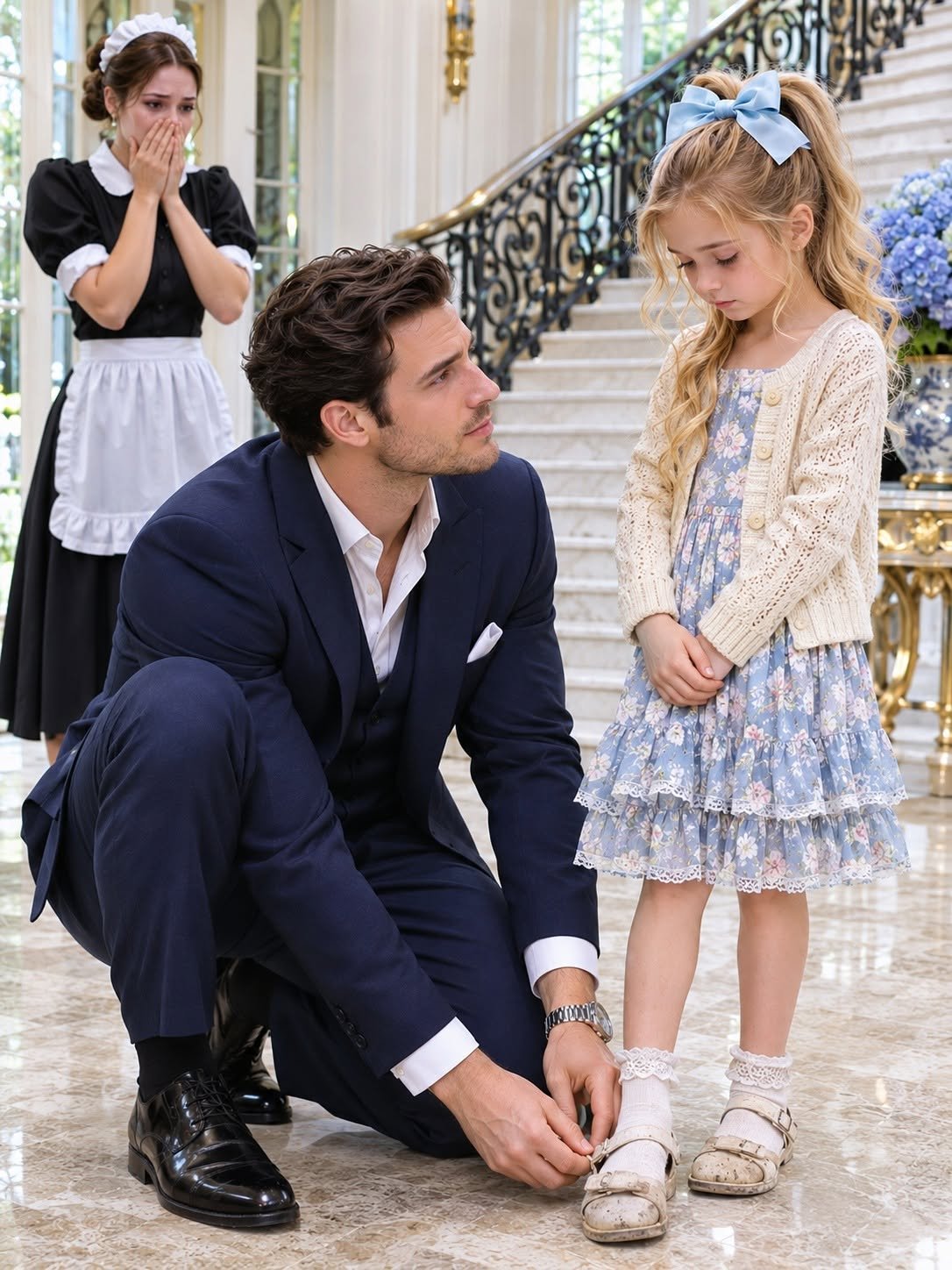
He crouched down until he was at my daughter’s eye level.
PART 2
Nobody said a word.
The man half the city seemed to fear was on his knees on the marble, in front of a little girl in old sneakers with dried glue on her fingers.
“You tried to fix them yourself?” he asked.
Lucy nodded.
“Yes, sir.”
“Why?”
She looked at me before answering.
“Because my mama works a lot and new shoes cost money.”
Castellan studied the broken sneaker.
“And you thought that would help your mama?”
“Yes. We have to save for our house.”
I felt my eyes fill with tears.
He looked up at me.
“Natalie, right?”
“Yes, sir.”
“How long have you worked here?”
“Almost two years.”
He looked back at Lucy.
“Shoes shouldn’t be this much work for you.”
She frowned.
“They shouldn’t?”
“No. They’re supposed to help you run and play.”
“I like to run.”
For the first time, I saw a shadow of a smile on his face.
“Then you need a pair that can keep up with you.”
He asked for a chair, sat down beside her, and asked what she was drawing.
Lucy opened her notebook and showed him the yellow house.
“My mama and I are going to live here someday.”
“Does it have a yard?”
“Yes. For our puppy.”
He nodded, then looked at me.
“When your shift ends, I want to talk to you in my office.”
The hope that had started to rise in me vanished. I thought he was only being kind to her before firing me.
At four that afternoon, I walked into his office with ice-cold hands.
“Sit down, Natalie.”
“Sir, I’m very sorry about this morning. It won’t happen again.”
He raised a hand.
“I didn’t call you here to punish you.”
I looked at him, confused. All day I had rehearsed an apology and even thought about what I could sell if I lost my paycheck.
“You’ve worked here almost two years. You’re punctual, careful, and you’ve never caused a problem. Today you risked your job because you had nowhere to leave your daughter. Why didn’t you ask for help?”
I thought about the rent, the pharmacy, and all the times I’d calculated every last dollar before buying groceries.
“Because I didn’t think anyone here cared about my problems.”
He asked me to tell him the truth. It was hard. Talking about money always shamed me, because admitting I couldn’t make ends meet felt like admitting I had failed.
I explained that Lucy’s father had left when she was very small. I told him about the apartment, the overdue rent, and the bills I couldn’t cover.
When I finished, he asked:
“Does your daughter know all that?”
“Not the details. But she senses it. This morning she was gluing her sneakers because she thought it would save me money.”
Castellan lowered his eyes.
“When I was a boy, my mother worked two jobs. She mended my school uniform at the kitchen table because she couldn’t afford another.”
He was quiet for a moment.
“I haven’t thought about that in years. Your daughter reminded me of something I shouldn’t have forgotten.”
He looked at me again.
“There are people who work until they’re exhausted and still need help. That doesn’t mean they’re irresponsible, or that they haven’t tried hard enough.”
Then he picked up the phone on his desk.
And I still didn’t understand how far that conversation was about to go.
PART 3
The first call was to his assistant.
Victor Castellan asked that, after my shift, a driver take Lucy and me to a children’s shoe store.
“Sir, you don’t have to do that,” I said immediately.
“I know I don’t have to.”
His tone wasn’t harsh.
“I want to.”
Then he made a second request.
He ordered that the estate’s administration create an emergency child-care support program for employees facing unexpected situations.
“No parent should have to choose between keeping their job and making sure their child is safe.”
I stared at him.
For almost two years I had believed the rules of that house were unbreakable.
And my daughter, in her broken sneakers, had just gotten the owner to question one of them.
Then he asked that my salary and the benefits available to employees be reviewed.
“You’ve been a valuable worker,” he told me. “That should be reflected in how we treat you.”
That’s when I couldn’t hold it in anymore.
I began to cry.
Not because all our problems had vanished. We still owed rent. Bills were waiting. Our life hadn’t magically become a perfect fairy tale.
I cried because, after months of feeling invisible, someone had seen how much I was trying to carry.
“Thank you.”
Castellan shook his head gently.
“You don’t have to thank me for listening.”
When I got back to the kitchen, Lucy ran to me.
“Mama! They said we’re going somewhere!”
I bent down and hugged her.
“Yes.”
“Where?”
I looked at her split sneakers.
“To buy you new ones.”
She looked down.
“But I can try to glue them again.”
I stroked her hair.
“No, my love. This time you don’t have to.”
That afternoon she chose lavender sneakers with little silver stars.
She walked slowly around the store, trying them on.
Then she started to spin.
Her laughter filled the place.
I stood watching her and realized how long it had been since I’d heard her laugh without feeling she had to worry about me.
“Mama! These ones don’t come apart!”
I laughed.
“No, sweetheart. These won’t.”
She ran to me and hugged me.
That night, for the first time in many months, I allowed myself to think that maybe tomorrow could be a little less hard.
The following weeks didn’t bring miracles.
They brought something better: small, real changes.
The employee assistance program helped me cover the most urgent bills. The raise gave me a little breathing room. I began catching up on rent.
I finally picked up the prescription that had been waiting at the pharmacy.
And when the daycare closed unexpectedly again one day, I didn’t feel the same terror.
Now there was an alternative.
I could ask for help without thinking I’d lose my job for being a mother.
Victor Castellan didn’t transform overnight, either.
He was still serious.
He still demanded that work be done well.
He still smiled very little.
But something inside the estate did change.
The staff began speaking up when they had a real difficulty. The head of household staff stopped treating every family emergency like an unforgivable offense.
And I began to understand that asking for help didn’t mean failing.
Weeks later, the estate held a small gathering for the staff’s families.
Lucy came with me.
She wore her lavender sneakers.
When she saw Castellan near the garden, she ran to him.
“Mr. Castellan! Look! My shoes are still good!”
He looked down.
“So I see.”
“I can run super fast in them.”
“Then it seems you chose well.”
Lucy smiled and pulled a folded sheet of paper from her pocket.
It was a drawing.
A little girl stood beside a tall man in a dark suit.
They were both smiling.
Below, in crooked letters, she had written:
“Thank you for my shoes.”
Castellan stared at the page for several seconds.
Then he folded it carefully and tucked it inside his jacket.
“Thank you, Lucy. I’m going to keep it.”
I watched from a few steps away.
For a long time, I had thought a man like him would never notice someone like us.
That morning taught me that people can be far more complicated than the reputation that surrounds them.
Months later, Lucy and I were still living in the same apartment.
The furniture was still old.
The kitchen was still small.
We didn’t have a luxurious life.
But the rent was current, the refrigerator was full, and I no longer felt afraid every time the phone rang.
One afternoon, Lucy was drawing another house at the table.
This one had a red door and an enormous tree in the yard.
“Mama, do you think we’ll live in a house like that someday?”
I looked at her drawing.
“I think we can keep working to make it happen.”
“And will we have a puppy?”
I laughed.
“We’ll talk about the puppy when we have the yard.”
She kept coloring.
Then she lifted her head.
“Mama, remember when I fixed my shoes?”
“Of course.”
“I thought you’d be sad when they broke again.”
I took her hand.
“I was never angry with you about those shoes.”
“Really?”
“Really. And I want you to remember something.”
She put down the crayon.
“What?”
“You don’t have to solve grown-ups’ problems. You don’t have to worry about rent, or bills, or whether I have enough money. Your job is to learn, play, laugh, and be a little girl.”
She listened carefully.
“And your job is taking care of me?”
I smiled.
“Exactly.”
She climbed out of her chair, settled into my lap, and wrapped her arms around my neck.
“I love you, Mama.”
“And I love you more than anything.”
That night, after putting her to bed, I found her old pink sneakers at the back of the closet.
The glue had hardened at the edges, and one sole was still hanging loose.
I sat on the floor with them in my hands.
They represented one of the hardest mornings of my life.
But they also marked the moment something began to change.
For too long I had believed that being a good mother meant carrying every problem alone.
My daughter taught me the opposite.
She reminded me that love can also show up in tiny gestures: a little girl trying to save a few dollars for her mother, a person who decides to listen, and a powerful man who, with every chance to look the other way, chooses to stop.
I put the sneakers in a box.
Someday, when Lucy was older, I would tell her the whole story.
Not to remind her how much we lacked.
But so she would understand how much her heart had meant that day.
And so she would never forget something even more important:
She never had to earn love by sacrificing her own happiness.
She had always been worthy of it.
THE END