Every string light in my son’s backyard had been paid for with my credit card, and I knew it the moment Courtney raised her glass.
The lights were lovely. I’ll give her that. Hundreds of tiny gold bulbs crisscrossed the new patio, and the whole yard glowed like a Christmas card in the middle of June.
60 guests sat at long tables beneath them, eating short ribs off real China.
The catering bill, $6,812, had popped up on my phone the afternoon before as a fraud alert.
It wasn’t fraud. It was my daughter-in-law using the card I had handed her for her emergencies.
My name is Helen Brooks. I’m 66 years old, and I spent 34 years as the school secretary at Maple Ridge Elementary in Worthington, Ohio.
Anyone who has worked a front desk knows who really runs a school. And it isn’t the principal. It’s the woman who knows where every dollar went.
I knew where every dollar of mine had gone, too. I just hadn’t been looking.
“Okay, everybody, quiet down.”
Courtney tapped her fork against her wine glass. She wore a white linen dress, and her blonde hair was in that effortless knot that takes 40 minutes.
“Ryan and I want to thank you all for coming to the big reveal. Two and a half years of contractors, dust, and decisions.”
Applause rippled across the patio.
“And a very special thank you,” she went on, her eyes finding me at the far end of the table, “to Ryan’s
mom.”
Heads turned.
I smiled the way you smile at parent teacher night.
“Helen, honestly, you’re not even really family.”
Courtney laughed and waved her glass, and wine sloshed over her fingers.
“You’re our bank, open all hours, no questions asked, and never once sent a statement.”
The laughter that followed came in two kinds. Some of it was real. Some of it died halfway down the table, the way laughter does when people realize the joke has a person in it.
I didn’t look at Courtney. I looked at my son.
Ryan is 38 years old, with his father’s shoulders and his father’s way of going still when he’s uncomfortable.
He was peeling the label off his beer bottle with his thumbnail, slowly, carefully, as if it were the most important job in the state of Ohio.
He didn’t laugh. I’ll say that for him. But he didn’t speak either.
And that silence cost me more than the short ribs.
Beside me, my niece Tessa went rigid. Her hand found my wrist under the tablecloth. I patted it.
Then I picked up my glass, which held nothing stronger than lemonade, and I stood.
“You’re right, Courtney,” I said.
Her smile flickered. She had expected me to blush or laugh along or quietly refill last basket the way I had for years.
“I’m not family. I’m your bank.”
I let that settle.
“That’s wonderful news, because it means I can finally do what banks do.”
I raised my glass one inch.
“Review the account. Your statement will arrive Monday morning.”
Nobody breathed.
Somewhere, a wine glass clanked against a plate. Courtney’s mouth opened and closed.
“Please enjoy the cake,” I said.
Then I set down my lemonade, took my purse from the back of my chair, and walked across my son’s beautiful new patio, past 60 frozen faces, under every single one of those golden lights.
Tessa caught up with me at my car, still clutching her napkin.
“Aunt Helen, are you okay?”
“I’ve never been better,” I said, and was startled to find it true, which is a strange thing to learn on a night like this.
She hugged me hard.
Tessa is my late sister’s daughter, 29 years old, a pediatric nurse with a laugh you can hear across a parking lot.
“Whatever you’re planning,” she said into my shoulder, “count me in.”
“I’m not planning anything, sweetheart. I’m just going to start paying attention.”
I drove the 10 minutes home to Worthington with the radio off.
My house is a brick two-story on Elmwood Lane, where I raised Ryan and where my husband Walt taught
him to swing a hammer.
Walt taught shop at the high school for 31 years and bragged that he had never lost a finger.
His heart took him four years ago. This March, out in the garden with a tomato cage in his hand.
His recliner still sits in the den. I haven’t managed to move it.
I made a pot of tea I didn’t drink and sat down at the kitchen table.
Then I did what I have always done when something hurts.
I opened a ledger.
It was a green clothbound book, the same kind I kept at school, and every page was in my handwriting.
Two and a half years ago, Ryan had sat at the same table and told me they couldn’t swing the down payment on the Westerville house.
“You’re rattling around in here, Mom,” he’d said. “And Max is on the way. Invest in your family.”
So, I did.
Walt’s life insurance and a good chunk of my savings. $94,000 in all.
But I’m a school secretary, my friends. I don’t hand over $94,000 on a hug.
I called Dana Whitfield, an attorney whose father played poker with Walt, and she drew up a promisory note and recorded a second mortgage against the house.
$650 a month to begin 12 months after closing.
Courtney signed with a purple gel pen and said, “Wow, so formal, Helen.”
Ryan said, “Mom just likes paperwork.”
Everyone laughed. I laughed, too.
18 payments have come due since then. I kept count. Not one has arrived.
Last fall, I brought it up gently, standing at Courtney’s marble kitchen island.
She put a hand on my arm.
“Helen, family doesn’t invoice family.”
Ryan said, “Mom, can we not do this today?”
And I said, “Of course.”
I said, “Of course,” for 18 months.
Courtney didn’t build this cage alone, you understand? I handed her the bars one course at a time.
That night, I ran the numbers.
94,000 for the note, or 58,000 300 on the family credit card, which I’d given them after Max was born for emergencies and groceries and nothing else.
7,120 for the phone plan, the insurance, and every streaming service known to man.
The total at the bottom of the page was $159,420.
Then I pulled up the card statements and read them the way I used to read the school lunch accounts, line by line.
Emergencies, it turned out, included four nights in Cabo for $4,380.
Charged the same September that Ryan texted me they were just too tight to make a note payment.
They included 6 months of rent at 2,200 a month on a studio for Courtney’s event business, Gathering Glow, a creative space that had hosted exactly two events.
They included three designer handbags.
A woman, my friends, can only carry one handbag at a time.
I thought about Tessa.
After her divorce, she lived in my spare room for 8 months. I told her she owed me nothing.
She paid me anyway, in electric bills and cleaned gutters and Sunday pot roasts, because she couldn’t stand to be a guest.
When she bought her own condo, she hung a key to it on my key ring and said, “You’re always welcome, Aunt Helen.”
That is what gratitude looks like.
I had known it all along. I just hadn’t thought to expect it from my own son.
I closed the ledger, and a sheet of paper slid out from the back and land and on the table.
I knew what it was before it stopped moving.
A listing printed in April. Sandpiper Lane, Marblehead, Ohio.
Two bedrooms, one bath, a screened porch, and 40 steps to Lake Erie.
In the margin, in my own handwriting, I had written two words: “Walt’s Lake.”
Every August for 20 years, Walt and I rented a room in a little motel there and watched the sun go down
over the water.
He used to say, “Someday, Helen, we’ll just buy one of these.”
Someday never came.
In April, I had printed that listing and hidden it inside my ledger like a teenager hiding a love letter.
I never called.
Spending money on something that was only mine felt like a crime.
When was the last time I had done it?
I sat there, and I honestly couldn’t remember.
At 11:40 that night, I turned to a clean page and wrote a list.
The card, the phone plan, the child care, the note, Walt’s things.
At the bottom, underlined twice, I wrote one more word: lake.
None of it was revenge.
Revenge is loud, and it makes the person doing it smaller.
This was just bookkeeping.
At 9:02 on Monday morning, I called the credit card company.
The representative’s name was Briana.
“I’d like to remove two authorized demisers from my account.”
“Of course, Mrs. Brooks. Is there any concern about fraud?”
“No, dear,” I said. “Just a conclusion.”
It took 4 minutes.
Then I sent a text to Ryan and Courtney, polite as a thank you note.
“Beginning next month, your phone lines will be your own. Instructions for transferring your numbers are attached.”
I couldn’t cut them off overnight.
I’m not cruel, and a dead phone is a dangerous thing in a house with a three-year-old.
But the streaming accounts, the meal kit subscription, and the warehouse club membership I had
upgraded for Courtney’s party supply runs, those vanished with a few clicks.
Then I made two more phone calls, one to the number at the bottom of a printed listing and one to a realtor here in Worthington named Marcy Delgado.
I’ll tell you about those in a little while.
At 12:17, Ryan called.
“Mom. Courtney’s card got declined at the grocery store in front of the whole checkout line.”
“Which card?”
A pause.
“Yours.”
Then it did exactly what it was supposed to do.
“She didn’t mean it the way it sounded at the party. She’d had a couple of glasses of—”
“She meant every syllable, Ryan. She just didn’t expect me to hear it.”
He went quiet.
Behind him, a shopping cart rattled.
“You were peeling a beer label,” I said.
“I know,” he said very low.
That was all.
He didn’t say sorry. He said I know.
And I decided it might be the beginnings of something, though near the end of it.
At 12:34, a text arrived from Courtney.
“It was a joke, Helen. You are punishing us over a joke.”
I read it twice. I didn’t answer.
Some messages deserve the dignity of being left alone.
For two years, I had driven to Westerville every Tuesday, Wednesday, and Thursday at 7:30 in the morning to watch my grandson.
Max is three. He smells like Graham crackers and sunshine, and he calls me Graham in a voice like a tiny trumpet.
Those three days were the engine of Gather and Glow.
Courtney booked her clients, built her flower walls, and posted her photos while I handled the nap schedule and the snack schedule for free.
I never asked to be paid, but then nobody ever asked me either.
On Wednesday morning, I knocked on her door instead of letting myself in with my key.
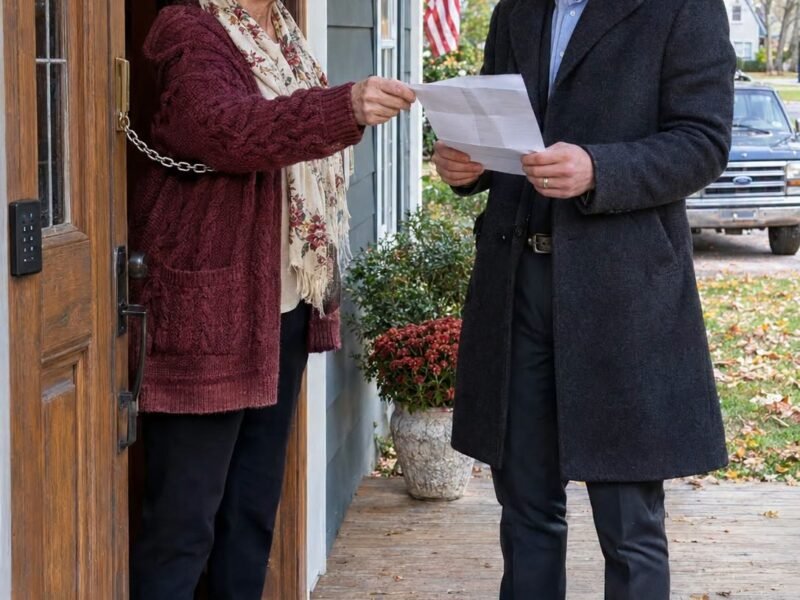
I carried a folder with brochures for three well-reed daycarees in Westerville. Tour times already marked in yellow highlighter.
Courtney opened the door in yoga clothes, arms crossed.
“What is this?”
“Two weeks notice,” I said. “I’m retiring from weekday child care effective the end of the month. I’ll see Max every Saturday morning and every Sunday dinner for as long as I’m breathing.”
“So you’re using Max as leverage.”
I felt that one land. It was meant to.
I took a breath and let it pass through me.
“No. Max is the one thing in this house I’m not negotiating. He gets his grandmother whether you ever pay me back or not. What he won’t get is a grandmother who’s also your unpaid employee.”
“Unpaid ere. We feed you every Sunday.”
“Your Sunday dinners are catered,” I said gently. “And I’ve seen the receipts.”
A small shape appeared around her legs and dragging a stuffed stegosaurus.
“Graham!”
I scooped him up and breathed in graham crackers.
“Hey buddy, Saturday we’re going to the duck pond. Deal?”
“The ducks!” Max shouted, which settled that.
Over his curls, Courtney’s eyes were two hot coals.
I handed him back, kissed his head, and walked to my car without hurrying.
My knees didn’t start shaking until I reached the end of the driveway.
On Friday afternoon, a certified letter from Dana Whitfield’s office arrived in Westerville.
Dana had written it exactly the way I’d asked, friendly and firm, like a good school secretary.
It listed the principal of $94,000.
It listed 18 missed payments of $650 each, $11,700 in all.
It enclosed a repayment agreement.
Starting the first of next month, they would resume the $650 a month, plus 200 more toward the back payments.
Both signatures were due within 21 days.
If they didn’t sign, the default clause in the note they had both initialed would give me the right to call the entire balance due.
At 7:40 that evening, Courtney was on my porch.
No Ryan, no wine glass.
Her mascara had migrated south of her eyes.
“You can’t be serious.”
“Come in, Courtney. It’s getting cold.”
“I will not.”
She held up the letter, and it shook.
“Family doesn’t invoice.”
“Everyone keeps telling me that.”
I leaned on the door frame.
“But you stood up in front of 60 people and called me your bank. A bank that never sends a statement isn’t a bank, honey. It’s a vending machine.”
“You’d take our house, your own grandson’s house.”
“I don’t want your house. I want what the paper says. $650 a month, and I’d gladly take that along with a Sunday dinner. But which one of those you’d rather deal with is entirely up to you.”
“Ryan will never forgive you for this.”
“Ryan is a grown man,” I said. “He can forgive whomever he likes. He can also read a contract.”
She stared at me as if I’d turned into someone she’d never met.
Then she spun around and stomped down the walk.
Her car door slammed hard enough to rattle my porch lights.
After Walt died, Ryan had asked to take his workbench and tools to Westerville.
“So Max can grow up around Dad’s things,” he’d said.
And I had cried and said yes.
I had been inside that garage exactly once since.
On Thursday night, I’d sent my son a text.
“Saturday at 10:00, I’m collecting Dad’s workbench, his tools, and his mother’s mantle clock. You’re
welcome to help. Bring gloves.”
No reply.
Saturday morning, Tessa and I pulled up in a friend’s borrowed pickup.
Courtney’s SUV was gone.
According to the Gathering Glow Instagram page, she was at a client’s wedding, but Ryan stood alone in the open garage doorway wearing work gloves.
My heart sank anyway, because there it was.
Folding chairs stacked to the rafters, a flower wall lying on its side, a neon sign that said, “Better
together,” leaning against the drywall.
And somewhere beneath all of it, Walt’s workbench, buried like a ship at the bottom of the ocean.
His tools weren’t on it.
They were in a banker’s box on the floor, and across the lid in Courtney’s loopy marker were “mis junk.”
Nobody spoke.
Ryan stared at that box for a long, long moment.
Then he took a black marker from the junk drawer by the door, crossed out “MIS junk,” and wrote in thick, careful capitals, “Dad’s tools.”
“Okay,” he said, and his voice cracked. “Let’s get it out from under there.”
It took an hour and the three of us to move those chairs.
When the workbench was finally free, Ryan ran his palm along the old steel vice.
“He built this the summer I was nine,” he said. “I held the flashlight. He always said, ‘Measure twice.’”
A wet laugh.
“Cut once.”
We carried it to the truck without talking.
When the last box was strapped down, Ryan stood in the driveway with his gloves hanging from one hand.
“Mom, I should have said something at the party. Before the party, really.”
“Yes,” I said. “You should have.”
“I don’t know how to fix it.”
“Start by finding out what’s true. Your wife handles the money. Asked to see the statements. Not mine. Yours.”
He nodded slowly.
“Where are you taking all this?”
“Somewhere it’ll get used.”
“Where?”
“You’ll know soon enough,” I said.
And Tessa, behind the wheel, raised both eyebrows at the windshield.
Tuesday night at 9 and 5, Ryan was on my porch with a laptop under his arm like a man bringing evidence to trial.
“The house fund,” he said before I had the door all the way open. “Courtney told me there was $38,000 in. I’d never actually checked. I checked tonight, and $1,140.”
I stepped aside, and he came in and sat in the same kitchen chair where he’d once asked me for $94,000.
He opened the laptop, and I watched my son read his own life for the first time.
Cabo, $4,380, which Courtney had called a work retreat.
Studio rent, a leased white SUV she’d up Glass Leg Spring without mentioning it.
A $22,000 loan for the outdoor kitchen, which he had co-signed without reading.
“I make $96,000 a year, Mom,” he said. “I couldn’t tell you where one of those dollars went.”
“That was a choice too, honey.”
“I know.”
His jaw worked.
“I know it was. It was easier not to ask.”
Then he clicked open one more file and turned the screen toward me.
A spreadsheet.
The title was “The Plan.”
Row three read: “Helen’s house est $410,000 hours eventually. Don’t rush her.”
I read it twice.
A smiley.
“Don’t rush her.”
Somewhere in my chest, something I had been holding up for 4 years quietly set itself down.
“I swear I never saw that before tonight,” Ryan whispered.
“I believe you,” I said. “That doesn’t make it better. But I believe you.”
My son, 38 years old, put his face in his hands the way he did at seven when he broke Walt’s level.
For a while, I just let him.
Then I set a cup of tea in front of him and said nothing at all, because for once he didn’t need me to
carry any of it.
The sign went up Wednesday morning.
“For Sale,” in red letters, planted in the grass beneath Walt’s maple tree by one of Marcy Delgado’s crew.
By 6:00 that evening, my phone was buzzing.
My neighbor Barbara Ames had texted, “Helen, is that sign on your lawn real?”
Courtney pulled into my driveway at 6:20 with Ryan in the passenger seat, looking like a man in a car wash.
She was out before the engine stopped.
“You listed Walt’s house?”
Her voice cracked across the lawn.
“That’s Ryan’s inheritance.”
“Courtney,” I said from my porch swing. “An inheritance is what you receive after a person is gone. I’m sitting right here.”
“That house is the whole plan.”
“Yes,” I said. “I’ve read the plan. Don’t rush her with a smiley face.”
All the color drained from her face.
She turned slowly toward her husband.
“You showed her.”
“I showed her,” Ryan said.
I came down the porch steps and stood on my own front walk, and I told them, “I’m moving to
Marblehead on Lake Erie, Sandpiper Lane. Two bedrooms, one bath, 40 steps to the water.”
Walt and I rented a motel room there every August for 20 years and talked about it like a fairy tale.
I called a realtor the morning after your toast, Courtney.
My offer on that cottage was accepted the same Friday Dana’s letter went out.
“You’re abandoning your family.”
“I’ll be 2 hours away with a guest room and a good coffee pot. Every Saturday I’ll drive down for Max. That isn’t abandonment. That’s a schedule.”
“You’re doing this to punish me.”
“No.”
And here I said what I had been practicing in my head for a month.
“I stayed 10 minutes from you for 4 years because I thought I was needed. It turns out I was only useful. Needed and useful are not the same thing. And it took one toast to teach me the difference.”
Courtney opened her mouth to answer.
And my son stepped between us. Not in front of me. Or between us.
“Court, stop.”
She stared at him.
“Ryan.”
“She isn’t punishing you. She’s reading you the bill.”
His voice shook, but it held.
“I saw the accounts. I saw the spreadsheet. There was a smiley face, Courtney. We took from her, and then we laughed about it in front of our friends. I’m done with that.”
“So, you’re choosing her over your wife?”
“I’m choosing the truth. I’d like you to choose it with me.”
He looked at her for a long moment.
“But I’m choosing it either way.”
Down Elmwood Lane, a lawnmower droned.
Courtney’s lip trembled, and for the first time in 4 years, I saw something beneath all that polish that
wasn’t contempt.
It looked an awful lot like fear.
“Go home,” I said softly. “Both of you talk. The agreement is due Friday.”
They left in one car, in the kind of quiet that has a lot of words in it.
The deadline fell on a Friday, exactly 21 days after the letter.
At noon, Ryan came up my walk alone, carrying a folder and a check.
His signature was on the agreement in blue ink. The line beneath it was empty.
“She wants to bring hers herself,” he said.
Then he told me everything, standing right there on the porch like a man reading a report he had written
himself.
He had spent two evenings with a counselor at their credit union.
He had taken over the family’s finances.
They had turned in the leased SUV and bought a used Honda.
Courtney had let the studio lease laps and moved Gather and Glow back to the kitchen table where it began and where it might finally turn a profit.
She had toured two daycarees on her own.
Max started at Little Acorns on Monday.
The check was for $2,000 from his own savings. The first toward the back payments.
“That’s not Courtney’s money,” I said. “It’s yours.”
“It’s mine,” he agreed. “That’s why I want you to have it.”
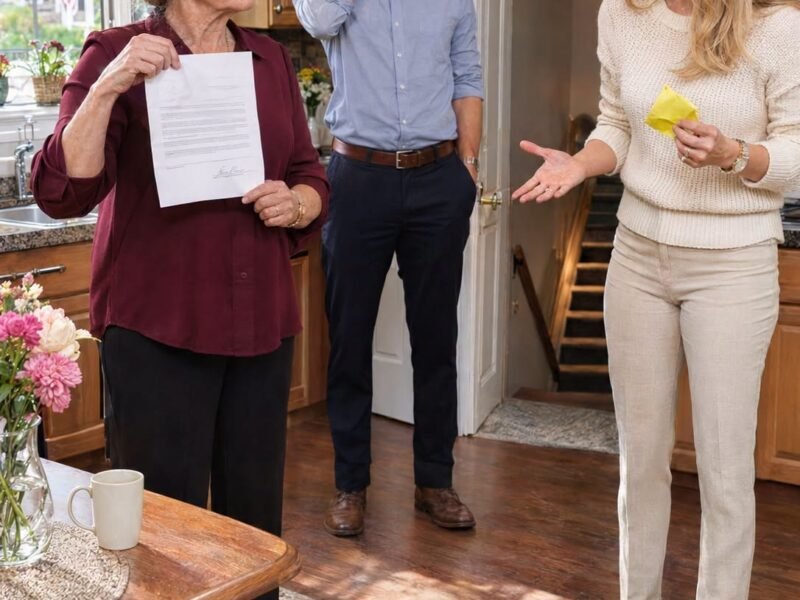
At 4:00, Courtney came up the walk, no makeup, hair in a plain ponytail, holding the agreement in both hands like a hot dish.
She signed on my porch railing with that Saint Se sameachel pen.
Then she set it down very carefully, as if it might go off.
“I said it was a joke,” she said. “It wasn’t. I think I wanted to feel like I’d built something that was mine, and you were the one person I was sure would never fight back. You were kind to me, and I decided that
made you small.”
Her chin trembled.
“I’m sorry, Helen. Not because you stopped paying, because you never deserved it.”
“Or thank you,” I said. “I accept your apology. I don’t accept the word joke.”
“No,” she whispered. “You shouldn’t.”
“Forgiveness is free, Courtney. Trust gets paid in Anton’s installment. Same as the note.”
She laughed a wet surprise sound and wiped her face with her wrist.
“Will you still be Max’s Graham?”
“I was Graham before I was your bank,” I said. “I’ll be Graham after you’ve paid me off.”
The house sold within the week to a young couple expecting their first baby.
The wife taught first grade, and when she stood in Walt’s den, she said, “I’m going to keep that maple tree if it’s the last thing I do.”
I told her it was a fine last thing to do.
6 months later, on a gray December morning, I stood at the window of a little cottage on Sandpiper Lane
and watched Lake Eerie turn the color of pewtor.
Ice rimmed the breakwater.
40 steps from my door.
The water was enormous and cold and entirely mine to look at.
Walt’s workbench sits in the shed out back now, under a string of white lights, and his tools hang on a
pegboard in the same order he kept them.
I’ve learned to restore old furniture out there.
Last month, I regained a chair seat for the first time and cried like a fool over it.
On weekends, I volunteer at the Marblehead Lighthouse, telling visitors it’s the oldest continuously operating light on the Great Lakes, as if I’d built it myself.
On the first of every month, a deposit appears in my account.
The first one came with a memo line that said, “Statement received.”
The second said, “Paid.”
With a smiley face, I decided to forgive.
By October, the memo read, “Thank you, Helen.”
$650 plus 200 toward the back payments every single month.
The money isn’t what matters, my friends.
It’s the first of the month.
It’s the sound of someone keeping their word.
Last Sunday, they drove up with Max, who is now four, and tells everyone he’s almost five.
Tessa came too, carrying an apple pie and a bag of fresh bagels, and she hung her coat on the hook beside mine without being asked.
Courtney carried in a chocolate cake she had baked herself, slightly lopsided, which I loved more than
any catered thing I’ve ever eaten.
Over dessert, Courtney stood up with her glass in her hand.
My heart skipped.
Then she looked at me a little shy and smiled.
“I’d like to make a toast,” she said. “And this time I’m going to get it right.”
She raised her glass.
“To Helen. Not our bank, our family.”
“And family,” I said, lifting my lemonade, “pays on the first.”
The whole table roared.
Ryan laughed until he had to wipe his eyes.
Max, who under none of it, laughed loudest of all.
Later, when the dishes were done and the stars had come out over the water, I stood alone on my screened porch with a cup of tea.
Behind me, through the window, I could see my son drying a plate beside my niece while my grandson
explained something enormous as about dinosaurs.
Nobody was waiting for a check.
Nobody was keeping score.
If you were sitting at my kitchen table right now, my friends, here is what I would tell you.
Kindness is a gift. It is not a subscription.
Put it in writing. Even with your own child, especially with your own child, know the difference between a
loan and a gift.
And never let anyone blur the line.
Never hand over an open-ended card without a limit.
Say the small no early before it grows into a big one.
And expect gratitude gently from the very first day, because people tend to give you exactly what you’ve taught them to expect.
I didn’t win anything in my son’s backyard that night.
I simply stopped paying for my own disrespect.
And I discovered that the quiet on the other side of that decision wasn’t loneliness at all.
It was a lake.
So tell me, my friends, did I wait too long or did I handle it the right way?
And tell me where you’re listening from.