“My father laughed over brunch
at his country club while telling
his golf buddies I was “just a nurse”
handing out flu shots on some
Air Force base.
He thought I was too ordinary
to matter, too quiet to impress anyone
at his table.
Then, twelve feet behind him,
a two-star general slowly stood up,
stared directly at the insignia pinned
to my blazer, and addressed me
by the title my father never imagined
I carried.
By the time I pulled into
the circular driveway of Briarwood Country Club
outside Columbus, Ohio, the summer heat
had already soaked through the back
of my blouse.
My father’s silver Cadillac sat crooked
across two parking spaces near the entrance.
Of course it did.
Gordon Whitmore had spent his entire life
believing rules were suggestions
for other people.
I stayed inside my car
for a moment longer than necessary,
checking my reflection in the rearview mirror.
Navy blazer.
Cream silk blouse.
Hair twisted neatly at the nape
of my neck.
And pinned carefully to my lapel—
A small silver insignia most civilians
never recognized.
Flight surgeon wings.
Tiny.
Understated.
Easy to misunderstand.
Which was exactly why I wore them.
The clubhouse smelled like polished wood,
expensive coffee, and quiet arrogance.
Oil paintings of dead businessmen lined
the walls while old golf trophies glittered
beneath chandeliers like relics
of inherited importance.
My father was featured in three
framed photos near the entrance.
My brother Nathan appeared in another
shaking hands with a senator.
I wasn’t in any.
That didn’t surprise me anymore.
Families don’t always erase people loudly.
Sometimes they just stop making space
for them.
They were seated on the patio
overlooking the golf course when I arrived.
My mother gave me a polite
little wave without standing.
“Claire,” she said pleasantly.
“You made it.”
No hug.
No warmth.
Just acknowledgment.
My father sat at the center
of the table exactly where he always
positioned himself—like leadership naturally belonged to him
even during breakfast.
Beside him sat his golf friends:

Dennis Walker, retired investment broker,
and Frank Ellis, a former commercial pilot
who still wore his old aviation pin
everywhere like a medal from another lifetime.
My empty chair waited nearest
the service cart.
Someone had already ordered for me.
Again.
Dad loved doing that.
It made him feel generous without requiring
him to ask what anyone actually wanted.
“Perfect timing,” he announced as I
sat down.
“Nathan was just telling us
about his promotion.”
Nathan grinned immediately.
“Regional vice president now.”
“Thirty-four years old,” my father added proudly.
“Youngest executive in company history.”
The men nodded approvingly.
My mother smiled into her mimosa.
Then my father suddenly gestured toward me
with casual dismissal.
“And this is my daughter Claire,”
he said.
“She’s a nurse on one
of the Air Force bases somewhere out west.”
He chuckled softly.
“Not exactly brain surgery, but somebody’s
got to give pilots their flu shots.”
The table laughed politely.
Even Nathan smirked.
I reached calmly for my coffee
instead of responding.
Years ago, comments like that
used to hurt.
Now they just sounded small.
Frank leaned toward me kindly.
“Well, military nursing’s still admirable work.”
Before I could answer,
my father interrupted.
“Oh, she’s always been dramatic about it.
You’d think she was running the Pentagon.”
More laughter.
Then suddenly—
A chair scraped sharply against
the patio floor behind us.
The sound cut through the conversation instantly.
I turned slightly.
So did everyone else.
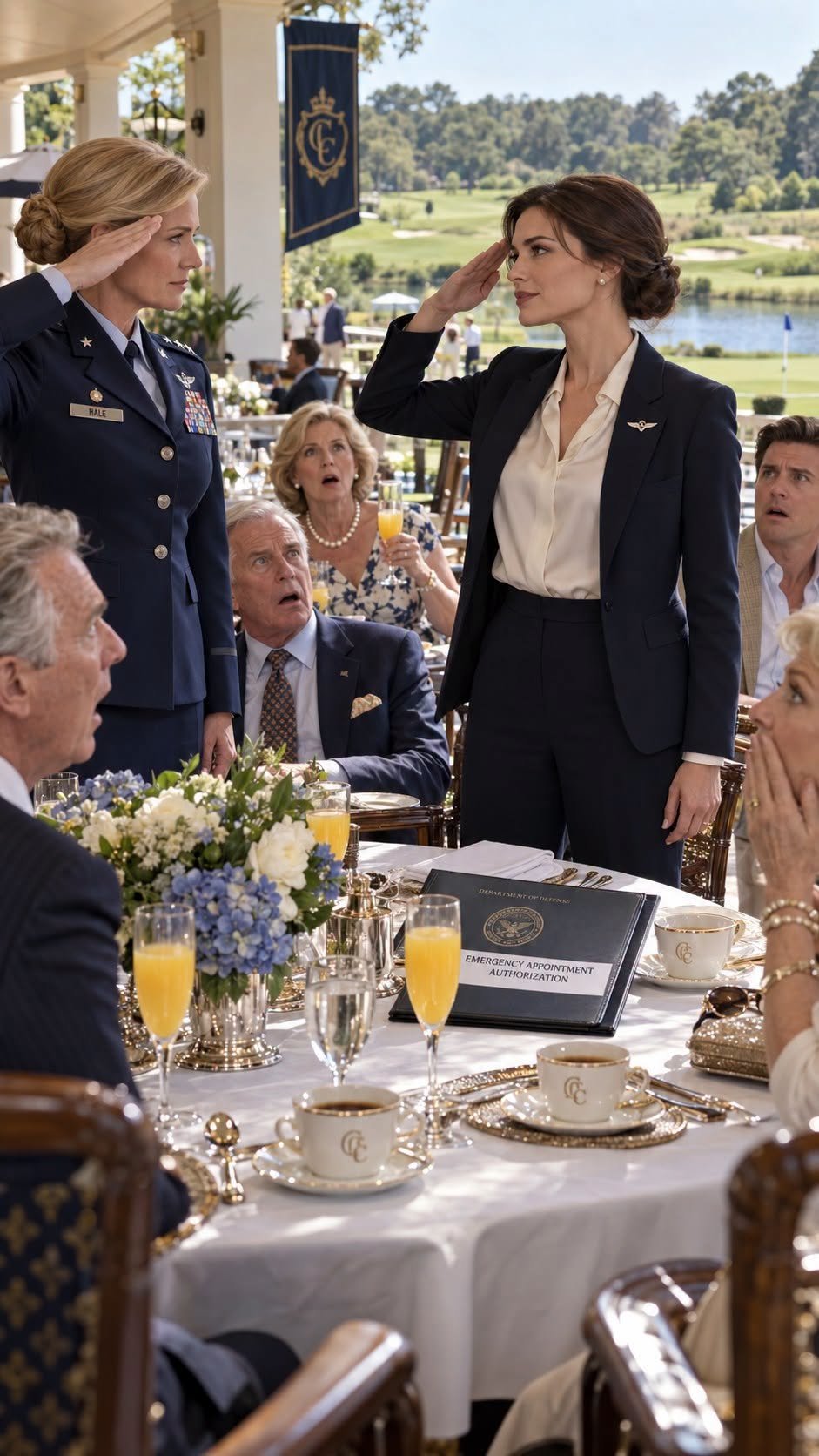
A woman in Air Force dress blues
had risen slowly from a nearby table.
Two silver stars gleamed brightly
on her shoulders.
Major General Victoria Hale.
Commander of Wright-Patterson Air Force Base.
Every instinct in my body
straightened automatically.
The general’s eyes locked directly onto
the insignia on my lapel.
Then onto me.
And suddenly her expression changed completely.
Recognition.
Real recognition.
She stepped toward our table without hesitation.
My father blinked in confusion.
The entire patio fell silent
as conversations nearby faded one by one.
General Hale stopped directly beside me.

Then, to my father’s absolute shock—
She saluted me.
“Colonel Claire Whitmore,” she said clearly.
“I didn’t realize you’d be here today.”
You could hear silverware clink somewhere
across the patio.
My father stared at me like he’d
forgotten how breathing worked.
Frank’s mouth literally fell open.
Nathan’s confident smile vanished instantly.
I rose smoothly to return the salute.
“Good morning, General.”
General Hale smiled faintly.
“I was hoping Washington would finally
confirm your transfer soon.”
She glanced toward my father briefly.
“Most people don’t realize the Air Force
only has three trauma flight surgeons
currently qualified for orbital recovery operations.”
Silence.
Total silence.
My father looked at me slowly.
“Orbital… what?”
I set my coffee cup down carefully.
For the first time all morning,
I smiled.
“I don’t give flu shots, Dad.”
But General Hale wasn’t finished.
Because she reached into her briefcase,
removed a sealed folder stamped
DEPARTMENT OF DEFENSE,
and quietly placed it in front of me.
And when I saw the words
printed across the top—
EMERGENCY APPOINTMENT AUTHORIZATION
—I realized this awkward family brunch
was about to become an international incident.”
My hand settled over the folder
before my father could reach it.
For a second,
neither of us moved.
His fingers hovered beside the seal.
Mine stayed flat.
“Claire,” he said,
with the warning buried inside my name.
The same warning he used
when I was twelve
and corrected him about my birthday.
General Hale looked toward the clubhouse doors.
A man in a dark suit
stood just inside them,
speaking quietly into his sleeve.
“Is there somewhere private?” she asked.
“The library,” Frank said immediately.
“Through the hall. First door.”
My father started to stand.
“I’m her father.”
The general’s eyes returned to him.
“Yes,” she said.
Then she looked at me.
“Colonel?”
I picked up the folder.
“I’m ready.”
My mother’s glass touched the table
with a small, uncertain sound.
“Claire, your breakfast—”
“I haven’t ordered breakfast, Mom.”
She looked at the untouched plate.
Then at my father.
For once,
he had nothing prepared.
I followed General Hale inside.
Behind us,
a server stepped aside,
holding a pot of coffee
that trembled against its saucer.
The general waited until the library door
closed before she spoke again.
“You’re on leave.”
“Yes, ma’am.”
“Your name came through twenty minutes ago.
I was here for a veterans’ breakfast.
My aide was arranging to locate you.”
She set a secure phone
on the polished table.
“Then I heard your father.”
A little heat rose in my face.
“I’m sorry about—”

“Don’t apologize for someone else’s conduct.”
Her voice remained level.
“Sit.”
Outside the windows,
sprinklers swept the putting green.
Inside,
the phone began to vibrate.
The general answered,
confirmed a code,
then turned the screen toward me.
A spacecraft rotated against darkness.
For an instant,
I thought the image had frozen.
Then a thin line of debris
drifted past its hull.
“The Orpheus research vehicle,” Hale said.
“Joint civilian mission.
Five registered crew.
They assisted a damaged research capsule
six hours ago.”
I leaned closer.
A diagram appeared beside the video.
Oxygen pressure.
Cabin temperature.
A heart rate too fast
for someone supposedly resting.
“Who’s injured?”
“Commander Owen Mercer.
Penetrating chest injury during the docking emergency.
Their physician is conscious,
but she’s hurt too.”
The general paused.
“Russian civilian physician.
Dr. Elena Sokolova.
Transferred from the damaged capsule.”
“So six people.”
“Operationally, yes.”
The way she said it
made me look up.
“The paperwork hasn’t caught up.”
“Paperwork doesn’t breathe.”
“No,” she said.
“It doesn’t.”
A voice came through the speaker.
“Recovery corridor has shifted again.”
A map replaced the spacecraft.
Northern Atlantic.
Storm bands.
A narrow projected splashdown area
uncomfortably close to disputed interpretations
of who could recover what.
“The medical request is multinational,”
General Hale said.
“The recovery operation needs one clinical lead.
You trained on both pressure systems.
You know the transfer equipment.”
I opened the folder.
The authorization was brief.
Temporary medical command.
Joint recovery assignment.
Immediate departure.
Below the signature block,
a line listed the treating physician.
Me.
The patio seemed impossibly far away.
“Transport?”
“Aircraft standing by.
You’ll join the forward team
at a partner airfield.”
“Medical telemetry?”
“Waiting for you.”
“Direct contact with their physician?”
A moment passed.
Then the voice on the phone said,
“We’re arranging it.”
“Arrange it now.”
I heard a keyboard.
General Hale watched my face.
“Claire.”
I looked at her.
“This is a request.
Your leave status matters.
So does your ability to deploy.”
My hands were steady.
That was usually how I knew.
The hurt could wait.
The people in that capsule couldn’t.
“Yes, ma’am,” I said.
“I accept.”
She slid a pen toward me.
I signed beneath my name.
Outside,
somebody laughed on the patio.
The ordinary sound struck me
with such force
that I almost turned.

Six people were circling the earth,
and breakfast was still being served.
That was how emergencies always worked.
Somewhere,
the world was ending.
Somewhere else,
someone wanted more coffee.
The general made two calls.
I made one.
Major Rosa Delgado answered immediately.
“Tell me you’re calling about lunch.”
“Orpheus.”
Her voice changed.
“What do we know?”
“Six aboard.
One penetrating chest injury.
One injured physician.
Possible toxic exposure.
I’ll send the medical packet.”
A drawer opened on her end.
“See you at the aircraft.”
“Rosa.”
“Already packing.”
I closed my eyes briefly.
There were people
who required long explanations.
And there were people
who heard one word
and started making room for you.
When we left the library,
my father was waiting in the corridor.
Nathan stood beside him.
My mother remained several feet away,
holding my handbag.
Dad’s eyes went straight to the folder.
“What is all this?”
“An emergency assignment.”
“Since when are you a colonel?”
“Since last autumn.”
Nathan looked down.
My father noticed.
“You knew?”
My brother’s throat moved.
Claire would have answered,
the younger version of me thought.
Claire would have supplied dates,
degrees,
photographs,
proof.
Claire would have hurried
to make the truth digestible.
Instead,
I took my handbag from my mother.
“Thank you.”
Her fingers stayed around the strap
for half a second.
“Will you be safe?”
“I’ll take the precautions I can.”
My father moved into my path.
“You don’t just leave
when your family is speaking to you.”
General Hale stopped beside me.
The corridor seemed to contract.
“Mr. Whitmore,” she said,
“your daughter has accepted an urgent assignment.”
“I’m talking to my daughter.”
“So am I.”
Her tone never rose.
That made him angrier.
“This has gotten ridiculous.
If she’s such an important doctor,
why didn’t anyone tell me?”
“I did,” I said.
He stared.
“Many times.”
“That’s not what I remember.”
“I know.”
Those two words landed harder
than anything I could have shouted.
A man near the reception desk
lowered his phone.
The general noticed.
“Please don’t photograph the documents.”
He put the phone away.
Dad glanced toward the witnesses.
I recognized the calculation.
The room had changed,
so his role would change with it.
He straightened his jacket.
“Well,” he announced,
“I’ve always encouraged public service.
We’re extremely proud of her.”
“No,” I said softly.
His smile stayed on.
His eyes didn’t.
“No?”
“You don’t get to rewrite
the last twenty minutes.”
My mother drew in a breath.

I stepped around him.
Nathan touched my elbow
before I reached the door.
Not a grip.
Just contact.
“Claire, wait.”
I looked at his hand.
He let go.
“I knew about the promotion.”
“When?”
“November.”
“And the medical degree?”
He didn’t answer quickly enough.
I nodded.
“We’ll speak when I return.”
“If you return—”
He stopped,
horrified by his own words.
“When,” I said.
But I couldn’t promise him that.
Outside,
the air smelled like cut grass
and hot asphalt.
A black vehicle waited at the curb.
I gave the aide my car keys
and asked him to arrange secure storage.
My father followed us down the steps.
“Claire!”
I turned.
For one strange moment,
I hoped he would say
the simplest possible thing.
Be careful.
I love you.
Call when you can.
Instead,
he said,
“Don’t make us look bad.”
The general opened the vehicle door.
I looked at my father
standing in the sunlight,
his country club behind him,
his life arranged around appearances.
“I’m going to help people, Dad.”
Then I got in.
The door closed.
For the first time that morning,
I could breathe all the way down.
At the airfield,
Rosa was waiting beside the aircraft
with two cases at her feet.
Her dark hair was pulled back.
Her sleeves were already rolled.
She took one look at my blazer.
“Fancy deployment uniform.”
“Family brunch.”
“Ah.”
One syllable.
Enough.
Captain Tessa Lin climbed down the stairs
carrying a tablet and a water bottle.
“Telemetry’s coming through.
You should see the respiratory trends.”
Technical Sergeant Aaron Bell appeared behind her.
He carried the rescue pack
as though it weighed nothing.
“Morning, Colonel.”
“Morning.”
He studied my shoes.
“We brought boots.”
“I love this team.”
Rosa handed me a folded uniform.
“Bathroom’s yours.”
In the small aircraft lavatory,
I removed my flight surgeon wings.
For a moment,
they rested in my palm.
Silver.
Warm from my skin.
I remembered the first time
I had earned the right to wear them.
My father hadn’t come.
Neither had my mother.
Nathan had sent a message
asking whether military doctors
received free houses.
I had stood for the photograph anyway.
A woman from my training class
had fixed my crooked collar.
Afterward,
we ate hamburgers in a parking lot
because the restaurants were closed.
I remembered laughing.
That mattered.
There had been laughter in my life
that hadn’t required humiliation.
I pinned the wings inside my handbag,
changed,
and joined the team.
We lifted into a white sky.
Rosa strapped in opposite me.

“Did they finally listen?”
I knew who she meant.
“They heard my rank.”
“That isn’t the same thing.”
“No.”
She held out the water bottle.
“Drink.”
I drank.
Then Tessa turned the screen
so all of us could see.
The commander’s pulse climbed.
His oxygen reading dropped.
A small camera window opened.
A woman’s face appeared,
pale beneath harsh cabin light.
There was blood at her hairline.
One eye had swollen partly shut.
Behind her,
somebody coughed.
“Dr. Sokolova?” I said.
“Yes.”
“I’m Colonel Whitmore.
Physician leading the recovery medical team.”
The woman shut her good eye.
Not relief exactly.
Permission to stop being alone.
Then she opened it.
“Owen has deteriorated.”
“Tell me what you’ve done.”
She did.
Clearly.
Precisely.
Her accent thickened only
when she described the injury.
During the docking emergency,
a broken restraint fitting
had struck the commander’s chest.
The cabin had stayed pressurized.
His body had not stayed safe.
She had sealed the wound,
supported his breathing,
treated pain,
and improvised stabilization
with supplies built for five people.
“How is your breathing?” I asked.
“Acceptable.”
“That isn’t a measurement.”
The corner of her mouth moved.
“Fast.”
“Pain?”
“Yes.”
“Location?”
“Left side.
Ribs.”
“Any loss of consciousness?”
A pause.
“Elena.”
“Briefly.”
Rosa made a note.
On the screen,
the woman looked away from us.
“I cannot be the second patient.”
“You already are,” I said.
“We’ll plan accordingly.”
Somewhere behind her,
a man groaned.
She turned the camera.
Commander Mercer floated against a secured stretcher.
His face looked gray.
The dressing on his chest
moved with shallow breaths.
Another crew member braced beside him,
holding equipment against a restraint loop.
I asked questions.
Elena answered.
Tessa tracked the readings.
Rosa checked the equipment manifest.
Aaron listened without interrupting.
Outside our aircraft windows,
Ohio disappeared beneath cloud.
Inside,
the world narrowed to a chest
that needed to keep moving.
A second voice entered the call.
“Colonel Whitmore.
Adrian Vale, mission liaison.”
His camera remained off.
“We need a quick assessment
of whether the extra passenger
is compromising the return profile.”
“The additional physician?”
“Yes.”
“Her name is Dr. Sokolova.”
“Understood.
But the recovery agreement lists five.”
“Then update it.”
“We have national authorities
asking difficult questions.”
“And I have six patients.”
A silence followed.
General Hale’s voice joined us.
“I’ll handle the coordination.”
Vale said,
“We also need confirmation
there’s no risk of interference
with mission equipment.”
Elena’s face went still.
I had seen that expression before.
An injured person realizing
the room had begun discussing them
as a problem.
“What equipment?” I asked.
“The failed cabin controller.
She accessed it.”
“I accessed it,” Elena said,
“because it was overheating.”
Vale continued over her.
“A foreign specialist making modifications
during an emergency creates concerns.”
“A physician trying to keep people alive
creates a medical record,” I said.
“We’ll document what happened.”
“We can’t dismiss sabotage.”
“We can’t diagnose it over a phone.”
General Hale interrupted.
“Clinical channel stays clinical.
Mr. Vale, send your concerns separately.”
His voice disappeared.
Elena watched the camera.
“I know how this sounds.”
“Tell me what happened.”
She swallowed.
“The controller alarm started
before we completed the transfer.
Owen moved to isolate the section.
That is when the fitting broke.”
“What did you change?”
“Nothing.
I disconnected the overheating unit
under the commander’s direction.
There was smoke.”
Tessa leaned forward.
“What kind?”
“Thin.
Chemical smell.

It stopped when power was isolated.”
Tessa looked at me.
The oxygen figures mattered.
So did the kind of exposure
those figures might conceal.
We asked for the cabin logs.
We asked for the controller history.
We asked each conscious crew member
to describe symptoms.
The Canadian materials scientist
could barely finish a sentence
without coughing.
The European pilot complained of headache.
The American engineer said
he had tasted metal for hours.
Elena had been treating all of them
while holding her own ribs.
And someone,
somewhere,
had decided her nationality
was the easiest explanation.
When the communication window closed,
Aaron exhaled.
“Six seats.
We need six.”
“Six,” Rosa said.
She looked at me.
“Whatever the printed sheet says.”
I nodded.
Outside,
the sky grew darker.
Our forward airfield lay beneath rain.
The aircraft landed hard enough
to rattle the medical cases.
Inside a borrowed briefing room,
a dozen people waited around a table.
Uniforms.
Civilian jackets.
Wet coats.
Different accents.
The same exhaustion.
A Danish rescue coordinator
introduced herself as Ingrid Madsen.
She had a pencil behind her ear
and seawater on one cuff.
“Your recovery ship is moving,” she said.
“Helicopter crew is briefed.
Weather gives us one workable window.”
“How workable?”
Her expression answered before her words.
“Workable enough to try.”
I studied the map.
A storm front pressed toward
the projected landing zone.
Beyond it,
two vessels were approaching
from different directions.
One had been assigned recovery.
The other had announced
its intent to retrieve its citizen
and secure equipment from the damaged capsule.
Adrian Vale stood at the far end.
He wore an expensive raincoat
and the fixed expression
of a man preparing statements
before outcomes existed.
“We need clear jurisdiction,” he said.
Ingrid tapped the weather map.
“The sea doesn’t care.”
A communications officer covered
his headset microphone.
“The other vessel requests assurance
Dr. Sokolova won’t be detained.”
“Will she?” I asked.
Vale looked at me.
“That isn’t your decision.”
“Whether a patient is medically fit
for transfer is my decision.”
“No one is asking you
to interfere with clinical care.”
“The manifest still lists five.”
He looked toward the officer.
“Administrative oversight.”
“Then correct it before boarding.”
The room quieted.
General Hale appeared on a wall monitor.
Her voice cut through the rain
beating against the windows.
“The recovery medical manifest is six.
Put that in the shared packet.
All parties receive the same copy.”
Vale’s jaw tightened.
“Yes, General.”
I turned back to Ingrid.
“What’s the fastest route
to surgical capability?”
She showed me.
A receiving hospital had cleared
an operating room and critical care beds.
Their trauma surgeon joined the briefing remotely.
We reviewed the commander’s deterioration.
We planned for airway problems,
for exposure,
for transport delays.
We planned for the physician
who would insist she was fine.
Rosa held up our equipment list.
“Blood products confirmed?”
“Confirmed,” the hospital surgeon said.

“Additional ventilatory support?”
“Waiting.”
“Translator?”
A woman beside Ingrid raised her hand.
“I’ll come.”
Her name was Liv.
She spoke Russian
and had worked in emergency departments.
I thanked her.
She shook her head.
“Thank me afterward.”
By the time we boarded the helicopter,
the sky had lowered
until it seemed to touch the sea.
Aaron checked each harness.
Tessa secured the monitoring equipment.
Rosa adjusted a strap on my shoulder.
“Too tight?”
“Fine.”
She loosened it a little anyway.
The rotors started.
The world became vibration.
Below us,
the coast gave way to dark water.
I looked at my team.
People my father would have dismissed
if their titles weren’t announced first.
A nurse.
A therapist.
A rescue medic.
People whose quiet competence
could mean the difference
between a family receiving a phone call
and a family receiving a body.
I thought of Frank saying
military nursing was admirable.
He had been right.
My father had laughed anyway.
I pressed the headset closer.
“Rosa.”
She turned.
“At brunch, I said
I don’t give flu shots.”
Her eyes searched mine.
“Okay.”
“It sounded like I agreed
there was something small about it.”
She waited.
“There isn’t.”
“No,” she said.
“There isn’t.”
The helicopter moved through rain.
“I know what you meant, Claire.”
“I want to say it better.”
“Then come home
and say it better.”
Through the windshield,
a ship emerged from mist.
Its deck lights burned yellow
against the restless gray.
The landing felt less like landing
than being caught.
Crew members guided us inside.
The ship rolled beneath my boots.
A radio crackled overhead.
“Capsule descending.”
We entered the medical compartment.
Six places had been prepared.
I counted them.
Once.
Then again.
Rosa noticed.
“Six,” she said.
The recovery camera showed
a dark shape falling beneath parachutes.
For several seconds,
everyone stopped speaking.
The capsule hit the water.
A wall of spray swallowed it.
When it emerged,
it rode low,
turning awkwardly against the swell.
The recovery boat moved toward it.
A voice on the radio
reported a jammed hatch.
Another reported smoke inside.
I pulled my gloves on.
Aaron was already moving.
“I’ll go.”
“Take the exposure pack,” I said.
He nodded.
No performance.
No speech.
Just a man turning toward
the worst part of the work.
We watched the camera.
The boat rose,
dropped,
rose again.
Aaron and another rescuer reached the capsule.
A wave struck the hull.
For a moment,
the image tilted into gray.
My hands stayed still
only because I forced them to.
The hatch opened.
A face appeared.
Then another.
An arm reached into the rain.
The radio came alive.
“Commander first.
Severe respiratory distress.”
I moved to the receiving area.
Rosa stood at my left.
Tessa at my right.
Behind us,
Liv waited with a dry blanket
over each arm.
The first stretcher crossed the deck
between two waves.
Mercer’s lips were pale.
His eyes moved without focusing.
He tried to speak.
I leaned close.
“Commander, I’m Dr. Whitmore.
You’re aboard the recovery ship.”
His hand caught my sleeve.
“Elena.”
“She’s coming.”
He shook his head,
weak but urgent.
“All—”
“All six,” I said.
“We’re taking all six.”
His fingers loosened.
Rosa started the assessment.
Tessa placed the monitoring leads.
We worked in the narrow compartment
as the ship shifted beneath us.
The commander’s breathing worsened.
His pressure fell.
I asked for the ultrasound.
The image gave shape

to what we had suspected.
He needed intervention now.
Not at the hospital.
Not after the next discussion
about jurisdiction.
Now.
Rosa met my eyes.
“Ready.”
I told Mercer what we were doing,
though I wasn’t certain
he could understand all of it.
He looked at me once.
Then he nodded.
The procedure was brief.
The relief wasn’t.
His chest began to move
with less terrible effort.
A number on the monitor climbed.
Another steadied.
Nobody cheered.
We had too much left.
The next patient arrived coughing.
Then the pilot.
Then the engineer.
The sixth stretcher came last.
Elena lay on it
with one hand pressed against her side.
Her eyes found the commander immediately.
“How is he?”
“Better.”
“Drain?”
“Yes.”
She closed her eye again.
“Good.”
Rosa bent beside her.
“Now you.”
“I can help.”
“You already did.”
“I need to—”
“You need to let us.”
Elena looked toward me.
I held her gaze.
“Doctor’s orders.”
A faint breath escaped her.
Almost a laugh.
Then her body gave up
the effort of pretending.
Her blood pressure dropped
as we moved her inside.
The room sharpened.
Rosa called the numbers.
Tessa brought the ultrasound.
I placed a hand
against Elena’s uninjured shoulder.
“Stay with us.”
Her good eye drifted.
“Did they count me?”
“Yes.”
She tried to take a breath.
It caught halfway.
“On the paper?”
My throat tightened.
“Yes, Elena.
On the paper.”
Liv translated quietly,
though Elena understood.
Sometimes words needed
more than one voice.
We found evidence of internal injury.
The receiving surgeon listened
as I described the scan.
The helicopter crew reported
worsening conditions.
We had a narrow choice.
Fly now with support,
or wait aboard a rolling ship
with a patient who needed surgery.
I looked toward Ingrid.
She had come aboard
to coordinate the transfers.
“Pilot’s assessment?”
“He can make the hospital.
He needs the decision now.”
I looked at Rosa.
She had already prepared
the transport equipment.
“Go,” she said.
I authorized the flight.
Then a civilian official entered
with a sealed evidence pouch.
Behind him stood Vale,
rain shining on his shoulders.
“Dr. Sokolova’s effects
need to remain aboard,” he said.
“She has a data module.”
Liv stiffened.
Elena’s hand moved weakly
toward the pocket of her flight suit.
“Medical,” she whispered.
Vale looked at me.
“The contents are not verified.”
“Then secure a copy
under the agreed procedure.”
“We can’t permit unauthorized transfer.”
“She’s transferring for emergency surgery.”
“The module could contain
restricted mission information.”
“So can her medical history.”
My voice stayed quiet.
I could hear my father
in the memory beneath it.
Don’t be difficult.
Don’t embarrass people.
Know your place.
Elena’s monitor alarm sounded.
Rosa didn’t look up.
“Claire.
We need to move.”
I turned to the official.
“Document the item.
Witness the seal.
Arrange authorized review.
Her transport proceeds now.”
Vale stepped closer.
“You’re exceeding your role.”
“No.
I’m carrying it out.”
For one second,
the ship’s engine
was the loudest sound.
Then Ingrid spoke.
“The receiving hospital accepts her.

The transfer is authorized.
Move away from the stretcher.”
She didn’t wait for agreement.
She opened the door.
We carried Elena into the rain.
The helicopter swallowed us
in noise and cold.
Inside,
Rosa secured the patient.
I held a pressure bag
and watched Elena’s face.
Her mouth moved.
I leaned closer.
“What?”
“I didn’t break it.”
“I heard you.”
“The controller.”
“We’ll establish what happened.”
She looked almost angry.
“Not for me.”
Her fingers brushed my sleeve.
“For next crew.”
I thought about that
for the entire flight.
For next crew.
Even now,
she was trying to keep strangers alive.
At the hospital,
the doors opened before we reached them.
Warm air.
Bright light.
A waiting trauma team.
We delivered the report
without wasting a word.
The surgeon examined the scan,
then Elena.
“She comes with us.”
Elena caught my wrist.
Her grip was barely there.
“Six?”
“Six.”
Only then did she let go.
The operating room doors closed.
I stood in the corridor
with dried salt on my face
and someone else’s blood
darkening one sleeve.
Rosa leaned against the wall.
For several seconds,
neither of us spoke.
Then she said,
“You should sit.”
“I’m fine.”
She looked at me.
“That isn’t a measurement.”
I laughed once.
It came out broken.
She handed me water.
This time,
I drank all of it.
Commander Mercer reached the hospital
on the next transfer.
The remaining crew followed.
There were no missing names.
No body left on a manifest
as an administrative question.
The commander needed surgery too.
The other four required treatment
and observation for exposure.
We completed handoffs.
We checked each bed.
We answered the same questions
for different teams.
By evening,
the international incident
had reached the television screens.
Two ships.
One disputed recovery.
A Russian physician.
An American commander.
Speculation traveled faster
than either helicopter had.
In a staff room,
someone muted the news
when I entered.
I appreciated that more
than any salute.
General Hale called
while I was washing my hands.
“Both surgical teams report progress.”
“Yes, ma’am.”
“You made the right transport decision.”
I stared at the sink.
Pink water disappeared down the drain.
“Has anyone corrected the sabotage claim?”
“Not yet.”
“Then we need the cabin logs.”
“They’re under review.”
“Elena recorded the medical timeline.
The module has exposure symptoms,
controller alarm times,
and the commander’s instructions.”
“I know.
Your documentation reached the review team.”

I turned off the tap.
“Ma’am, if this becomes
a convenient foreign culprit,
they’ll miss the equipment failure.”
“I agree.”
Her voice softened slightly.
“Get some food.
You’re still needed tomorrow.”
The call ended.
For a moment,
I stood with the phone
against my palm.
Then I opened my personal messages.
Forty-three notifications.
My mother had sent three.
Are you there?
Please tell me you’re all right.
You don’t need to answer immediately.
Just when you can.
Nathan had sent one.
I should have told the truth.
My father had sent twelve.
The first demanded a call.
The second asked whether
the club photograph could be shared.
The third contained a link
to a local reporter.
By the seventh,
he had begun offering advice.
Don’t let anyone exploit you.
Make sure they know
what kind of family you come from.
The final message read:
We should put this unpleasantness behind us.
I sat on a narrow chair
and stared at that sentence.
Unpleasantness.
A word that could fold
twenty years of erasure
into something small enough
to slide beneath a plate.
Rosa entered with two sandwiches.
“Turkey or cheese?”
“Either.”
“That’s not an answer.”
I looked up.
She held them patiently.
“Turkey.”
She gave me the turkey.
It was such a small thing.
Being asked.
Being allowed to choose.
I cried before I took a bite.
Rosa sat beside me.
She didn’t touch me immediately.
She didn’t tell me
I was overtired.
She waited.
“I thought I was past it,” I said.
“Past what?”
“Wanting him to be proud.”
Rosa watched the muted television.
Onscreen,
a capsule bobbed in gray water.
“Wanting love isn’t a failure.”
“He saw a general recognize me,
and the first thing he wanted
was a photograph.”
“I’m sorry.”
I wiped my cheek.
“I’m forty-two years old.”
“That doesn’t change
who you needed at twelve.”
The sandwich wrapper crackled
in my lap.
After a while,
I ate.
The turkey was dry.
The bread tasted faintly sweet.
I remembered every bite
because I had finally stopped
holding myself upright for witnesses.
Elena’s surgery lasted into the night.
Mercer’s lasted longer than expected.
I waited with the team
in a corridor that smelled
of disinfectant and vending machine coffee.
Aaron fell asleep sitting up.
Tessa placed her jacket
over his shoulders.
Liv called Elena’s sister
through the approved contact channel.
I listened to her translate.
Alive.
In surgery.
Receiving care.
No promises beyond the truth.
At midnight,
Mercer’s surgeon came out.
The injury had been repaired.
His condition remained serious,
but he had survived the operation.
An hour later,
Elena’s surgeon found us.
She would need monitoring,
rest,
and a recovery measured in weeks.
But she was alive.
I thanked him.
Then I walked into an empty stairwell
and sat on the bottom step.
The fluorescent light hummed.
My knees began to shake.
That was the part
my father had never understood.
The shaking came afterward.
You could be steady
while everything was falling apart.
You could speak clearly,
make decisions,
carry someone through a doorway.
Then,
when the doors closed,
your body remembered
what it had almost lost.
General Hale found me there
through a nurse’s directions.
She had arrived late,
after the coordination meetings
shifted from crisis to accounting.
She stopped on the landing.
“May I?”
I nodded.
She sat one st

ep above me.
For a while,
we listened to the building.
A trolley passed.
A door clicked.
Somewhere,
a baby cried.
“I shouldn’t have approached you
so publicly at brunch,” she said.
I looked up.
“The recognition happened before
I understood the family situation.”
“You didn’t create it.”
“No.
But public attention has consequences.”
I thought about my father’s messages.
“Yes.”
“I wanted you to know
you can decline interviews.
Including ones arranged by relatives.”
A laugh escaped me.
“You already know.”
“I know enough.”
She rested her hands
on her knees.
“Your team did excellent work.”
“My team always does.”
“Then make sure they’re named.”
“I will.”
She nodded.
There was no grand speech.
No claim that everything
had happened for a reason.
Just a senior officer
sitting in a hospital stairwell
until I could stand again.
The next morning,
the review changed direction.
The recovered controller’s event log
showed the first fault
before Elena entered Orpheus.
A stored diagnostic record
matched her medical timeline.
The commander’s voice recording
confirmed he had ordered
the unit isolated.
There had been no unauthorized alteration.
A defective component,
combined with an incomplete service alert,
had contributed to the overheating.
The injury came during
an emergency response to that failure.
The evidence was plain enough
that speculation finally had to yield.
Vale attended the review
from the hospital conference room.
He arrived with talking points.
He left with a preservation order
covering earlier communications.
I sat beside Rosa
as the independent investigator
read the sequence aloud.
“Elena’s notes were accurate,”
the investigator said.
“Her intervention reduced exposure.”
Vale shifted in his chair.
“Preliminary concerns were reasonable.”
“Concerns can be investigated,” I said.
“Claims can harm patients.”
“We were under considerable pressure.”
“So was she.”
The investigator held up a page.
One of Vale’s early briefings
had described foreign interference
as the leading explanation.
It had been circulated
before the technical logs were examined.
Another message suggested limiting
the sixth patient’s transfer
until her status was clarified.
He called it caution.
The timestamps called it something else.
No one shouted.
No one needed to.
The review team required a correction,
removed him from the recovery liaison role,
and referred his handling
of the incident for further investigation.
The manufacturer grounded
the affected controller units.
The service alert became mandatory.
Six names entered the official recovery record.
One name was corrected
in every briefing where suspicion
had replaced evidence.
Dr. Elena Sokolova.
Physician.
Patient.
Member of the rescued group.
That afternoon,
I went to her bedside.
Her face had regained a little color.
A nurse adjusted the blanket
while Liv translated a message
from Elena’s sister.
When she saw me,
Elena tried to sit higher.
“Don’t,” I said.
She stopped.
A small victory.
I told her what the review found.
She listened without interrupting.
When I finished,
her eyes filled.
I had expected relief.
What came instead
looked like exhaustion finally
finding a safe place to land.
“My sister saw the reports,” she said.
“I know.”
“She asked if I had done
something terrible.”
I pulled a chair closer.
“I’m sorry.”
Elena looked at the window.
Rain moved down the glass.
“I can live with people
not thanking me.”
Her voice grew thinner.
“I was afraid they would

make my work into evidence
against me.”
“They won’t.”
“You cannot promise everyone.”
She was right.
I corrected myself.
“The record won’t.”
She nodded slowly.
That promise I could make.
We sat in silence.
Then she asked,
“Do you have children?”
“No.”
“Family?”
“Yes.”
I must have answered too carefully.
Her gaze returned to me.
“Complicated?”
“Very.”
She touched the edge
of her blanket.
“My father wanted me
to be a pianist.”
“Mine wanted me
to be convenient.”
A tiny smile appeared.
“That sounds harder.”
“It was.”
Outside,
the rain eased.
We talked for almost an hour.
About medicine.
About sleep.
About the peculiar loneliness
of being the person
everyone expected to stay calm.
When the nurse returned,
Elena said,
“This is my American doctor.”
Then she frowned.
“No.
My friend.”
I let the word stay.
Mercer was awake by the following day.
He looked smaller
without the pressure suit.
Hospitals did that to people.
They removed every symbol
except the body.
I explained his injuries,
the procedures,
the next steps.
He listened,
then asked for Elena.
“She’s recovering.”
“Can I see her?”
“When both teams approve.”
He turned toward the ceiling.
“She stayed with me.”
“I know.”
“She was hurt.
I told her to strap in.”
“She didn’t.”
“No.”
He closed his eyes.
“Make sure her name stays.”
“It will.”
When he opened them again,
they were wet.
“I heard you say six.”
I looked at his hand
resting on the blanket.
“You needed to know.”
“My daughter keeps count,” he said.
“Every time we go anywhere.
Everyone in the car.
Everyone home.”
His mouth trembled.
“I couldn’t stop thinking
she’d be counting me.”
I waited until he could speak again.
Then he told me
his daughter was seven,
hated peas,
and believed every spacecraft
should carry a dog.
I wrote down the hospital contact details
for his wife.
He asked whether I would
join the first family call.
I did.
There were moments in my profession
that nobody photographed.
A child recognizing a voice.
A wife pressing her palm
against a screen.
A father too weak to sit up,
but strong enough
to say he was coming home.
Those moments were the work.
Everything else was packaging.
Three days later,
the joint mission issued a public statement.
I reviewed the medical language
and insisted on naming
the entire recovery team.
Rosa.
Tessa.
Aaron.
The ship’s crew.
Ingrid.
Liv.
The hospital teams.
Elena.
The briefing described the emergency,
the successful recovery,
and the technical investigation.
It avoided turning uncertainty
into a villain.
It also corrected the false suggestion
that Elena had caused the failure.
A reporter asked me
what had motivated my decision
to transfer her so quickly.
“She needed surgery,” I said.
Another asked whether politics
had entered my thinking.
“Her condition entered my thinking.”
Then someone asked
about my father’s country club account.
I stared at the screen.
The briefing room seemed very still.

“What account?”
The reporter glanced at a page.
“He described raising you
to serve your country.
And funding your medical education.”
Rosa’s hand rested
on the table beside mine.
Not touching.
Present.
I knew that sentence.
I had lived inside versions
of it for years.
The flattering story
that arrived after the work
had been done by someone else.
“My education was supported
through my own work
and military scholarship commitments,” I said.
“My professional record is public
where appropriate.
I’m here to discuss the patients.”
The moderator moved on.
I stayed until the briefing ended.
Then I went outside.
The air smelled of wet stone.
I called my father.
He answered immediately.
“Finally.”
“What did you tell the reporter?”
A pause.
“Who?”
“The reporter who asked
whether you funded medical school.”
“Oh, that.
They called me.
I wasn’t going to be rude.”
“What did you tell them?”
“I said we supported you.”
“You said you paid for it.”
“Claire, families support each other.
You don’t need to be so literal.”
“Yes,” I said.
“I do.”
Traffic passed on the road
beyond the hospital entrance.
A cyclist pulled up her hood.
A man held a door
for someone using crutches.
Ordinary kindness.
No audience required.
My father’s voice hardened.
“You embarrassed me
in front of important people.”
“At brunch?”
“At the press conference.”
“By telling the truth?”
“You could have said
your parents were proud.”
“Were you?”
He inhaled sharply.
“This obsession with old grievances
is getting tiresome.”
I looked at my reflection
in the hospital glass.
Exhausted.
Unpolished.
Alive.
“No more statements about me,” I said.
“No interviews.
No photographs from my service
used without permission.
No claims about financing my education.”
“Who do you think you’re talking to?”
“My father.”
The words hurt.
That was their power.
“I would like that relationship
to mean more than permission
to diminish me.”
“You’re being dramatic again.”
I closed my eyes.
There it was.
The phrase from brunch.
The phrase from childhood.
The phrase that turned
every objection into a flaw
in the person making it.
“I’m ending the call.”
“Don’t you dare—”
I ended it.
My hands shook.
I let them.
That evening,
Nathan called.
I nearly ignored him.
Then I answered.
“I’m not calling for Dad,” he said.
“Good.”
He took a breath.
“I watched the briefing.”
“Okay.”
“You looked tired.”
“I am.”
Another silence.
For once,
he didn’t rush to fill it
with something about himself.
“I knew you were a doctor.”
The words landed quietly.
“How long?”
“Since medical school.”
I looked at the wall.
A painting of a harbor
hung slightly crooked above the chair.
“All that time?”
“Yes.”
“And you laughed.”
“Yes.”
“Why?”
He didn’t offer a joke.
He didn’t blame Dad immediately.
That mattered.
But it didn’t make
the answer easier to hear.
“Because it kept me safe.”
I held the phone tighter.
“From what?”
“Being the disappointment.”
I thought of him at brunch,
thirty-four,
smiling over a promotion
that our father had announced
as though he had earned it himself.
Nathan continued.
“If Dad was talking about you,
he wasn’t talking about
what I hadn’t done.”

“So you let him use me.”
“Yes.”
He sounded younger.
I didn’t rescue him from it.
After a while,
he said,
“I’m sorry.”
“What exactly are you sorry for?”
“For laughing.
For knowing better.
For making you carry it
so I wouldn’t have to.”
I sat down.
It was the first apology
from anyone in my family
that named the act.
Nathan breathed unevenly.
“I sent Dad your promotion notice
in November.”
My eyes closed.
“So he knew.”
“Yes.”
“What did he say?”
Nathan didn’t answer.
“Tell me.”
“He said a title
doesn’t make someone important.”
The room seemed to tilt.
A part of me
had still believed
the right fact might fix it.
The right rank.
The right degree.
The right person at the right table.
He had known.
The missing information
had never been the problem.
I pressed a hand
against my mouth.
Nathan waited.
Then he said,
“I should have told you.”
“Yes.”
“I wanted the family
to stay easy for me.”
“It stayed easy for you
because it stayed hard for me.”
“I know.”
“No.
You’re beginning to know.”
He accepted that.
We stayed on the phone
for a long time.
He told me
about the biography Dad had submitted
for the country club’s summer
community leadership dinner.
There was a paragraph
about his military daughter.
Her service.
His sacrifices.
His financial commitment
to her training.
“He wants you at the dinner,”
Nathan said.
“Now.”
I laughed once.
There was no humor in it.
“Of course he does.”
“I told the organizer
the education claim was false.”
“When?”
“This afternoon.”
“Without asking me?”
“I didn’t discuss your private life.
I told them I had
personal knowledge it was inaccurate.
They’re checking the submission.”
I thought about that.
Action,
taken before an apology
could purchase forgiveness.
“What did Dad say?”
“He said I was betraying him.”
“And?”
“And I didn’t take it back.”
For the first time,
I could imagine a conversation
with my brother
that didn’t require shrinking.
It wasn’t enough yet.
But it was something.
“When I get home,” I said,
“we can have coffee.”
His breath caught.
“Just coffee?”
“Just coffee.”
“Okay.”
Before hanging up,
he asked one last question.
“Was Frank wrong
about military nursing?”
“No.”
“Dad’s friends keep saying
they didn’t know.”
“They didn’t have to know
I was a doctor
to treat me decently.”
“I’ll tell them.”
“Tell yourself first.”
“I will.”
I returned to Ohio
nine days after brunch.
The transfer authorization
had become a formal assignment
to lead a small recovery medicine program
based at Wright-Patterson.
There would be training,
equipment review,
international planning,
and a great deal
of ordinary administrative work.
I welcomed the ordinary.
Crisis made an impressive headline.
Preparation made fewer crises.
Rosa joined the program.
Tessa took the respiratory lead.
Aaron agreed to instruct
the recovery crews.
We spent our first meeting
arguing about storage space.
It was wonderfully uneventful.
My car waited in secure parking.
The blouse from brunch
lay folded inside my handbag,
creased beyond saving.
I drove past the country club
without turning in.
Then I checked into
a small furnished apartment
near the base.
My mother was waiting
when I came downstairs
to collect a grocery delivery.
She stood beside the entrance
holding a paper bag.
For a moment,
I saw the woman
from the patio.
The polite wave.
The mimosa.
The careful absence
of anything that might upset Dad.
Then she said,
“I called before coming.
You didn’t answer.
I should have waited.”
I looked at her phone.
She had called once.
And left a message.
That was new too.
“I have half an hour.”
She nodded.
“May I come up?”
I stepped aside.
Inside,
she placed the bag

on the kitchen counter.
Bread.
Peaches.
A small jar of coffee.
Not an elaborate meal
that could become another obligation.
“I didn’t know what you liked
for breakfast anymore,” she said.
“So I brought things
you can keep.”
The sentence nearly undid me.
She noticed.
Her eyes lowered.
“I should have known.”
I pulled out a chair.
“Sit.”
She sat at the kitchen table.
I remained standing
until my knees reminded me
how tired I was.
Then I sat opposite her.
Outside,
a lawn mower started.
For several moments,
it spoke for both of us.
Finally,
my mother said,
“I owe you an apology.”
“Yes.”
“I let him tell people
you were a nurse.”
I waited.
“I let him make jokes.
I let him decide
what we knew about you.”
“You had your own eyes.”
Her face crumpled slightly.
“Yes.”
“And your own phone.”
“Yes.”
“And I invited you.”
She looked at her hands.
“I know.”
“My graduation.
My first assignment ceremony.
The promotion.”
She nodded at each one.
I didn’t soften the list.
Those empty chairs
had belonged to her too.
“Why didn’t you come?”
She looked at me then.
Her eyes were red,
but her voice remained clear.
“Because I didn’t want
the fight afterward.”
I felt the answer
in the center of my chest.
All those years,
I had invented
more complicated explanations.
Perhaps she was frightened.
Perhaps she didn’t understand.
Perhaps the timing was wrong.
The truth was smaller,
and more painful.
She had chosen
the quieter house.
I had paid for it.
“I told myself
you were strong,” she said.
“That you didn’t need us there.”
“I wanted you there.”
“I know that now.”
“I wanted you then.”
She began to cry.
Quietly.
Without asking me
to comfort her.
I was grateful
for that small mercy.
After a while,
she opened her handbag.
“I brought something.”
My body tightened.
I didn’t want another object
standing in for a conversation.
She placed an envelope
on the table.
“It doesn’t excuse anything.”
“What is it?”
“A card I bought
for your medical school graduation.”
I stared at it.
My name was written
in her familiar handwriting.
The envelope had yellowed
around the edges.
“Did you send it?”
“No.”
“Why?”
“Your father said
we shouldn’t encourage the idea
that leaving home
made you better than us.”
I looked at her.
“And you agreed?”
“I stayed quiet.”
“That was agreement
from where I was standing.”
“Yes.”
She pushed the envelope
a little closer.
“I understand.”
I didn’t open it immediately.
My mother watched
without urging me.
At last,
I slid my finger
beneath the flap.
Inside was a simple card.
A watercolor tree.
No military symbols.
No title.
Her handwriting filled both sides.
She remembered me at seven,
placing bandages on stuffed animals.
At thirteen,
sitting beside our neighbor

after her chemotherapy.
At seventeen,
working evenings
and keeping anatomy books
beneath the car seat.
The final sentence said
she was proud
of the person I was becoming.
I read it twice.
Then I set it down.
“You loved me in a drawer.”
She covered her mouth.
I hadn’t meant to be cruel.
But I needed her
to hear the shape of it.
“I’m sorry,” she whispered.
“I don’t know what to do
with this yet.”
“You don’t have to know.”
That was the right answer.
For once,
she gave it.
We sat until the mower stopped.
Then I told her
what I could offer.
An occasional call.
A meal sometimes.
No surprises.
No reporting my conversations
to my father.
No requests to forgive him
because he was embarrassed.
No pretending
this visit had repaired everything.
She listened.
Then she said,
“I can do that.”
“Can you do it
when he gets angry?”
Her fingers tightened together.
“I’ll have to.”
It wasn’t certainty.
But it was honest.
Before leaving,
she asked whether she could hug me.
I said yes.
The hug was awkward.
We were both careful.
Then her hand settled
between my shoulder blades,
and for one brief moment,
I felt the mother
I had kept hoping for.
When she left,
I cried over the peaches.
Two days later,
my father asked for a meeting.
The message was short.
No demand.
No accusation.
I stared at it
for a long time.
Then I chose
a public coffee shop,
a time,
and an hour.
He arrived early.
His Cadillac occupied one parking space.
I noticed.
I didn’t make it a symbol.
People could park correctly
and still hurt you.
He stood when I entered.
That surprised me more.
“Claire.”
“Dad.”
He gestured toward the counter.
“Can I get you something?”
“I’ll order mine.”
A muscle moved in his jaw.
Then he nodded.
I chose coffee
and sat across from him.
No service cart.
No golf buddies.
No son to compare me with.
Just two chairs
and the space between them.
He looked older.
I reminded myself
that age wasn’t an apology.
“The club has postponed my award,”
he said.
I waited.
“They say the biography
contained inaccurate information.”
“It did.”
“I’ve resigned from the dinner committee.”
“Okay.”
He rubbed a thumb
against the edge of his cup.
“Dennis won’t take my calls.”
“Frank?”
“He called you?”
“He sent a letter.”
Frank’s letter had been brief.
He apologized for laughing.
He wrote that kindness
didn’t depend on knowing a person’s rank.
He had enclosed no excuses.
My father looked away.
“Everyone’s acting like
I committed some terrible crime.”
I felt the old door opening.
The invitation to comfort him.
To measure his pain
against mine
and choose his.
I let it close.
“You asked to meet,” I said.
“Yes.”
“Why?”
“Because this has gone too far.”
“Which part?”
He frowned.
“Claire.”
“I need you to say it.”
He shifted in his chair.
“The publicity.”
“No.”
“The family fighting.”
“No.”
He looked toward the window.
A woman outside
was helping a child
zip a jacket.
My father watched them
for several seconds.
Then he said,
“The way I spoke to you.”
I sat very still.
“Yes.”
His eyes returned to mine.
“I was wrong.”
“About my job?”
He exhaled.
“Yes.”

“That isn’t enough.”
His face hardened.
For a moment,
I thought he would leave.
I was prepared to let him.
Then the anger changed.
It didn’t disappear.
It seemed to turn inward
and find somewhere unfamiliar.
“I knew,” he said.
“About being a doctor.”
“Yes.”
“And the promotion.”
“Nathan sent it.”
“So why?”
He stared at his cup.
The coffee had gone cold.
“Because every time you came home,
I felt like I was
looking at a life
I couldn’t take credit for.”
I hadn’t expected that.
He continued,
haltingly.
“Nathan stayed close.
Worked in the circles I knew.
Asked my advice.
You went somewhere
I couldn’t follow.”
“You could have asked questions.”
“I didn’t want
to feel like a fool.”
“So you made me one.”
His eyes closed.
“Yes.”
The word came out rough.
Outside,
the child ran ahead.
The woman called after him.
My father opened his eyes.
“When you were younger,
you looked at me
like I knew everything.”
“I was a child.”
“I liked it.”
“I know.”
“I didn’t know
how to stop needing it.”
For a long time,
I said nothing.
His honesty mattered.
It also changed nothing
about the empty chairs.
“I’m not responsible
for keeping you impressive,” I said.
He nodded once.
“You shouldn’t have been.”
“And you don’t have to
understand every part of my work
to love me.”
“I do love you.”
I looked at him.
“Then love has to become
something I can experience.”
His mouth trembled.
I had never seen that before.
Perhaps he had learned
to do it privately.
Perhaps he had never tried.
“I don’t know where to start.”
“Correct what you said.”
“I sent the club a letter.”
“Send it to the reporter.”
He hesitated.
I stood.
“Claire.”
“I’m not negotiating
whether a lie gets corrected.”
“I’ll send it.”
“Then send it.”
He took out his phone.
I watched him write
a short correction
to the reporter
who had interviewed him.
He had not funded my education.
He had misstated my profession.
His earlier description
of his role was inaccurate.
He showed me the message.
I read it.
Then he sent it.
It wasn’t redemption.
It was a task
he should have completed already.
Still,
it was completed.
I sat down again.
He put the phone away.
“I thought if people respected you
more than me,
there wouldn’t be much left.”
I looked at his hands.
The hands that had taught me
to tie fishing line.
The hands that had clapped
for Nathan at every ceremony.
The hands that had hovered
over a sealed folder
because ownership felt natural to him.
“Respect isn’t a plate of food, Dad.
My having some
doesn’t empty yours.”
He looked at me
for a long time.
Then he cried.
Not dramatically.
Not beautifully.
His face folded,
and he covered it

with one broad hand.
A younger version of me
would have moved immediately.
Would have apologized.
Would have made the moment easier.
I stayed where I was.
I let him have
the full weight
of what he had understood.
When he lowered his hand,
he said,
“I’m sorry I made you small.”
The room blurred.
There it was.
The sentence
I had stopped believing
he could say.
“I’m sorry I let you,” I said.
Then I shook my head.
“No.
That isn’t mine to apologize for.”
He nodded.
“No,” he said.
“It isn’t.”
We didn’t hug.
We didn’t become
a different family
in a coffee shop.
I told him
I needed distance.
I told him
respect had to continue
when there were no witnesses.
I told him
my work wasn’t available
as decoration for his reputation.
He listened.
At the end of the hour,
we stood.
“May I call next week?” he asked.
“You may send a message.”
“Okay.”
I walked to my car.
He didn’t call after me.
That was a beginning too.
The summer moved slowly afterward.
The public correction appeared
in the same local outlet
that had printed his claims.
Briarwood withdrew the award
after reviewing the false biography.
My father remained a member.
He lost positions
he had treated as extensions
of his own importance.
No one dragged him away.
No dramatic punishment arrived.
He had to keep living
among people who knew
he had lied.
That was consequence enough.
The liaison investigation concluded
several months later.
Vale had bypassed review procedures
and circulated unsupported allegations.
His employer removed him
from public mission coordination.
The technical findings remained separate,
documented,
and available to the partner agencies.
The manufacturer replaced the faulty units.
The recovery agreements were revised

to prevent an injured person
from disappearing between manifests.
Elena reviewed the medical sections
during her rehabilitation.
She sent corrections
in precise blue annotations.
At the end,
she wrote one sentence.
Always count the people first.
We put that sentence
above the planning board.
Not as inspiration.
As instruction.
Mercer recovered steadily.
There were setbacks.
Pain.
Sleep interrupted by memories
of metal breaking.
A return to physical therapy
after he tried to rush it.
He called someti mes.
Usually to ask a med ical question
he already knew the ans wer to.
Eventually,
I le arned he wanted
to talk about fear.
So we did.
His daughter sent a drawing
of the recovery sh
ip.
Six people stood on deck.
Every p erson had enormous hands.
“I made the m big,” she wrote,
“because they h elped.”
We framed it
in t he team room.
Elena re turned home
after her ph ysicians cleared the journey.
Liv accompanied
the handoff.
Th ere were official arrangements,
patient records,
and far less television
than there had
been
wh en suspicion was convenient.
Elena’s sister sent a photograph
from their kitchen.
Two mugs.
A bowl of cher
ries.
Elen
a wearing a sweater
inst ead of a pressure suit.
The capt ion read:
Six home.
I kept that ph
otograph
on
my desk for months.
Aaro n earned formal recognition
for the c apsule extraction.
At the cerem ony,
his wife held thei
r youngest child
whi le the oldest tried
to salut e every person
who walke d past.
Tessa’s revised
exposure protocol
e
ntered the training package.
She celebrated by insisting
we repl ace the broken coffee machine.
Rosa receive d a commendation too.
She accepted it,
then returned to w
ork
on the nursing staffing plan.
“Som eone has to make sure
your bril liant ideas have people,”
she told me.
I s miled.
“Not e xactly brain surgery.”
Her eyes n arrowed.
Then I added,
“Harder in severa
l important ways.”
She laughed.
I laughe d with her.
The phrase finally belonged
to something h armless.
I began seeing a c
ounselor
thr ough an available clinical referral.
The firs t session felt
more fright ening than the helicopter.
There was no m edical case
to put between us.
No team to direct.
Just a w oman asking
how long I had been
earning the rig ht
to take up space.
I sa id,
after a w hile ,
“I think alwa
ys.”
We worked on that.
On the difference
between privacy and hiding.
On how my quietness
had sometimes been strength,
and sometimes been a shelter
I had mistaken for a home.
On why recognition from strangers
could make me feel
both grateful and ashamed.
On letting anger exist
without turning it into cruelty.
I stopped rehearsing conversations
with my father
while brushing my teeth.
Not all at once.
Some mornings,
I still caught myself.
But there were more mornings
when I thought about breakfast.
Or the weather.
Or what book to read.
Freedom arrived
in ordinary subjects.
Nathan and I had coffee
three times that summer.
The first meeting was awkward.
The second was less so.
At the third,
he admitted his promotion
had brought more pressure
than satisfaction.
“Dad tells everyone
I’m the youngest,” he said.
“I don’t think
that’s even confirmed.”
“Then stop repeating it.”
He looked at me.
Then he laughed.
Not at me.
At the ridiculous weight
of a sentence
we had both inherited.
He asked about my work.
I told him what I could.
He listened.
When he didn’t understand,

he said so.
I found that
I liked my brother
more when he wasn’t performing.
He found a counselor too.
He didn’t announce it
as an achievement.
He mentioned it once
because something had changed
in a conversation with Dad.
“I didn’t agree
just to get out faster,” he said.
“How did that feel?”
“Terrible.”
“And afterward?”
He smiled a little.
“Better.”
My mother called on Sundays.
Sometimes we spoke
for only ten minutes.
She learned
I liked my coffee strong,
my peaches firm,
and my eggs
cooked however I chose that day.
The learning was late.
It was still learning.
She told my father
she would visit me
whether he approved or not.
The first time,
he refused to speak to her
for the rest of the evening.
She came anyway.
The second time,
he asked whether
he could send something.
She told him
to ask me himself.
I liked that story
more than the gift.
Dad’s messages changed gradually.
At first,
they still carried
little hooks of authority.
You should consider—
I’ve always said—
Someone told me—
Sometimes I didn’t answer.
Sometimes I replied,
“Do you want to ask,
or tell?”
He began asking.
He didn’t transform
into a gentle man.
He remained stubborn,
vain,
and uncomfortable
when he wasn’t in charge.
But he stopped making jokes
about my work.
He corrected Dennis once
when Dennis described a nurse
as “only support staff.”
My mother told me.
I didn’t reward him
with a phone call.
Decency needed to survive
without a prize.

By September,
I had moved into a small house
with an old maple tree
and a kitchen window
that faced the morning light.
I bought a table
with four chairs.
Not because I expected
my family to fill them.
Because I liked the table.
Rosa helped me carry boxes.
Tessa brought dinner.
Aaron arrived with tools
and fixed a sticking back door.
When everyone left,
I stood in the kitchen
and listened.
No footsteps waiting
to evaluate me.
No laughter
I had to prepare for.
The refrigerator hummed.
The window stood open.
A leaf brushed the screen.
I slept better
than I had in years.
A month later,
General Hale invited our team
to a small recognition ceremony.
I almost declined.
I had become wary
of standing in rooms
where people measured worth
through applause.
Then Rosa said,
“It’s our work.
We can let them name it.”
So I accepted.
The ceremony was simple.
Families sat in folding chairs.
The mission crew joined remotely.
Elena appeared on one screen.
Mercer on another,
with his daughter leaning
against his shoulder.
I invited my mother
and Nathan.
I sent my father
an invitation too.
No special request.
No speech about what attendance meant.
Just the time
and the place.
He replied,
“Thank you.
I’ll be there.”
I didn’t let myself
build the day around it.
When I entered the room,
my team was already assembling.
Rosa adjusted her cuff.
Tessa checked that the screens worked.
Aaron’s oldest child
was saluting a potted plant.
I smiled.
Then I saw my family.
My mother sat
in the second row.
Nathan beside her.
Dad at the end.
He rose when he saw me.
He didn’t wave
to draw attention.
He didn’t point
at my rank.
He simply stood,
then sat when I nodded.
General Hale named each contribution.
The planning.
The rescue.
The nursing care.
The respiratory support.
The surgical handoffs.
The civilian coordination.
The physician inside the capsule
who had continued working
while injured.
When my name was called,
I walked forward.
The medal felt less important
than the people behind me.
I said so
when they asked me to speak.
Then I corrected
something I had said
months earlier.
“At the beginning of this assignment,
I said I didn’t give flu shots.”
A few people looked puzzled.
Rosa watched me steadily.
“I meant to correct
an inaccurate description of my work.
But the words could suggest
some kinds of care matter less.”
I looked toward my father.
He didn’t look away.
“They don’t.
Routine care protects lives.
Nursing protects lives.
The person who listens carefully
may be the reason
an emergency never happens.”
I took a breath.
“We succeeded because people
with different skills
treated one another
as necessary.”
The room remained quiet.
Then I thanked my team
and stepped back.
Afterward,
my mother hugged me.
Nathan said,
“I’m glad I came.”
Dad waited until
the others moved aside.
“You did well,” he said.
I nodded.
“Thank you.”
His eyes shone.
Then he added,
“You would have mattered
if none of this had happened.”
I stared at him.
He swallowed.
“I’m trying to understand that.”
The old ache rose,
deep and familiar.
This time,
it had somewhere to go.
“So am I,” I said.
He asked whether
he could hug me.
I thought about it.
Then I said yes.
It was brief.
A little stiff.
His hand shook
against my shoulder.
When we stepped apart,
nothing had been erased.
But something had been
put down carefully.
That evening,
a package waited
at my front door.
It came from Elena.
Inside was a small wooden box
and a letter.
The box held
a brass button
from her damaged flight suit.
The letter explained
that she had found it
during the medical evacuation handoff.
It had broken loose
when Aaron pulled her
through the capsule hatch.
She had almost thrown it away.
Then she changed her mind.
“It is an ordinary thing,”
she wrote.
“But ordinary things
can carry us home.”
Below that,
she included a photograph
I hadn’t seen before.
A still image
from the recovery footage.
Not the capsule.
Not the helicopter.
Me,
bending beside her stretcher,
my face almost hidden
behind wet hair
and the edge of a hood.
My wings weren’t visible.
My rank wasn’t visible.
No one could have known
whether I was a doctor,
a nurse,
or someone holding a blanket.
One hand rested
against her shoulder.
On the back,
Elena had written:
This is how I recognized you.
I sat at my kitchen table
until the light changed.
For months,
I had remembered
the general recognizing my insignia.
The stars.
The salute.
The title that silenced a patio.
I had thought
that was the moment
the world finally saw me.
Elena’s photograph showed
something quieter.
A person bending
toward another person.
Nothing pinned to a lapel.
Nothing announced.
I began to cry.
Not with the sharp pain
from the hospital staff room.
Not with the grief
of my mother’s unsent card.
These tears came slowly,
without resistance.
I had spent so much time
waiting to be recognized
by the right authority.
Meanwhile,
the people I loved working beside
had known me all along.
So had the people
I had helped.
They knew my voice.
My hands.
The way I stayed.
I put the photograph
in a plain frame.
Then I placed it
beside the drawing
with the enormous hands.
The following Sunday,
I invited my family
to breakfast at my house.
I chose a day
when I wanted company.
Not a holiday.
Not a test.
My mother brought flowers
and asked where to put them.
Nathan brought oranges
because he remembered
I liked fresh juice.
Dad arrived with a loaf of bread
from a bakery across town.
He stood on the porch
until I opened the door.
“May I?”
“Yes.”
He stepped inside.
For a moment,
he looked around
as though searching
for the correct thing to praise.
Then he said,
“It feels like you.”
I let myself hear that.
In the kitchen,
he noticed the photograph.
He studied it silently.
“Is that the physician?”
“Elena.”
“And you?”
“Yes.”
He leaned closer.
There was no insignia
to help him.
No title
to tell him how to feel.
Just my hand
on another person’s shoulder.
After a while,
he nodded.
“I see.”
We ate at my table.
My table.
My four chairs.
There was no head position
I had surrendered automatically.
Dad asked Nathan
about a project.
Then he asked me
what the new program
was working on.
I

answered.
When he didn’t understand,
he asked again.
My mother laughed
at something Nathan said.
The laugh carried no victim.
I noticed that too.
Later,
Dad offered to wash dishes.
He broke nothing.
He complained mildly
about the water temperature.
I told him
he could adjust it.
He laughed at himself.
It was a small sound.
New in our house.
Before leaving,
he stopped beside the door.
“I’m not asking
whether everything’s forgiven,” he said.
“Good.”
He looked at me.
“I’m grateful you let me come.”
“I wanted to see
how breakfast would feel.”
“How did it?”
I considered the question.
“Better.”
He nodded,
accepting the size
of the answer.
My mother hugged me goodbye.
Nathan promised to call
about a book
he had borrowed.
Dad waited
until I stepped forward.
Then I hugged him too.
When they left,
I didn’t stand at the window
searching for evidence
that I had disappointed them.
I cleared the table.
I saved the bread.
I watered the flowers.
That afternoon,
Rosa called.
“How was the family experiment?”
“Breakfast.”
“Breakfast, then.”
“It was good.”
“Good enough?”
I smiled.
“Good for today.”
“That counts.”
“Yes,” I said.
“It does.”
After we hung up,
I took my coffee
to the back porch.
The maple tree
had started turning gold.
A neighbor’s dog
slept against the fence.
Somewhere down the street,
a child was learning
to ride a bicycle.
I heard a parent say,
“I’m right here.”
Then the wheels
began to turn.
Inside the house,
my phone lit up
with a photograph from Mercer.
His daughter had drawn
another spacecraft.
This one carried a dog.
Elena sent a message afterward.
She had returned
to a limited teaching schedule.
Her sister was still insisting
she eat more soup.
Ingrid wrote
about the revised recovery exercise.
Liv sent a picture
of the sea
on a clear day.
All those lives
continued beyond the emergency.
Mine did too.
I looked down
at my cup.
No one had ordered it for me.
No one had decided
how much space
I should occupy.
The house behind me
was quiet.
The quiet felt different now.
It wasn’t the silence
after a joke
I was expected to accept.
It wasn’t the silence
of an unanswered invitation.
It was the sound
of nothing being demanded.
I stayed on the porch
until the sun
reached the steps.
Tomorrow,
I would go to work.
There would be forms,
meetings,
equipment checks,
and people needing care.
I would answer
to the responsibilities
I had chosen.
But here,
for this hour,
I didn’t need
a general’s recognition.
I didn’t need
my father’s corrected story.
I didn’t need
to earn the chair
beneath me.
The coffee was warm.
The leaves moved.
And when I finally
went inside,
I carried my own cup
into my own kitchen,
and left the door open
to the afternoon light.